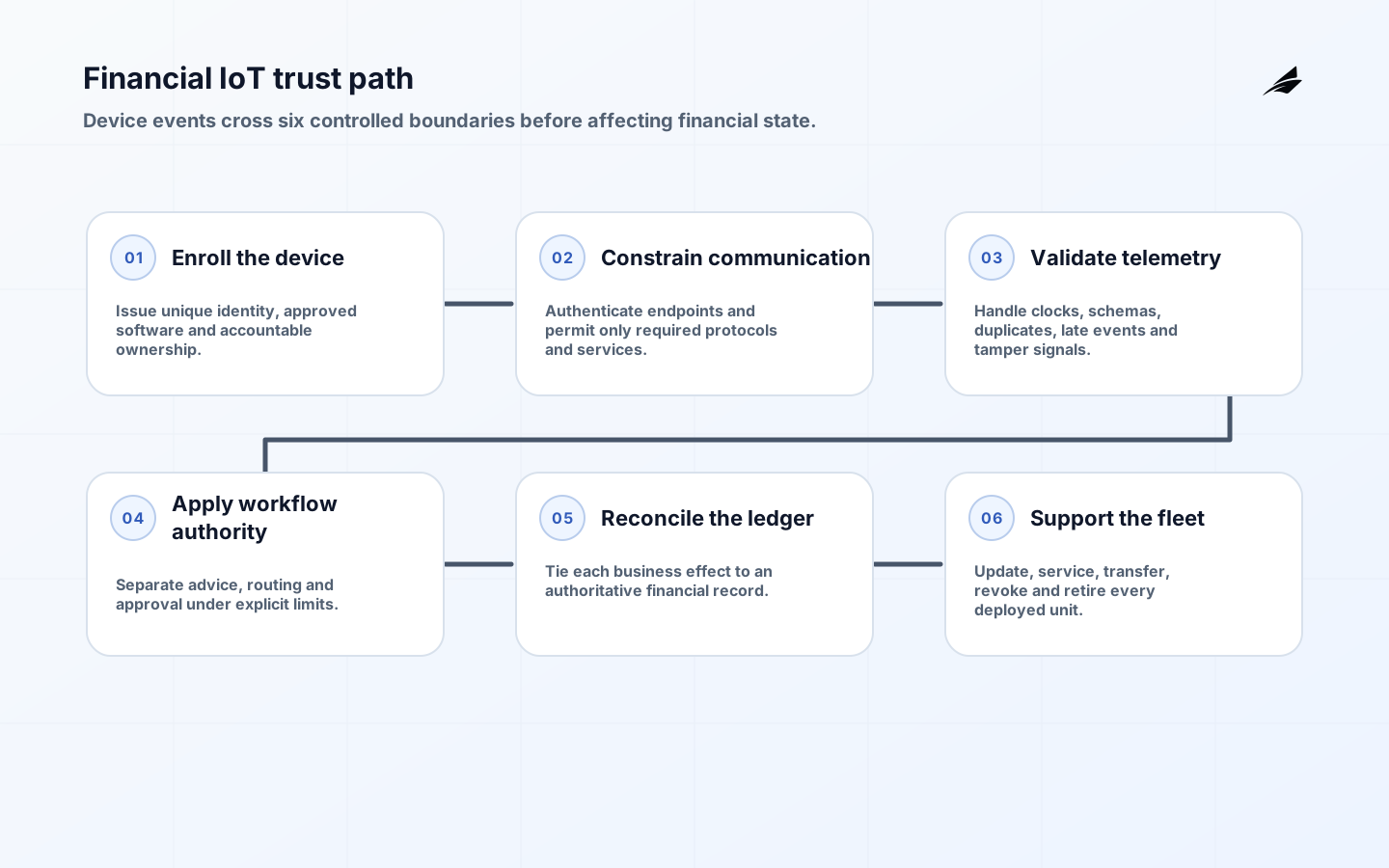
This IoT software development company for finance FAQ covers connected payment terminals, cash-handling sensors, branch devices, asset trackers, telematics integrations and operational monitoring. The financial context raises the cost of weak device identity, unreliable telemetry and unsupported hardware, but it does not make every sensor a transaction system. Buyers need to separate use cases, establish trust boundaries and contract for the complete device lifecycle rather than a demonstration that sends data to a dashboard. Field maintenance, secure updates and retirement belong in the product from the first design review.
Use the finance IoT scope and delivery plan to compare proposals and the finance IoT implementation checklist during delivery. Early-stage teams can also consult the startup IoT production checklist. Involve security, operations, product, privacy and the owner of any financial decision the device can influence.
Which financial IoT use cases are suitable?
Start with a bounded decision. A branch temperature sensor may protect equipment; a tamper signal may open an investigation; a vehicle device may support asset recovery; a kiosk may accept a customer interaction. Record whether data is advisory, triggers a workflow or directly authorizes value movement. The last category needs stronger controls and often a separate certified payment or transaction component. Do not let a general-purpose telemetry service silently become the authoritative ledger.
Define measurable success such as reduction in equipment downtime, verified asset location, faster exception detection or fewer manual inspections. Include false alerts, missed events, data latency, battery life, connectivity loss and maintenance effort. Run field discovery because radio conditions, power, weather, physical access and staff behavior defeat lab assumptions. A useful proof of concept tests the least convenient real location and an actual recovery path, not only normal messages from a developer's desk.
| Boundary | Required decision | Example evidence |
|---|---|---|
| Device | What identity and code may run? | Unique identity and verified firmware |
| Network | Which endpoints and protocols are allowed? | Observed allowlist and denied connection |
| Cloud ingestion | How are duplicates and late events handled? | Replay and ordering test |
| Business workflow | Can telemetry advise or authorize? | Rule and human authority record |
| Ledger | What system proves financial state? | Reconciled transaction identifier |
What security baseline should the device meet?
Use a tailored product baseline. The updated NISTIR 8259 series frames manufacturer activities across design and support. NISTIR 8259A identifies core technical capabilities including device identification, configuration, data protection, logical access, software update and cybersecurity state awareness. Turn each relevant capability into a testable requirement for the specific hardware, gateway, application and service rather than copying a list into the contract.
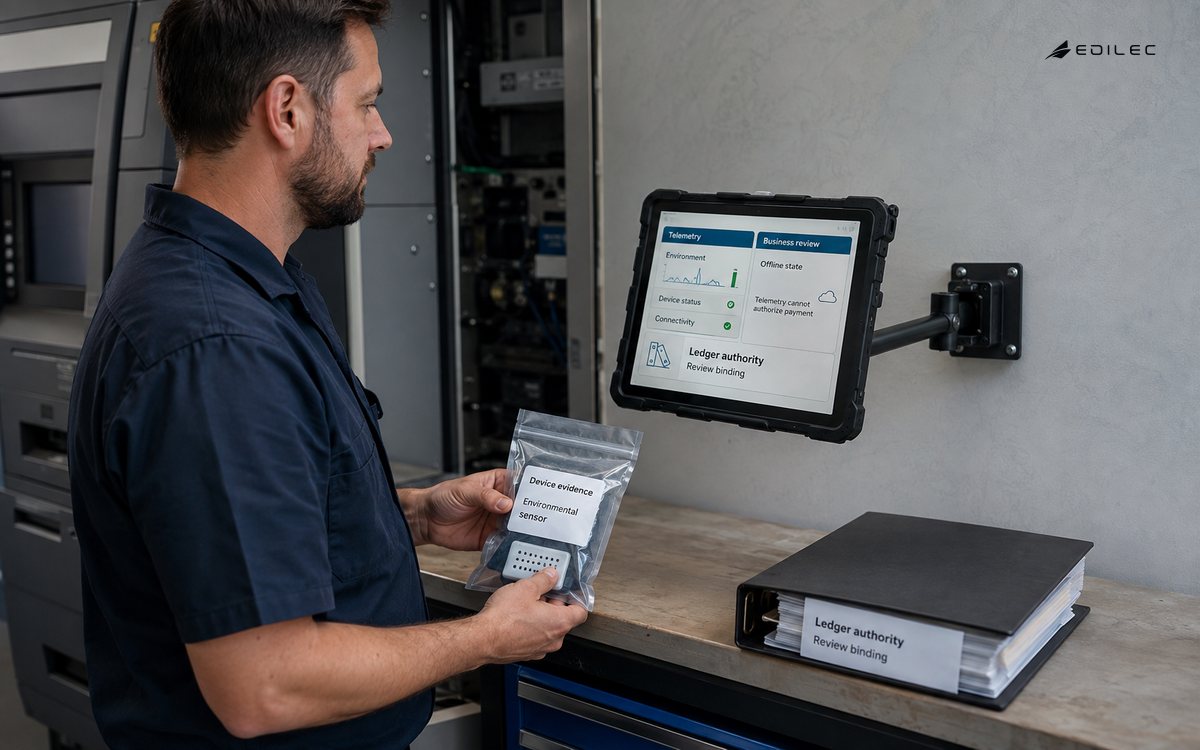
Provision a unique device identity at a controlled manufacturing or enrollment step. Protect private keys in suitable hardware where risk justifies it, authenticate both device and service, and support credential rotation and revocation. Disable unnecessary interfaces and default accounts. Encrypt sensitive data in transit and at rest with managed key ownership. Separate fleet administration from business approval. A device that can report its identity but cannot be securely updated or decommissioned is not ready for a long financial-service life.
How should telemetry and financial data be separated?
Classify every field and minimize collection. Device health, approximate location, customer identifiers, cardholder data and transaction records have different purposes and retention. Use pseudonymous device or session references where the workflow does not need identity. Keep raw telemetry in a bounded ingestion zone, validate schema and timestamps, and publish curated events to downstream systems. Never put secrets or unnecessary personal data into logs. Document who can join device data to customer or account records.
Treat device time and connectivity as untrusted. Assign a server receipt time, preserve device event time, record sequence or monotonic counters where possible, and define tolerance for clock drift and late delivery. Use idempotency keys so retries do not create duplicate financial effects. Reconcile business outcomes to the ledger: a successfully delivered message is not proof that a cash count, payment or asset status was correctly posted. Route mismatches to an owned queue with repair and replay procedures.
How should software updates work?
Require authenticated, integrity-checked updates; a supported rollback or recovery mode; staged deployment groups; power-loss testing; version inventory; and an emergency path for critical defects. Define whether boot verifies trusted code and how signing keys are protected and rotated. The ETSI EN 303 645 baseline includes provisions on vulnerability reporting, secure updates, sensitive parameter storage, attack-surface reduction, software integrity, telemetry and data deletion that offer useful procurement questions even where the consumer-IoT standard is not directly applicable.
Test updates over poor networks, low battery, interrupted power, full storage and a partially upgraded fleet. A failed update must leave the device in a known recoverable state, not an inaccessible branch or vehicle. Maintain software bills of materials and component support dates where useful, but connect them to vulnerability triage and deployed versions. Contract for security updates, functional maintenance, end-of-support notice and migration assistance for the expected device life.
| Lifecycle stage | Supplier obligation | Buyer acceptance test |
|---|---|---|
| Manufacture | Controlled identity and software load | Sample provenance and duplicate check |
| Enroll | Authorized owner and policy assignment | Rogue enrollment denied |
| Operate | Health, logs and least-privilege access | Lost connectivity and alert test |
| Update | Signed staged release and recovery | Interrupted update survives |
| Transfer | Secure reset and ownership change | Prior credentials rejected |
| Retire | Data deletion and revocation | Device cannot reconnect |
What should the development contract require?
Specify deliverables for hardware abstraction, firmware, mobile or web apps, cloud ingestion, device registry, operations tooling, tests, documentation and source ownership. Identify third-party modules, licenses, build environments and manufacturing dependencies. Require threat modeling, code review, penetration testing proportionate to risk, vulnerability intake and remediation targets. NISTIR 8259B complements device features with non-technical manufacturer capabilities such as documentation, information reception, dissemination and education, which are essential after launch.
Define acceptance by observable behavior: unauthorized devices cannot enroll; expired credentials fail; duplicate events produce one business effect; offline data returns in order; access is logged; an update rolls back; a device can be revoked; and fleet inventory matches deployed versions. Keep source, build instructions, signing arrangements and operational data accessible to the buyer or an agreed escrow. Price field replacement, connectivity, support and certification separately from initial software development.
How should rollout and operations be controlled?
Use laboratory, employee, limited-site and broader rollout stages. Select pilot locations that cover difficult connectivity and operational conditions. Establish stop criteria for safety, security, data quality, financial mismatch and support load. Train staff to recognize tampering and failure without asking them to diagnose firmware. Keep a manual alternative for the business process until reliability and reconciliation are proven across a representative cycle.
Operate a fleet inventory with device identity, hardware revision, software version, owner, location, last contact, security state and support date. Alert on unexpected network behavior, repeated authentication failure, configuration drift and update lag. Map enterprise controls using a catalog such as NIST SP 800-53 Revision 5, while tailoring them to physical devices and constrained networks. Review incidents across device, network, cloud and business layers; isolated teams otherwise miss cross-boundary causes.
Plan field service as part of software design. Technicians need a way to verify device identity, diagnose health, replace hardware and transfer ownership without receiving universal fleet credentials. Record custody for devices that can expose keys or local data. Define spare inventory, return-material authorization, secure reset, tamper evidence and destruction. Test a replacement at a remote site: the new unit should enroll into the correct customer and policy, the old identity should be revoked, queued events should reconcile, and historical reporting should preserve continuity without treating two physical devices as one simultaneous source.
Include manufacturing and component change control. A substituted modem, secure element or operating-system image can alter radio behavior, cryptography, update support and certification. Require the supplier to notify the buyer, update the bill of materials, repeat risk-based tests and preserve hardware-revision visibility in fleet management. Maintain an end-of-life forecast by deployed quantity and business criticality. The cost model must include truck rolls, replacement lead time and disposal; cheap hardware becomes expensive when a security defect requires touching every branch or vehicle. Keep approved golden samples for investigation, and record which production lots received each component revision.
Key takeaways
- Define whether device data informs, triggers or authorizes a financial action.
- Require unique identity, minimal interfaces, protected data, secure updates and state awareness.
- Design ingestion for late, duplicated, reordered and fabricated telemetry.
- Contract for vulnerability handling, field support and retirement, not only initial code.
- Pilot under real physical and network conditions with ledger reconciliation.
Frequently asked questions
Does financial IoT need blockchain?
Usually no. A conventional authenticated device registry, append-only audit records and authoritative ledger are simpler for most bounded organizations. Consider distributed consensus only when independent parties genuinely cannot rely on one operator and the governance, privacy, throughput and recovery trade-offs are justified.
What happens when a device is offline?
Define which actions may continue, how much data can queue, how events are ordered and when staff must use a manual process. High-impact authorization should fail safely according to business risk. On reconnection, authenticate again, upload with idempotency controls and reconcile outcomes before clearing local records.
Which certification is required?
It depends on device type, radio market, payment function, geography and regulated use. Identify applicable product safety, radio, cybersecurity, privacy and payment requirements with qualified counsel and laboratories before freezing hardware. Late certification discoveries can force enclosure, component or software changes.
Conclusion
Financial IoT succeeds when the entire trust path is explicit: device identity, constrained communication, validated telemetry, controlled workflow, authoritative ledger and supported retirement. Select a development partner that can demonstrate those boundaries and test failure in the field. The durable product is not the sensor or dashboard alone; it is the operated lifecycle around every deployed device.