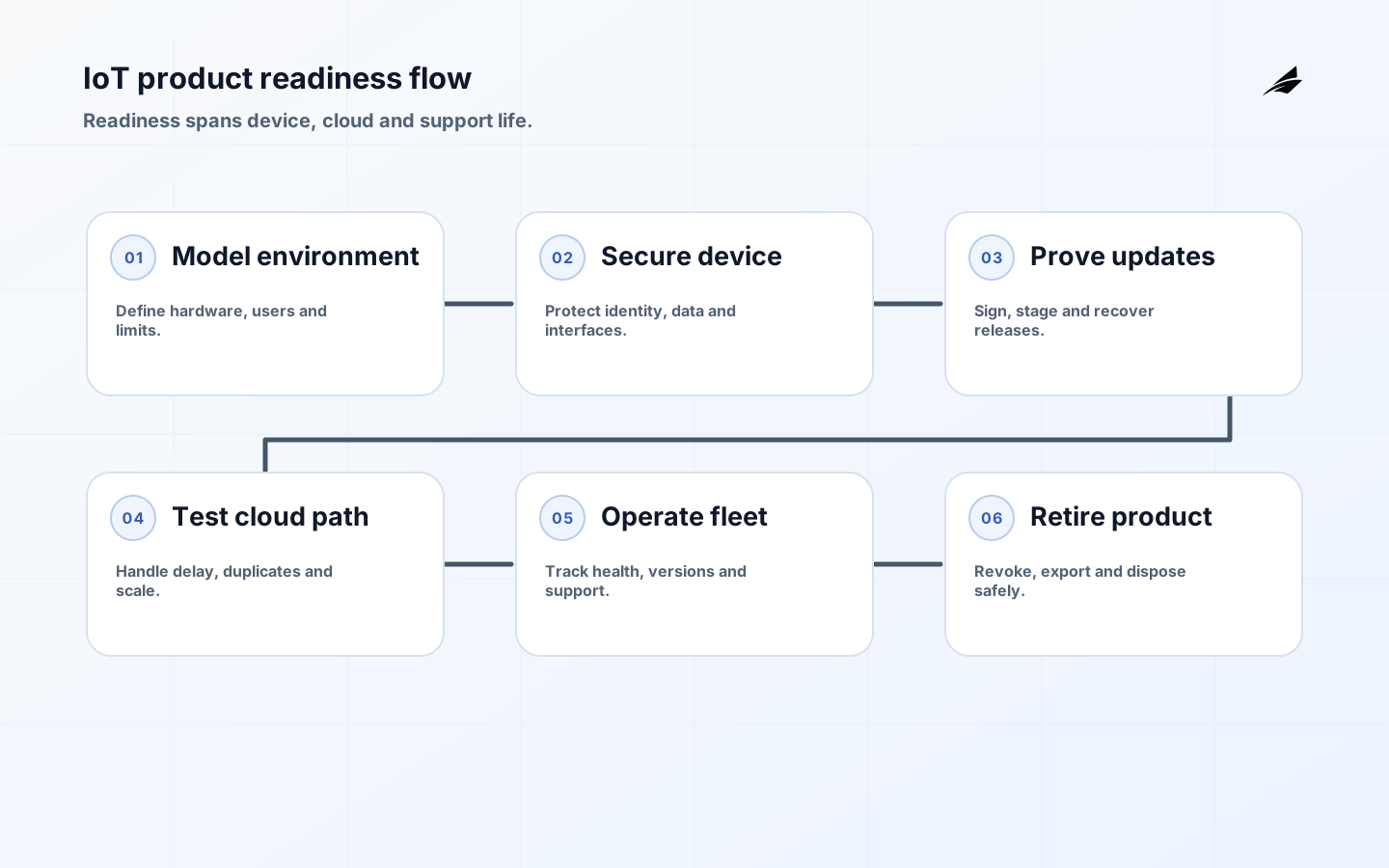
An IoT software development readiness checklist must cover the whole product: device hardware, boot chain, firmware, local interfaces, mobile or web applications, gateways, cloud services, data, manufacturing, fleet operations, support and retirement. A prototype that sends sensor data proves only a thin happy path. Production readiness means the team can identify every deployed unit, authorize it, update it safely, diagnose failure, protect data, recover service and support customers for a declared lifetime. Physical exposure, intermittent networks and long-lived fleets make unresolved lifecycle decisions expensive to correct after shipment.
This checklist complements the IoT software development scope guide and the IoT architecture FAQ. Use it at architecture, design freeze, pilot, production and end-of-life gates. Tailor controls to the device, environment and consequence. A consumer monitor, industrial actuator and clinical device do not share one assurance profile, even though they need similar lifecycle questions.
1. Define the product boundary and operating environment
List every component and trust boundary: sensors, actuators, processor, secure element, bootloader, firmware, operating system, radio, ports, companion app, gateway, broker, APIs, databases, admin console, analytics and external integrations. Record expected owners, physical access, connectivity, power, bandwidth, clock quality, data, safety consequence and support life. NIST's IR 8259 series addresses manufacturer activities plus technical and nontechnical capabilities across the IoT lifecycle.
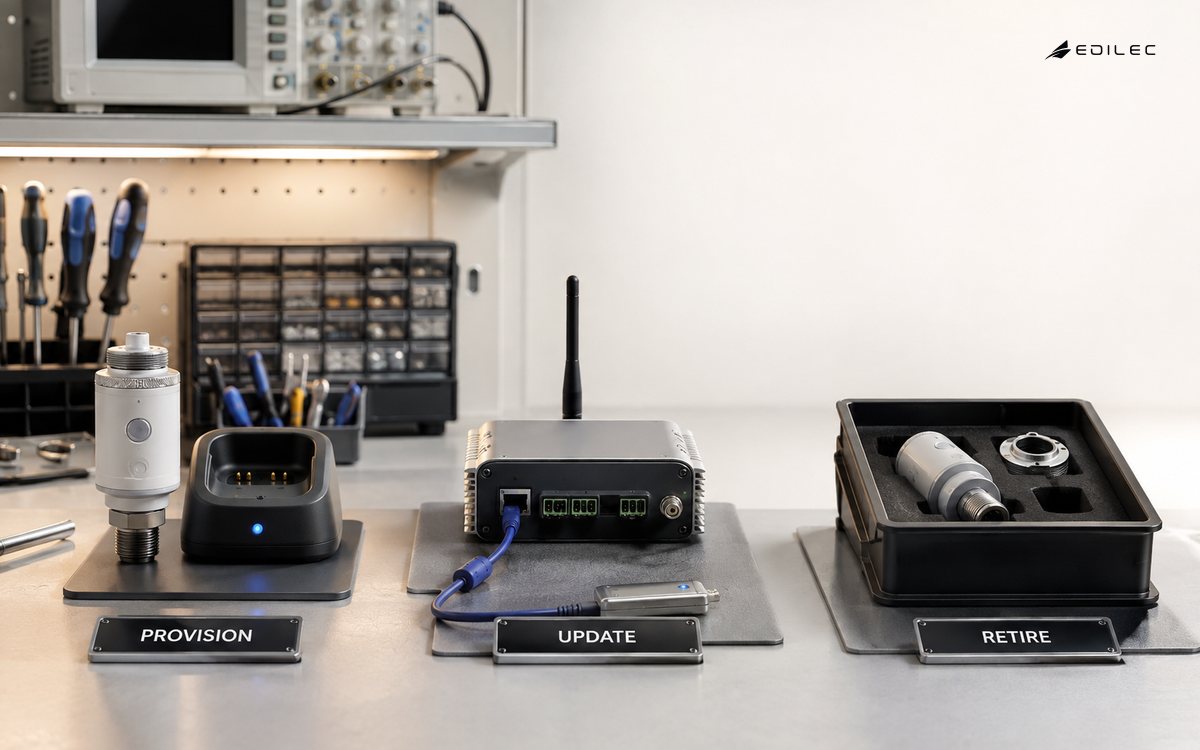
Write normal, degraded and hostile scenarios. What happens offline, after a reboot, with a full disk, expired certificate, duplicated command, wrong time, partial update or unavailable cloud? Decide which functions must remain local and which may fail closed. Identify the authoritative state for configuration and commands. The startup IoT delivery guide helps teams stage an early product without excluding lifecycle work.
| Boundary area | Readiness evidence | Gate question |
|---|---|---|
| Device identity | Unique logical and physical identifier | Can every unit be traced without a shared secret? |
| Environment | Power, network, physical and safety assumptions | Have limits been tested where deployed? |
| Data | Collection purpose, sensitivity, location and retention | Is each flow necessary and protected? |
| Command path | Authorization, ordering, timeout and acknowledgement | Can stale or duplicated commands cause harm? |
| Dependency | Cloud, gateway, app and supplier map | Is degraded behavior deliberate? |
| Lifetime | Support, update and retirement commitment | Can the manufacturer sustain the fleet? |
2. Establish the device security baseline
NIST IR 8259A defines a core baseline covering device identification, configuration, data protection, logical access to interfaces, software update and cybersecurity state awareness; NIST's current catalog also includes device security. Translate each capability into product requirements. Disable unused services and debug paths in production, protect credentials per device, validate input and enforce authorization locally where a network intermediary cannot guarantee safety.
Define secure boot and integrity according to threat and hardware capability. Secrets must not be universal across a fleet or recoverable from routine logs. Provisioning should bind a unit to the intended tenant and support secure reprovisioning. Local reset must specify what data and credentials are removed. Protect stored and transmitted data, but also minimize collection. Physical attack resistance, tamper evidence and safety interlocks should follow consequence rather than marketing claims.
3. Prove the update and software supply chain
Inventory source, third-party components, toolchains, build runners, signing keys and manufacturing images. NIST's SSDF provides practices for preparing the organization, protecting software, producing secured releases and responding to vulnerabilities. Use reproducible or controlled builds, protected artifacts, dependency review and release provenance. Separate signing authority from routine development and design key rotation or recovery before a compromise occurs.
The update mechanism needs authenticated metadata and payloads, anti-rollback policy where appropriate, compatibility checks, staged rollout, power-loss recovery, bounded retries and visible status. Test interruption at each write phase and recovery from a bad release. Support a pilot cohort and pause rules. Decide how gateways and offline devices receive updates and how the team identifies unreachable units. An update feature that has never been exercised across representative hardware is not readiness evidence.
4. Build reliable cloud, data and command paths
Use mutually authenticated device connections and narrowly scoped authorization. Design for reconnect storms, duplicate telemetry, delayed events, out-of-order delivery and clock drift. Commands require identifiers, expiry, authorization, acknowledgement and idempotent or explicitly nonrepeatable semantics. Rate limits and tenant isolation should be enforced server side. Keep desired and reported configuration distinct so operators can see convergence rather than assuming a command succeeded because it was queued.
Define schemas and compatibility before fleet growth. Retain raw or diagnostic evidence only as long as justified, and separate operational telemetry from customer content. Monitor ingestion delay, connection failures, command completion, firmware distribution and data quality. The startup IoT production checklist covers cloud release basics; mature fleets also need capacity tests for mass reconnect, rollout and certificate rotation events.
| Failure exercise | Expected behavior | Evidence retained |
|---|---|---|
| Network loss | Device follows safe local mode and reconnect policy | State transition and backlog age |
| Duplicate command | No unintended repeated effect | Command ID and disposition |
| Power loss during update | Previous or valid new image boots | Boot and update state |
| Expired credential | Device is denied and recoverable securely | Authentication reason and recovery action |
| Cloud-region disruption | Defined buffering, failover or degraded service | Data loss and recovery measurement |
| Factory reset or transfer | Prior tenant data and credentials are removed | Reprovisioning audit |
5. Prepare manufacturing and fleet operations
Manufacturing must provision unique identity, trusted firmware and product configuration through controlled stations. Track hardware revision, bill of materials, firmware, certificates and test result per unit. Protect factory credentials and revoke test access before shipment. Sample devices from the line and verify that production settings match the approved image. Counterfeit or untracked replacement units need a defined rejection or enrollment path.
Fleet operations require inventory, health, firmware distribution, vulnerability exposure, certificate age, update success, connectivity and support status. The revised NIST IR 8259 Rev. 1, published in April 2026, emphasizes foundational manufacturer activities before sale and support that reduces customer burden. Establish vulnerability intake, triage, coordinated communication, customer instructions and support contacts. Practice a fleet-wide urgent update without beginning at full scale.
6. Pilot the full lifecycle and plan retirement
Pilot representative hardware, locations, networks, users and physical conditions. Include installation, ownership transfer, offline operation, update, certificate rotation, support, data export, reset and decommission. Measure installation success, battery or resource use, connectivity, data quality, update completion, incident volume and support effort. Pilot gates should expose unresolved assumptions, not reward a curated demonstration. Keep rollback authority and spare-unit logistics explicit.
Publish support duration, update expectations, dependency requirements and end-of-life communication. NIST's IoT capability catalog pairs technical device capabilities with documentation, information reception, dissemination and education. Retirement should revoke credentials, stop commands, support data export or deletion, explain safe disposal and prevent abandoned devices from becoming unmanaged access paths. Include ongoing security and cloud cost in the original business case.
Readiness also includes product safety and privacy review beyond generic cybersecurity. Identify whether a delayed, missing or forged measurement can lead a person or controller to unsafe action. Apply local interlocks, range checks and fail-safe behavior where cloud policy arrives too late. Give customers understandable indicators for connectivity, update and security state without exposing secrets. Document what telemetry is necessary, how users control optional collection and how support diagnoses a unit without gaining excessive access. These decisions should be verified on the constrained production hardware, not only in a cloud simulator.
Maintain a compatibility matrix across hardware revisions, bootloaders, firmware, gateways, mobile apps, APIs and cloud schemas. Define the supported upgrade paths and the minimum version that can recover a stranded device. Test mixed fleets because production rarely upgrades at once. A server change that assumes the newest firmware can disable older units, while an update that exceeds flash or memory limits can create an unserviceable cohort. Compatibility evidence should accompany every release decision and remain available for the declared product lifetime.
Make the production gate a signed decision across product, hardware, firmware, cloud, security, manufacturing, support and business ownership. List accepted limitations, affected hardware cohorts and the evidence that will trigger reconsideration. Shipment volume should remain bounded until manufacturing yield, installation, connectivity, update and support measures stabilize. This prevents commercial pressure from silently converting a pilot assumption into a fleet-wide obligation.
Key takeaways
- Treat device, apps, cloud, manufacturing, fleet support and retirement as one product.
- Translate an IoT security baseline into testable requirements tailored to consequence.
- Exercise signed updates under interruption and bad-release conditions.
- Design telemetry and commands for delay, duplication, disconnection and clock error.
- Track each unit, hardware revision, firmware, identity and support state.
- Pilot installation through decommissioning and fund the declared support lifetime.
IoT software development readiness FAQ
Is encryption enough to secure an IoT product? No. It protects some data paths but does not establish identity, authorization, update safety, integrity, minimization, monitoring or vulnerability response. Controls must work as a system.
When should hardware be frozen? Only after security, update, memory, storage, power, radio, observability and manufacturing requirements are tested. Hardware constraints can make later software controls impossible or uneconomic.
Can devices share one credential? A shared fleet credential creates broad compromise and revocation risk. Prefer unique device identity and scoped authorization, with a secure provisioning and recovery process.
What proves an over-the-air update is production ready? Signed and authorized payloads, compatibility checks, interrupted-update recovery, staged rollout, pause and rollback policy, fleet visibility and success on representative hardware and networks.
Conclusion
IoT readiness is the ability to support a physical fleet through years of change and imperfect connectivity. Define the whole product boundary, give each unit a manageable identity, protect the software supply chain, prove safe updates and design cloud paths for duplicate and delayed reality. Then pilot manufacturing, operation, support and retirement together. A team ready to ship should be equally ready to rotate a certificate, pause a rollout, explain a failure and remove a device without leaving its data or access behind.