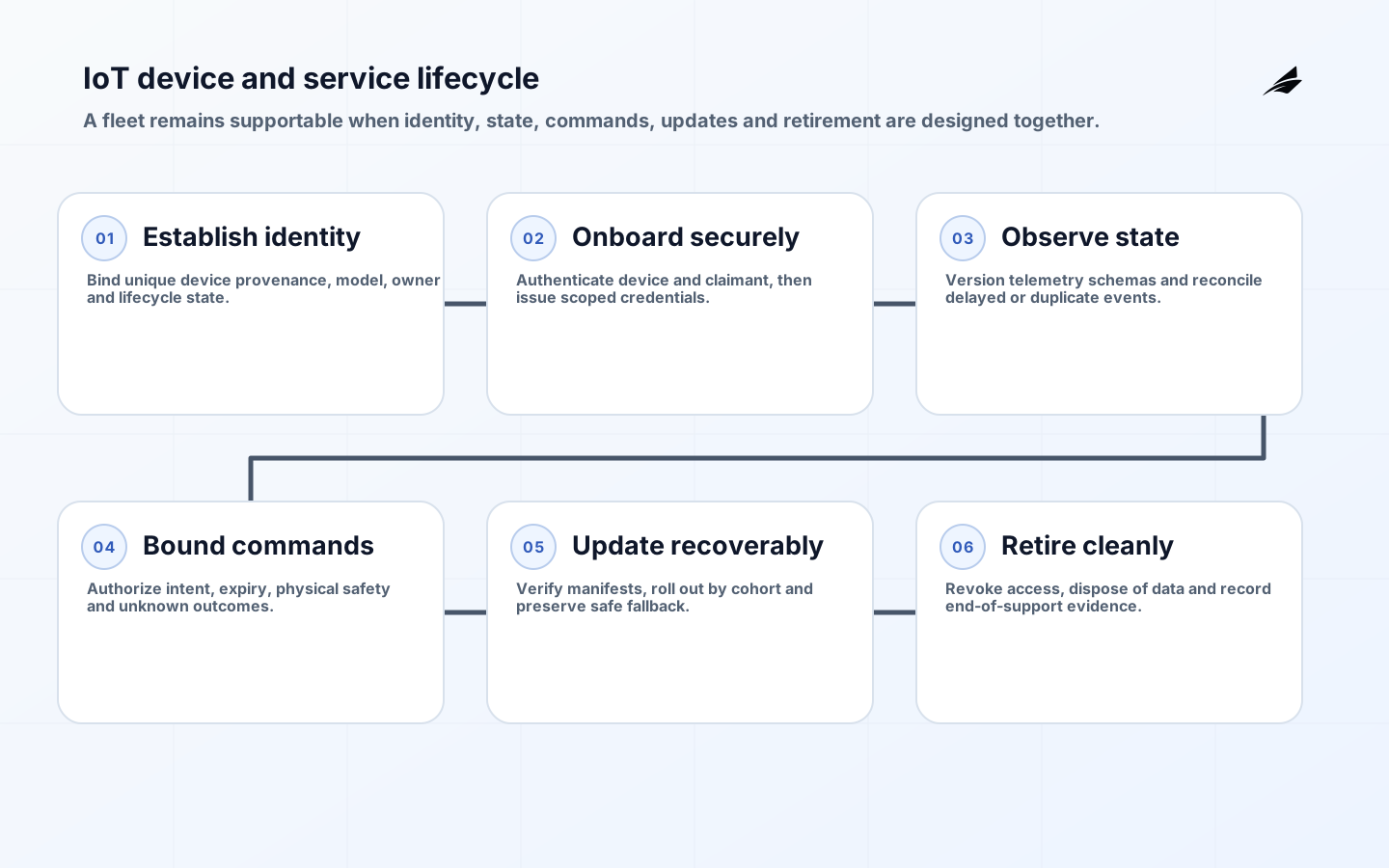
IoT software development joins physical devices, embedded software, networks, cloud services, applications and field operations into one product. A server retry can become a repeated physical action; intermittent connectivity is normal; devices may remain deployed after teams and suppliers change. Implementation must therefore define device identity, message semantics, safe commands, update recovery and end-of-support before a pilot becomes a fleet.
This FAQ supports teams planning an IoT product or modernizing an existing device estate. Use it with the IoT scope, cost and risk plan and readiness checklist. The safest architecture starts with one device class and one operational outcome, then proves lifecycle behavior under weak networks, partial failure and unattended operation.
What belongs inside the IoT product boundary?
Map the complete service: hardware and sensors, boot and firmware, local application, identity, connectivity, broker or gateway, ingestion, device registry, state, command service, business application, analytics, update system and support. Name which team or supplier owns each layer and the interfaces between them. Device success is an end-to-end outcome such as reliable temperature evidence or safe equipment configuration, not merely packets arriving in a cloud topic.
Define operating conditions: power, bandwidth, latency, environment, physical access, expected lifetime, maintenance visits and failure consequence. State what the device can do offline and how it reconciles later. A consumer sensor and an industrial actuator require different safety, identity and update controls. Keep hardware constraints visible in product planning because memory, storage, cryptographic capability and radio behavior determine what software can be supported for years.
| Lifecycle stage | Authoritative record | Acceptance evidence |
|---|---|---|
| Manufacture or enrollment | Device identity and model | Unique credentials and provenance |
| Onboarding | Tenant, owner and policy binding | Authenticated claim and audit |
| Operation | Reported and desired state | Timestamped telemetry and reconciliation |
| Update | Firmware and manifest status | Verified install or safe rollback |
| Retirement | Revoked identity and data disposition | Fleet record and access removal |
How should device identity and onboarding work?
Give each device a unique identity rooted in protected manufacturing or enrollment material. Avoid shared fleet passwords and predictable secrets. The registry should record model, hardware revision, firmware, owner, tenant, certificate state and lifecycle status. Onboarding must authenticate the device and the claimant, bind it to the correct tenant and issue scoped credentials. Support replacement and transfer without making an old owner or credential valid indefinitely.
NISTIR 8259A identifies device identification, configuration, data protection, interface access control, software update, cybersecurity state awareness and device security as baseline capabilities. Translate them into product requirements and evidence. Rotate and revoke credentials, enforce least privilege by device class and limit service identities to intended topics or APIs. Recovery and factory reset need explicit policy because a reset must not bypass ownership or silently rejoin the wrong fleet.
How should telemetry and device state be modeled?
Every message needs device identity, schema version, event time, sequence or deduplication information, quality and units. Distinguish observed state from desired configuration and command acknowledgement. Networks may duplicate, delay and reorder messages; the backend must not assume arrival order is event order. Define clock trust and how devices without reliable time represent samples. Preserve raw evidence only as long as necessary, then derive governed aggregates for product and operations.
Use versioned schemas and compatibility rules. Route invalid payloads to a bounded quarantine with model and firmware context. Avoid creating a new topic or database table for every device variation without governance. Backpressure and retention must protect critical signals during bursts. Dashboards should show fleet coverage and freshness, not only message volume. A silent device, a disconnected device and a device reporting an unchanged healthy state are different conditions.
How can remote commands be made safe?
Treat commands as consequential business operations. Authorize the person or service, validate the target and current state, constrain values and include expiry. Give each command a unique intent identifier and explicit states such as requested, accepted, executing, succeeded, rejected, expired and unknown. A delivery acknowledgement is not proof of physical execution. The device should reject replay and incompatible commands, and the platform should avoid retrying an unknown physical action blindly.
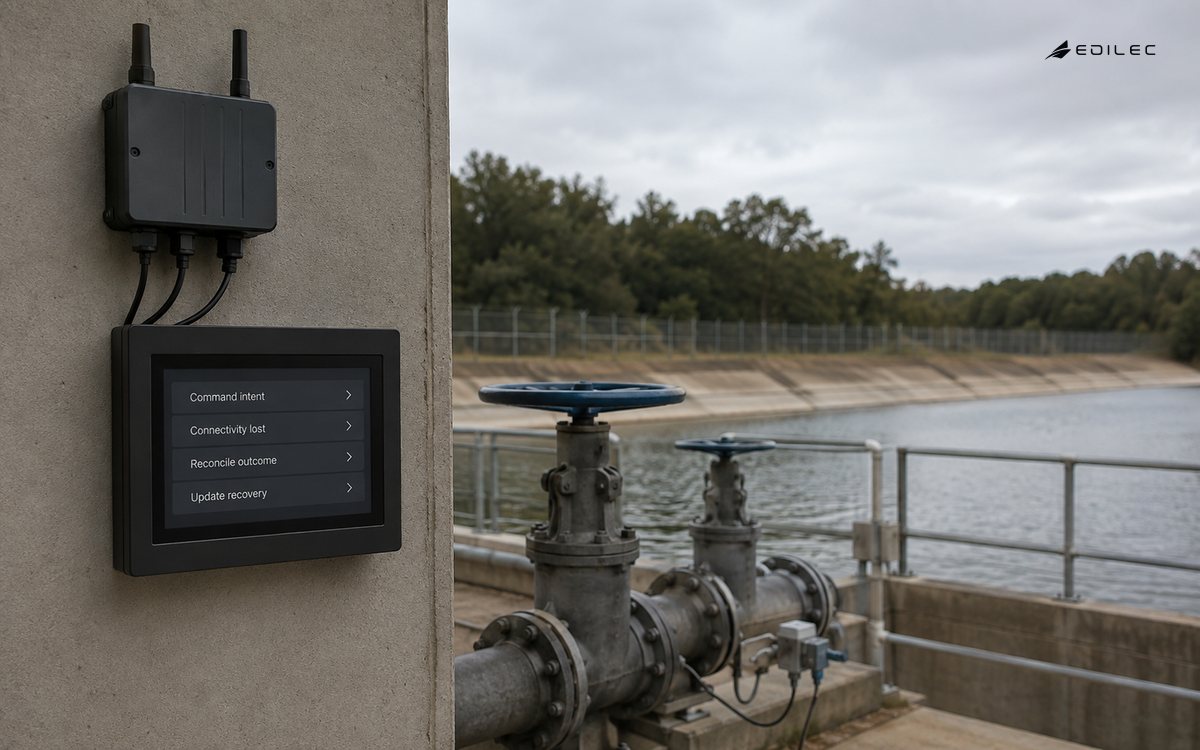
For high-impact actions, require approval, local interlock or a safe operating envelope. Record who requested the action, policy version, device firmware, acknowledgement and resulting observed state. Support cancellation only when the device semantics genuinely permit it. Test delayed commands, duplicate delivery, device reboot during execution and contradictory desired state. Field operators need a visible manual override and a reconciliation path after offline work.
| Fault | Unsafe behavior | Required recovery |
|---|---|---|
| Command acknowledgement lost | Repeat physical action automatically | Query state and reconcile intent |
| Telemetry arrives late | Overwrite current state blindly | Order by event semantics and quality |
| Device loses power during update | Leave device unbootable | Atomic or dual-bank recovery path |
| Credential compromised | Trust device until manual visit | Remote revoke, contain and re-enroll |
| Backend outage | Drop critical events silently | Bounded local queue and explicit overflow policy |
What does a secure update service require?
RFC 9019 describes an IoT firmware update architecture, and RFC 9124 defines information a protected update manifest needs. Sign update metadata, verify authorization and compatibility, prevent rollback to vulnerable versions where policy requires it, and bind the payload to a model and dependency set. Protect signing keys and separate release approval from artifact build. A valid signature proves origin and integrity; it does not prove the firmware is safe for every hardware revision.
Roll out by lab, internal fleet, small cohort and broader rings with health gates. Measure download, verification, install, reboot and post-update behavior. Devices need a safe recovery path such as dual-bank images or a protected fallback appropriate to constraints. Test interrupted transfer, low power, full storage, corrupt image and failed health check. Preserve campaign and device evidence so support can explain why one device stayed on an older release.
How should the cloud and fleet be operated?
Separate ingestion, device registry, state, command, update and business processing so each can scale and fail with bounded consequences. Use queues and idempotent consumers, but set expiry and dead-letter ownership. Partition or shard by stable tenant and device keys while preventing one fleet from exhausting shared capacity. Monitor connection success, telemetry freshness, invalid schema, command age, update coverage, credential expiry and support exceptions by model and firmware.
Define service objectives from the physical outcome. Cloud API uptime does not help if a gateway cannot connect or devices are stuck on unsafe firmware. Runbooks should cover certificate failure, broker overload, bad release, regional outage and compromised device cohort. Maintain a searchable fleet inventory and supported-version policy. NISTIR 8259B emphasizes nontechnical capabilities such as documentation, information and query reception, dissemination, education and support; fleet safety depends on those operating practices.
How should IoT testing and lifecycle support be planned?
Use hardware-in-the-loop tests for timing, sensors, power and update behavior; protocol simulators for scale and malformed traffic; and end-to-end tests for identity, state, command and support. Test poor signal, loss, duplication, reordering, clock drift, storage pressure, reboot and backend throttling. Maintain representative hardware revisions and production firmware in the test matrix. A cloud-only test cannot prove what happens after a brownout during an update.
Publish a support period, vulnerability reporting channel and end-of-life process. ETSI EN 303 645 includes widely applicable consumer IoT provisions such as no universal default passwords, vulnerability management, secure updates and protected personal data. When support ends, notify owners, disable unsafe services where appropriate, revoke credentials and provide data export or deletion. Design for decommissioning before thousands of devices become unreachable liabilities.
Accept a representative fleet before broad deployment
Build a pilot fleet that includes every supported hardware revision, network type and important operating environment. Enroll devices through the production identity path, operate them through power loss and connectivity gaps, issue safe commands, rotate credentials, update firmware by cohort and retire at least one unit. Compare device, gateway and cloud records after each disruption. A dashboard screenshot is insufficient; retain logs, manifest results, observed state and field-operator notes that explain the outcome.
Set fleet expansion gates for onboarding success, telemetry freshness, command uncertainty, update completion, rollback, security findings, support cases and unit economics. Include a stop rule for a model-specific fault and authority to suspend a campaign. Verify that support can identify an affected cohort and guide a safe local action. Production readiness means the organization can maintain and recover the deployed devices for their promised life, not merely connect the first hundred units.
Key takeaways
- Treat device, cloud and field operations as one product boundary.
- Use unique device identity and explicit lifecycle state.
- Model commands for authorization, expiry, unknown outcomes and physical safety.
- Make secure update recovery a launch requirement.
- Operate from fleet coverage, freshness, version and support evidence.
Frequently asked questions
Should devices connect directly to the cloud or through a gateway?
Direct connection can simplify small capable devices; gateways can aggregate constrained protocols, provide local control and reduce cloud dependence. Choose from power, network, safety, update and site-operations needs. A gateway becomes another managed device and trust boundary.
Which protocol should an IoT product use?
Choose after defining message semantics, network conditions, device resources, delivery needs and ecosystem compatibility. MQTT, HTTP, CoAP and vendor protocols each fit different constraints. Protocol selection does not replace identity, authorization, idempotency and lifecycle design.
How long should an IoT vendor support devices?
Set and communicate a period that reflects expected product life, vulnerability risk, contracts and applicable regulation. The implementation needs signing, update, documentation, support and retirement capacity for that entire commitment, not only the launch year.
Conclusion
IoT software is dependable when it treats every device as a long-lived managed identity with observable state, bounded authority and a recoverable update path. Architecture must survive weak networks and partial failure without confusing message delivery with physical truth. A small representative fleet should prove onboarding, operation, incident handling, update and retirement before the product scales.