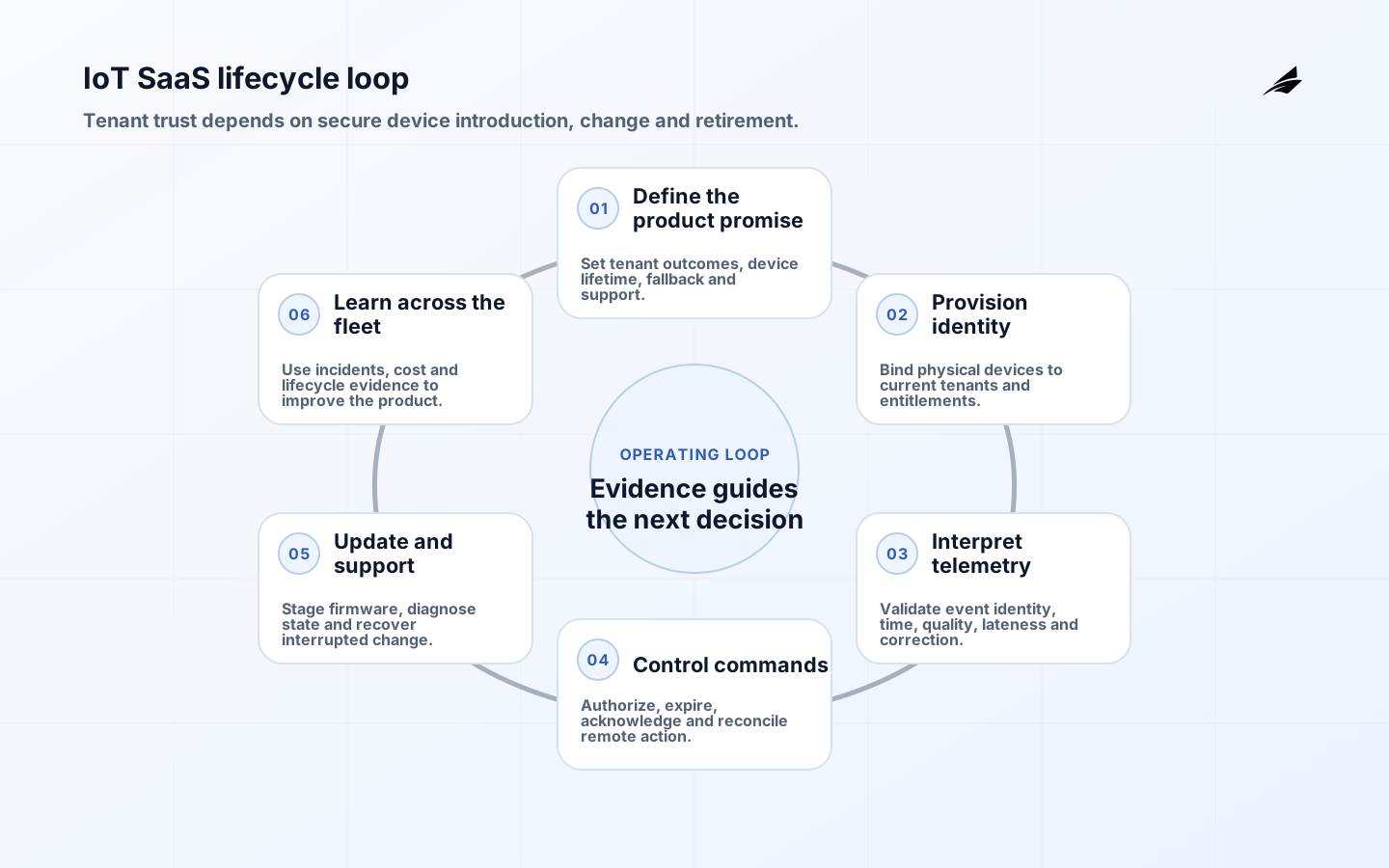
An IoT software development company for SaaS companies must build more than device connectivity. The product has at least three lifecycles: hardware and firmware in the field, a multi-tenant cloud service, and customer operations that install, support and retire devices. The partner must preserve identity, tenant isolation, command authority, data meaning, secure updates and support evidence across all three. This FAQ explains the architecture and commercial questions a SaaS team should settle before engagement.
For a staged project, use the IoT SaaS scope and delivery plan and the companion IoT SaaS implementation checklist. Product teams still reducing device and market uncertainty can also use Edilec's startup IoT production checklist.
What should an IoT SaaS development engagement include?
Scope the device or gateway software, manufacturing and provisioning support, connectivity, protocol, device registry, telemetry ingestion, command service, update service, tenant and entitlement model, user interfaces, APIs, integrations, observability, support tooling and retirement. Name hardware, certification, mobile applications, field installation, data migration and round-the-clock support as included or excluded. A cloud dashboard alone is not a deliverable if no one can securely commission, diagnose or update the fleet.
NIST's IoT manufacturer series spans product conception through support; Revision 1 of NISTIR 8259 was finalized in April 2026. Use it to ask how the developer identifies customer cybersecurity needs, plans support and communicates limitations. Require a product lifecycle and support period that match likely hardware deployment, not only the initial SaaS contract.
| Capability | Product question | Acceptance evidence | Long-term owner |
|---|---|---|---|
| Provisioning | How does a physical unit gain a tenant-bound identity? | Factory-to-customer trace | Device platform |
| Telemetry | How are time, units, quality and corrections represented? | Contract and replay test | Data product |
| Commands | Who may request, approve and cancel action? | Authorized and rejected traces | Product operations |
| Updates | How are images verified, rolled out and recovered? | Cohort update exercise | Firmware owner |
| Support | Can an agent reconstruct device state safely? | Diagnostic case exercise | Customer support |
How should tenancy and device identity work?
Model organization, site, user, device, gateway, entitlement and ownership transfer explicitly. Give each device a unique identity that is not merely a customer-editable serial number. Bind physical and logical identity during a controlled provisioning ceremony, then authorize connections and commands against current tenant ownership. Test that moving a device between tenants removes prior access, credentials, cached configuration and data visibility without erasing required audit history.
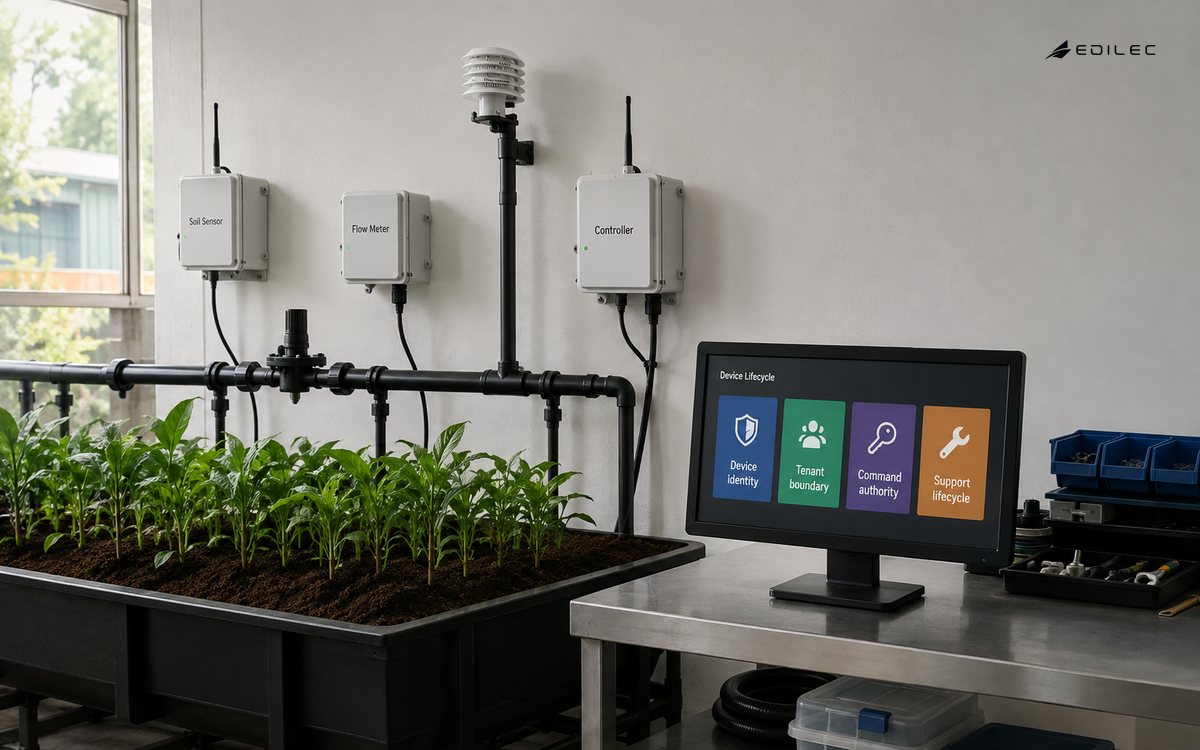
The NISTIR 8259A baseline covers device identification, configuration, data protection, logical access to interfaces, software update and cybersecurity state awareness. Translate each area into product requirements and customer controls. Tenant administrators should be able to see supported device versions and security state without gaining access to secrets or unrestricted fleet commands.
How should telemetry and commands be designed?
Define a versioned event contract with device identity, event time, ingestion time, schema, units, quality and stable message identity. Decide how duplicates, late events, clock error, missing intervals and corrections are represented. Partition and retain data according to tenant and product needs. Preserve enough original context to replay a corrected transformation, but minimize collection and retention of customer-sensitive data.
MQTT 5.0 is a standardized publish-subscribe protocol frequently used in IoT, but protocol delivery quality does not settle business processing. Consumers and command handlers still need idempotency, expiry, authorization and outcome reconciliation. Give every command a unique identifier, requester, policy decision, target, issue and expiry times, acknowledgement and observed result. Commands with physical or commercial consequence may need an explicit approval step.
What makes firmware updates production-ready?
A device should verify update authenticity, compatibility and anti-rollback policy before installation. The service needs staged cohorts, pause, retry, bandwidth control, update status and a safe response to interrupted power or connectivity. RFC 9019 describes a transport-independent firmware-update architecture based on protected manifests. Test an invalid image, wrong hardware target, interrupted transfer, full storage, failed boot and fleet rollback or forward recovery.
Separate firmware support status from mere connectivity. A device past support should be visible to customer and platform owners, with a documented path to update, isolate or retire it. Keep signing keys under strong custody with rotation and recovery plans. The development company should not be the only entity capable of fleet recovery unless that dependency is deliberately contracted, protected and tested.
| Failure | Device behavior | Cloud behavior | Customer communication |
|---|---|---|---|
| Intermittent network | Buffer within limits and expose age | Deduplicate and mark freshness | Show delayed state |
| Duplicate message | Reuse stable identity | Process idempotently | Avoid duplicate action |
| Invalid command | Reject unauthorized or expired request | Record policy denial | Explain actionable reason |
| Failed update | Return to known safe state | Pause cohort and preserve evidence | Name affected population |
| Unsupported device | Restrict according to policy | Flag risk and block unsafe features | Provide replacement path |
What security and support capabilities should buyers require?
Require threat modeling across physical access, device interfaces, network, gateway, cloud tenancy, APIs, support tools and supply chain. Protect source, builds, dependencies, signing keys and service identities. Implement vulnerability intake, triage, coordinated disclosure, fixes and customer notification. NIST's non-technical supporting baseline emphasizes documentation, receiving and disseminating information, and education throughout the lifecycle.
Support agents need a tenant-authorized view of identity, connectivity, firmware, configuration, telemetry gaps, update and command history. High-impact remote actions need role controls, reason capture, audit and customer consent where appropriate. Instrument device, gateway, ingestion and application services. OpenTelemetry can correlate traces, metrics and logs in the cloud path, but device telemetry and customer data should not become unrestricted observability labels.
How are cost, timeline and development partners evaluated?
Cost drivers include hardware variants, operating systems, connectivity, message rate, retention, commands, update volume, tenant features, compliance, field testing, certification, integrations and support. Estimate a vertical slice first: representative device, provisioning, secure telemetry, one command, one update, tenant UI and support trace. Then price fleet scale and lifecycle operation. Include connectivity, egress, observability, certificate operations, vulnerability response and replacement, not just cloud compute.
Evaluate candidates with a scenario workshop and a technical slice. Ask them to design ownership transfer, delayed telemetry, invalid firmware, tenant isolation and a compromised device response. Inspect source practices, hardware test capability, key custody, update experience, subcontractors, incident support and exit. Milestones should produce working evidence: provisioned devices, replay results, update recovery, support runbooks and customer-owned artifacts.
What should be accepted before fleet growth?
Provision devices through the intended manufacturing and customer path. Test tenant transfer, duplicate and late telemetry, loss of connection, command denial, certificate rotation, invalid and interrupted updates, support diagnosis, export and deletion. Measure catch-up behavior and unit cost at representative rates. Have the receiving team operate the platform during the exercise and transfer source, builds, keys under agreed custody, registries, contracts, dashboards, runbooks, supplier contacts and known limitations.
Build an end-to-end reference slice
A useful reference slice starts with one production-intent device, not a simulator alone. Provision it through the intended factory or field process, bind it to a test tenant and send versioned telemetry through the production-like ingestion path. Display event age and quality in the user interface. Issue one reversible command with authorization, expiry and acknowledgement, then trace the result through support tooling.
Next, deliver a signed firmware update to a small cohort. Interrupt power and network on separate devices, attempt an incompatible image and rotate a device credential. Confirm recovery, update status and customer communication. Transfer one device to another tenant, then verify that prior users lose access while retained audit history remains attributable. These tests expose identity and lifecycle defects that endpoint demonstrations usually miss.
Finally, calculate the slice's unit economics from connectivity, messages, state, storage, updates, observability and support effort. Extrapolate quiet, normal and noisy device profiles and include failed-update support. A product can be technically sound but commercially fragile if one faulty device produces unlimited messages or one routine replacement needs an engineer. Use quotas, bounded retention and diagnostic automation where they preserve customer value.
Treat the reference slice as a maintained product, not disposable demonstration code. Keep its hardware, test tenant and fixtures available for protocol, firmware, cloud and support regression. Run it before changing certificates, message contracts, update services or tenant ownership behavior. Where production fleets contain materially different hardware or networks, add representative fixtures rather than assuming the first device covers them. The reference environment should never share production credentials or unrestricted customer data.
Publish a support matrix by device model, firmware and cloud API version. State supported combinations, upgrade order, end dates and behavior for an offline device that returns after several releases. Test that path before declaring an old version unsupported. Customers need enough notice and fleet visibility to schedule work; silently rejecting an older but deployed device can convert routine lifecycle management into a widespread outage.
Key takeaways
- Scope device, cloud, tenant and field-support lifecycles together.
- Bind unique device identity to current tenant ownership through controlled provisioning.
- Make event and command semantics explicit beyond transport guarantees.
- Treat secure firmware update and product support period as core product features.
- Give support enough evidence to diagnose without granting unsafe fleet authority.
- Prove lifecycle failures on representative hardware before fleet scale.
IoT SaaS development FAQ
Should a SaaS company build its own IoT platform? Build product-specific workflows and use proven managed components where their lifecycle, cost and exit fit. Can devices operate offline? Only within a defined safe boundary with buffered data, expiry and reconciliation. How long does an MVP take? A useful MVP is a complete vertical slice; duration depends heavily on hardware maturity and field access. Who owns device data? Define customer, platform and derived-data rights contractually and enforce them through tenancy and retention. How should per-device pricing be modeled? Include connectivity, messages, storage, commands, updates, support and shared platform cost, then test heavy and quiet device profiles.
Conclusion: design for the installed lifetime
An IoT SaaS partner is valuable when it can connect field reality to a supportable multi-tenant product. Select on lifecycle evidence, not dashboard polish: secure provisioning, unambiguous telemetry, controlled commands, recoverable updates, tenant-safe support and a credible path through device retirement.