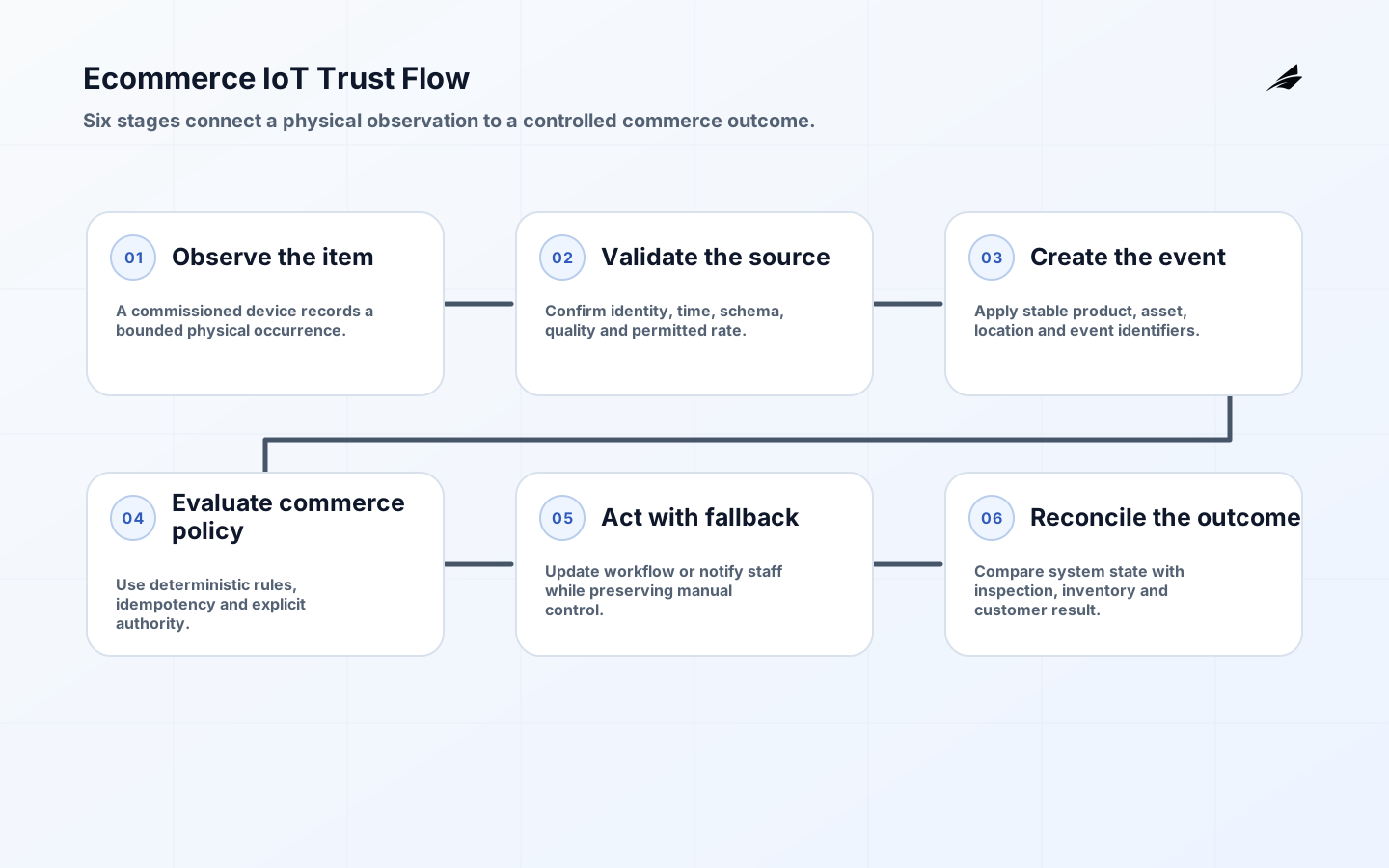
An ecommerce IoT implementation should turn a trustworthy physical observation into a useful customer or operations action. Shelf sensors, smart lockers, condition monitors and connected labels create value only when identity, event meaning, inventory authority and exception handling are designed together. This checklist helps a retailer and its IoT software development company agree what production-ready means.
Review it alongside the ecommerce IoT delivery plan, ecommerce IoT FAQ, startup IoT scope guide and startup IoT production checklist. Begin with a bounded operational decision, not a broad promise of real-time visibility.
1. Define the decision and source of truth
Describe one journey from physical occurrence to action. For cold-chain fulfillment: a sensor observes temperature, a gateway validates and forwards it, a rules service opens an exception, an operator inspects the package, and the order system records release or quarantine. State latency, accuracy, evidence and fallback needs at each step. Decide whether IoT data advises the inventory system or is permitted to change sellable quantity automatically.
Name owners for devices, locations, product identifiers, event vocabulary, customer communication, security and support. Set measurable outcomes such as fewer unlocated units, lower manual scan effort or faster locker collection. Include a guard metric: false stock-outs, unnecessary quarantines, notification failure or increased support contacts. A feature that improves one metric by creating costly exceptions elsewhere has not met its objective.
| Use case | Trusted observation | Business action | Fallback |
|---|---|---|---|
| Smart locker pickup | Door, compartment and credential event | Mark collected and notify customer | Staff verification code |
| Cold-chain order | Time-bounded condition readings | Release, inspect or quarantine | Manual probe and hold |
| Inventory location | Item or case sighting at known zone | Update availability confidence | Cycle count |
| Return inspection | Seal or usage state | Route return disposition | Human inspection |
2. Approve devices and lifecycle controls
Evaluate identification, configuration, data protection, interface access, software update and cybersecurity state awareness against the NIST IR 8259A core baseline. Require unique credentials, protected secrets, authenticated updates, secure defaults, event logs and a documented support period. Test a replacement device and credential revocation; these routine lifecycle actions expose fragile enrollment designs before a store rollout does.
Record model, revision, firmware, certificates, location, owner, last contact, update status and support end date. Define lost, stolen, returned, refurbished and retired states. Ensure field staff can identify the correct unit without exposing a reusable secret. For battery devices, measure actual reporting and retry behavior because aggressive connectivity and logging can shorten service life and change the economics of the rollout.
3. Standardize identifiers and event contracts
Use stable identifiers for products, logistic units, locations and assets. The GS1 EPCIS 2.0 standard supports supply-chain visibility events with JSON/JSON-LD, REST capture and query, and sensor data. Its event model can express what, when, where, why and how across trading relationships. Adopt only the vocabulary and event patterns the use case needs, with governed extensions.
For non-EPCIS internal events, a consistent envelope still matters. The CloudEvents specification standardizes event context for interoperability. Include event ID, source, type, subject, occurrence time, schema reference and correlation ID. Keep payloads free of unnecessary customer data. Version schemas and test backward compatibility; a firmware update must not silently change units, precision or enum meanings.
4. Build clear edge and commerce boundaries
At the edge, validate device identity, normalize time and units, buffer bounded data and enforce local safety or operational rules. In the platform, authenticate gateways, rate-limit ingestion, validate schemas, deduplicate events and retain a durable event history. In commerce systems, apply business rules through idempotent commands and record why inventory, order or customer state changed. Do not let a device write directly to the order database.
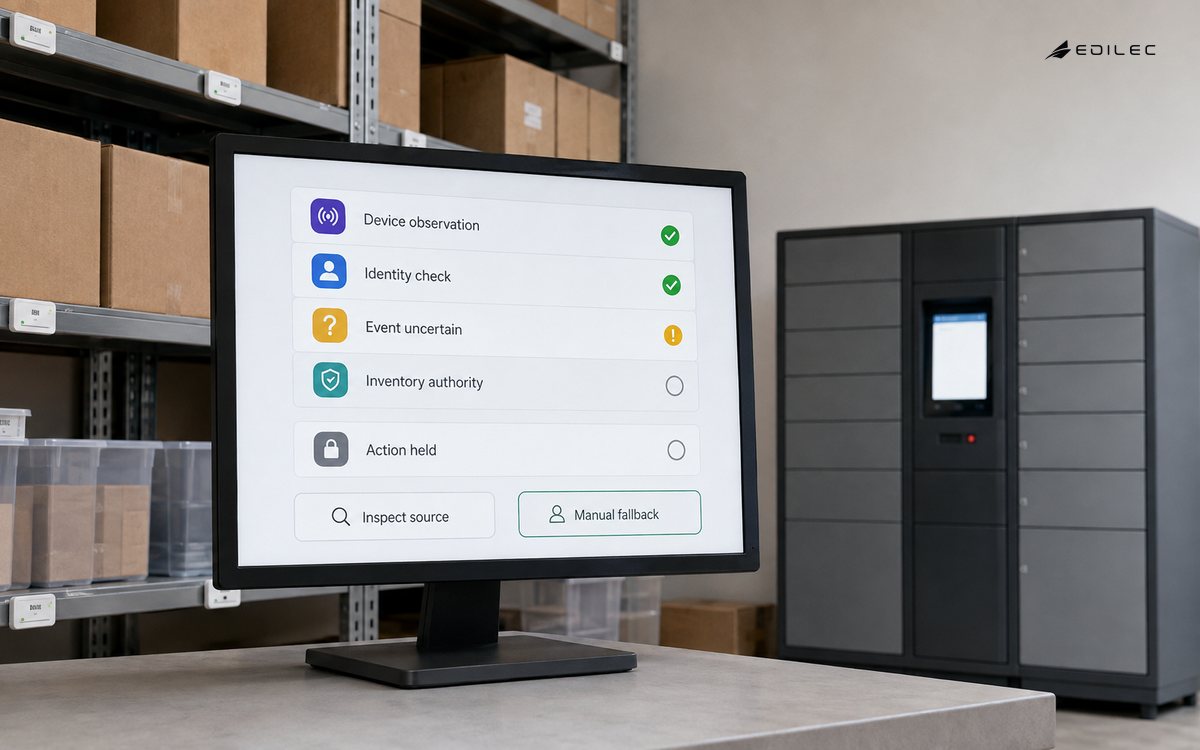
The W3C Web of Things Architecture 1.1 describes Thing Descriptions as machine-readable metadata for interfaces and interactions across protocol bindings. A description or equivalent device contract can separate application logic from protocol details. Keep commands distinct from observations, define preconditions and expiry, and confirm the resulting physical state instead of assuming a successful message means the action occurred.
| Control point | Implementation check | Failure test |
|---|---|---|
| Enrollment | Device bound to approved asset and site | Unknown and cloned identity rejected |
| Ingestion | Schema, rate, timestamp and signature validated | Malformed burst quarantined |
| Commerce update | Idempotent command with audit reason | Duplicate event changes state once |
| Privacy | Only necessary data retained and exposed | Support role cannot view excess data |
| Operations | Health, battery, backlog and update visible | Disconnected cohort identified |
5. Isolate payment and personal-data exposure
Map customer identifiers, location data, access codes, images and payment-related data through devices, apps, brokers, logs and support tools. Minimize collection and retention, restrict support views and redact telemetry. Keep connected devices and their management plane out of the cardholder data environment where architecture permits. Where payment data is involved, validate scope and controls against the current PCI DSS resources with a qualified professional.
Threat-model misuse as well as intrusion: repeated locker unlock requests, fraudulent return-state signals, inventory suppression and location stalking. Put server-side limits around device claims. High-consequence actions may require a second signal or human confirmation. Log access and decisions with stable identities, but avoid turning audit logs into a new store of sensitive customer data.
6. Test the end-to-end exception path
Create a golden event set covering normal, duplicate, late, out-of-order, impossible and version-mismatched observations. Test weak connectivity, gateway restart, wrong device time, credential expiry, full local storage and interrupted firmware updates. Validate commerce consequences: reserved stock, customer notifications, refunds, fulfillment queues and reports. Reconciliation must reveal missing or contradictory state rather than choosing a convenient answer silently.
Pilot one representative site and a limited product cohort. Train store or warehouse staff on commissioning, exception handling and manual fallback. Hold rollout when false actions, unidentified devices, backlog age, support effort or battery behavior exceed thresholds. Compare physical counts and inspected conditions with system claims. A pilot is an evidence phase, not a smaller ceremonial launch.
Operate, support and retire the system
Handover repositories, infrastructure definitions, device inventory, credentials process, event catalog, data-flow map, dashboards, runbooks, supplier contacts, vulnerability procedure and support calendar. Define who responds to a device fault versus a commerce-system fault and how evidence moves between teams. Track fleet contact rate, update success, ingestion rejects, event delay, command success, reconciliation differences and business outcome.
Retirement should revoke identity, remove authorization, clear or destroy local data, update asset and inventory records and preserve required business evidence. Test bulk revocation and supplier exit before the first model reaches end of support. Connected retail programs become expensive when decommissioning is improvised store by store.
Worked example: cold-chain fulfillment exceptions
An online grocery operation instruments reusable chilled totes between packing and handoff. The decision is whether a tote can proceed, needs inspection or must remain on hold. Each observation carries tote and sensor identity, location, event time, received time, temperature, battery and quality. The order system does not consume individual readings directly. A condition service evaluates an agreed time window and emits a release recommendation with the readings and rule version that support it.
The implementation binds sensors during tote commissioning, validates a golden payload set and rejects unrecognized units. A gateway buffers during loading-bay network loss and expires data that arrives too late to support dispatch. Duplicate observations share an event ID and do not create duplicate exceptions. Staff see the original condition evidence and can record probe results and disposition. If the condition service is unavailable, every affected tote remains visibly pending rather than being treated as safe.
A two-week pilot compares automated recommendations with manual probe inspections across ordinary and deliberately stressed totes. The rollout gate covers false release, false hold, event delay, missing sensor identity, staff handling time and customer notification. Privacy review confirms that the sensor path uses tote and order references rather than names or addresses. At handover, warehouse staff replace a sensor, replay a buffered event set and complete a quarantine without developer access.
Production acceptance evidence
- Use-case map tying physical events to commerce decisions, owners and manual fallback.
- Approved device inventory with identity, firmware, location, support and retirement fields.
- Versioned event schemas and interoperability tests against golden payloads.
- Duplicate, late, offline, malformed and wrong-clock test results with expected outcomes.
- Commerce reconciliation showing one controlled state change for each accepted event.
- Privacy and payment data-flow review with scope and retention decisions.
- Pilot comparison against physical inspection and documented rollout thresholds.
- Store or warehouse runbook exercise completed by the receiving support team.
Key takeaways
- Tie each sensor or device event to a defined commerce decision and fallback.
- Use standard identifiers and versioned event contracts across physical and digital systems.
- Keep devices outside direct order, inventory and payment database access.
- Pilot exception behavior, reconciliation and support effort, not only happy-path telemetry.
- Fund updates, vulnerability handling and retirement from the start.
Frequently asked questions
Should IoT become the inventory source of truth?
Usually it should first improve confidence or generate proposed adjustments. Automatic authority is appropriate only after event accuracy, reconciliation, exception ownership and business controls are proven. Preserve the reason and evidence for every automated inventory change.
Does ecommerce IoT need real-time processing?
Use latency that matches the decision. Locker access and safety exceptions may need seconds; replenishment analysis may tolerate minutes or hours. Lower latency increases connectivity, operating and failure-handling demands, so specify an outcome rather than using real time as a default.
How should an IoT development company be evaluated?
Ask for evidence of device lifecycle design, event-contract testing, secure enrollment, offline behavior, commerce integration, rollout telemetry and support handover. Require customer ownership of accounts, code, device identities and operational data, plus a practical transition plan.
Conclusion
Production ecommerce IoT connects a physical fact to a controlled business action. Secure device lifecycle, interoperable events, explicit commerce boundaries and evidence-led rollout keep that connection trustworthy. The implementation is complete only when staff can handle exceptions and retire devices as confidently as they commission them.