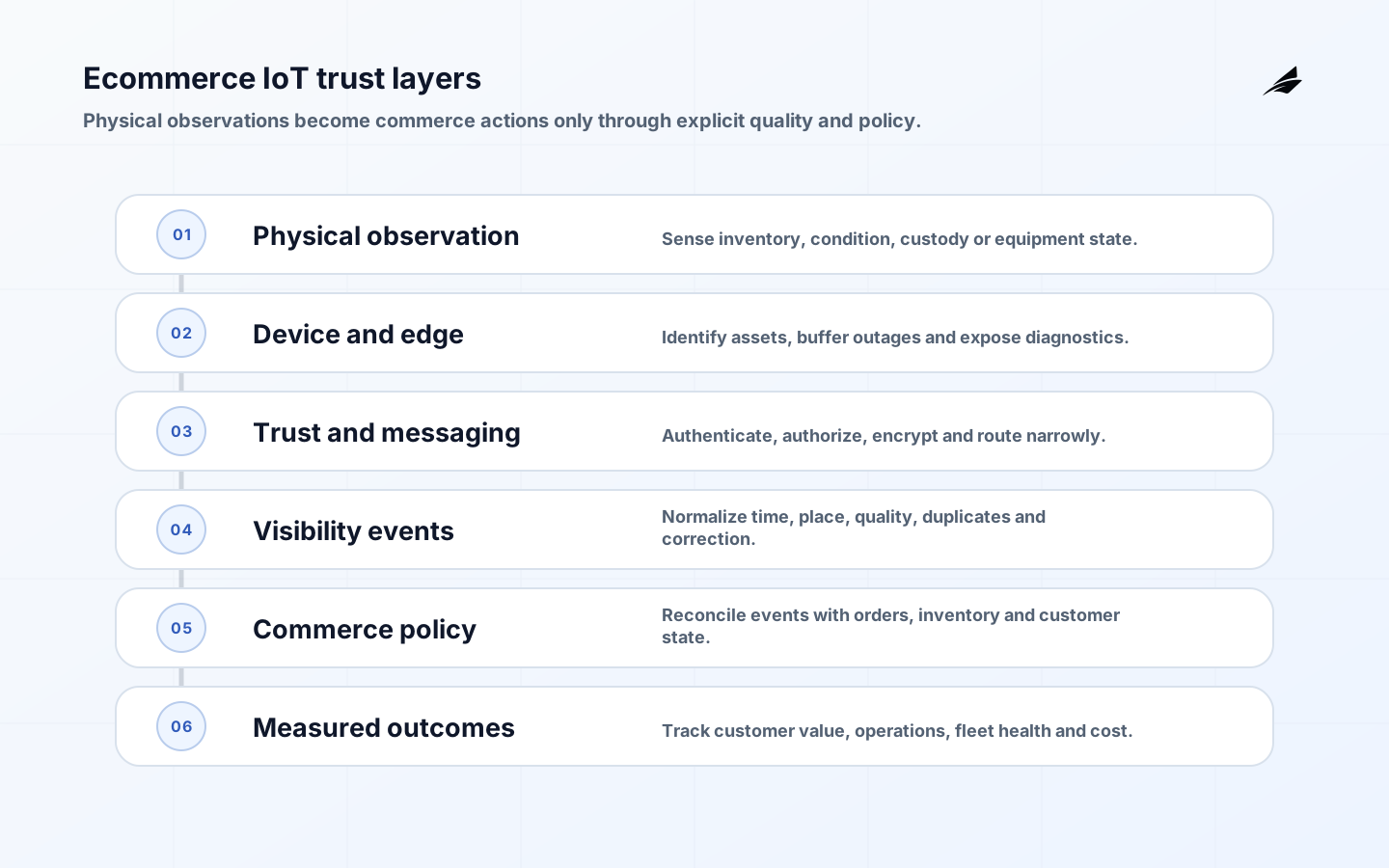
An ecommerce IoT software development company should connect physical inventory, facilities or fulfillment activity to digital workflows without creating a second, less trustworthy version of stock or order truth. Buyers typically investigate shelf or bin sensing, RFID and scanner events, cold-chain monitoring, smart lockers, connected packaging, returns inspection or warehouse equipment telemetry. The right first question is not which device platform to buy. It is which customer or operating decision improves when a timely physical observation becomes available.
This FAQ helps commerce, operations and technology leaders compare providers. Edilec's ecommerce IoT delivery plan covers scope and commercial planning, while the production implementation checklist covers rollout. The startup IoT delivery plan offers a narrower path for a first product.
Which ecommerce IoT use cases are worth building?
Prioritize a recurring decision with measurable loss or delay: finding misplaced inventory, detecting a cold-chain excursion, confirming locker custody, reducing manual cycle counts or locating returnable assets. Establish the current cost, error and elapsed time. Avoid use cases that require near-perfect sensing but offer little value when observations are uncertain. A sensor should assist a business workflow, not bypass it. Define what operators do when the physical and digital records disagree.
Run a site observation before estimating. Device placement, metal, liquids, power, radio interference, cleaning, movement and worker practice change performance. Test representative products, packaging, locations and peak periods. The business case should include devices, installation, gateways, connectivity, platform usage, support, replacements, security updates, data retention and process change. Benefits should be measured after exception handling, not from laboratory read rates alone.
What architecture should a vendor propose?
A supportable design separates device and gateway adapters, secure messaging, registry and digital state, event processing, enterprise integration, customer-facing services and observability. Protocol choice depends on constraints. MQTT 5.0 supports publish-subscribe messaging and defined delivery behaviors, but business deduplication and reconciliation remain application duties. Edge components should buffer outages and fail safely without becoming an opaque second platform.
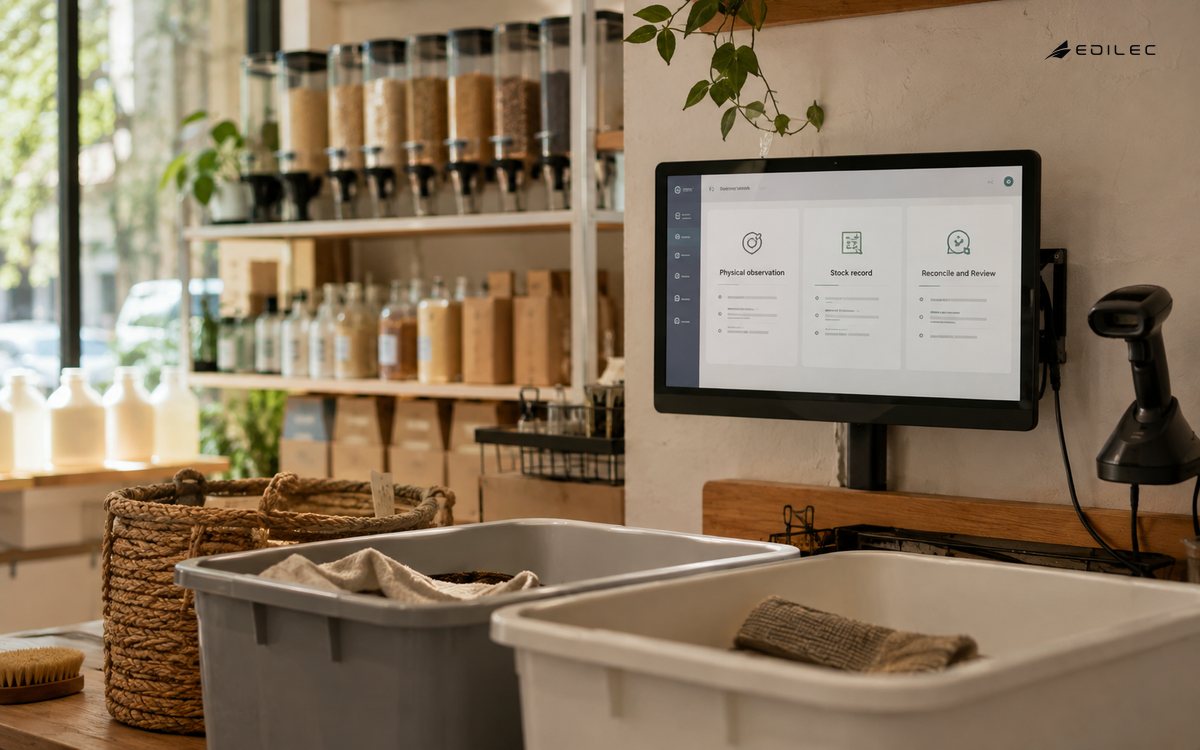
Define canonical events with object identity, event identity, observed and received time, location, business step, value, unit, quality and source version. GS1 EPCIS is designed to share visibility events across enterprises and includes sensor data support. It can reduce bespoke semantics where trading partners need common meaning. The commerce platform still governs catalog, order, inventory and customer state; device events propose or support controlled updates. Corrections must remain traceable.
| Layer | Vendor deliverable | Buyer acceptance |
|---|---|---|
| Device | Supported model and firmware matrix | Representative hardware passes field tests |
| Edge | Offline buffer, health and remote diagnostics | Outage and catch-up remain controlled |
| Messaging | Identity, encryption and routing policy | Unauthorized publish and subscribe fail |
| Event | Versioned schema and quality rules | Duplicates, lateness and corrections reconcile |
| Commerce | Bounded API and inventory policy | System-of-record changes are idempotent |
| Operations | Fleet, cost and incident evidence | Permanent support team can recover service |
How should devices and data be secured?
The NISTIR 8259 series provides a baseline spanning device identification, configuration, data protection, interface access, software update, cybersecurity-state awareness and manufacturer support. Ask the vendor to map each requirement to the device, gateway, platform, customer or supplier. Require unique device identity, protected credentials, signed updates, supported configuration, vulnerability disclosure and a stated support period. Shared defaults and unpatchable field devices are material procurement risks.
Segment device and management traffic, restrict egress and authorize resources by identity. NIST zero trust guidance cautions against treating network location as implicit trust. Separate workforce, device and service identities; time-bound privileged support; log sensitive actions; and rehearse certificate rotation and revocation. Minimize customer and location data. Define retention and deletion for telemetry, especially when it could reveal individual behavior or home occupancy.
Should the platform be built, bought or combined?
Buy commodity device connectivity, fleet management or protocol support when it meets lifecycle requirements and avoids maintenance. Build the business logic that differentiates fulfillment, customer experience or partner coordination. A combined model is common: a managed IoT platform handles identity and messaging while custom services normalize events and govern commerce actions. Compare portability of device identities, schemas, historical data, rules and firmware workflows before accepting a proprietary platform.
Ask providers to identify every dependency, license and subcontractor. The customer should own source repositories, cloud accounts, domains, data and release artifacts or have clear transfer rights. Apply the NIST Secure Software Development Framework to custom code and device software: protect source and builds, review dependencies, test security and maintain vulnerability response. Hardware does not exempt firmware from software supply-chain discipline.
What drives cost and schedule?
Device diversity, site variation, installation, certification, unreliable connectivity, battery life, firmware ownership, integrations, data volume and support hours drive effort. A prototype with one device on a bench says little about a multi-site fleet. Estimate discovery and field testing separately from platform build. Price a representative pilot, production hardening and each rollout wave. Include replacement stock, remote diagnostics, truck rolls, carrier charges, cloud messages, storage, security updates and end-of-life processing.
Use phase gates tied to evidence, not elapsed weeks. Discovery ends with a measured workflow and site constraints. Prototype ends when representative devices produce valid events. Pilot ends when users, security, operations and recovery meet criteria. Scale proceeds when deployment and support are repeatable. Do not sign a fleet-wide hardware commitment before the pilot proves field performance and operating cost.
| Provider evidence | Why it matters | Weak answer |
|---|---|---|
| Field test record | Shows behavior outside a demo | Only laboratory screenshots |
| Lifecycle matrix | Makes firmware and support explicit | No end-of-support dates |
| Threat model | Connects physical and digital attack paths | Generic cloud security claim |
| Failure exercise | Proves offline, rollback and recovery | Backup job status only |
| Ownership schedule | Protects accounts, code and data | Vendor retains all platform control |
| Unit economics | Tests affordability at fleet size | One-time development quote |
How should an IoT development company be selected?
Provide finalists with the same workflow, site facts and constraints. Ask for a solution boundary, assumptions, failure modes, lifecycle model, estimate range and smallest useful pilot. Meet firmware, cloud, security and operations leads. Review redacted architecture, test, incident and handover artifacts. References should involve comparable device diversity and physical rollout, not merely a mobile application that consumes an API. Score operating evidence and ownership as heavily as feature fit.
Contracts should define acceptance, supported hardware and versions, security updates, vulnerability notification, data rights, telemetry access, service levels, subcontractors, warranty, replacement, exit assistance and secure retirement. Clarify who pays for diagnosing a fault that crosses device, network and cloud boundaries. Require source escrow or transfer arrangements where unsupported proprietary firmware could strand critical hardware. Keep a customer-controlled registry export and current fleet inventory.
What should rollout and acceptance look like?
Roll out by a coherent unit such as one facility, fulfillment zone or locker cohort. Entry criteria should cover trained operators, inventory baseline, network survey, installed-device record, support contacts and rollback. Observe long enough to include peak volume, maintenance and at least one connectivity disruption. Compare physical samples with platform state and downstream commerce records. Stop expansion when event quality, battery, support load or reconciliation exceeds agreed limits. A rollout schedule should remain subordinate to evidence; installed hardware is not the same as accepted capability.
Define incident severity around commerce impact: customer unable to collect an order, inventory unavailable for sale, temperature excursion not detected, or widespread device compromise. The support path must cross store or warehouse operations, device supplier, network, cloud platform and commerce engineering without forcing frontline staff to diagnose architecture. Preserve device and gateway diagnostics, deployment versions and event lineage. After recovery, reconcile orders, inventory and customer communication rather than closing the incident when connectivity returns.
Measure product value with both operational and customer signals. Useful measures may include inventory discrepancy, time to locate an item, failed pickup, spoilage, manual scan effort, device availability, update success and cost per monitored asset. Segment by site, hardware and workflow. Avoid crediting every inventory improvement to sensors when process or catalog changes occurred at the same time. A controlled cohort or phased comparison produces more credible evidence for further investment.
Acceptance should also cover retirement. Revoke a sample device, remove its customer or site assignment, export required records, erase data according to policy and confirm that the old identity cannot publish. Update inventory and billing. This small exercise exposes platform dependencies that a connectivity test misses and proves the vendor can support transfers, replacements and end-of-life rather than only new enrollment.
Key takeaways
- Begin with a physical-to-digital decision whose outcome and current cost can be measured.
- Test representative products, packaging, sites, connectivity and worker practice before fleet commitments.
- Keep commerce records authoritative and reconcile uncertain, duplicate and late device events.
- Evaluate device security and support across enrollment, update, incident and retirement.
- Select a provider on field evidence, operating ownership, lifecycle cost and transferability.
Frequently asked questions
How long does an ecommerce IoT pilot take? It depends on hardware and site access; define duration by representative conditions and evidence rather than a fixed number. Can IoT replace inventory reconciliation? It can improve observation, but policy must still resolve conflicts and corrections. Who owns device data? The contract should state customer rights, supplier use, retention and export. Is Wi-Fi enough? Sometimes; evaluate coverage, credentials, roaming, interference and outage behavior at each site. What is the most important handover artifact? A current fleet and responsibility record connected to code, credentials, dashboards, support and lifecycle dates.
Conclusion
Choose an ecommerce IoT software development company that can prove the entire lifecycle, not just device connectivity. The provider should understand physical operations, preserve event meaning, protect each identity, integrate through controlled business rules and leave a supportable platform. A bounded field pilot with explicit acceptance evidence is the strongest bridge between an attractive demonstration and a dependable commerce capability.