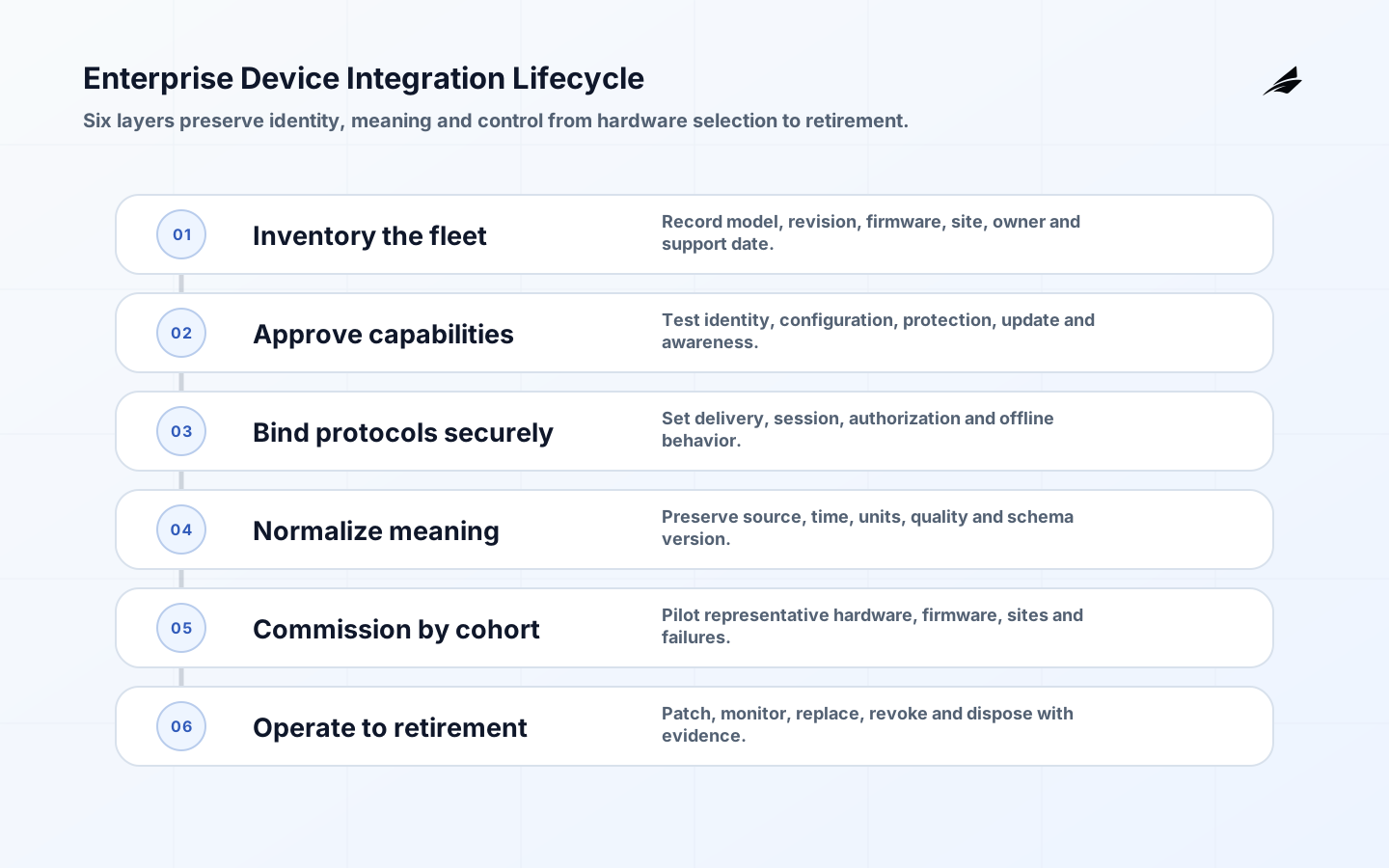
Device integration services for enterprise teams connect physical assets to business systems while preserving safety, security, meaning and lifecycle control. The difficult work lies beyond moving a payload: the enterprise must know which device produced it, whether the reading is trustworthy, how commands are authorized, how intermittent connectivity behaves and who supports the device after deployment.
Pair this guide with the enterprise device integration checklist, device integration FAQ, infrastructure delivery plan and infrastructure implementation checklist. Treat every device model and firmware line as an operated product, not a one-time endpoint.
Define operational outcomes and authority
Name the decisions the integration should improve: detecting cold-chain excursions, scheduling maintenance, locating assets or changing a machine setpoint. Separate telemetry from command and control. A delayed temperature reading may affect reporting; a delayed or duplicated command can affect physical operation. Assign a product owner, site owner, security owner, safety authority, data steward and support lead, with explicit approval for remote actions.
Inventory model, hardware revision, firmware, serial identity, certificates, installed location, network path, data owner, update method and end-of-support date. Include gateways and mobile commissioning tools. A procurement list is insufficient because integrations fail at the boundaries between nominally similar revisions. Record environmental and connectivity constraints such as power loss, roaming, low bandwidth and periods where devices cannot be reached.
| Contract area | Questions to settle | Acceptance evidence |
|---|---|---|
| Identity | How is a unique device bound to its record? | Enrollment and replacement test |
| Telemetry | Units, clock, quality, frequency and schema version? | Golden payload corpus |
| Commands | Who may issue, approve, cancel and verify? | Authorized and rejected command tests |
| Offline behavior | What is buffered, expired or reconciled? | Disconnect and replay exercise |
| Lifecycle | How are update, support and retirement handled? | Signed update and decommission record |
Set a device capability baseline
The NIST IR 8259A baseline identifies device capabilities including identification, configuration, data protection, logical access to interfaces, software update and cybersecurity state awareness. Translate each applicable capability into a procurement and test requirement. For example, identification means a stable, verifiable identity with a documented replacement process, not merely a serial number printed on a removable label.
Operational support matters equally. NIST IR 8259B covers documentation, receiving vulnerability information, disseminating information and education. Require a vulnerability contact, support period, update notice process and end-of-life policy. Ask suppliers for component transparency; CISA's SBOM resources explain the role of a nested component inventory in software supply-chain visibility and vulnerability response.
Separate transport from business meaning
Choose protocols from device constraints and interaction patterns. The OASIS MQTT 5.0 specification defines publish-subscribe messaging and three delivery quality levels. Those levels do not remove the need for application idempotency: reconnects, retries and downstream processing can still expose duplicates or reordered business events. Define message expiry, retained-message policy, topic authorization and session behavior explicitly.
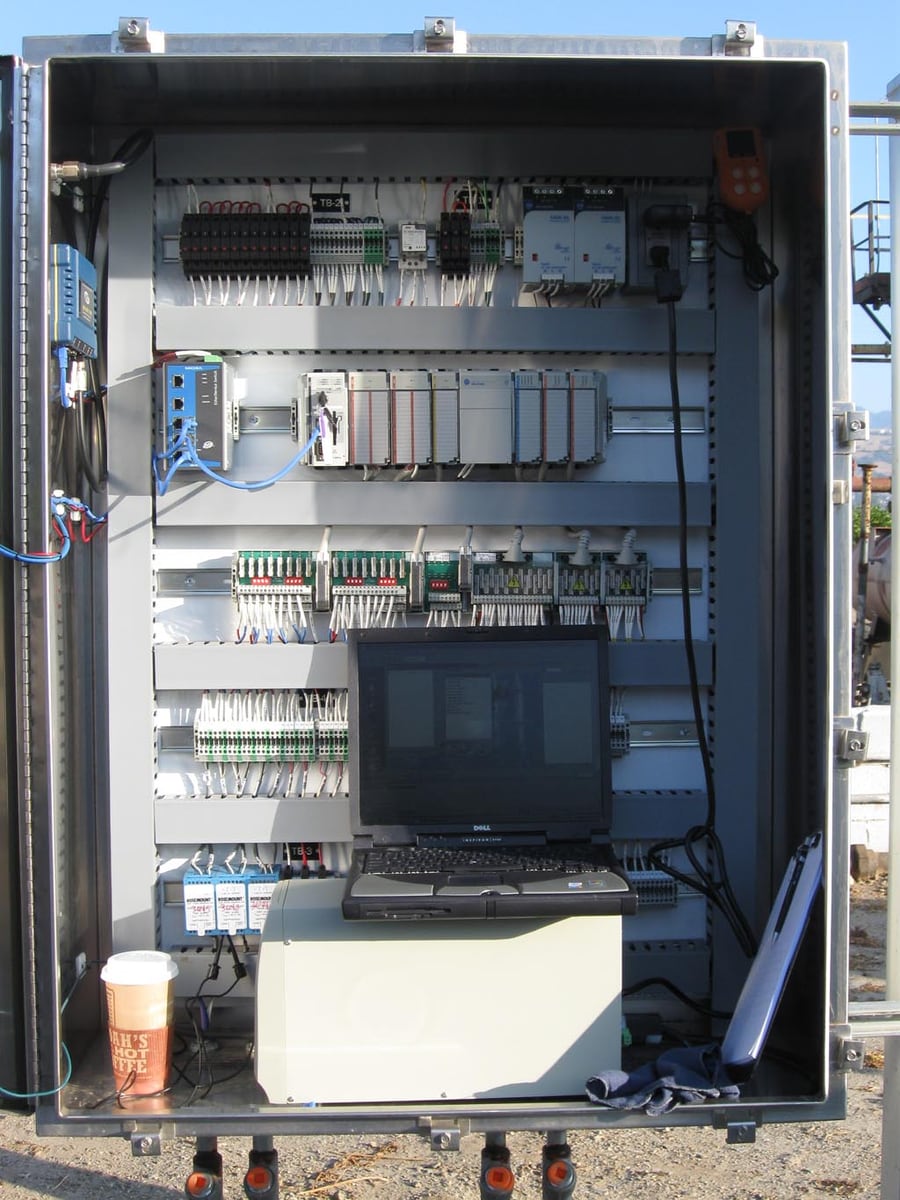
Industrial integrations often need rich information models and discovery. The OPC UA core specification defines information, message, communication and conformance models for interoperability. Even with a standard protocol, agree semantic identifiers, units, quality states and command preconditions. A gateway should adapt protocols at the edge while preserving source identity, original timestamp and quality metadata.
Design identity and security for the fleet
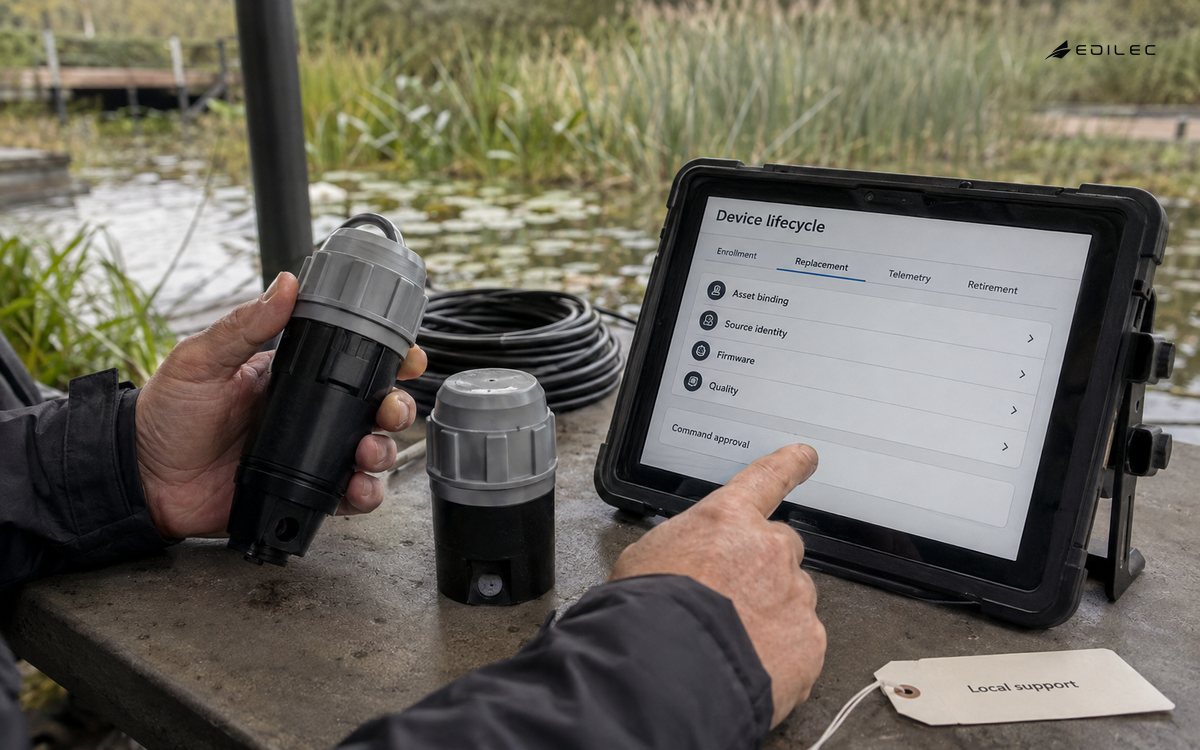
Enroll devices through a controlled process that binds manufacturing or commissioning evidence to an enterprise identity. Use per-device credentials, protected key storage where hardware permits, certificate rotation and immediate revocation. Do not let a shared factory password become the fleet trust anchor. Separate production, test and service identities, and ensure a replaced unit cannot inherit authorization merely by reusing a hostname.
The NIST zero trust architecture states that trust should not be granted solely from network location or ownership. Apply that idea to devices: authenticate device and service, authorize each resource and action, evaluate state where feasible and log decisions. Segment device networks, limit egress, protect brokers and gateways, and require an additional control for safety- or revenue-significant commands.
Build explicit integration layers
Use a device adapter for protocol and firmware differences, an ingestion layer for authentication and rate control, a canonical event layer for stable enterprise meaning, a state service for latest known status, and business APIs or streams for consumers. Keep raw payloads for a bounded diagnostic period where lawful, but prevent every analytics or workflow team from coupling directly to device-specific topics.
| Layer | Primary responsibility | Failure control |
|---|---|---|
| Device and gateway | Sense, act, buffer and identify | Local limits and durable queue |
| Connectivity | Secure session and message transfer | Backoff, expiry and rate limits |
| Normalization | Schema, units, quality and deduplication | Quarantine and contract validation |
| State and events | Current status and durable history | Ordering key and replay policy |
| Enterprise use | Workflow, analytics and command approval | Idempotency and authorization |
Define a canonical envelope with event ID, device ID, event type, observed time, received time, schema version, firmware version and quality. Keep the original value and normalized value when conversion matters. Consumers should tolerate additive fields and reject incompatible versions visibly. Use a dead-letter or quarantine path with ownership and replay tooling rather than silently dropping malformed data.
Commission and roll out by cohort
Test in a lab with representative hardware, weak networks, wrong clocks, expired credentials, duplicate messages, buffer overflow and interrupted updates. Then deploy to one controlled site with trained local support. Compare observed traffic, battery or resource use, alert volume, data quality and support effort against assumptions. Expand by device model, firmware and site cohort so faults can be isolated and rollback remains possible.
Commissioning evidence should include physical identity, ownership, firmware and configuration, network reachability, credential validation, telemetry contract tests, command interlocks, monitoring, update capability and local fallback. For a warehouse sensor rollout, acceptance might require ninety-nine percent expected readings over a representative week, no unknown devices, bounded clock skew and a demonstrated certificate replacement without physical factory reset.
Model cost across the device lifecycle
Estimate hardware variants, certification, gateway deployment, connectivity, platform traffic, storage, observability, field installation, help desk, replacement stock, vulnerability response, firmware maintenance and retirement. Integration labor often follows the number of device variants and sites more closely than the number of messages. Price an expected case and a difficult-site case where access, connectivity and legacy controllers increase effort.
Require a retirement workflow that revokes credentials, removes authorization, records final state, handles retained data and directs physical disposal or reuse. Keep support dates visible in portfolio planning. A fleet that can be onboarded but not safely updated or retired accumulates operational and security debt with every successful deployment.
Worked example: integrating a mixed warehouse fleet
A distribution company wants condition and runtime data from two generations of refrigeration controller across twelve warehouses. New controllers support MQTT with certificates; older controllers expose registers through an existing site gateway. The team defines a canonical equipment event with controller identity, site, observed time, metric, unit, quality and firmware. Remote setpoint change is excluded from phase one, eliminating a safety-critical command path while telemetry trust is established.
The gateway adapter maps legacy values and preserves the source register and quality code. The MQTT path uses per-device topics and authorization. Both routes enter schema validation, unit normalization and a quarantine stream before the equipment-state service. Lab tests include duplicate delivery, twenty-four hours offline, wrong device time, gateway restart and certificate expiry. Operations can distinguish a silent device from a healthy device reporting an unchanged value because expected contact and state awareness are separate signals.
The pilot installs ten devices of each generation at one warehouse. Acceptance requires complete asset binding, no unknown identities, bounded event delay after reconnection, explainable rejects and a successful signed update on the newer model. Field staff replace one controller and retire the old identity using the runbook. Only then does rollout proceed by model and site. The cost forecast is updated with measured gateway configuration and field-support time, which proved larger than cloud ingestion cost.
Fleet acceptance evidence
- Device-model matrix with firmware, interfaces, support dates and update method.
- Canonical schema and golden payloads for each supported revision and quality state.
- Enrollment, replacement, credential rotation and revocation records from representative hardware.
- Protocol tests covering delivery level, duplicate handling, ordering, expiry and reconnect.
- Gateway configuration under version control with protected deployment identity.
- Offline buffer, time correction, update interruption and local-fallback exercise results.
- Pilot metrics segmented by model, firmware, site and connectivity condition.
- Retirement record proving authorization removal, data handling and asset disposition.
Key takeaways
- Define telemetry, commands, offline behavior and lifecycle in a device contract.
- Use unique device identity and authorize actions independently of network location.
- Normalize enterprise meaning without discarding source and quality context.
- Pilot representative hardware and weak-network conditions before cohort rollout.
- Fund update, vulnerability response and retirement as part of integration cost.
Frequently asked questions
Is one protocol enough for an enterprise fleet?
Usually not. Device constraints and existing industrial systems may require several protocols. Standardize the enterprise event and identity contract, keep protocol adaptation at controlled gateways, and support a deliberately small set of tested patterns.
How should duplicate telemetry be handled?
Give each event a stable source identity and event ID, choose an ordering scope, make consumers idempotent and retain enough state to detect expected retries. Decide whether duplicates are dropped, merged or exposed; the correct choice depends on whether the event is a reading, state transition or command result.
What should be required from a device supplier?
Require documented identity, configuration, access, update and state-awareness capabilities; protocol and schema details; support and vulnerability contacts; component information; end-of-support dates; and test units. Contract for notification and transition, not only initial delivery.
Conclusion
Enterprise device integration succeeds when physical assets enter a governed lifecycle with verifiable identity, stable meaning, controlled commands and supportable updates. A layered architecture and cohort rollout make heterogeneity manageable while preserving the evidence needed to operate the fleet safely.