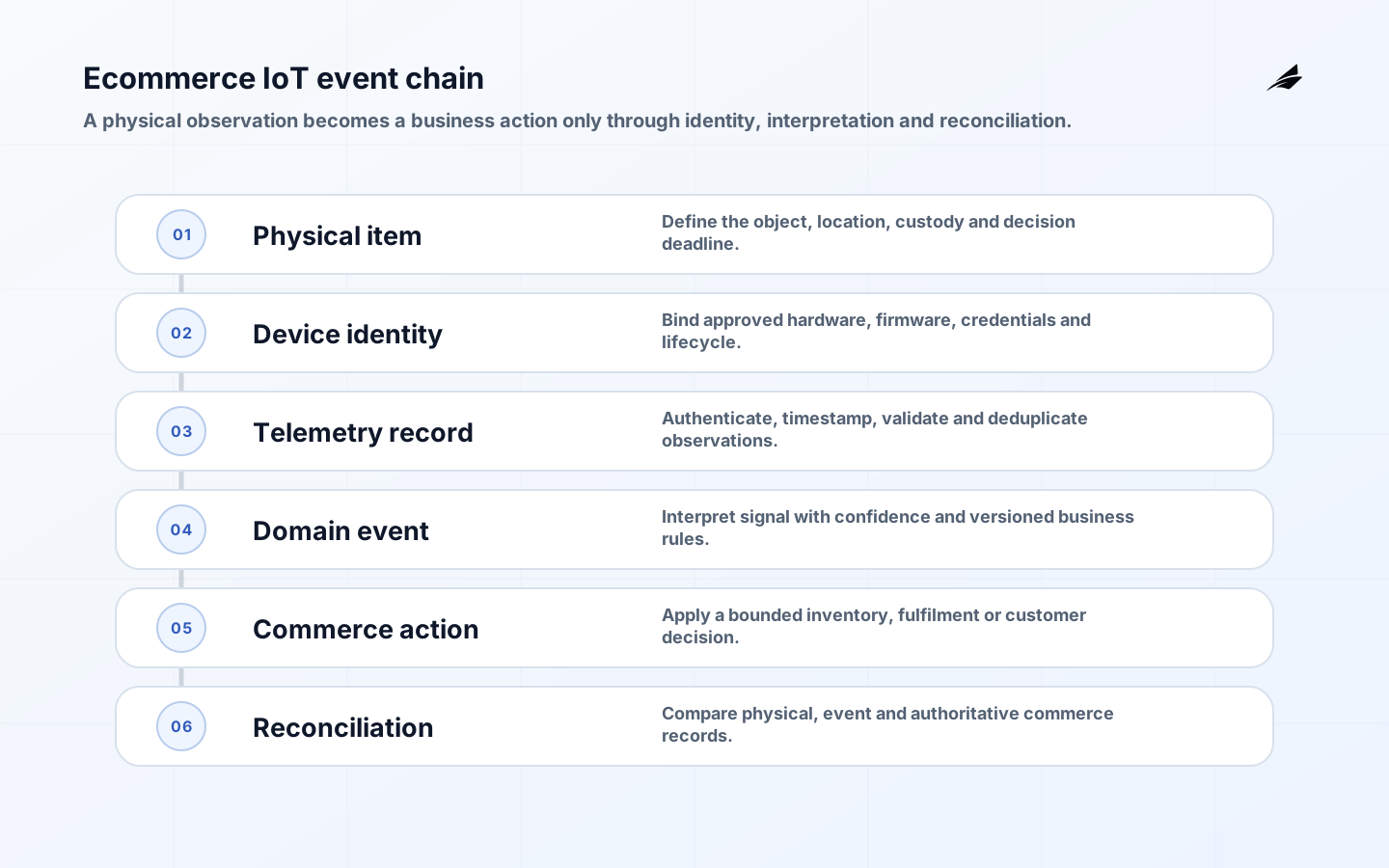
IoT software development for ecommerce should begin with a business event, not a connected-device demonstration. A shelf sensor, reusable delivery container, smart locker or cold-chain tag is useful only when its observation changes an inventory, fulfilment, loss-prevention or customer-service decision. The delivery plan must connect physical identity, device telemetry, business events and authoritative commerce records while accounting for intermittent networks, inaccurate sensors and equipment that will remain deployed long after the first application release.
A development company should therefore be evaluated on the complete operating system: device onboarding, firmware support, edge behavior, event ingestion, identity mapping, exception handling, security, observability and field service. NIST’s IoT capability baseline identifies device identification, configuration, data protection, restricted interfaces, secure software update and cybersecurity-state awareness as common starting capabilities. Ecommerce adds a second requirement: observations must reconcile to orders, locations, items and custody events without silently overwriting the commercial source of truth.
Choose an ecommerce outcome and a physical decision
State one decision the system will improve. Examples include whether an item is actually available for same-day pickup, whether a return reached the warehouse, whether a parcel stayed within a temperature range or whether a locker door may release an order. Define the current baseline, decision deadline, tolerated false-positive and false-negative rates, and fallback when telemetry is absent. “Real-time visibility” is not an acceptance criterion; a five-second event can still be wrong, duplicated or attached to the wrong item.
Map the physical process with store, warehouse, support and security staff. Record who applies an identifier, moves the item, replaces a device, resolves a mismatch and authorizes a business correction. Distinguish observation from fact. A sensor may report presence, but inventory becomes authoritative only after the business rule considers location, recent sale, reservation, return and confidence. Preserve both the raw observation and the interpreted event so a disputed decision can be explained and a better rule can be replayed.
| Use case | Physical signal | Business event | Fallback |
|---|---|---|---|
| Smart shelf availability | Presence or weight change | Item quantity requires review | Use last verified count and request cycle count |
| Cold-chain fulfilment | Time and temperature series | Shipment excursion recorded | Quarantine and inspect |
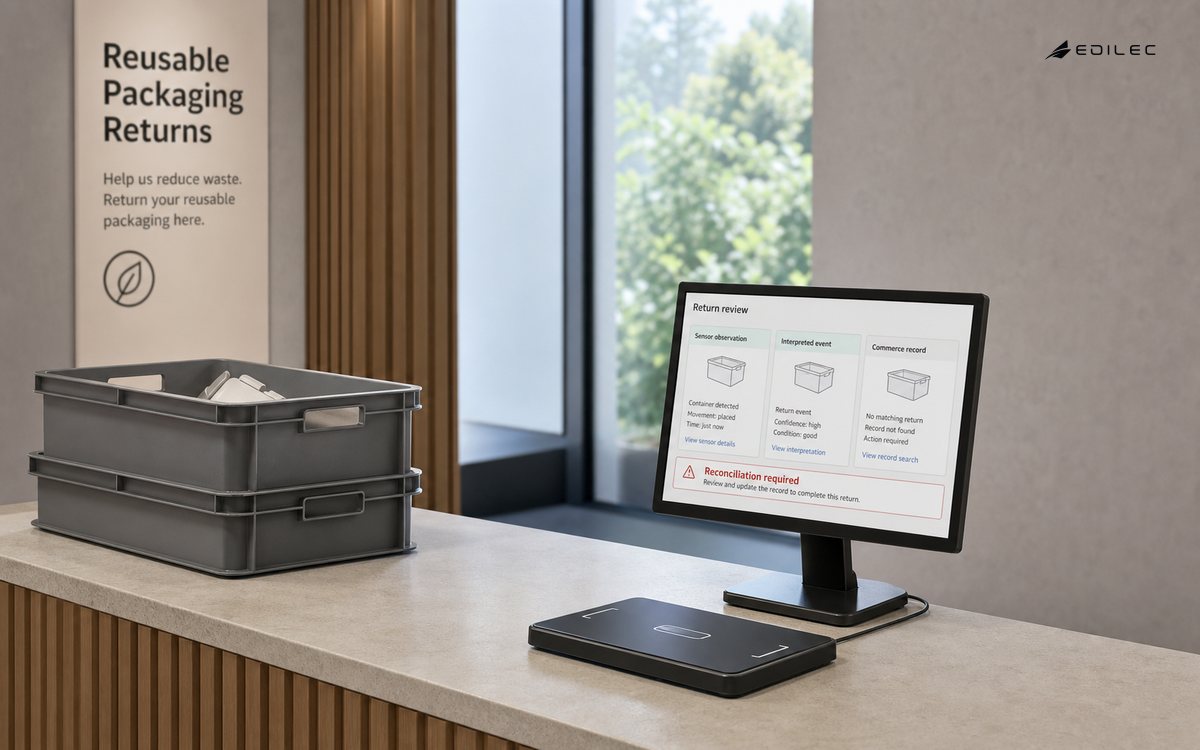
| Returnable package | Tag read at location | Custody transferred | Scan barcode manually |
| Smart locker | Door and compartment state | Order collected | Staff release with identity check |
Separate device, telemetry, event and commerce layers
Give each device a stable identity and lifecycle record independent of the product or parcel it observes. A replaceable sensor must not become the permanent identifier of an item. The ingestion layer authenticates the device, validates message shape, records event time and receive time, and applies idempotency keys. An interpretation service converts telemetry into domain events. The commerce integration then proposes or performs bounded actions through documented APIs. This separation allows firmware, rules and commerce systems to change at different speeds.
Use a standard event vocabulary where it reduces ambiguity. GS1 EPCIS 2.0 describes visibility events around the what, when, where, why and how of objects moving through a business process. It does not solve every sensor problem, but it provides a useful boundary between capture and downstream use. MQTT can support constrained publish-subscribe communication, yet protocol choice does not supply authorization, replay protection or business reconciliation automatically. Specify topic design, delivery semantics, session behavior and duplicate handling explicitly.
Design the device lifecycle before field deployment
Procurement evidence should cover unique credentials, secure boot where justified, supported cryptography, signed updates, vulnerability reporting, support period, reset and decommissioning. Avoid fleet-wide default secrets. Enrollment should bind a physical device to an approved tenant, site and purpose through a controlled process. Store manufacturing and operational identity separately, rotate credentials, and make a lost or stolen device revocable without rebuilding the fleet. Record hardware and firmware versions so an exposure can be scoped quickly.
Updates require staged rollout, power and connectivity assumptions, rollback behavior and proof of installed state. A device that misses several updates must not disappear from reporting. Define end-of-support action and data deletion. NISTIR 8259B emphasizes non-technical support such as documentation, information reception and dissemination; these matter because field teams need to report defects and customers need timely vulnerability and update information. Include supplier response and replacement lead times in the service model.
Make event quality and reconciliation visible
Track clock drift, gaps, duplicates, impossible transitions, device silence and confidence. Keep event time separate from processing time so delayed messages do not rewrite history without review. Establish a quarantine path for unknown device IDs, invalid signatures and events that violate physical sequence. For each automated action, preserve the evidence, rule version and resulting commerce-system response. A dead-letter queue is not resolution; exceptions need priority, owner, age target and a safe way to replay after the cause is fixed.
Reconcile at business boundaries. Compare shipped orders with observed custody, locker collections with customer confirmations, and device inventory with the asset register. Sample apparently successful events because silent semantic errors may pass schema validation. Use synthetic devices and recorded traces in testing, but also run controlled physical trials under poor connectivity, battery depletion, swapped labels and repeated scans. The system must degrade to a known manual process rather than continue making high-confidence claims from stale data.
| Cost area | Early estimate driver | Control |
|---|---|---|
| Devices and installation | Units, sites, mounting and calibration | Pilot representative environments |
| Connectivity and ingestion | Message frequency, payload and retention | Budget by event and cap noisy devices |
| Integration | Number and quality of commerce interfaces | Use contract tests and stable event IDs |
| Field operations | Failure rate, travel and replacement | Remote diagnostics and spare policy |
| Security and compliance | Data sensitivity and physical exposure | Threat model and lifecycle evidence |
Use a staged delivery and commercial plan
Discovery should produce the physical process map, event model, device capability profile, threat model, integration contracts and baseline economics. A technical proof confirms signal and connectivity; it is not a business pilot. The pilot must include representative sites, actual staff, operational support, exception resolution and measured decisions. Only then should the team industrialize manufacturing enrollment, fleet management, observability, service desk integration and deployment automation. Expansion follows explicit accuracy, reliability and unit-cost gates.
Price the service over the hardware life, not just initial development. Include devices, installation, connectivity, cloud ingestion, storage, observability, certificates, firmware maintenance, replacements, field labor, support and decommissioning. Contract for ownership of source, schemas, device records and exportable history. Require supplier security support and vulnerability notification. A low prototype quote can become expensive if every update requires a site visit or the device protocol can only be decoded by one vendor.
Set production acceptance around recoverable operations
Acceptance should prove fleet inventory, individual revocation, staged updates, telemetry loss detection, duplicate-safe processing, business reconciliation, observability and manual fallback. Run a compromised-device exercise and a regional connectivity outage. Verify that support can identify affected sites and business orders without unrestricted access to customer data. Measure mean time to detect device silence, exception age, update coverage, event-to-decision latency, false action rate and cost per useful business event rather than raw message volume.
Keep product and operational ownership after launch. Commerce teams own business semantics; platform teams own ingestion and reliability; security owns policy and response authority; field operations own physical maintenance. One service owner resolves cross-layer priority. Review whether the use case still produces value as product mix and logistics change. Retire devices and data deliberately when the signal no longer improves a decision.
Evaluate a development partner with a working scenario
Ask shortlisted teams to design one representative event path and explain uncertainty, security, retries, ownership and field failure. Look for experience across embedded constraints, cloud operations and commerce semantics rather than a polished mobile dashboard. Review a redacted event contract, fleet update design and incident record. The partner should identify what it would buy, what it would build and which decisions remain with retail operations. A proposal that hides device and support assumptions behind a single platform line item is not ready for comparison.
Use milestone acceptance tied to evidence: physical process and event model approved; device capability and threat profile agreed; ingestion and commerce contracts tested; representative pilot operated; fleet support and recovery exercised; ownership transferred. Retain customer access to device registry, source, schemas, telemetry history and deployment configuration. This structure protects both parties because scope changes become visible where they enter the operating chain.
Key takeaways
- Anchor the system in a physical business decision and measurable error tolerance.
- Keep device identity, raw telemetry, interpreted events and commerce records separate.
- Procure secure update, support and decommissioning capabilities before deployment.
- Reconcile IoT events with authoritative order, stock and custody records.
- Scale only after a representative pilot proves field support and unit economics.
Frequently asked questions
Should an ecommerce team buy an IoT platform or build one?
Buy commodity fleet and ingestion capabilities when they fit the device and security model; build the domain interpretation and commerce decisions that differentiate the operation. Evaluate exportability, protocol support, tenant isolation and lifecycle cost. A hybrid is common, but ownership boundaries must remain explicit.
Does every IoT use case need real-time processing?
No. The decision deadline should set the architecture. Locker release may need seconds; replenishment planning may tolerate minutes or hours. Faster processing costs more and can amplify bad signals. Choose latency alongside correctness, availability and fallback.
How many devices are enough for a pilot?
Use enough devices to represent environmental and operational variation, not a universal number. Include different sites, connectivity conditions, staff patterns and hardware batches. The pilot is credible when it estimates error, support effort and unit economics with bounded uncertainty.
Conclusion
A credible ecommerce IoT engagement delivers more than connected hardware. It creates a traceable chain from physical observation to a bounded business action, supported by secure device lifecycle controls, observable event processing and human-owned exceptions. Select a partner by asking it to demonstrate that chain under loss, delay, duplication and field failure. The best architecture is the one that improves a decision and remains explainable when reality disagrees with the sensor.