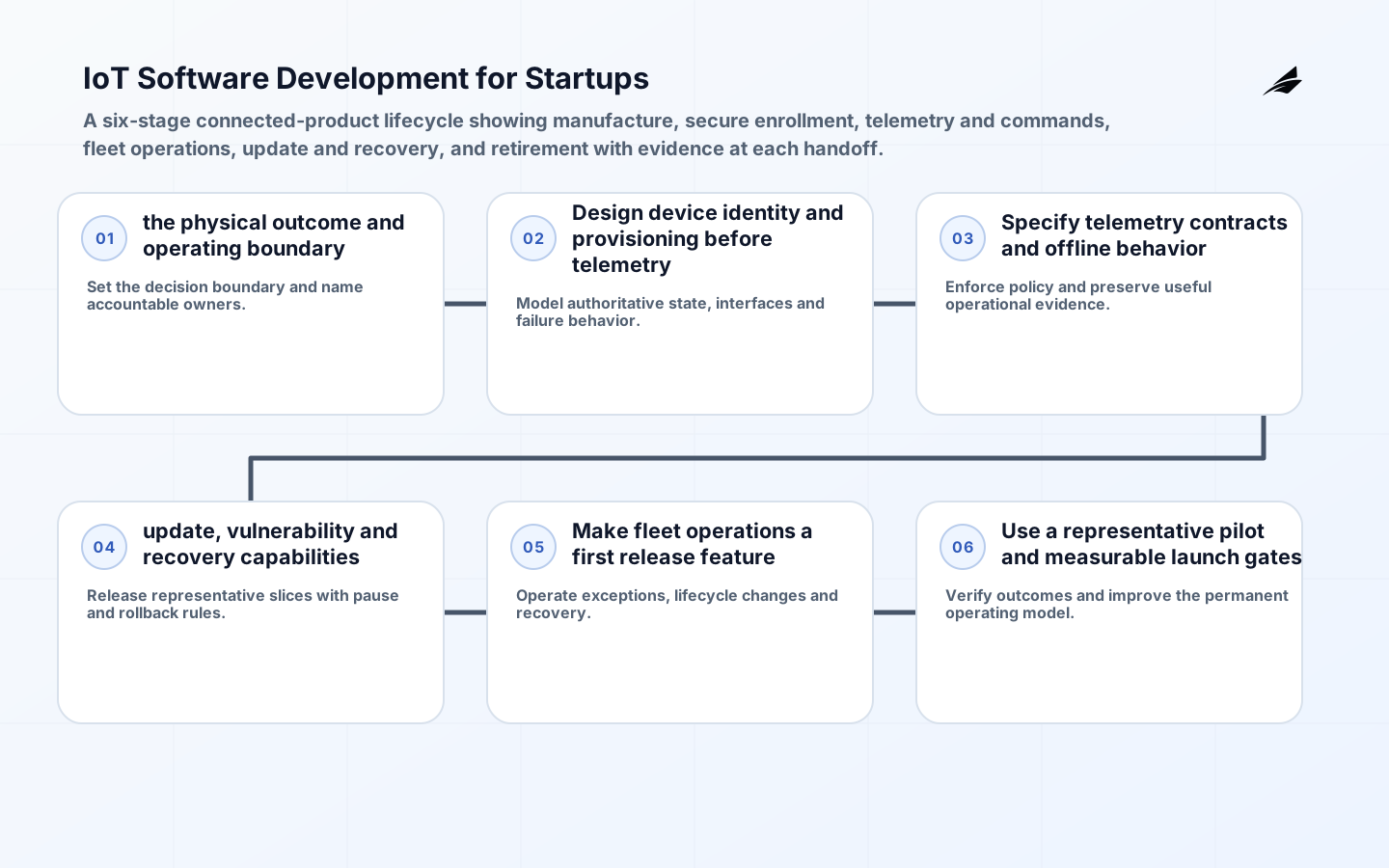
IoT software development for startups succeeds when the team treats the connected product as one service spanning hardware, firmware, communications, cloud software, mobile or web interfaces, support and field operations. A polished dashboard cannot compensate for devices that cannot be identified, updated or recovered. Before scaling a pilot, founders should be able to explain how a device is manufactured, enrolled, authorized, observed, upgraded, transferred and retired. The implementation checklist below turns those lifecycle questions into evidence a startup can review before committing scarce engineering and support capacity.
The checklist is deliberately broader than an application backlog. NIST IR 8259 Rev. 1, finalized in April 2026, emphasizes manufacturer activities and customer support across the product lifecycle; the companion capability catalog covers identification, configuration, data protection, access to interfaces, software update and cybersecurity-state awareness. Those capabilities belong in product requirements and acceptance tests. Teams comparing delivery options can also use the startup IoT scope and delivery guide and startup IoT FAQ.
Define the physical outcome and operating boundary
Write the product promise as an observable physical outcome: detect a condition, control equipment, reduce waste or document a field event. Then state the tolerated delay, measurement uncertainty, offline duration and consequence of a wrong action. This prevents the team from treating every sensor reading as equally valuable. It also clarifies whether the cloud may suggest an action, automatically execute it or must wait for a person. Safety, privacy and contractual constraints should be attached to the affected journey, not left in a generic risk document.
Draw the full trust and ownership boundary. Include device components, bootloader, firmware, local storage, radio, gateways, broker, APIs, data stores, analytics, administrator tools, customer identities and third-party services. Name who controls manufacturing credentials, network onboarding, cloud tenancy, field installation and support access. Record assumptions such as stable power, cellular coverage or customer-managed Wi-Fi. An assumption without a detection or recovery path becomes a support incident after launch.
| Decision | Evidence before build | Launch blocker |
|---|---|---|
| Physical outcome | Named action, accuracy and latency target | No measurable customer outcome |
| Operating environment | Power, network, temperature and interference envelope | Pilot conditions do not represent the field |
| Authority | Rules for automatic, suggested and human-approved actions | Unsafe action can execute without a boundary |
| Ownership | Owner for device, cloud, data and support handoffs | A critical lifecycle step has no accountable team |
Design device identity and provisioning before telemetry
Every production device needs a stable identity that cannot be confused with a serial number printed on a label. Decide how identity is created, bound to hardware, attested where appropriate, registered to a product record and associated with a customer or location. Manufacturing, repair and replacement flows must preserve the distinction between a device, its current credentials and its owner. Avoid fleet-wide secrets. Compromise of one unit should not give an attacker credentials accepted by every other device.
Provisioning should be an explicit state machine: manufactured, unclaimed, claimed, active, suspended, transferred and retired. Test duplicate claims, expired enrollment codes, clock errors, interrupted onboarding and re-provisioning after service. Administrative APIs must authorize both the person and the target device or tenant. Keep an auditable record of who changed ownership, policy or credentials without exposing secret material in application logs.
Specify telemetry contracts and offline behavior
A telemetry contract defines topic or endpoint, schema, units, timestamps, quality indicators, ordering expectations, retention and compatibility rules. Add device and firmware versions so the platform can explain changes. MQTT quality-of-service levels affect delivery behavior but do not by themselves create business-level exactly-once processing. Consumers need idempotency keys, duplicate handling and explicit reconciliation. Version schemas additively where possible and test old firmware against new consumers before deployment.
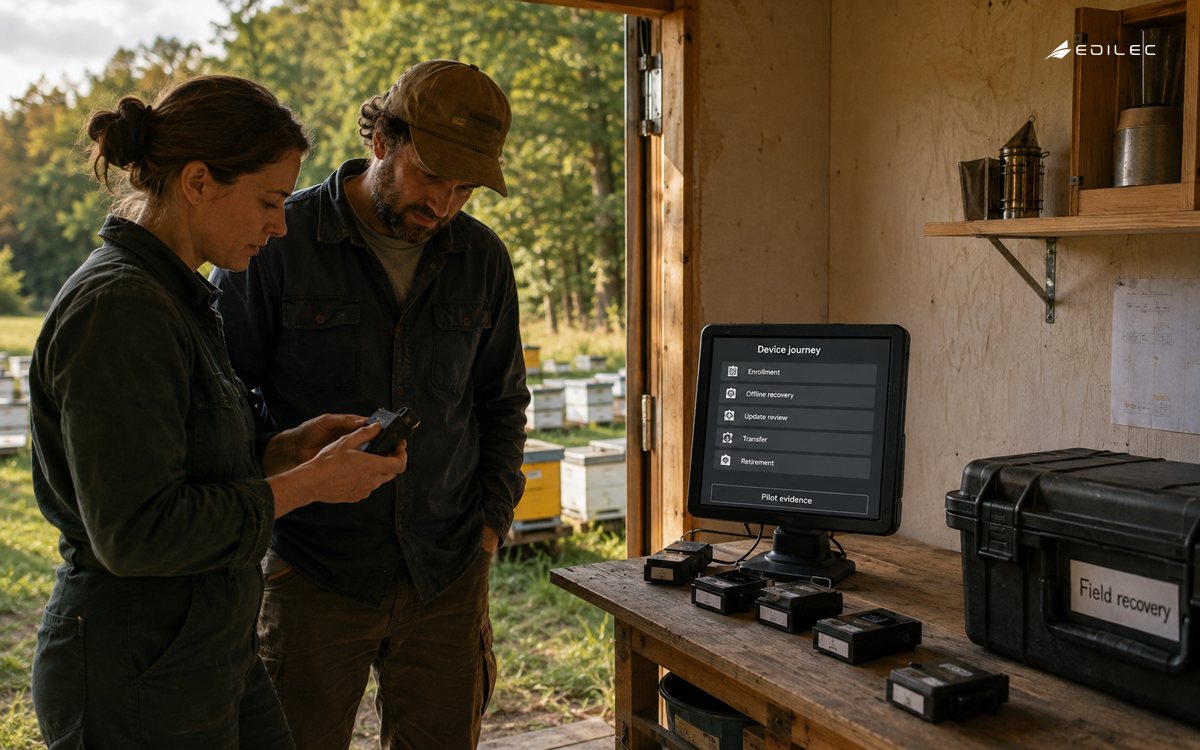
Design for intermittent connectivity from the first prototype. Bound local queues by time and storage, define which events may be dropped or summarized, and state what happens when a command expires before delivery. Use device timestamps carefully when clocks may drift. Reconnection storms can overload brokers and downstream databases, so add randomized backoff, admission control and fleet-level rate limits. A field test should include hours of disconnection followed by synchronized recovery, not only a clean laboratory network.
| Path | Contract to define | Failure test |
|---|---|---|
| Device to cloud | Schema, identity, time, retry and duplicate rules | Offline queue reconnects after a long gap |
| Cloud to device | Authorization, expiry, acknowledgement and idempotency | Expired command is not executed |
| Firmware update | Signing, compatibility, staged rollout and rollback | Power loss during installation |
| Customer export | Tenant boundary, units, retention and rate limit | Large replay cannot exhaust the service |
Build update, vulnerability and recovery capabilities
Secure update is a product capability, not a future operations feature. Define artifact signing, verification at the device, anti-rollback policy, compatibility checks, staged cohorts, health observation and recovery after interruption. Separate release authorization from artifact creation. A device that rejects an update should report a reason the support team can act on. Maintain a support-period policy and communicate when a product will no longer receive security fixes.
Use the OWASP IoT Security Testing Guide to plan coverage across firmware, memory, physical and wireless interfaces, data exchange and user interfaces. Establish a vulnerability intake channel, triage clock and coordinated disclosure process before shipment. Keep a software and component inventory that connects a vulnerable library to affected firmware and device cohorts. Practice credential revocation and containment for a stolen unit, compromised signing key and malicious customer account.
Make fleet operations a first release feature
Operations need fleet views based on actionable states rather than raw chart volume. Show enrollment failures, last successful contact, firmware distribution, update failures, battery or resource health, certificate expiry, abnormal restart and customer-impacting command errors. Every alert needs a severity, owner, runbook and suppression rule. Do not page an engineer for a single sleeping device if the product intentionally reports once per day; alert on a violated product expectation or a meaningful cohort change.
Support tools deserve the same authorization and audit quality as customer features. Limit operators to the tenants and actions they need, require stronger approval for destructive commands and make bulk targeting previewable. Preserve the request, selected cohort, policy version and result for each fleet action. Provide a safe diagnostic bundle that removes secrets and personal data. This shortens incident response without granting support unrestricted shell access to customer devices.
Use a representative pilot and measurable launch gates
Select pilot sites that represent difficult installation, network and user conditions rather than only friendly offices. Include multiple hardware revisions, firmware versions and customer roles. Track installation completion, time to first useful signal, offline duration, failed commands, support contacts, update success and battery or bandwidth assumptions. Interview installers and support staff because workarounds often reveal missing product states before metrics do.
A launch gate should prove lifecycle operations, not merely feature completion. Require successful manufacture-to-retirement traces for sample devices, update and rollback evidence, tenant-isolation tests, load results for reconnect bursts, backup and restore of cloud state, incident contacts, privacy review and a funded support model. Keep a stop condition for unsafe behavior or unexplained data loss. Scaling a fleet multiplies unresolved operational ambiguity much faster than it multiplies product value.
Review iot software development for startups: production implementation checklist as a living operating capability after launch. At each review, compare the documented boundary with production configuration, recent incidents, support work, supplier changes and measured outcomes. Sample evidence rather than relying only on aggregate status. Record decisions, owners and due dates, and retire controls or reports that no longer support a real risk or business need. This cadence keeps architecture, policy and day-to-day practice aligned as customer volume, integrations, regulations and team responsibilities change.
Key takeaways
- Treat the connected product as one lifecycle across device, cloud, customer and support.
- Make per-device identity, provisioning states and credential rotation testable before scale.
- Define telemetry, commands and offline recovery as versioned contracts.
- Ship secure update, vulnerability response and fleet operations with the first production release.
- Gate launch on representative field evidence and complete lifecycle exercises.
Frequently asked questions
What belongs in an IoT startup MVP?
The MVP should prove one valuable physical journey plus the lifecycle needed to operate it: secure enrollment, bounded telemetry, authorized commands, basic fleet health, signed update and a recoverable support path. Features that do not test the riskiest assumptions can wait.
Should a startup use a managed IoT platform?
A managed platform can reduce broker, identity and device-management work, but the team still owns product authorization, data meaning, field behavior, customer support and portability. Evaluate protocol support, pricing at realistic message volume, export paths, regional availability and end-of-service options.
Does MQTT QoS 2 guarantee every business event exactly once?
No. MQTT defines messaging delivery behavior between clients and brokers. Retries, reconnects and downstream processing can still create duplicate or missing business effects. Use stable event identifiers, idempotent consumers and reconciliation against authoritative device or business state.
When is the product ready to scale?
Scale after representative pilots prove onboarding, offline recovery, updates, support, tenant separation and load behavior, with owners and budgets for failures. A high prototype success rate in controlled conditions is not sufficient evidence for a large field fleet.
Conclusion
A startup does not need enterprise ceremony to build a dependable connected product, but it does need explicit lifecycle decisions. The strongest implementation plan follows a device from manufacture through enrollment, ordinary operation, failure, update, ownership change and retirement, while proving customer value at each stage. That discipline protects runway: it directs engineering toward risks that become expensive only after hardware is deployed and gives customers credible evidence that the product can be supported beyond a demonstration.