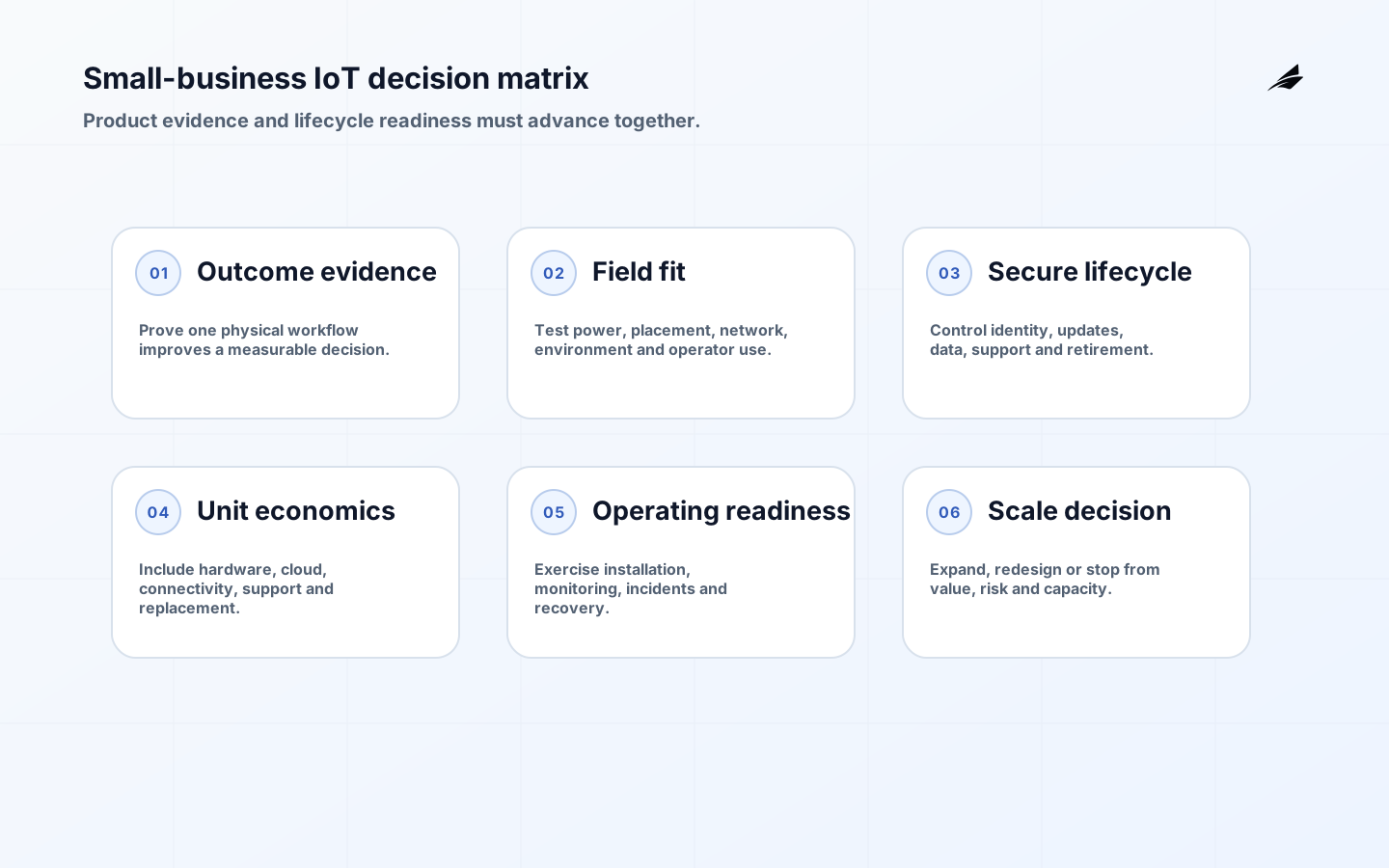
Small business IoT software development succeeds when a narrow physical problem justifies the continuing cost of hardware, connectivity, cloud software and support. A company may want remote equipment status, environmental monitoring, asset location, access control or a connected product feature. The delivery plan must cover the device's whole supported life, not only an application launch. This guide explains how to define scope, estimate cost, control risk and move through a field pilot without committing the business to an oversized platform.
Use the small-business IoT implementation checklist once scope is approved and the small-business IoT FAQ when comparing providers. Edilec's startup IoT delivery plan provides additional product-validation context.
Define a useful first scope
Write the workflow before the architecture: physical trigger, actor, decision, action, frequency, current delay, error and value. State the locations, device count, environmental conditions, connectivity, power and tolerated outage. Decide what the device observes and what it may control. A monitoring use case usually carries less risk than remote actuation. Name a business owner, product or service owner and technical owner, even when one person fills several roles.
Set exclusions. The first release may support one device model, one country, one connectivity method and one bounded workflow. Avoid adding a general analytics platform, consumer app and multiple hardware families before the core observation proves useful. Define acceptance in business terms such as fewer emergency visits or faster detection, then include device accuracy, message delivery, battery, security, support and recovery evidence. A prototype is not production acceptance.
| Scope decision | Pilot answer | Future question |
|---|---|---|
| Outcome | One measurable operating decision | Which adjacent workflows share the data? |
| Fleet | Representative device and site cohort | How will enrollment and replacement scale? |
| Authority | Observe, notify or bounded command | What added controls precede autonomy? |
| Integration | One system-of-record boundary | Which interfaces need stable contracts? |
| Support | Named responder and fallback | What coverage does wider adoption require? |
Choose the smallest supportable architecture
A common design includes device firmware, optional gateway, secure messaging, device registry, event processing, business integration, user interface and observability. Use a managed platform when it provides needed identity, messaging and fleet functions at an acceptable lock-in and unit cost. MQTT 5.0 is a common messaging standard, but protocol features do not replace application contracts for identity, units, duplicates, lateness, command expiry or reconciliation.
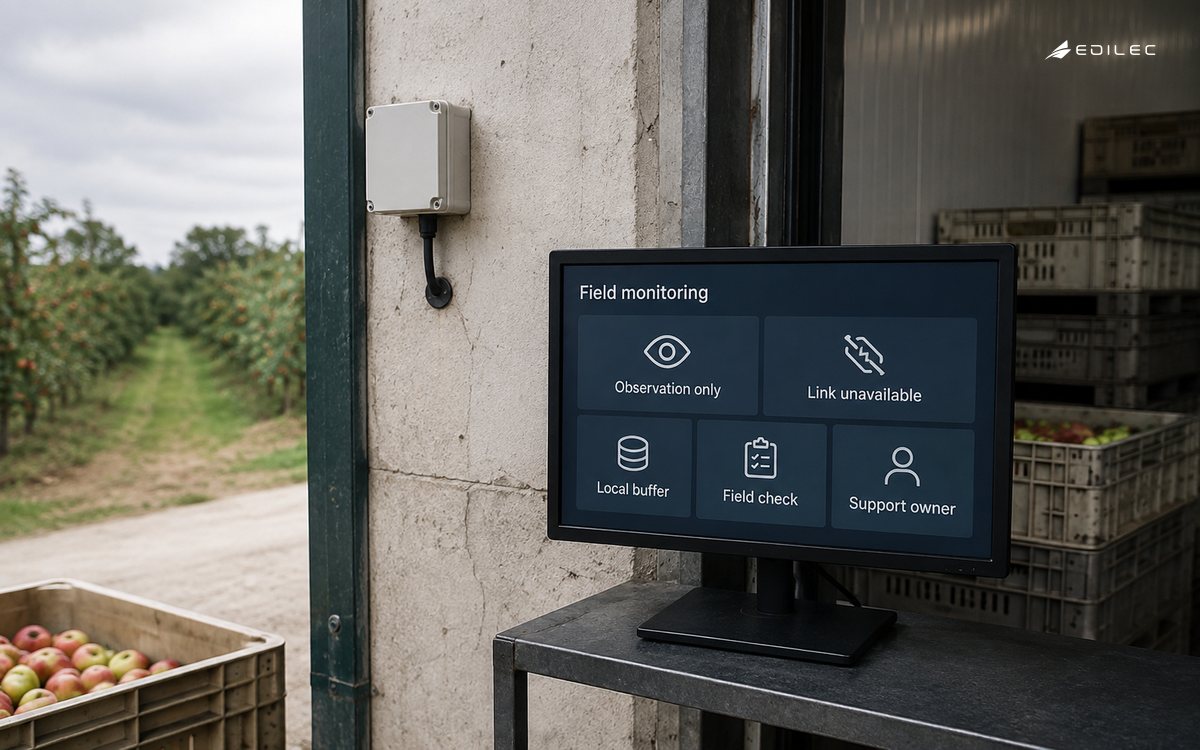
Keep the cloud account, source repositories, domains and customer data under business control. Separate development and production. Prefer a canonical event model over exposing device-specific payloads to every application. Design offline buffering and safe degraded behavior. Avoid a gateway unless it solves protocol, latency, privacy or connectivity constraints because every edge component creates another update and support surface. Record portability for identities, firmware, schemas and event history.
Build security and privacy into procurement
NIST's updated foundational IoT manufacturer guidance asks manufacturers to identify customer cybersecurity needs, address them in product design and plan communication and support. Use the IoT capability catalog to discuss device identification, configuration, data protection, interface access, update and state awareness. Require unique identities, no shared default credentials, signed updates, supported cryptography, vulnerability handling and an explicit end-of-support date.
Use named workforce accounts, least privilege and multi-factor authentication; CISA's small-business MFA guidance recommends phishing-resistant options where possible. Limit device permissions and network flows. Collect only data required for the purpose. The NIST Privacy Framework helps teams connect data processing to organizational risk. Explain sensing to affected users, define retention and deletion, and prevent test telemetry from becoming an uncontrolled personal-data archive.
Estimate total lifecycle cost
Separate non-recurring engineering from recurring fleet cost. Engineering includes discovery, hardware selection, industrial or enclosure work, firmware, cloud services, applications, integrations, security testing, field testing and production hardening. Recurring cost includes hardware, installation, connectivity, cloud messages and storage, monitoring, support, replacements, certificate operations, firmware updates and eventual retirement. Add contingency for device certification, lead times and field rework where they apply.
Model three volumes and two demand patterns rather than one average. Unit cost may fall with procurement volume while support and data cost rise. Include failed installations, spare inventory, battery replacement, truck rolls and provider minimums. Compare expected annual benefit after operator review and exception work. Treat a quote that excludes firmware maintenance or vulnerability response as an incomplete price. Delay long cloud or hardware commitments until the pilot establishes demand and message behavior.
| Cost area | Estimate driver | Evidence before scale |
|---|---|---|
| Hardware | Model, sensors, enclosure and certification | Field accuracy and failure rate |
| Installation | Site access, power, mounting and training | Repeatable installation record |
| Connectivity | Carrier, payload, frequency and roaming | Measured traffic and coverage |
| Cloud | Registry, messages, compute, storage and egress | Cost per active device and outcome |
| Operations | Monitoring, support, updates and replacements | Permanent owner and exercised runbooks |
| Retirement | Data export, erasure, disposal and migration | Documented offboarding procedure |
Control the risks that derail small IoT projects
The largest risks are weak product value, hardware or site mismatch, ambiguous event meaning, insecure devices, supplier dependence and missing operations. Reduce value risk with workflow evidence before custom hardware. Reduce field risk through representative tests. Reduce data risk with schemas and reconciliation. Reduce supplier risk through account ownership, export formats, source rights and alternative components. Reduce operating risk by involving the permanent responder during design, not after rollout.
Plan for compromise, cloud outage, lost connectivity, expired certificates, failed update, bad sensor, power loss and vendor closure. Define which local behavior is safe and which commands are prohibited offline. Keep a known-good firmware and rollback strategy where the hardware allows it. Monitor support and component end-of-life. A cheap device that cannot be securely updated or diagnosed can make the entire fleet economically unusable.
Deliver in evidence-based stages
Stage one observes work and tests hardware feasibility. Stage two connects a bench prototype with fake or limited business data. Stage three creates a production skeleton with identity, logging, support and one integration. Stage four runs a representative field pilot. Stage five hardens enrollment, updates, recovery and deployment. Stage six expands by cohort. Each gate should have entry facts, acceptance evidence, spending authority and a stop condition. Preserve learning when a device or use case fails.
During the pilot, test normal operation, peak traffic, duplicates, delayed events, offline buffering, clock drift, credential rotation, update interruption, unauthorized access and replacement. Measure business outcome, field accuracy, operator effort, incident load and unit cost. Have someone other than the builder install a device and recover a fault. Scale only when the permanent team can support the cohort and the value still exceeds the full operating cost.
Select and contract the development partner
Ask vendors for a bounded pilot, assumptions, architecture, hardware and support matrix, threat model, lifecycle estimate and sample handover. Meet firmware and operations specialists. Prefer providers that explain limits and failure behavior clearly. Contracts should allocate device, cloud, security, data, incident, update and retirement duties. Define acceptance, warranty, vulnerability notifications, subcontractors, source and account ownership, service levels, data export and exit support.
Run a lightweight operating review
A monthly review should combine business outcome, fleet health, security, cost and support. Examine active and unknown devices, event acceptance, offline duration, update coverage, credential expiry, incidents, operator corrections and cost per active device. Review by model and site because fleet averages hide concentrated failures. Select a few owned actions and close them before adding more metrics. Revisit the original business baseline quarterly to confirm that the connected workflow still provides enough value to justify ongoing support.
Prepare customer and staff communication before sensing expands. Explain what devices collect, why, how long records are retained and how concerns are handled. For a connected product, document setup, secure configuration, updates, reset, transfer and end-of-support in language customers can act on. Support should be able to distinguish hardware, connectivity, account and cloud failures. Feed recurring questions into product design; avoid requiring every customer to discover the same secure configuration or recovery sequence independently.
Keep an exit test alongside recovery tests. Export the fleet registry, required event history, configuration and ownership data; revoke a sample device; remove it from billing; and confirm it cannot reconnect under its former identity. Verify source and build access can move to another qualified team. This evidence turns contractual portability into an executable capability and gives the business leverage if supplier quality, pricing or strategy changes.
Document the decision to scale with measured benefit, operating cost, residual risk, support capacity and the next bounded cohort. This short record prevents enthusiasm about device count from outrunning the evidence that justified the product.
Key takeaways
- Choose one measurable physical workflow before designing a broad platform.
- Budget firmware, field support, connectivity, security updates and retirement alongside initial development.
- Retain strategic control of accounts, source, identities and business data.
- Test representative environmental, network and operator conditions before hardware commitments.
- Expand only after value, fleet operations, recovery and unit cost are proven together.
Frequently asked questions
Should a small business build custom hardware? Only when commercial devices cannot meet the validated need and the differentiation justifies certification and lifecycle cost. How many devices belong in a pilot? Enough to represent important device, site and user variation, not an arbitrary fleet percentage. Can one developer maintain the system? One person may lead, but access, documentation and recovery must not depend solely on them. What is the first scaling bottleneck? Enrollment, installation and support often fail before cloud throughput. When should a project stop? When useful field accuracy, safe operation or credible lifecycle economics cannot be achieved within agreed limits.
Conclusion
A practical small business IoT software development plan keeps the first outcome narrow while treating the device lifecycle seriously. Prove the physical observation in representative conditions, build a secure and portable service boundary, measure complete economics and give permanent operators real recovery experience. That creates room to grow without turning an early experiment into an unsupported fleet.