A pharma medical devices implementation checklist should make a regulated digital system explainable from intended use through postmarket action. The question is not whether a team has purchased a quality platform or run a set of scripts. It is whether the manufacturer can show which product outcome the system supports, what risk the workflow controls, which configuration was approved, what was verified, and how a change or field signal will be handled. Use this checklist with the pharma medical devices digital systems guide, pharma and medical device FAQ and medical device platform checklist to connect strategy, platform decisions and implementation evidence.
This article uses current official material as a planning lens, not as a substitute for device classification, regulatory advice or a quality agreement. FDA states that its Quality Management System Regulation became effective on February 2, 2026 and incorporates ISO 13485:2016 by reference. The FDA's February 2026 computer software assurance guidance superseded the prior version, and its medical-device cybersecurity guidance addresses design, labeling and premarket documentation. Teams serving Europe must separately map the EU medical-device framework.
The durable unit of delivery is the product evidence lifecycle: intended use, risk, requirements, design, software and hardware configuration, verification, release, distribution, surveillance and corrective action. A cloud migration, analytics model, production application or connected service can affect that lifecycle even when it is not itself the marketed device. The implementation team should therefore bring product, quality, regulatory, engineering, security, manufacturing and operations owners into the same decision record before selecting a tool or supplier.
Define intended use, markets and the digital boundary
Start with the finished device, intended users, use environment, clinical purpose, patient population and reasonably foreseeable misuse. Record each market and submission pathway under consideration. A mobile app, decision-support function, cloud service, production system or data pipeline may be a device function, an accessory, an input to a device, or a business system supporting a regulated process. The boundary changes the evidence and controls required. Capture the classification rationale, approver, date and trigger for reassessment when claims, connectivity, population or operating environment changes.
Map every component that can affect safety, performance, manufacturing consistency, data integrity or regulatory records: source code, software of unknown provenance, identity services, cloud infrastructure, mobile operating systems, update services, manufacturing equipment, labeling repositories, complaint tools and analytics. Identify the legal manufacturer, specification developer, contract manufacturer, importer, distributor and service-provider responsibilities for each market. An omitted dependency is not out of scope merely because it sits behind a supplier contract.
| Boundary decision | Evidence to retain | Acceptance question | Accountable role |
|---|---|---|---|
| Intended use and claims | Approved users, environment, indications, contraindications and claim map | Does the evidence match the product promise and foreseeable use? | Product and regulatory |
| Market pathway | Classification rationale, submission route and local responsibilities | Are applicable rules and escalation points named? | Regulatory affairs |
| Digital component scope | Architecture showing safety, quality-record and cybersecurity relevance | Could this component alter a regulated outcome or record? | Systems engineering |
| Economic-operator duties | Responsibility matrix for manufacturers, suppliers, importers and distributors | Who owns evidence, change, incident and field action? | Quality and legal |
| Change boundary | Criteria for design, regulatory, validation and security reassessment | Will a material change trigger the right review automatically? | Change control board |
Make the QMSR operating model visible in daily work
A quality management system is credible when ordinary work produces controlled, retrievable records. Configure workflows so approved design inputs connect to risk controls, implementation items, verification results, deviations, nonconformities and released configurations. Preserve authorship, review, approval, version, effective date and reason for change. Separate collaborative drafts from approved records, but do not force people to reconstruct the decision in a second system immediately before an audit. The FDA QMSR page and its FAQ make record availability and the new inspection context part of implementation planning.
Use risk to scale assurance. A low-risk collaboration workspace can have lighter review than software that authorizes release, disposes of a nonconformance, evaluates a complaint or controls a production parameter. The FDA's current computer software assurance guidance describes a risk-based approach for production and quality-management-system automation. Translate that into intended use, hazard or quality impact, test depth, reviewer competence, deviation handling and objective evidence for each configured function. Vendor validation material can support the assessment; it does not validate the manufacturer's configuration or process.
| System function | Risk to resolve | Assurance evidence before use |
|---|---|---|
| Document and training workflow | An obsolete or unauthorized instruction reaches the wrong role | Role, version, approval and effective-date tests |
| Design and risk traceability | A requirement or control cannot be traced to verification | Bidirectional trace test with representative records |
| Release authorization | An incomplete or unapproved configuration is released | Segregated approval, immutable record and negative-path test |
| Complaint or nonconformance routing | A safety-relevant signal is delayed, lost or misclassified | Routing, escalation, audit and recovery exercise |
| Electronic record and signature | History, identity or signature meaning is unreliable | Authentication, timestamp, alteration and restore evidence |
Build one traceable product evidence lifecycle
Create a trace model that works in both directions. A reviewer should be able to move from a hazardous situation to the control, requirement, implementation and verification that address it, and from a released software or hardware item back to the approved requirement and risk rationale. Include usability risks, cybersecurity threats, supplier components and production controls when they affect the same product outcome. Automated link counts can expose gaps, but a green traceability dashboard does not prove that the underlying evidence is relevant, representative or sufficiently challenging.

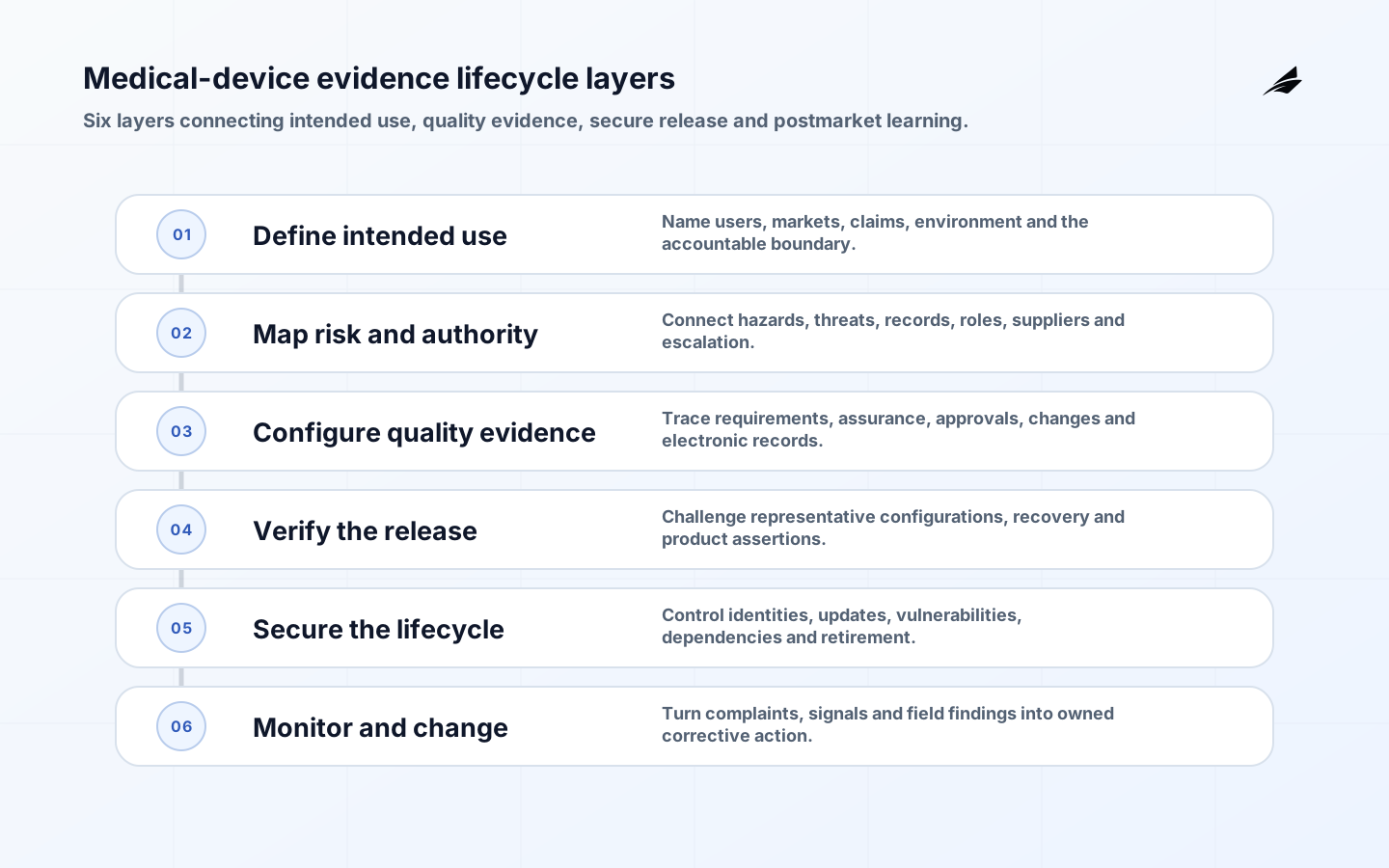
Treat each released configuration as a reproducible evidence bundle. Record device and software versions, manufacturing specifications, approved suppliers, labeling, deployment region, known anomalies, security documentation, validation status and postmarket monitoring commitments. For a cloud service, preserve application, infrastructure, configuration and data-migration versions. The six-stage lifecycle diagram specified for this section emphasizes the handoffs that commonly lose context: risk to design, design to verification, verification to release and release to field learning.
Engineer cybersecurity as product risk management
Connected-device cybersecurity begins with architecture, but it ends with a maintained operating capability. Inventory assets, interfaces, trust boundaries, data flows, update paths and external dependencies. Define security objectives alongside safety, performance and availability requirements. Use unique identities, least privilege, protected credentials, authenticated updates, secure defaults and useful security logging. The FDA's current cybersecurity guidance treats cybersecurity as part of device design and quality-system evidence, while the NIST Cybersecurity Framework 2.0 supplies a vocabulary for governance, protection, detection, response and recovery.
Plan vulnerability intake and remediation before launch. Maintain component provenance and a software bill of materials where appropriate, but do not mistake an inventory for impact analysis. Define how updates are signed, distributed, verified, rolled back and communicated when connectivity is intermittent or clinical availability is critical. Track devices that cannot receive an update and assign compensating controls with an owner and expiry. Exercise compromised credentials, unavailable cloud dependencies, partial update failure and restoration of a known-good configuration.
| Lifecycle event | Control question | Acceptance evidence |
|---|---|---|
| New dependency | Can provenance, support horizon, vulnerability and product relevance be shown? | Approved component record linked to configuration |
| Design change | Could the change alter hazards, threats, performance or regulatory status? | Signed impact assessment and updated trace links |
| Secure release | Is the bundle authentic, reproducible and deployed as approved? | Release record, signature, checksum and reconciliation |
| Field vulnerability | What is the affected population, exploitability and patient impact? | Time-bounded decision, remediation and communication record |
| Retirement | Can access end while required records and safety information remain available? | Approved retirement plan and completed control checks |
Make software and AI change control cumulative
Distinguish administrative edits from changes that can alter safety, performance, manufacturing consistency, cybersecurity or regulatory status. Assess cumulative effects: a sequence of small model, rules, dependency, infrastructure or configuration updates can change behavior materially even when no single pull request appears significant. Define emergency authority and retrospective review without making emergency treatment routine. The FDA's device software guidance explains why a risk-based boundary matters; teams should preserve the rationale for deciding whether a function is a device function, a supporting system or outside the relevant oversight focus.
If analytics or AI prioritize complaints, predict maintenance or detect field signals, validate the complete decision workflow rather than only model accuracy. Record data provenance, exclusions, version, thresholds, human authority, override behavior and monitoring. A model must not silently narrow the reportable population or change a risk score without a defined review. Every change needs a release record that connects the new behavior to affected requirements, verification, training, labeling and postmarket observation.
Control suppliers, cloud services and data dependencies
Supplier qualification should reflect the supplied item's effect on product quality and patient risk. Assess technical capability, quality controls, security practices, continuity, subcontractors, support horizon and change-notification commitments. Contracts should define evidence access, incident cooperation, vulnerability handling, audit or assessment rights, retention, return, exit and recovery obligations. For cloud and software services, make responsibility explicit for patching each layer, managing keys, reviewing privileged access, preserving logs and restoring data. A supplier certificate is useful context, not a replacement for product-specific acceptance.
Data used for design, production, clinical evaluation or surveillance needs provenance and fitness rules. Record origin, permitted use, transformations, exclusions, quality checks, version and retention. Separate exploratory data from approved evidence. Cross-border transfer and health-data restrictions require jurisdiction-specific review. The system should support lawful deletion or restriction without destroying records that must be retained, and it should identify which team can reconcile a correction across product, quality, manufacturing and postmarket views.
Close the loop through postmarket operations
Unify complaints, service events, adverse-event inputs, cybersecurity reports, returns and production nonconformities around the affected product and configuration. Intake should preserve the original report, identify missing information and route urgent safety questions to qualified reviewers. Trend by failure mode, severity, version, geography and denominator where meaningful. A dashboard is valuable only when it leads to a documented decision: continue monitoring, investigate, contain, correct, notify or escalate. The European Commission's MDCG guidance collection is an index of current material, but teams must confirm which guidance and law apply to the device.
After deployment, reconcile the actual population, watch leading signals and retain a stop or rollback decision. Feed verified field findings into risk management, requirements, supplier controls, training and release criteria so corrective action changes the system that produced the problem. Review the age of open safety decisions and the time from signal to containment, but interpret the metrics with qualified product and regulatory owners rather than treating a low count as proof of low risk.
Sequence implementation around evidence-bearing gates
- Approve intended use, markets, device or supporting-system boundary, product claims and accountable economic-operator roles.
- Map hazards, quality risks, cybersecurity threats, data flows, suppliers, records and postmarket obligations to the product outcome.
- Configure controlled requirements, risk, change, training, complaint and release workflows with role and record rules.
- Build a representative evidence slice that includes verification, secure configuration, electronic records, supplier inputs and recovery.
- Run the release and postmarket rehearsal: create a record, approve a configuration, introduce a vulnerability, contain it and reconcile the field response.
- Review the evidence pack with product, quality, regulatory, security and operations owners before expanding scope or changing the promise.
Pharma medical devices takeaways
- Anchor the digital boundary in intended use, markets, product risk and accountable roles.
- Make daily workflows produce controlled, retrievable records instead of rebuilding evidence before review.
- Connect requirements, risks, design, verification, released configuration and field findings in both directions.
- Use proportionate computer software assurance for production and quality-system functions, with objective evidence.
- Treat connected-device cybersecurity, updates, disclosure and retirement as lifecycle responsibilities.
- Scale supplier oversight to product impact and make cloud ownership, evidence and exit contractual.
- Use postmarket signals to drive documented containment, correction and controlled change.
Frequently asked questions
Does a SaaS quality system remove the manufacturer's validation responsibility?
No. A supplier can provide development, testing and security evidence, but the manufacturer still has to show that its intended use, configuration, data, access, records and approvals perform as required for the product and market. Assurance depth should follow process and product risk.
Does every software change require a new regulatory submission?
Not automatically. Each change needs a documented assessment of intended use, safety, performance, cybersecurity, configuration and applicable market requirements. Regulatory specialists should define the decision criteria and escalation path; delivery teams should provide precise technical and verification evidence.
How should computer software assurance be scoped?
Begin with the automated function's intended use and the impact of an incorrect or unavailable result. Then select proportionate assurance activities that establish reliable performance, challenge important failure modes and preserve evidence of review, approval and change.
What makes medical-device cybersecurity an operating responsibility?
The team must maintain identity, update, vulnerability, monitoring, disclosure, incident-response and retirement controls across the product life cycle. A secure premarket design is necessary, but it does not answer what happens when a component is compromised or a device can no longer receive a patch.
Conclusion
A reliable pharma medical devices implementation checklist makes the product evidence lifecycle visible and owned. It begins with intended use and market scope, applies proportionate quality and software assurance, connects cybersecurity to safety and availability, governs suppliers and data, and turns postmarket signals into controlled change. That structure helps digital teams move with purpose while preserving the traceability, accountability and patient protection that regulated products require.