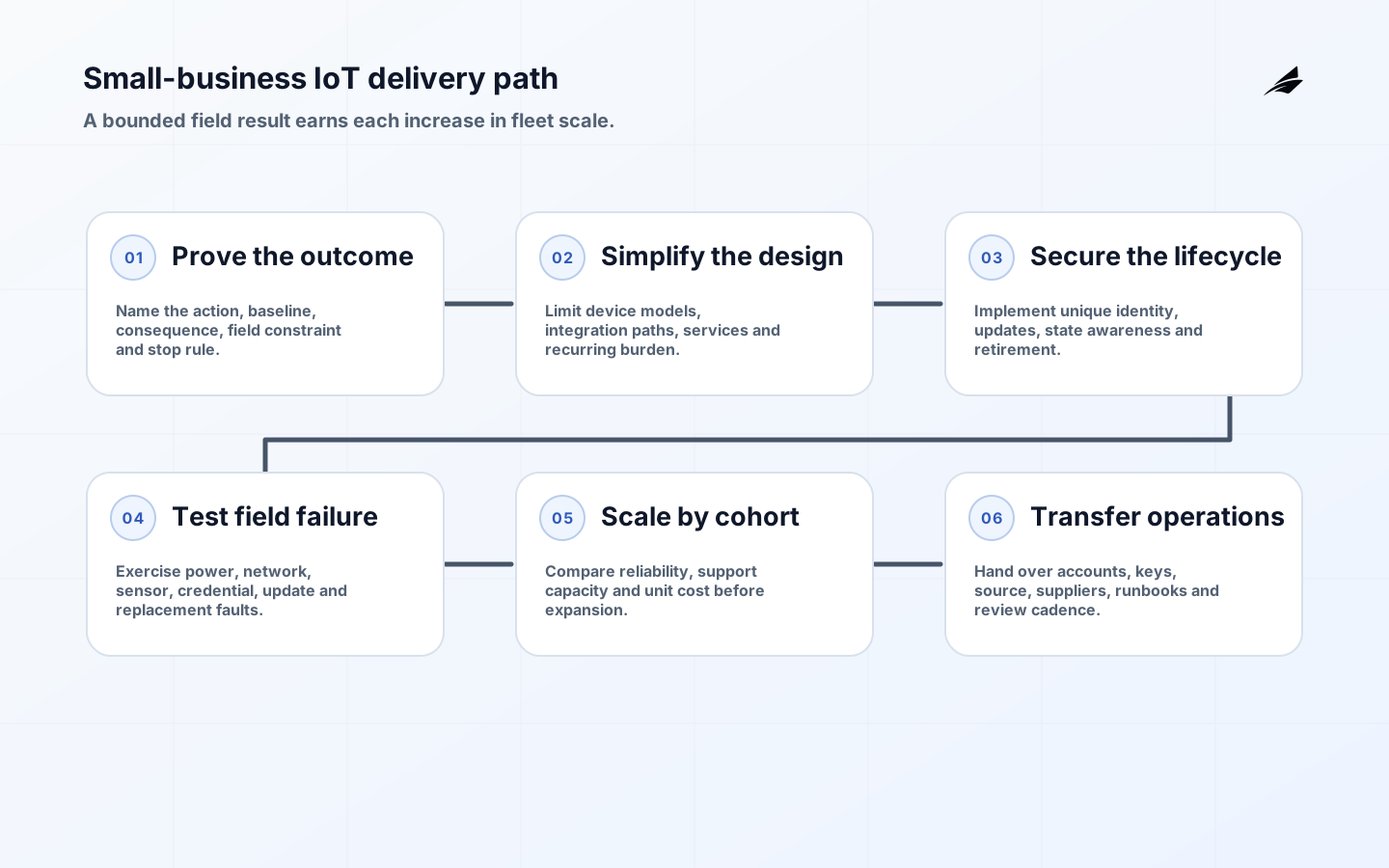
An IoT software development company for small business should help prove a narrow business result before creating a fleet the company cannot support. This implementation checklist is for buyers ready to move from idea to field pilot. It covers commercial fit, device and software architecture, security, verification, rollout and handover with controls that remain realistic for a lean team.
Use it with Edilec's small-business IoT delivery plan, small-business IoT FAQ and startup IoT implementation checklist. Keep one accountable owner inside the business even when the development company supplies most technical roles.
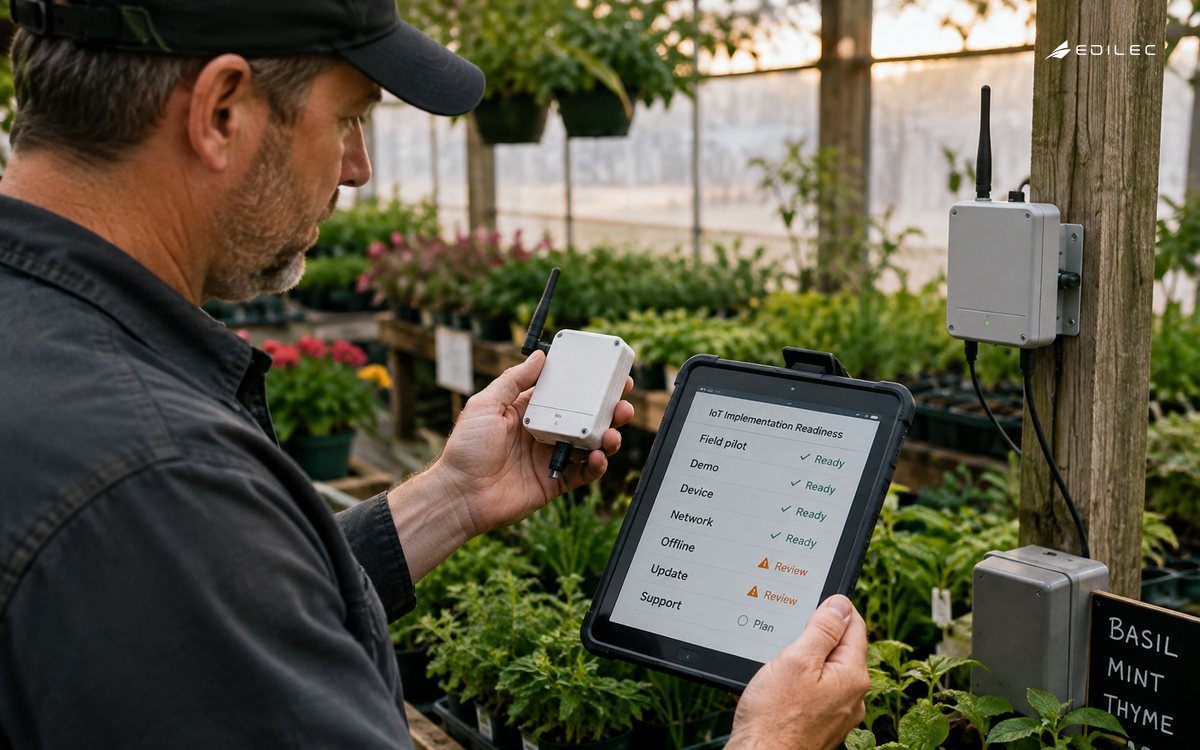
Key takeaways
- Prove that a device observation or command changes a valuable decision before scaling hardware.
- Choose supported components and managed services that the future operating team can understand.
- Require unique identity, secure configuration, updates and retirement from the first pilot.
- Test weak networks, power loss, duplicate events and replacement on real hardware.
- Accept documentation, source, cloud accounts, keys and support procedures as product deliverables.
1. Define the outcome and operating boundary
Write the user, physical asset, observation or command, decision, response time and measurable benefit in one page. Record operating locations, environmental conditions, data sensitivity, safety impact, expected fleet size and support hours. State what happens if the service is wrong or unavailable. This determines whether the project needs local control, human confirmation, redundant sensing or simply a delayed report.
Set a baseline before building: current labor, error, loss, downtime or delay. Define pilot success and stop criteria. A device count is not a business outcome. Useful measures include prevented spoilage, reduced manual readings, faster response, higher asset utilization or fewer missed maintenance events, paired with false alerts and support effort.
| Decision | Checklist question | Required record |
|---|---|---|
| Value | Which action improves because of connected data? | Baseline and target with accountable owner |
| Consequence | What if data or command is late, wrong or absent? | Safe degraded procedure and escalation |
| Environment | What power, radio, temperature and mounting constraints apply? | Site survey and hardware assumptions |
| Scale | What fleet, geography and event volume are plausible? | Normal and peak capacity model |
| Ownership | Who runs devices, platform and field support? | Responsibility matrix and budget |
2. Select the company and clarify ownership
Evaluate experience across embedded or edge software, cloud integration, security and field operations. Ask the proposed team to explain a failed deployment, hardware replacement and credential rotation. Review sample code, tests, device registry, update process and incident evidence. A polished mobile application does not demonstrate competence in fleet lifecycle management.
Contract for source repositories, build instructions, cloud tenancy, domain and app identities, infrastructure definitions, device credential custody, documentation, third-party licenses and exit assistance. Identify reusable supplier components and customer-owned work. Use outcome-based milestones: successful enrollment, offline recovery, secure update, restored data and operator handover.
3. Choose a maintainable architecture
Prefer a small number of supported device models and one standard integration path. Decide whether devices connect directly or through a gateway based on hardware capability, local protocols, offline needs and security. Define message size, frequency, event identifiers, timestamps, units, quality and schema versions. The W3C Web of Things architecture provides useful patterns for common descriptions without dictating a single device topology.
If using MQTT 5.0, document session, delivery, retained-message and authorization behavior. Regardless of protocol, make ingestion idempotent and bound device buffers. Choose managed services where they remove maintenance that adds no product differentiation, but retain exports and infrastructure records so the company is not trapped by undocumented configuration.
4. Establish device and software security
Give each device a unique inventory record and credential. Define enrollment, rotation, revocation, replacement and retirement. Restrict interfaces and commands, encrypt transport, protect secrets outside source code and verify update packages. The NIST IoT core baseline identifies device capabilities for identification, configuration, data protection, interface access, software update and state awareness.
Ask how long hardware and firmware will receive support and how vulnerabilities are communicated. The updated NISTIR 8259 series separates technical device capabilities from nontechnical support such as documentation and information dissemination. Apply the NIST SSDF to application, firmware and cloud development practices.
| Control | Implementation check | Pilot test |
|---|---|---|
| Identity | Unique credential bound to registry record | Clone or revoke one device and verify isolation |
| Configuration | Authorized, versioned and recoverable settings | Reject unauthorized and invalid configuration |
| Data | Protected in transit and retained by policy | Inspect flows and delete an expired record |
| Update | Signed, staged and observable package process | Interrupt an update and recover device operation |
| State awareness | Health and security events reach an owner | Trigger an alert and complete escalation |
| Retirement | Credentials revoked and data disposition recorded | Decommission a pilot device end to end |
5. Verify on representative hardware and networks
Create automated unit, contract and integration tests, then run hardware-in-the-loop scenarios. Include startup, low power, bad sensor values, clock loss, buffer full, duplicate event, delayed event, broker rejection, expired credential, network outage, reconnect storm and dependency timeout. Test physical installation and calibration with the staff who will perform it.
Measure event completeness, latency distribution, battery behavior, false alerts, command success, update completion and operator effort. Preserve logs and correlation identifiers across device, gateway and cloud. Do not average away a failing device cohort. Track by hardware, firmware, site and network so corrective action is possible.
6. Pilot, expand and preserve a fallback
Start with enough devices to reveal variation but few enough to inspect individually. Select difficult and ordinary sites. Limit command authority, keep the prior process available and define stop conditions for safety, security, data loss or support overload. Run the pilot long enough to experience representative environmental and operational cycles.
Expand in cohorts only after the team can provision, replace, update, revoke and retire devices without developer improvisation. Compare business benefit with device, connectivity, cloud and support cost per active asset. Revisit the architecture when support effort grows faster than the fleet.
7. Complete operational handover
Hand over architecture, inventory, event contracts, repositories, build and release process, cloud configuration, credential procedures, dashboards, alerts, backup and restore, supplier contacts, warranty terms, support matrix and retirement steps. Train both a primary and alternate owner. Remove unnecessary supplier access and test emergency access separately.
Schedule routine reviews for vulnerabilities, certificate expiry, firmware support, connectivity contracts, storage growth, alert quality and fleet economics. Maintain a spare and replacement policy. IoT work continues after launch because the physical fleet ages, moves and encounters conditions that software environments do not reproduce.
Control budget, suppliers and change
Maintain a unit-cost model from the pilot: device purchase and expected life, installation, connectivity, cloud processing, storage, map or message fees, support and replacement. Model normal and peak message volume plus an outage-reconnect scenario. Set budget alerts by service and environment, and identify who can approve a change that increases per-device recurring cost.
Keep a supplier register for hardware, carrier, cloud services, libraries and field support. Record contract owner, support end, data-processing terms, vulnerability contact and exit route. A small business is vulnerable to one discontinued module or developer account; use organizational accounts, named alternates and recoverable credentials for every critical supplier relationship.
Govern changes with a compatibility matrix and cohort rollout. A firmware, schema, gateway or mobile release can affect other layers even when its own tests pass. Require release notes, rollback or rescue behavior and observed pilot health before expansion. Review recurring custom support; repeated manual repair usually signals a missing product capability or an unsuitable component.
Create a simple service-level scorecard for the owner: active and unknown devices, event completeness, delayed events, failed updates, credential expiry, open vulnerabilities, false alerts, support hours and cost per active unit. Review it at a fixed cadence. Trends reveal whether growth is creating value or merely multiplying exceptions.
Protect the manual fallback from neglect. Document how staff record essential observations or commands while the service is unavailable, and how records are reconciled afterward. Exercise this during the pilot. A fallback that causes duplicate actions or loses traceability can be more dangerous than the original outage.
Before ordering a large hardware batch, test manufacturing variation and supplier change control. Sample devices from production lots, verify identifiers and credentials, and require notice before component or firmware substitutions. A seemingly equivalent radio, sensor or secure element can alter field behavior and invalidate prior evidence.
Set a formal pilot end date and decision meeting. Review value, reliability, security, support capacity and unit cost together. Choose scale, redesign or stop, and dispose of unused devices and credentials. A pilot that remains indefinitely connected creates cost and exposure without the controls or commitment of a real service.
Frequently asked questions
Should a small business build its own IoT platform?
Usually it should build only the differentiating workflow and use supported services for commodity registry, messaging or storage. Custom platform work is justified when requirements, economics or portability cannot be met otherwise. Price ongoing upgrades, security response and on-call ownership before choosing to build.
Should hardware be finalized before software starts?
No, but candidate hardware must be tested early. Hardware capability, power, radio and update support shape software architecture. Use a short discovery to compare devices against field constraints, then freeze a pilot profile and compatibility matrix rather than continuously changing components.
What is the most important scale test?
Test fleet operations, not only message throughput. Provision a cohort, rotate credentials, stage an update, simulate mass reconnect, identify failed devices and reconcile records. A platform may handle event volume while the small team cannot handle exceptions.
Conclusion
A capable IoT software development company for small business helps constrain the problem and transfer an operable service. Define value and consequence, simplify architecture, build lifecycle security, test real failure and scale by evidence. The final asset is not just software; it is a supportable fleet with clear ownership and economics.