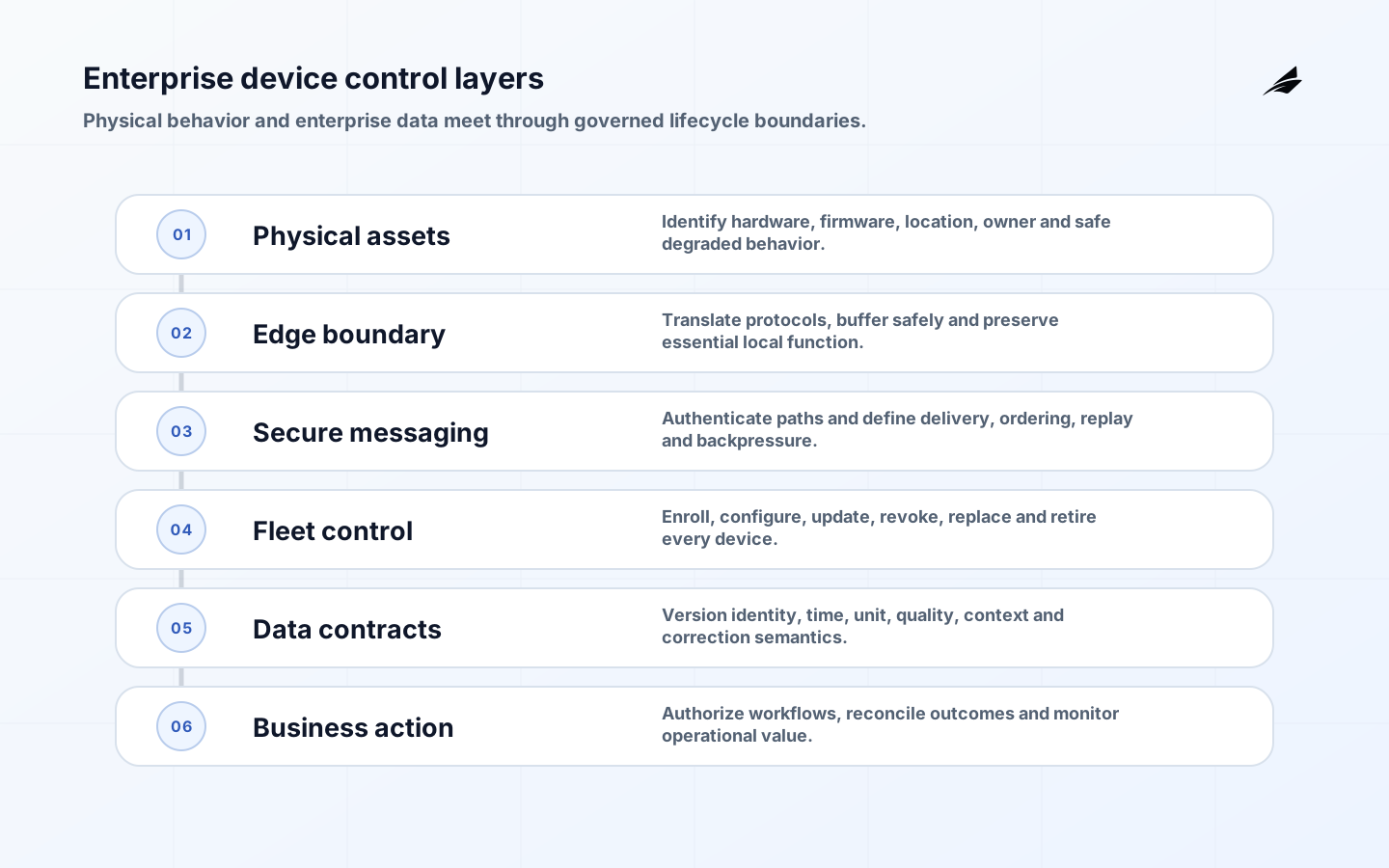
Device integration services for enterprise teams connect physical assets to business systems without losing identity, context, security or operational control. Buyers usually arrive with a mixed fleet, inconsistent protocols and multiple owners. They need to understand architecture, vendor scope, rollout risk and the evidence required before thousands of devices are trusted in production.
Use this FAQ with Edilec's enterprise device integration delivery plan, enterprise integration checklist and cognitive infrastructure checklist. A successful program treats each device as a managed product component, not merely a source of messages.
Key takeaways
- Inventory hardware, firmware, ownership, connectivity and physical consequences before designing adapters.
- Use stable canonical contracts at platform boundaries while preserving raw evidence needed for diagnosis.
- Give every device and service identity a lifecycle covering enrollment, rotation, revocation and retirement.
- Keep safety-critical or time-sensitive control local; cloud loss must lead to a defined degraded state.
- Prove upgrades, buffering, duplicate handling and fleet rollback on representative hardware before broad rollout.
What do device integration services include?
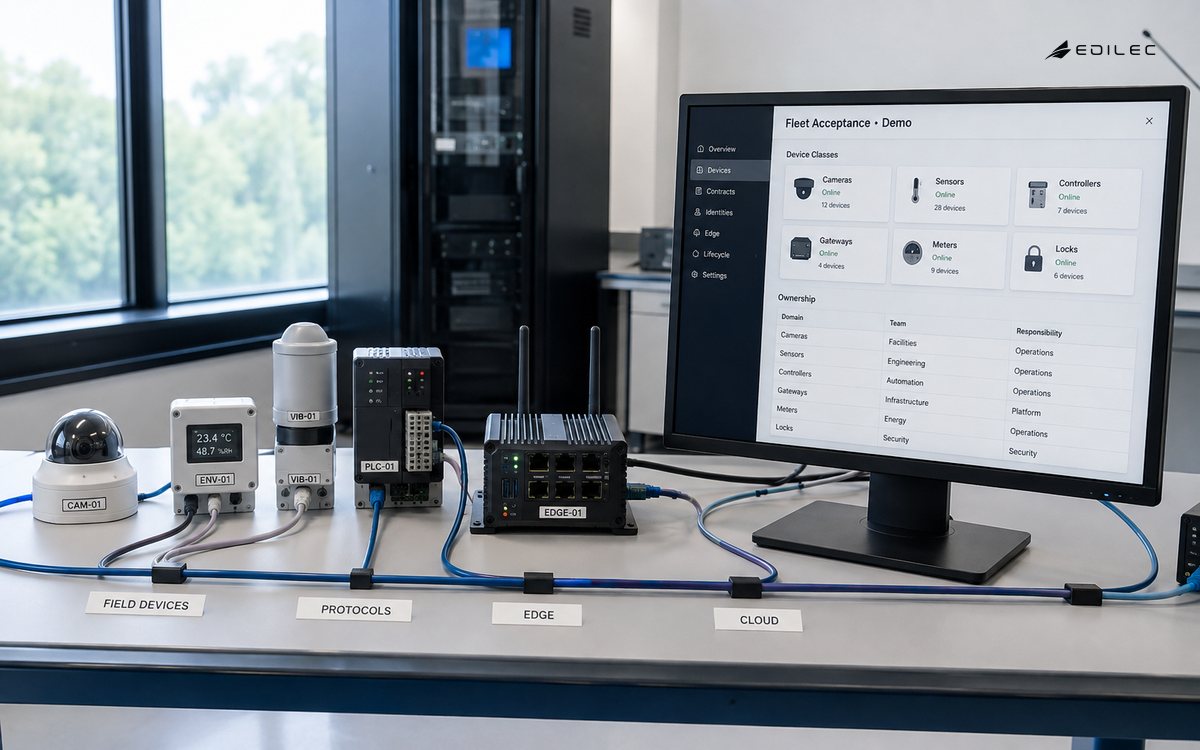
Scope normally spans device discovery, protocol adapters, gateways, connectivity, identity enrollment, secure messaging, command handling, event normalization, storage integration, fleet management, observability and operational support. It should identify which party owns firmware, field installation, carrier contracts, certificates, data models, cloud services, business applications and incident response. Exclusions matter: an integrator cannot promise fleet reliability if it has no authority over failing field power or unsupported firmware.
Begin with use cases expressed as physical outcome and decision latency. Monitoring a refrigerated shipment, stopping a hazardous machine and collecting a monthly utility reading require different availability, integrity and control patterns. Do not collapse telemetry and command paths into one generic API; commands need authorization, replay protection, acknowledgement and a documented safe failure mode.
| Integration layer | Primary responsibility | Acceptance evidence |
|---|---|---|
| Device | Sensing, actuation, local state and secure update | Hardware matrix, firmware identity and failure tests |
| Edge or gateway | Protocol translation, buffering and local policy | Offline operation, store-and-forward and recovery record |
| Messaging | Authenticated transport, routing and delivery behavior | Load, duplicate, ordering and reconnect tests |
| Platform | Registry, rules, storage and fleet operations | Enrollment, rotation, revocation and audit trail |
| Business systems | Workflow, master data and user action | End-to-end reconciliation and authorization tests |
How should protocols and data contracts be chosen?
Choose protocols from device capability, network quality, payload, timing, topology and ecosystem support. MQTT 5.0 is an OASIS publish-subscribe standard with defined session and delivery behavior, but a standard protocol does not by itself create semantic interoperability. Industrial environments may use OPC UA, whose security model covers client, server and user authentication plus communication integrity and confidentiality.
Define a versioned event envelope containing device identity, event time, receive time, schema version, quality, unit, location context and correlation identifiers. Separate raw observations from interpreted events. The W3C Web of Things architecture offers a useful abstraction for describing device properties, actions and events across heterogeneous implementations. Use canonical contracts at shared boundaries, but avoid forcing every constrained device to carry enterprise semantics.
What security controls are essential?
Require unique device identification, controlled configuration, data protection, restricted logical interfaces, software update capability and cybersecurity-state awareness. These are core areas in the NIST IoT device cybersecurity baseline. Translate each into testable procurement requirements: for example, how credentials are installed, whether they are unique, who can rotate them, what happens after expiry and how a compromised device is revoked.
Segment device, management and business networks. Use allow-listed communication paths, least-privilege service identities and separate administrative access. Protect signing keys and update infrastructure. For operational technology, availability and safety constrain maintenance; NIST SP 800-82 Rev. 3 emphasizes security that respects performance, reliability and safety requirements. Never assume an IT patch cadence can be imposed on a production line without validation.
| Threat or failure | Design response | Proof before scale |
|---|---|---|
| Stolen device credential | Per-device identity and rapid revocation | Revoke one identity without disrupting the fleet |
| Intermittent network | Bounded local buffer and replay-safe ingestion | Disconnect, reconnect and reconcile without silent loss |
| Duplicate or delayed event | Idempotency key, event time and quality state | Replay captured traffic and verify business totals |
| Unsafe remote command | Scoped authorization, confirmation and local interlock | Reject stale, unauthorized and out-of-range commands |
| Failed firmware update | Signed package, staged cohort and rollback or rescue mode | Recover representative devices from interrupted update |
What belongs at the edge and in the cloud?
Keep latency-critical control, safety interlocks and essential degraded operation close to the equipment. Use the edge for protocol translation, filtering, temporary buffering and local inference when bandwidth or privacy requires it. Use centralized services for fleet inventory, cross-site analytics, long-term history, policy distribution and integrations that benefit from elastic compute.
Document the boundary as contracts and failure modes. State maximum offline duration, buffer overflow behavior, clock expectations, synchronization strategy and which configurations remain authoritative during disconnection. Design backpressure so a recovered connection does not overwhelm the broker or downstream warehouse. Capacity testing should include reconnect storms and firmware campaigns, not only steady telemetry.
How should an enterprise rollout be staged?
Start with a lab containing the real hardware, firmware and gateway versions. Move to one operational site with limited command authority, then expand by cohorts that preserve a control group. A pilot should exercise normal operations, network loss, credential expiry, malformed payloads, update failure, device replacement and support escalation. Define stop conditions and a physical fallback before field deployment.
Maintain a compatibility matrix across device model, firmware, gateway, adapter and schema. Automate conformance tests where possible, but include field technicians and operators in acceptance because mounting, power, radio conditions and workflow can invalidate a laboratory result. Each expansion decision should cite evidence, open risks and support capacity.
What must ongoing operations cover?
Operate a registry with owner, location, model, firmware, credential state, support status and retirement date. Monitor connectivity, message lag, battery or power state, clock skew, firmware distribution, command outcomes and data-quality drift. Alert on business impact and fleet patterns rather than every transient disconnect. Preserve enough raw evidence to distinguish sensor failure, network loss, adapter defects and downstream processing errors.
Plan vulnerability intake, supplier notification, update validation, certificate rotation, spare devices, field replacement and secure disposal. A fleet is supportable only while compatible software and keys can be maintained. Make end-of-support visible early and budget migrations; unsupported hardware quietly converts a software integration into an unmanaged operational risk.
What belongs in procurement and acceptance?
Procurement should require a supported hardware and firmware matrix, device identity method, update period, vulnerability contact, data ownership, interface documentation, test equipment, licensing and replacement terms. Ask suppliers to disclose dependencies that reach end of support during the planned service life. Define whether an integrator may substitute hardware and what evidence is required before a substitution enters the fleet.
Acceptance should use sampled real devices, not only a simulator. Enroll a new device, rotate its credential, change configuration, lose connectivity, fill the local buffer, recover, update firmware, revoke access and retire it. Reconcile registry state with physical inventory. Confirm that operators can distinguish device, gateway, network and platform faults using available evidence.
Include transfer and continuity. The enterprise should receive adapter source or supported binaries, schemas, infrastructure definitions, certificate procedures, registry export, dashboards, runbooks and supplier contacts. Test a handover scenario in which the original implementation team is unavailable. This exposes undocumented dependencies before they become an operational emergency.
Data governance must cover collection purpose, precision, retention, residency, access and deletion. A sensor stream may reveal employee activity, facility operation or customer behavior even when it contains no obvious personal field. Minimize collection at the edge where appropriate, restrict downstream reuse and record which system is authoritative for corrected values.
Establish service objectives by class: command success and acknowledgement, telemetry completeness, acceptable latency, registry accuracy, update completion and recovery from disconnection. Define maintenance windows and field escalation. Report by device cohort and site, and connect technical measures to the affected operational process so response priority is clear.
Architecture review should include capacity for fleet events rather than only average messages. Simulate certificate rotation, mass reboot, carrier outage recovery and staged update. These coordinated events can create a burst many times higher than steady traffic and may expose throttling, queue, database or support limits.
Include physical inventory audits in the operating cadence. Compare sampled assets with the registry, network observations and certificate records. Investigate unknown, moved and inactive devices, then reconcile ownership. Software discovery alone cannot confirm that a retired controller was removed or that a replacement inherited the correct identity and configuration.
Frequently asked questions
Should the enterprise use one device platform?
Use one governed integration pattern where it reduces duplication, but do not force one runtime onto every operational domain. Stable identity, event and management contracts can support multiple device platforms. Consolidate only after comparing protocol fit, regional availability, lifecycle support, data portability and operational skill.
Can devices connect directly to the cloud?
Yes when devices can protect credentials, use supported transport, tolerate network loss and receive secure lifecycle updates. A gateway is preferable when protocols are local, hardware is constrained, data requires aggregation or operations need an offline boundary. Direct connectivity still requires inventory, segmentation and revocation.
How is integration success measured?
Measure usable event completeness, command success, fleet availability, reconnect recovery, update completion, data latency, identity compliance, support effort and business outcome. Separate missing physical observations from delayed platform processing. Fleet averages can hide a failing site or model, so report by cohort.
Conclusion
Enterprise device integration succeeds when physical behavior, software contracts and lifecycle operations are designed together. Inventory the fleet, select protocols deliberately, establish unique identity, preserve safe local behavior, roll out by evidence and fund retirement. That creates a governed bridge between devices and enterprise decisions instead of a fragile collection of adapters.