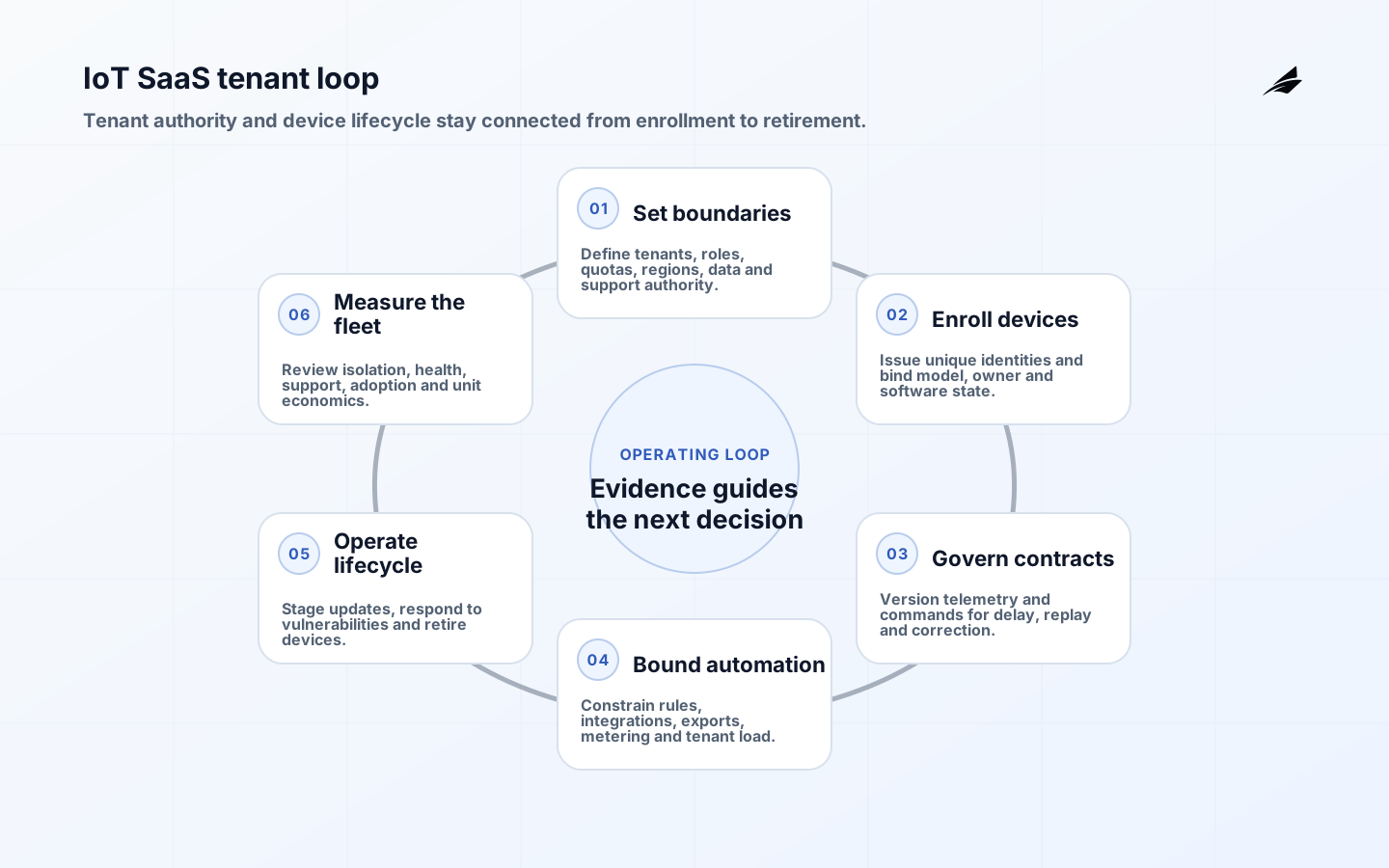
An IoT SaaS product is two systems joined by a trust boundary: a multi-tenant software service and a physical fleet that may be intermittently connected, exposed to tampering and slow to update. The product must keep device identity, telemetry, commands, customer data and support access inside the correct tenant while remaining operable across hardware generations. This implementation checklist turns that obligation into staged evidence.
Use it with the IoT SaaS scope and delivery guide and the IoT SaaS FAQ. Teams still proving product-market fit should compare the startup production checklist, because a commercial SaaS platform needs stronger tenant administration, billing, support and lifecycle controls than a connected prototype.
1. Define product, tenant and device boundaries
Define organizations, subaccounts, roles, environments, regions, quotas, data ownership and support authority. Decide whether a device belongs to one tenant at a time, can be transferred, or can publish shared data. Document device models, gateways, mobile applications, brokers, data stores, rules engines, APIs and downstream integrations. Set support period, offline behavior, command consequence, retention, recovery and export requirements. Every resource should carry tenant context at authorization and storage boundaries.
Threat-model cross-tenant access, cloned devices, replay, compromised support accounts, malicious firmware, excessive telemetry and unsafe commands. Treat tenant isolation as a property to test across APIs, queues, caches, object storage, search indexes, logs, analytics and backups. Avoid depending only on a tenant identifier supplied by the client; derive authorization from authenticated context and enforce it in shared access layers. Name a data and security owner for each boundary.
| Boundary | Implementation rule | Negative test |
|---|---|---|
| Tenant API | Derive tenant from authenticated principal and enforce object ownership | Request another tenant's known identifier |
| Device messaging | Bind credential to tenant, device and allowed topics | Publish or subscribe across tenant namespace |
| Storage | Partition or filter with enforced policy and scoped service roles | Bypass application through worker or export path |
| Commands | Authorize user, device capability and current state | Replay an expired or already completed command |
| Support | Time-bound elevation, masking and attributable audit | Search or export without approved case |
| Billing | Meter immutable tenant-attributed usage events | Duplicate, late and corrected usage |
2. Implement secure enrollment and inventory
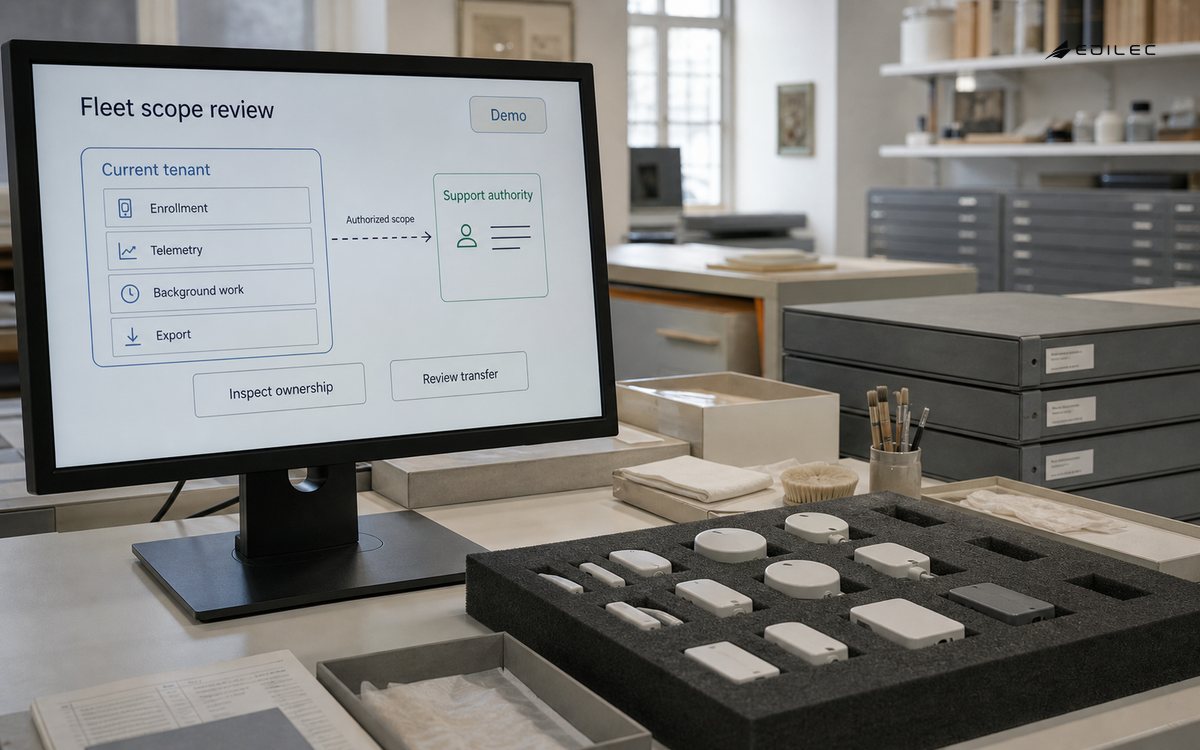
Issue unique device identities; do not ship a reusable fleet credential. Enrollment should bind manufacturing identity or an approved bootstrap token to model, serial number, tenant, owner and expected software state. Rotate credentials, revoke them promptly and separate production authorities from manufacturing and test. Maintain an inventory of identity, hardware, firmware, tenant, location where justified, last seen, support status and decommission state. Device transfer must revoke the former tenant before new ownership is activated.
The NIST IoT baseline covers device identification, configuration, data protection, interface access, software update and state awareness. Convert these capabilities into acceptance tests per model. Where a constrained device cannot implement a capability, document compensating gateway or service controls and residual risk. NIST SP 800-213 provides a way for purchasers to express device requirements; publishing product evidence makes enterprise evaluation easier.
3. Govern telemetry and command contracts
Version schemas for telemetry, events and commands. Define field meaning, unit, timestamp source, quality flags, required versus optional values, compatibility and retention. Validate payload size, type and rate before durable processing. Quarantine malformed data without blocking healthy tenants. Make ingestion idempotent and design for duplicates, delay and reordering. Store original evidence when regulated or diagnostic needs justify it, but avoid retaining high-volume raw telemetry indefinitely by default.
MQTT 5.0 standardizes protocol behavior including sessions, quality of service, properties and reason codes. Product logic still must decide topic authorization, expiry, deduplication and command state. Give commands identifiers, issue and expiry times, requested actor, target state and acknowledgement semantics. Define whether retry is safe. A timeout is an unknown outcome, not proof that a physical action did not occur.
4. Build bounded rules and integrations
Rules should execute within tenant quotas and authorization. Distinguish observation, alert, recommendation and physical command. Provide idempotent actions, cooldowns and loop prevention. Expose execution history with input version and reason. Protect the platform from a tenant that creates expensive fan-out or recursive automation. Test daylight-saving changes, delayed events, missing data and rule edits while events are in flight.
Design APIs, webhooks and exports as products. Authenticate clients, authorize tenant scope, paginate, rate-limit and version contracts. Sign webhook deliveries, use unique event identifiers and provide bounded retries with dead-letter visibility. Separate operational telemetry from billable usage and make correction rules auditable. Give customers export formats and deletion behavior before they integrate deeply. Never expose broker credentials as a substitute for a governed product API unless direct messaging is an intentional supported contract.
5. Operate updates and vulnerability response
NIST’s IR 8259 Rev. 1, finalized in April 2026, emphasizes manufacturer activities that help customers manage IoT cybersecurity risk. Establish secure development, component inventory, vulnerability intake, coordinated disclosure, support periods and customer communication. CISA and the FBI’s product security bad-practices guidance reinforces avoiding dangerous defaults and known classes of preventable product risk.
Sign update artifacts, protect signing keys, verify packages on device and prevent unauthorized rollback. Roll out by internal, canary and progressively larger rings with health criteria and stop controls. Account for offline devices and limited bandwidth. Report version coverage, update failure and unsupported devices by tenant. Define quarantine and minimum-supported-version policy. Retirement must revoke credentials, stop commands, handle retained data, update billing and produce customer evidence.
| Lifecycle gate | Evidence | Operational threshold |
|---|---|---|
| Enrollment | Unique identity and approved tenant binding | No shared production bootstrap secret |
| Ingestion | Schema, authorization, rate and replay tests | Malformed traffic cannot affect other tenants |
| Command | Actor, target, expiry and idempotency record | Unknown outcomes are reconciled |
| Update | Signature, ring, rollback and interruption tests | Failure rate triggers automatic pause |
| Vulnerability | Triage, affected-version and customer route | Critical cases meet approved response window |
| Retirement | Revocation, data and ownership closure | Retired device cannot reconnect or receive commands |
6. Observe the fleet and unit economics
Instrument connection state, authentication failures, ingestion success, validation rejects, end-to-end delay, rule execution, command outcome, update status and tenant quota use. Correlate device, gateway, service version and bounded tenant class without putting sensitive or unbounded identifiers into metric labels. OpenTelemetry semantic conventions give common names for traces, metrics, logs and resources; extend them carefully and keep high-cardinality detail in logs or traces.
Model unit cost per active device and useful message, including broker connections, compute, storage, retention, egress, observability, rules, notifications and support. Separate normal fleet behavior from malfunction or abuse. Establish budgets and quotas that degrade predictably rather than dropping data silently. Review reliability, security, adoption, support load and gross margin together. A feature that triples messages may be valuable, but its price and architecture need to reflect that effect.
A practical implementation sequence
For a refrigeration-monitoring SaaS, begin with tenant and site hierarchy, then enroll a small set of gateway and sensor models. Publish versioned temperature, battery and door-state schemas. Add alerts without remote control first, prove timestamps and offline reconciliation, then introduce bounded configuration commands. Pilot update rings across varied networks. Integrate ticketing and billing only after event identity is stable. This sequence proves trust and operations before adding high-consequence automation.
At every milestone, test with two or more tenants and deliberately attempt cross-tenant access. Use production-shaped device churn, stale firmware, duplicate telemetry and prolonged disconnects. Require a restore that includes tenant metadata, device inventory, rules and credentials or re-enrollment strategy. Hand support staff a real diagnostic case and verify they can help without broad data access. Preserve decisions and known constraints in the product backlog.
Package release evidence by device cohort
A platform release record should identify cloud build, device or gateway versions, schema versions, affected models, tenant cohorts and update rings. Link isolation, compatibility, performance, recovery and rollback results. State minimum supported firmware and behavior for devices that remain offline through the release. This is especially important when cloud and device releases cannot be deployed atomically.
For each ring, define eligible population, health indicators, observation period, stop threshold and authorized decision maker. Compare authentication, connection, ingestion, command and support metrics against baseline. Preserve a route to halt cloud features independently from firmware rollout. Communicate contract changes and minimum versions before enforcement, and provide affected customers with fleet-level progress and remediation options.
- Map cloud, schema and firmware compatibility explicitly.
- Release first to internal and representative canary cohorts.
- Pause automatically when health or isolation thresholds breach.
- Keep offline and unsupported-device behavior visible.
- Give tenants actionable fleet status without exposing other customers.
- Close the release only after lagging devices and exceptions have owners.
Key takeaways
- Enforce tenant context across messaging, storage, jobs, support, analytics, exports and billing.
- Treat unique device identity, transfer, update, vulnerability response and retirement as product capabilities.
- Version telemetry and command contracts and design explicitly for duplicate, delayed and unknown outcomes.
- Bound rules, integrations and tenant consumption so one customer cannot destabilize the service.
- Operate from fleet health, isolation evidence, security state and unit economics together.
Frequently asked questions
Does every tenant need a separate database?
Not necessarily. Shared, schema-separated and database-per-tenant models can all work. Choose from isolation, scale, residency, operations and cost requirements. Whatever the model, enforce authorization in every access path and test restoration, export and deletion by tenant.
Does MQTT QoS provide exactly-once business processing?
Protocol delivery guarantees do not make downstream business effects exactly once. Brokers, clients and services can reconnect or retry. Use stable event identifiers, idempotent consumers, transactional boundaries and reconciliation for important effects.
How long should devices receive updates?
Set a support period from customer use, hardware life, risk and commercial commitments, publish it before sale and maintain an end-of-support process. Long-lived fleets need realistic component, signing-key and deployment plans, not an indefinite promise without funding.
Conclusion
IoT SaaS quality rests on verifiable tenant and device authority across a long lifecycle. Secure enrollment, govern contracts, constrain automation, stage updates and make fleet health and cost visible. When isolation and failure behavior are tested from device through support and export, the platform can scale customers without scaling hidden risk.