Cognitive infrastructure services combine telemetry, policy, analytics and automation so infrastructure teams can detect conditions, explain their effect and execute approved responses. The label is often used loosely. A credible service is not a cloud that “thinks for itself”; it is an operating system for repeatable decisions such as scaling capacity, routing incidents, correcting configuration drift or forecasting cost. Humans remain accountable for objectives, permissions, exceptions and consequences. The implementation challenge is to make each automated decision observable and reversible rather than adding an opaque prediction layer to already complex operations.
This checklist uses cognitive infrastructure services as a provider-neutral term. It applies to public cloud, private cloud, edge and hybrid estates. NIST’s cloud definition emphasizes on-demand access, resource pooling, elasticity and measured service; those characteristics create both useful signals and rapid change. OpenTelemetry describes the traces, metrics and logs needed to ask new questions about distributed systems. The practical goal is to connect those signals to a service model and bounded action, while avoiding noisy correlation, unsafe remediation and automation that nobody can explain during an incident.
Choose decisions before tools
Begin with two or three decisions that are frequent, costly or time-sensitive. Examples include identifying the service owner for an alert, scaling a known stateless workload, detecting a missing backup, or pausing a rollout when error budget consumption accelerates. Describe the current trigger, evidence, decision authority, action and confirmation. Baseline elapsed time, false positives, manual touches, service impact and operator effort. Without that record, an analytics platform may produce more events without improving an outcome.
Reject use cases whose success cannot be observed or whose action is too consequential to automate safely. A model may estimate that a database is overprovisioned, but downsizing it without workload context can cause a customer-visible failure. A policy engine may detect an unapproved network rule, but deleting it immediately can interrupt emergency access. Start in recommendation mode, compare recommendations with operator decisions and capture disagreements. Promote only stable patterns to approval-assisted or automatic execution, with limits defined by service criticality.
| Decision | Minimum context | Safe initial authority |
|---|---|---|
| Route an alert | Service, owner, severity and recent change | Automatically enrich and assign; operator confirms escalation |
| Scale capacity | Demand, saturation, limits and cost guardrail | Automatic within tested minimum and maximum |
| Correct drift | Desired state, exception and dependency | Open a reviewed change before remediation |
| Stop a deployment | Service-level signal and rollout identity | Automatic pause; human decides rollback or resume |
| Optimize spend | Allocation, utilization and business calendar | Recommend; owner approves destructive or committed action |
Create a trustworthy service map
Analytics are only as useful as their operational context. Establish stable identifiers for business services, workloads, environments, accounts, clusters, resources, owners and changes. Connect infrastructure inventory to deployment records, identity, cost allocation and incident history. Do not assume a single configuration database is complete; reconcile provider APIs, infrastructure-as-code state, orchestration platforms and runtime discovery. Every inferred relationship should carry provenance and freshness. When a dependency is uncertain, the user interface and automation policy must represent uncertainty instead of presenting a false fact.
Define a minimum metadata contract at provisioning time: service name, technical owner, business criticality, environment, data classification, cost center and lifecycle state. Enforce what can be known automatically and route exceptions rather than allowing arbitrary tags. Microsoft’s cloud-governance guidance recommends applying policies at appropriate scopes and automating enforcement where feasible. Monitor a new policy before blocking broad workloads, then use exemptions with owners and expiry. This turns governance into maintained system behavior rather than a quarterly spreadsheet exercise.
Engineer telemetry as a product
Standardize collection and meaning before buying correlation features. For metrics, define units, aggregation and service-level use. For logs, define event identity, severity, retention and sensitive-data handling. For traces, propagate context across gateways, services, queues and data stores so a request can be reconstructed. OpenTelemetry’s shared model helps reduce instrumentation lock-in, but semantic conventions still need governance. Version instrumentation with the application and test that important fields survive collectors, sampling and backend transformations.
Measure signal quality. Track events without an owner, alerts without action, traces broken at a dependency, high-cardinality attributes, delayed telemetry and collector loss. Sampling policies should preserve errors and important transactions while controlling cost. Separate diagnostic telemetry from audit records; they have different integrity, retention and access needs. If an automated action depends on a metric, identify its source, delay, missing-data behavior and reset semantics. A zero value must not be confused with absent data, especially in scaling and recovery decisions.
Build a bounded automation control loop
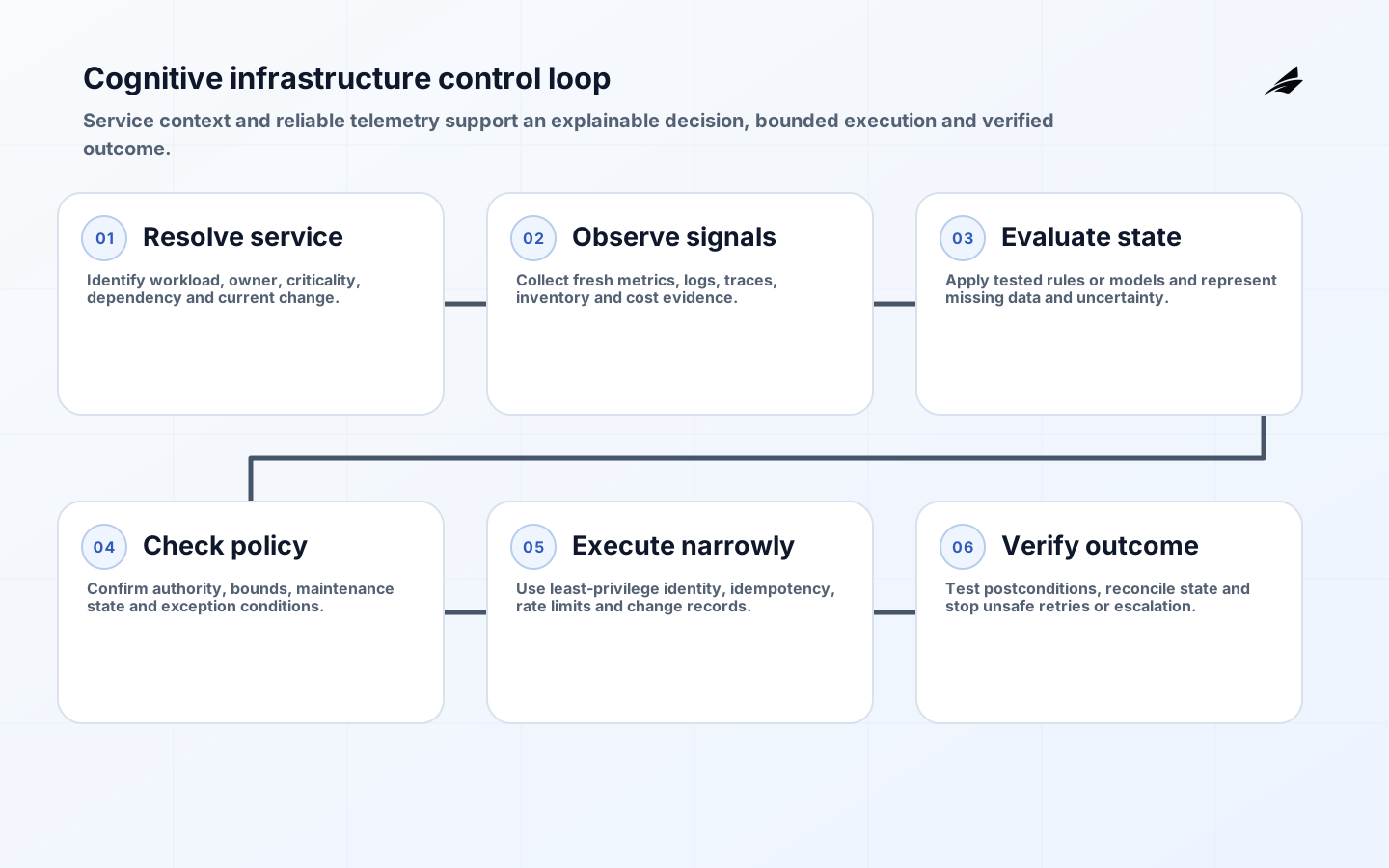
A safe control loop observes, evaluates, decides, acts and verifies. The decision service should state which policy or model produced the recommendation, what evidence it used and what confidence or uncertainty applies. The executor should use a narrowly scoped workload identity and an allowlist of actions. Apply rate limits, value bounds, maintenance rules and dependency checks. Write an idempotent action where possible, attach a unique operation identifier and preserve before-and-after state. Do not give an analytics component unrestricted administrator credentials simply because it may need to remediate multiple services.

Verification closes the loop. After scaling, confirm healthy capacity and cost state; after correcting drift, compare runtime with desired state; after pausing a deployment, confirm traffic no longer reaches the suspect version. If verification fails, stop retries that could amplify damage and route an owned exception. Provide a global and service-level kill switch whose effect is tested. Automation should degrade to a documented manual path when telemetry, policy, identity or execution services are unavailable.
| Control | Implementation evidence | Failure response |
|---|---|---|
| Identity | Dedicated executor with least-privilege roles | Deny action and page the service owner |
| Policy | Versioned rule, scope, approver and test cases | Retain last approved version or stop |
| Input quality | Freshness, completeness and range checks | Mark recommendation unavailable |
| Execution | Idempotency key, bounds and change record | Halt retry and reconcile state |
| Verification | Postcondition query and timeout | Escalate with before-and-after evidence |
| Override | Tested service and global disable control | Return to documented manual operation |
Evaluate analytics and models in context
For statistical or machine-learning components, maintain a use-case record with training or tuning data, features, target, evaluation window, known limitations and owner. Use historical replay to compare recommendations with observed outcomes, then run in shadow mode. Evaluate by service and condition rather than reporting one aggregate accuracy score. Incident patterns, seasonal demand and newly launched services may differ substantially. Monitor input drift and the rate at which operators accept, modify or reject recommendations; disagreement is valuable evidence, not merely user resistance.
Avoid claiming root cause when the system has identified only correlation. Present the affected service, relevant changes, dependency evidence and alternative hypotheses. Operators should be able to inspect the evidence without navigating five disconnected tools. Record which recommendation was shown and what action was taken so post-incident review can assess both system and human decisions. Sensitive logs, prompts or incident narratives require access control and retention limits; convenience does not remove privacy and security obligations.
Roll out by authority, not feature count
Use four authority stages: observe, recommend, approve and automate. At observe, establish data quality and baseline outcomes. At recommend, show evidence and capture operator response. At approve, execute through the same controlled path after a human decision. At automate, permit only tested actions within policy bounds. Promotion criteria should include false-action risk, successful verification, recovery behavior, coverage of representative services and operator understanding. A rollback returns the use case to a lower authority stage without removing the underlying observability.
Measure operational value with a balanced set of outcomes. DORA’s delivery metrics separate throughput from instability and warn against comparing unlike services or turning one metric into a target. For infrastructure automation, combine detection delay, time to safe action, repeated incident rate, change failure, operator interruption, telemetry cost and automation exceptions. FinOps practices add allocation and unit-economics context. A reduction in tickets is not automatically success if users are bypassing the system or failures are hidden.
Key takeaways
- Define cognitive infrastructure through specific operating decisions and measurable outcomes.
- Build service identity, ownership and telemetry quality before advanced correlation.
- Give automation narrow identities, bounded actions, explicit fallback and verified postconditions.
- Represent uncertainty and correlation honestly so operators can challenge recommendations.
- Increase authority gradually from observation to controlled automation.
Frequently asked questions
Is cognitive infrastructure the same as AIOps?
AIOps can be part of it, particularly for event analysis and recommendations. The broader service also includes inventory, policy, identity, execution controls, recovery and operating ownership. Analytics without those foundations cannot safely run infrastructure.
Does it require a perfect configuration database?
No, but it requires reconciled identifiers, ownership and dependency evidence for the decisions being automated. Use provider and runtime discovery alongside declared configuration, show provenance and freshness, and keep uncertain relationships out of high-consequence automatic actions.
What should be automated first?
Start with a frequent, reversible action that has clear inputs and postconditions, such as enriching and routing alerts or pausing a progressive rollout. Avoid destructive configuration changes until identity, policy, exception and recovery paths are proven.
Conclusion
Cognitive infrastructure services are valuable when they shorten the path from trustworthy evidence to a safe, verified action. The intelligence is not a dashboard full of anomalies; it is the combination of service context, observable signals, explicit policy, bounded authority and learning from outcomes. Teams that build those layers can automate more over time without losing accountability. Teams that skip them merely accelerate uncertain decisions. Begin with one service and one reversible decision, publish its operating evidence, and expand only after operators can explain both successful and failed actions. This disciplined sequence creates a reusable platform without pretending that infrastructure judgment has become automatic. It also gives leadership a defensible basis for deciding where additional automation is worth its cost and operational risk.