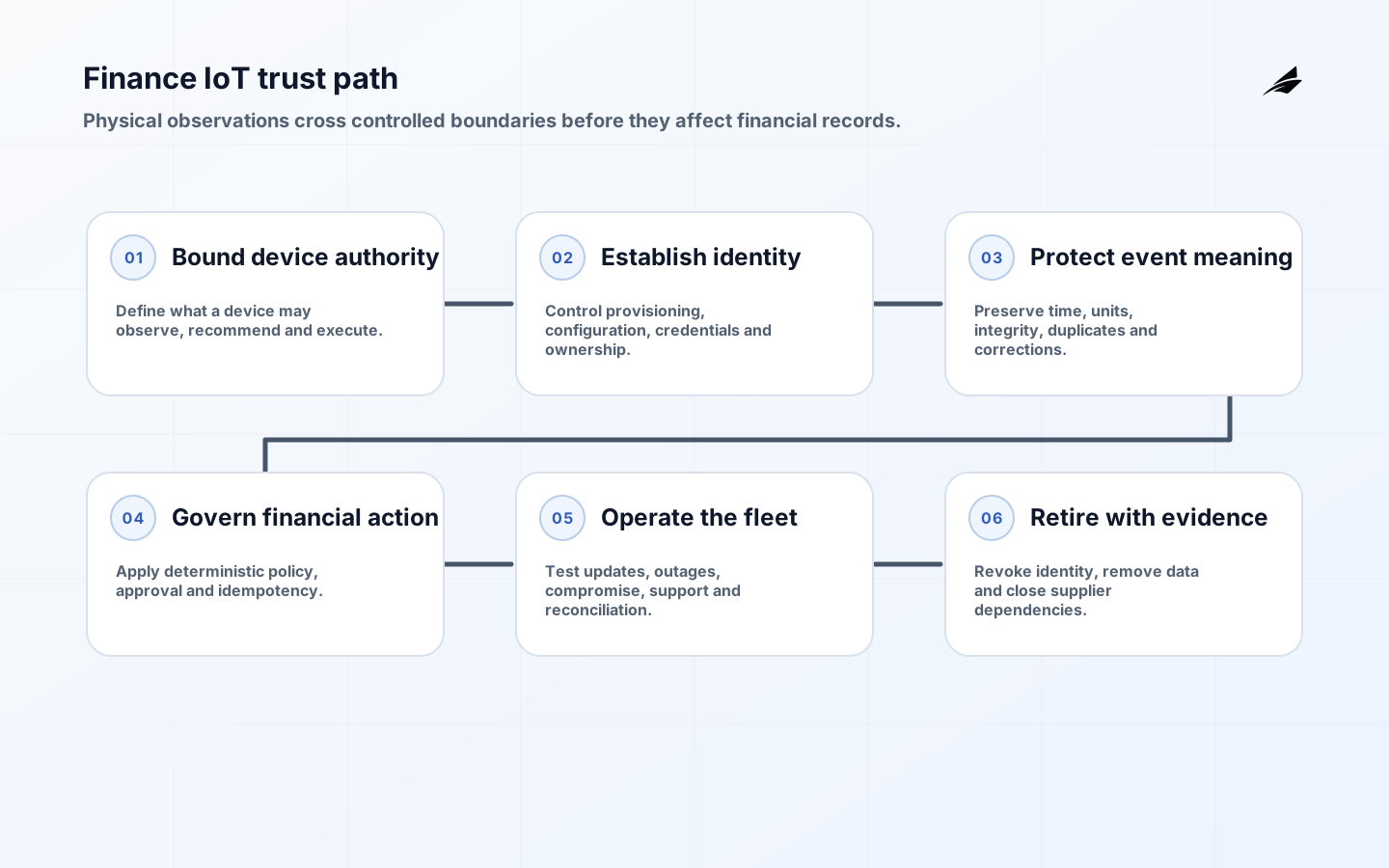
Selecting an IoT software development company for finance means entrusting software that connects physical devices, networks, cloud services and financial operations. The implementation must preserve device identity, transaction context, data integrity, customer privacy, operational resilience and evidence across a long hardware lifecycle. This checklist is for banks, insurers, payment businesses and fintech teams evaluating or governing a delivery partner; it does not replace the regulatory interpretation required for a specific institution or jurisdiction.
Start with the finance IoT scope and delivery plan and use the finance IoT FAQ during provider evaluation. Teams still validating a product can adapt the field evidence in Edilec's startup IoT delivery guide.
1. Define the financial outcome and device authority
Name the physical event and the financial or operational decision it informs. Examples include an ATM component state, insured asset telemetry, branch environment alert or payment-terminal health. State whether the device observation can inform, propose or execute an action. A sensor reading should not silently become authority to move money, deny service or alter a customer record. Consequential actions need deterministic policy, confidence handling, approval where appropriate and a reversible correction path.
Map sites, hazards, users, network conditions, device custody, expected lifetime and offline operation. Record data elements, identifiers, timestamps and retention. The 2026 NISTIR 8259 series now includes Revision 1 of the foundational manufacturer activities, while 8259A and 8259B remain the technical and non-technical baselines. Tailor them to the financial use case rather than claiming that a generic baseline settles risk.
| Boundary | Decision | Required evidence | Accountable role |
|---|---|---|---|
| Physical event | What is observed and how error is handled | Environmental and sensor test | Product owner |
| Device authority | Allowed commands and financial consequences | Policy and approval matrix | Business risk owner |
| Data record | Identity, time, units, integrity and retention | Data contract and sample trace | Data owner |
| Operational fallback | Behavior without device, network or cloud | Field scenario result | Operations owner |
| Supplier lifecycle | Support, disclosure, update and retirement | Contract and exit test | Third-party risk owner |
2. Specify device security and lifecycle capabilities
Require unique device identification, protected configuration, data protection, restricted logical interfaces, secure software update and cybersecurity state awareness. These are the core areas in NISTIR 8259A. Specify them as testable product requirements: how identity is issued and rotated, which interfaces exist, which roles may configure the device, how secrets are protected, how logs leave constrained hardware and what happens when integrity verification fails.
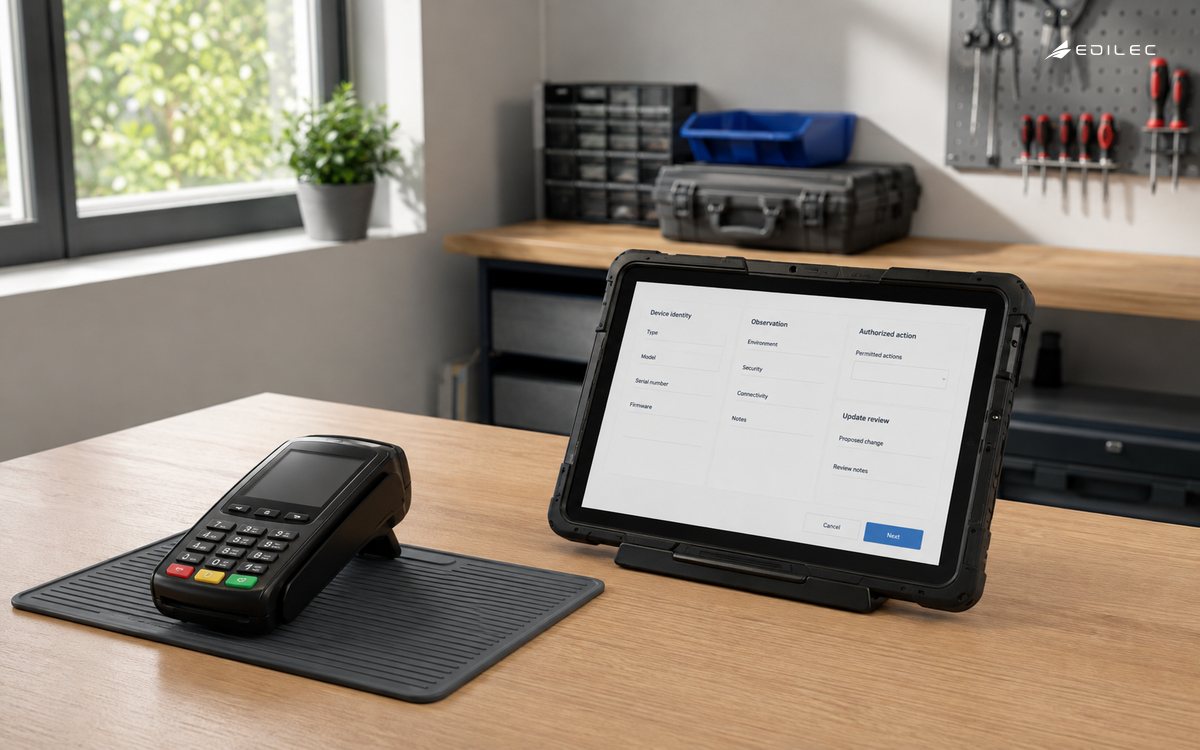
Define manufacturing, provisioning, ownership transfer, repair, replacement, decommissioning and disposal. Keep a registry linking physical label, hardware revision, logical identity, firmware, customer or site, support status and last known security state. A device returned from a branch must not retain credentials or customer data. A replacement must not inherit the old identity in a way that makes audit records ambiguous.
3. Design a traceable IoT and financial architecture
Separate device plane, connectivity, ingestion, device management, business processing and financial systems of record. Authenticate devices mutually where practical, segment device networks, rate-limit commands and use an immutable command identifier. Telemetry should carry device identity, event time, ingestion time, schema version, units and quality state. Preserve the original signed or protected envelope when investigation and replay requirements justify it.
Do not let an IoT platform become the authoritative financial ledger. Convert accepted device events into governed business events and reconcile resulting actions with the system of record. Design duplicate, late, missing and corrected event behavior. For commands, record requester, policy decision, target, payload hash, issue time, device acknowledgement and observed outcome. The NIST SP 800-213 series is useful for deriving device requirements from broader system risk.
4. Build, update and test the complete product
Protect source, build workers, dependencies, signing keys, firmware artifacts, mobile applications and cloud deployments. Produce a software bill of materials where it supports vulnerability response and retain artifact provenance. Firmware must verify authenticity and suitability before installation, reject rollback to prohibited versions, tolerate interrupted transfer and recover to a known state. RFC 9019 describes a firmware-update architecture and the role of protected manifests for constrained devices.
Test hardware revisions, low power, damaged storage, clock error, lost connectivity, replayed telemetry, duplicated commands, expired credentials, gateway compromise and cloud outage. Include safety and fraud specialists in scenario design. Run an update across a representative field cohort, pause it, resume it and attempt an invalid image. Verify that operators can identify the affected population and that devices outside support do not remain silently connected.
| Test scenario | Expected control | Financial or customer check | Evidence |
|---|---|---|---|
| Replayed event | Stable identifier and idempotent processing | No duplicate financial action | Event and ledger trace |
| Late correction | Versioned correction policy | Prior decision reviewed or reversed | Correction history |
| Invalid firmware | Signature and compatibility rejection | Device stays in safe mode | Update and state record |
| Cloud outage | Buffered data and bounded offline behavior | No unauthorized autonomous action | Recovery and reconciliation |
| Stolen device | Revoked identity and protected local data | No access to customer systems | Revocation and investigation |
5. Govern the development company and supply chain
Perform due diligence on financial condition, secure development, hardware and software suppliers, vulnerability disclosure, privileged access, data locations, incident notification, support periods and subcontractors. The joint regulators' third-party relationship guidance covers planning, due diligence, contract negotiation, ongoing monitoring and termination. A regulated institution's responsibility is not transferred merely because specialist development is outsourced.
Contract for source and artifact access, documented interfaces, security fixes, fleet migration, end-of-support notice, forensic cooperation and secure deletion. Define who owns device identities, signing roots, registries, telemetry and operational tooling. Avoid a design where the developer is the only party able to issue updates or recover the fleet unless that concentration is explicitly accepted and protected with escrow, dual control and tested continuity.
6. Accept resilience, evidence and handover
Operate the service across interconnected assets and third parties rather than treating the IoT platform as an isolated application. Monitor fleet inventory, connectivity, firmware, certificate expiry, update success, telemetry freshness, command outcomes, security events and reconciliation. Connect technical alerts to affected branches, devices, customers and business processes, and keep supplier escalation in the same incident path.
Run acceptance with field operations, security, fraud, compliance, support and business owners. Provision a device, transmit valid and invalid events, issue an approved command, lose connectivity, restore service, rotate a credential, deploy and reverse an update, revoke a device and reconcile every financial side effect. Transfer design decisions, threat model, source, builds, keys under appropriate custody, registry, test fixtures, monitoring, runbooks, supplier contacts and known risks.
Structure a representative finance IoT pilot
Select a small device cohort across realistic sites, network quality and staff workflows. Include at least two hardware or firmware conditions if the future fleet will contain them. Establish baseline task time, false alerts, support contacts and existing loss before measuring improvement. Keep financial action bounded during the pilot, with a clear manual fallback and daily reconciliation to authoritative records.
Prepare faults rather than waiting for them. Expire one certificate, interrupt an update, replay a valid event, delay telemetry, send a command to an ineligible device and disconnect a gateway. Verify customer and operator status, not only technical logs. Measure the time to identify the affected population, contain action, restore service and reconcile records. Require evidence from the same tools intended for production support.
The expansion gate should include device reliability, update success, security findings, data quality, support effort, network and platform unit cost, user outcome and unresolved exceptions. Separate defects that can be corrected in software from hardware or installation constraints that will become expensive at volume. Approve fleet growth only when the institution accepts the remaining physical, supplier and operational risks with named owners.
Retain a pilot evidence pack that a control or audit team can follow without replaying every meeting. Include approved use and authority, device and software inventory, architecture decisions, data contract, threat scenarios, update and recovery results, financial reconciliation, supplier exceptions and the scale decision. Link artifacts to stable repositories rather than embedding copies. The pack should identify the exact hardware, firmware, cloud release and site conditions tested so later changes do not inherit unsupported assurance.
Set change triggers that require renewed testing: new hardware, sensor range, firmware base, connectivity provider, cryptographic root, financial action, region or supplier. Classify which earlier evidence remains valid and which tests must repeat. This keeps assurance proportional while preventing a materially different product from being deployed under the pilot's name. Update customer and operations documentation at the same gate, before changed devices reach the field.
Key takeaways
- State exactly what a device may observe, recommend and execute.
- Specify security capabilities across provisioning, updates, support and retirement.
- Keep IoT events traceable but separate from authoritative financial records.
- Test duplicate, late, offline, compromised and invalid-update behavior on real hardware.
- Govern the developer through the complete third-party relationship lifecycle.
- Accept only after field operation, recovery and financial reconciliation are proven.
Finance IoT implementation FAQ
Can device telemetry trigger a transaction? It can be an input, but consequential action needs explicit authority, deterministic controls, confidence handling and reconciliation. Who should own signing keys? Ownership and custody should match risk and continuity needs; avoid unreviewed sole control by the developer. How long should devices receive security updates? State a supported lifetime before purchase and connect end of support to replacement or isolation. Is encryption enough to prove data integrity? No; identity, key custody, event semantics, replay protection and endpoint trust also matter. What is the first pilot? A representative site and device cohort that exercises weak connectivity, support, updates and financial side effects.
Conclusion: preserve trust from device to record
Financial IoT is dependable only when physical state, software identity, business authority and financial records can be reconciled. Choose a development company that can expose those boundaries, build a supportable device lifecycle and prove difficult field failures with the institution's own operators before fleet expansion.