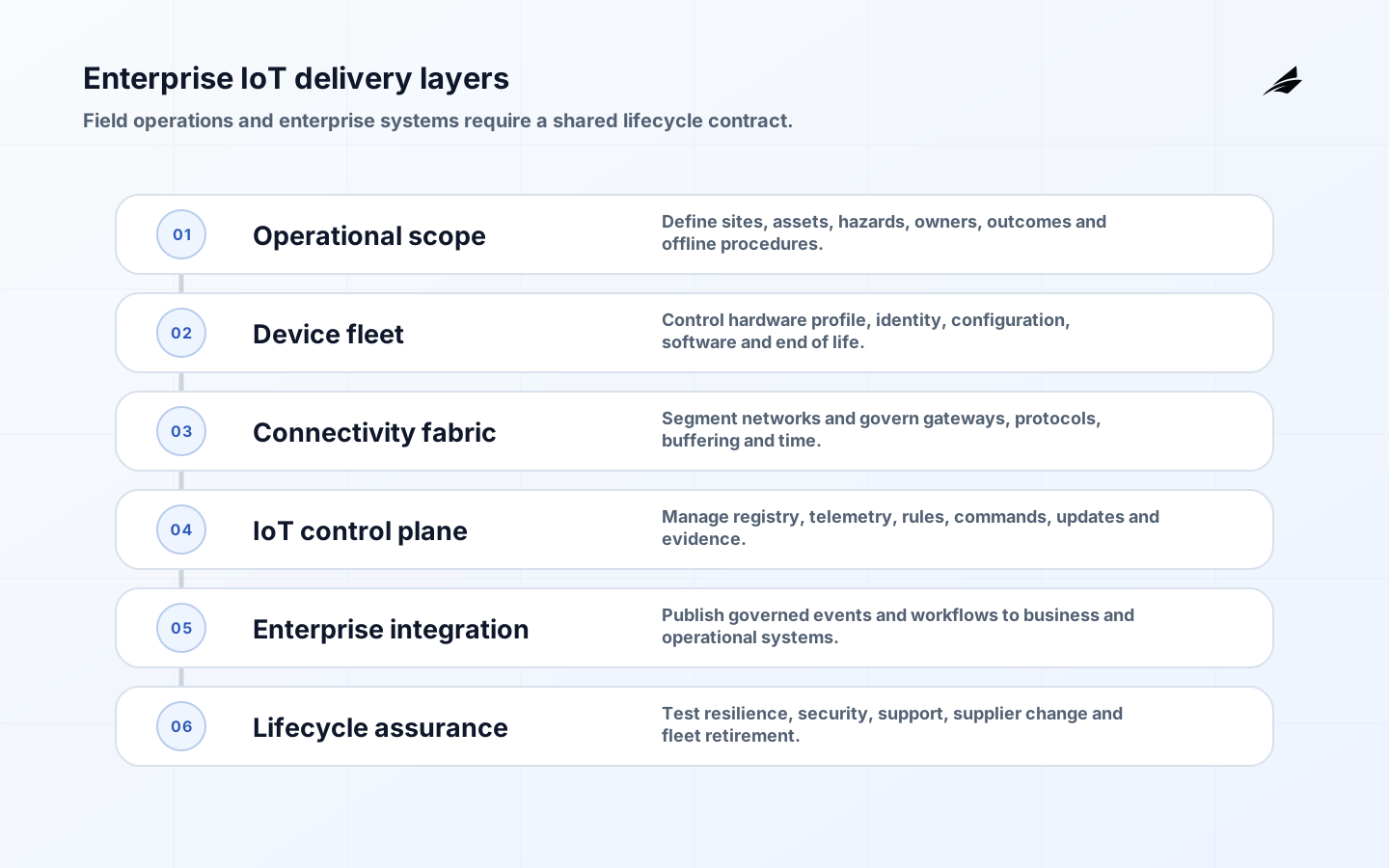
Selecting an IoT software development company for enterprise teams means selecting a partner for a cyber-physical lifecycle, not only an application build. Enterprise IoT connects field assets, embedded software, plant or site networks, cloud control, enterprise records and operational decisions. The implementation must preserve safety, ownership, data meaning and recovery across suppliers and locations where connectivity and maintenance conditions vary.
This checklist converts that scope into acceptance evidence. Pair it with the enterprise IoT scope and delivery plan and enterprise IoT FAQ. Start with one valuable, representative asset journey and expand by site or cohort only after field operations, security and service owners accept the result.
1. Define the operational outcome and authority boundary
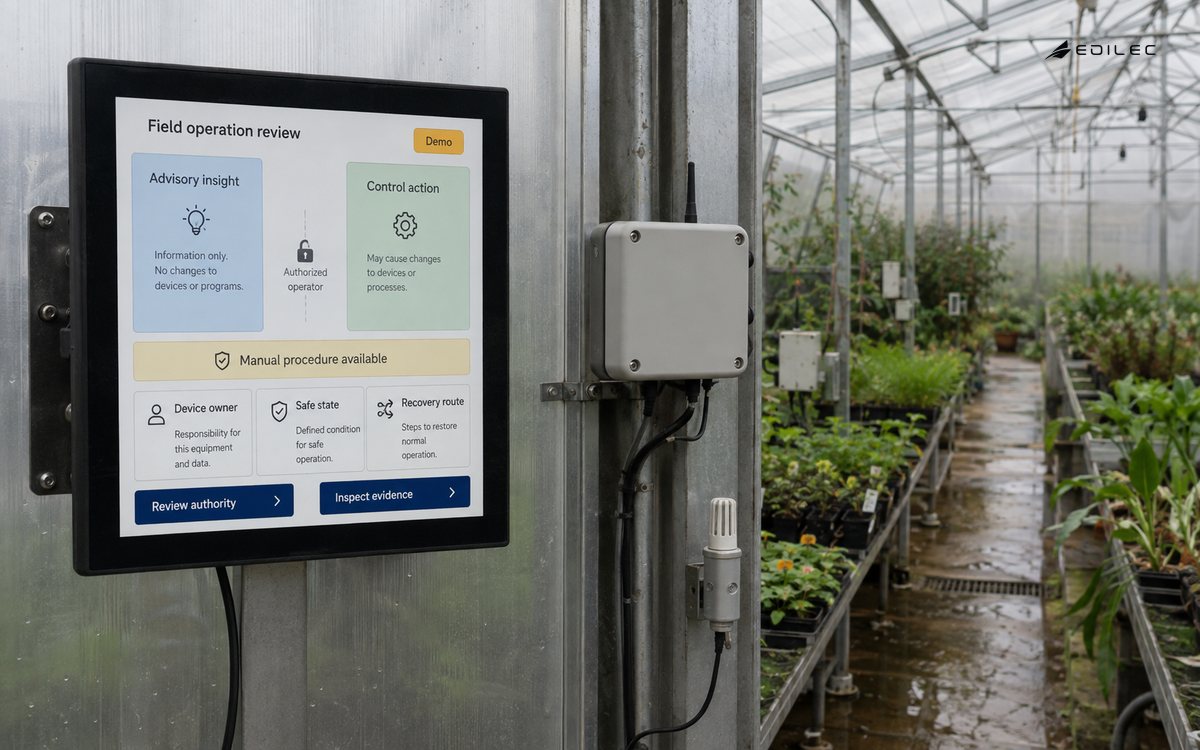
Name the asset, process and decision being improved. Establish a baseline such as inspection effort, downtime, energy use, product loss or response delay, including how it is measured. Map operators, maintainers, engineering, IT, security, data owners, suppliers and affected customers. Distinguish advisory insights from control actions. Any software that can influence physical equipment needs explicit authority, interlocks, safe states and a manual procedure approved by the relevant operational specialists.
Inventory sites, device classes, hardware and firmware versions, gateways, networks, protocols, data stores, business systems, support contracts and end-of-life dates. Record environmental and regulatory constraints without assuming one standard applies everywhere. Define ownership for device identity, configuration, keys, software update, data quality, vulnerability response, incident command and disposal. Supplier responsibility must be testable through evidence and service routes.
| Boundary | Implementation decision | Acceptance evidence |
|---|---|---|
| Physical process | Allowed observations and actions, hazards and safe fallback | Approved operating scenario and failure exercise |
| Device fleet | Identity, hardware profile, configuration, update and retirement | Registry reconciliation and lifecycle tests |
| Connectivity | Segmentation, gateway trust, protocol, buffering and clock | Representative loss, delay and reconnect test |
| Control plane | Tenancy, telemetry, rules, commands and evidence | Authorization, scale and isolation results |
| Enterprise integration | System of record, event contract, workflow and correction | End-to-end reconciliation with business owner |
| Operations | Monitoring, support, incident, recovery and supplier handoff | Observed rehearsal with accountable teams |
2. Establish a lifecycle-aware reference architecture
Give each device a unique logical and physical identity and bind it to model, software, site, owner and lifecycle state. Separate identity from mutable location or customer fields. Use gateways to translate or aggregate where legacy protocols, local control or bandwidth require it, but manage gateways as devices with their own identity, updates and evidence. Define how the system behaves when time, connectivity, cloud or enterprise integration is unavailable.
Protocol and semantic boundaries
Use protocols for their designed roles. OASIS MQTT 5.0 supports publish-subscribe messaging with defined sessions and delivery semantics. OPC UA combines platform-independent communication with information modeling used in industrial contexts. Neither removes the need to govern identifiers, units, timestamps, quality, authorization and versioning. Build adapters at explicit boundaries and test behavior, not protocol labels.
3. Specify device and ecosystem security
Tailor requirements through system risk. NIST SP 800-213 explains how organizations can establish IoT device cybersecurity requirements in the context of the system. Apply this during acquisition and custom development. The device capability baseline includes identification, configuration, data protection, logical access to interfaces, software update and cybersecurity-state awareness. Decide which capabilities are provided by device, gateway, platform or supporting process and test the complete outcome.
Provision unique credentials through a controlled manufacturing or enrollment process. Protect private keys according to consequence, authenticate endpoints, segment networks, restrict local and remote interfaces, sign updates and log administrative actions. Define vulnerability intake, inventory impact analysis, patch decision, testing, rollout, customer communication and exception handling. NIST IR 8259 Rev. 1 emphasizes manufacturer preparation and customer support before sale; require those activities in supplier evidence.
Use CISA's Secure by Demand Guide when evaluating platform and device suppliers. Ask about secure defaults, identity integration, logs, vulnerability disclosure, update support and product transparency. Confirm that the enterprise can export fleet and audit data, revoke supplier access, obtain software and hardware inventories and operate critical functions during a commercial or service dispute.
4. Govern telemetry, commands and enterprise integration
Create a canonical asset and event contract. Include source identity, event and receipt time, sequence, value, unit, quality, schema version and provenance. Keep raw evidence where justified, then publish validated observations for downstream use. Define deduplication, late data, correction and retention. A predictive or operational dashboard should not silently turn missing telemetry into zero or treat a stale state as current.
Commands require a stronger contract than telemetry. Define requesting role, target, desired action, preconditions, expiry, idempotency, acknowledgement, actual state and compensating action. Separate business approval from command execution. Do not let an enterprise workflow write directly to device topics or interfaces. Route actions through a control service that enforces current policy and can halt a cohort during an incident.
| Integration failure | Required behavior | Evidence retained |
|---|---|---|
| Duplicate telemetry | Deduplicate or process idempotently without losing audit history | Message identity and disposition |
| Late or reordered event | Apply event-time policy and mark revised results | Original and corrected processing runs |
| Enterprise system unavailable | Buffer within limit and surface backlog or use manual path | Queue age, retries and affected records |
| Unknown asset mapping | Quarantine rather than attach to a plausible asset | Source, mapping error and owner |
| Command timeout | Treat result as unknown until confirmed; do not retry blindly | Command ID, expiry and observed state |
| Schema incompatibility | Reject or route by version and notify owners | Producer version, consumer impact and resolution |
5. Pilot at representative sites and prove failure handling
Choose pilot sites that represent environment, network, operating role, legacy integration and maintenance variation. Freeze the approved hardware and software profile for each cohort. Train operators on purpose, limitations and fallback. Measure installation success, data quality, connectivity, command outcome, update recovery, support demand and business baseline. Observe actual shifts and maintenance windows; a daytime demonstration may miss the operating conditions that determine value.
Exercise identity collision, network partition, clock drift, full local buffer, expired credential, malformed message, unavailable enterprise system, interrupted update and compromised administrator. Restore services and reconcile delayed data. Verify that local operations remain safe and that incident teams can identify affected devices by model, site and version. Expansion requires written acceptance from operations, security, data, service and business owners, not only the delivery sponsor.
Use a cutover rehearsal at each site archetype. Stage devices and credentials, validate network segmentation, commission against the correct asset, confirm units and time, exercise the manual procedure, then run an update and replacement. Reconcile the device registry with the enterprise asset system and physical count. Observe the work during a real shift with normal support routes; a commissioning path that depends on the project architect's broad cloud access is not ready for operations.
Define a fleet expansion packet that can be repeated by local teams: site prerequisites, approved bill of materials, network and firewall requirements, identity issuance, installation evidence, validation queries, rollback, training, support contacts and acceptance signatures. Version the packet with the platform and device profile. If a supplier substitutes hardware, radio module or firmware, route it through compatibility, security and operating review before installation, even when the commercial part number appears unchanged.
Track benefits and externalities at the same boundary. If remote monitoring reduces inspections, verify that missed or false alerts do not shift work into emergency maintenance. Measure process outcome, device availability, data quality, operator burden, field travel, support demand and cost. Review results by site and asset class. An enterprise should pause expansion when the operating model is absorbing hidden manual correction, even if the central platform meets its technical uptime target.
6. Operate, update and retire the fleet
Maintain a reconciled fleet inventory across device registry, network, asset system, support and supplier records. Monitor last seen, software version, configuration drift, credential state, update outcome, telemetry quality and support status. Use staged update cohorts with stop conditions and a proven recovery route. Track unsupported versions and devices that can no longer receive updates as risk, not merely inventory noise.
Plan retirement during implementation. Define final export, ownership transfer, credential revocation, data deletion or retention, reset, physical disposal and record closure. Keep enough evidence to prove that a device cannot reconnect under its former authority. The startup IoT delivery plan and production checklist provide useful smaller-fleet comparisons when deciding what the enterprise must formalize at scale.
Key takeaways
- Begin with a physical operating outcome, authority boundary and approved fallback.
- Model device, gateway, cloud and enterprise responsibilities across the complete lifecycle.
- Tailor security requirements to system risk and require supplier support evidence.
- Govern telemetry and commands with different contracts and failure behavior.
- Pilot across representative sites and inject connectivity, identity, update and integration failures.
- Reconcile, update and retire the fleet through owned operating processes.
Enterprise IoT implementation FAQ
Should enterprise IoT use one platform? Standardize identity, evidence, lifecycle and integration patterns where they create value, but allow bounded differences for operational protocols and safety constraints. A nominally universal platform can create unsafe workarounds if it ignores field reality.
How should IT and operational technology teams divide ownership? Assign decisions by capability and consequence rather than organizational stereotype. Operations normally owns the physical process and safe fallback; shared governance should explicitly assign network, device, cloud, data, security and incident duties.
Can legacy equipment join without modification? A managed gateway may bridge protocols and add controls, but it cannot invent device capabilities such as secure update. Document residual risk, segmentation, monitoring and replacement timing.
What is the go-live gate? Representative users must complete the journey, controls and integrations must pass, failure and recovery must be exercised, support must be ready, and accountable owners must accept remaining exceptions.
Conclusion: govern the whole cyber-physical lifecycle
Enterprise IoT software development succeeds when the organization can identify every device, trust each material event, control every consequential action and continue operating through failure. Make lifecycle ownership and field evidence the acceptance standard, then expand by controlled cohorts rather than declaring platform completion from a central dashboard.