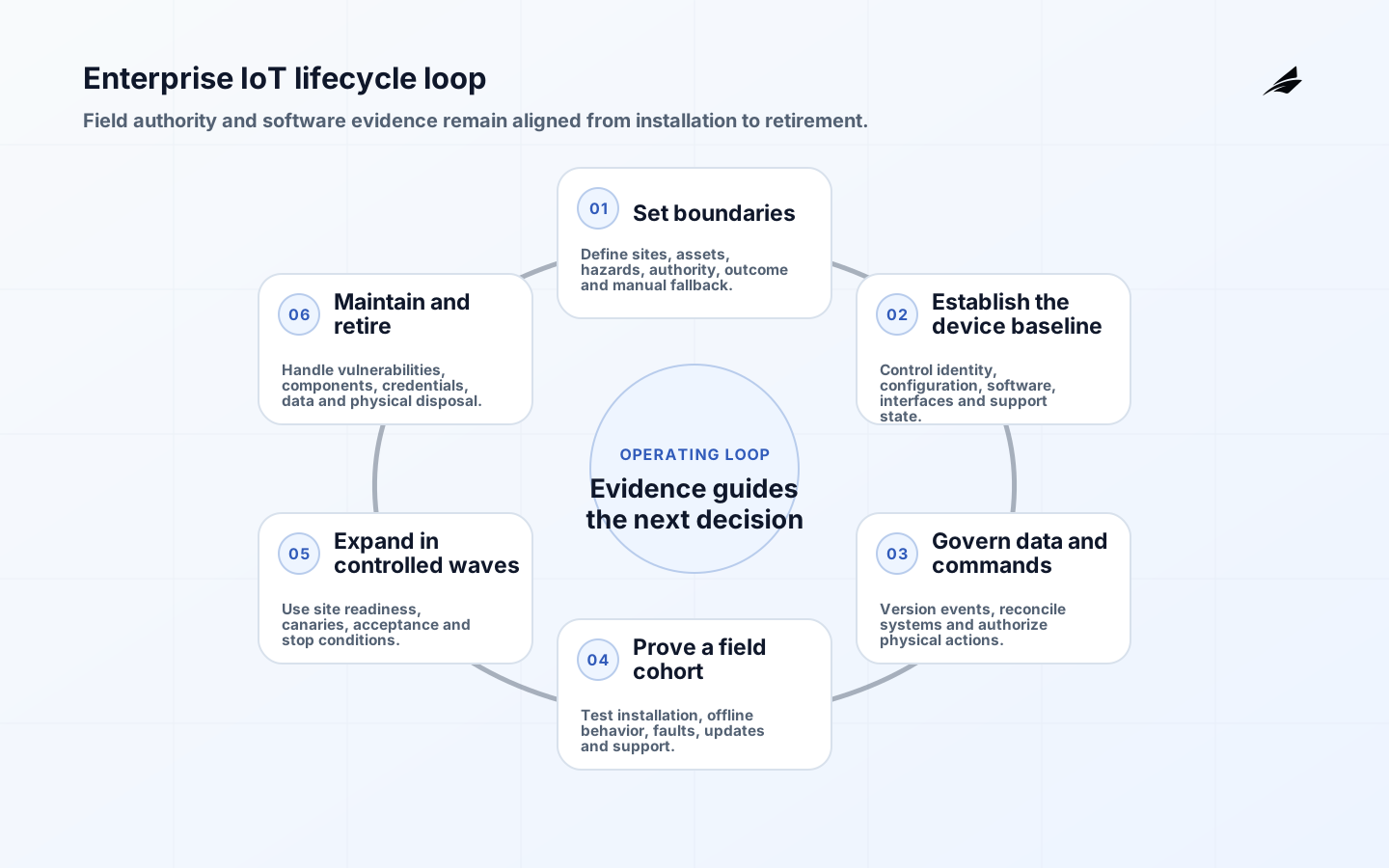
An IoT software development company for enterprise teams must work across physical operations, embedded systems, networks, cloud platforms, data governance and long-lived support. The deliverable is not an application beside a device; it is an operating capability spanning installation through retirement. Enterprise buyers should judge a partner by lifecycle evidence, safety awareness and integration discipline. This FAQ provides the questions and acceptance criteria that matter.
Begin with the enterprise IoT scope and delivery plan and the enterprise IoT implementation checklist. Teams testing a new connected-product proposition can also use the startup IoT delivery guide and its production checklist.
What should an enterprise IoT engagement include?
Scope the operational outcome, sites, assets, users, hazards, device classes, connectivity, control plane, applications, integrations, security, data and support. Identify what already exists in operational technology, facilities, enterprise identity, networks, maintenance and analytics. A discovery phase should produce a current-state map, target responsibilities, risk register, lifecycle cost and representative pilot. Avoid approving a platform before proving how field work and business decisions change.
Name authorities at each layer. Operations owns safe physical procedures; product or engineering owns device behavior; security sets risk controls; data owners govern use and retention; enterprise architecture governs integration; service management owns support coordination. The development partner can design and operate components, but should not silently become the only party able to identify a device, issue a command or recover the fleet.
| Lifecycle area | Enterprise owner decision | Partner evidence |
|---|---|---|
| Asset and site | Approved operating boundary and criticality | Reconciled device-to-asset registry |
| Device baseline | Hardware, firmware, identity and support profile | Signed build, tests and component record |
| Connectivity | Segmentation, protocol and offline rules | Coverage, buffering and failover results |
| Control plane | Command, update and administrative authority | Policy logs and staged rollout evidence |
| Integration | System of record and event contract | Reconciliation, retry and lineage tests |
| Retirement | Data, credential and physical disposal procedure | Revocation and deletion record |
How should IT, OT and safety boundaries be handled?
Map physical consequences before connecting systems. A telemetry-only sensor, building controller and production actuator have different hazard and availability requirements. NIST's Guide to Operational Technology Security addresses OT's distinctive performance, reliability and safety needs. Use existing hazard analysis, change windows and manual procedures. Cloud convenience must not override a safe local state or an operator's authority.
Segment networks and mediate traffic through approved gateways or brokers. Default-deny unsolicited paths into field zones, authenticate endpoints and monitor allowed flows. Separate observation from control. A remote command should carry requester, authorization, target, parameters, expiry and expected state transition. The device acknowledgement and physical outcome are different events. For high-consequence operations, require an independent local interlock or human confirmation.
What belongs in the device and fleet baseline?
The NIST IoT technical baseline identifies device identification, configuration, data protection, interface access, software update, cybersecurity state awareness and device security. Tailor these capabilities to the use case. Maintain physical and logical identifiers, owner, location, model, hardware revision, software, certificates, configuration, support status and last contact. Reconcile the registry with procurement and field records.
Protect unique credentials in hardware where feasible and never reuse a fleet secret. Configuration changes and commands need authenticated, authorized and attributable paths. Sign software and metadata, verify compatibility, stage updates and support recovery from interruption. Define what state the device reports for investigation without collecting excessive operational or personal data. Build test rigs and simulators for each supported hardware profile so fleet changes can be rehearsed.
NIST's revised foundational manufacturer activities asks manufacturers to identify customer cybersecurity needs, address them and plan support. Procurement should therefore request vulnerability handling, support period, component transparency, secure defaults, update method and end-of-life notice. A device that meets launch requirements but cannot be maintained through the enterprise asset life transfers an avoidable liability to the buyer.
How should data and enterprise integration work?
Define an event contract for device identity, asset, measurement, unit, timestamp source, quality, sequence, location precision and schema version. Distinguish observed time, device time and ingestion time. Handle duplicates, late events, missing intervals and clock drift explicitly. Raw telemetry, curated operational events and business records need separate retention and ownership. A dashboard should not become an unofficial system of record for asset or maintenance state.
Integrate through governed APIs or event streams with idempotent consumers and dead-letter handling. Map enterprise identifiers through a controlled reference rather than embedding multiple system keys in firmware. For a maintenance alert, preserve the path from measurement and rule version to work order and technician resolution. Reconcile commands and transactions across systems. Monitor contract failures and notify consumers before incompatible schema change.
How is fleet security governed?
Use the NIST Cybersecurity Framework 2.0 to describe target outcomes across Govern, Identify, Protect, Detect, Respond and Recover. Build an IoT profile that names owners and evidence. Include supplier and component risk, site access, credential lifecycle, network monitoring, vulnerability triage, fleet containment, recovery and communication. Map controls to operational constraints instead of importing an office IT baseline without adaptation.
Create fleet-specific incident playbooks. The organization must be able to locate affected models and versions, revoke a credential, isolate a site or cohort, block a command path, distribute a fix and preserve safe operation. Test a supplier compromise and an update failure. Maintain out-of-band contact with field teams and critical vendors. Evidence retention should support investigation while respecting labor, privacy and jurisdictional requirements.
CISA's Secure by Design guidance places responsibility for customer security outcomes on manufacturers and emphasizes transparency and leadership. Ask the partner and device suppliers for secure-default decisions, vulnerability disclosure, root-cause correction and customer communication. Contractual security questionnaires are useful inputs; demonstrated fleet controls and responsive support are stronger evidence.
What should the enterprise pilot prove?
Select sites that represent environmental, network, equipment and workforce variation while limiting consequence. Define the manual fallback, safety stop, pilot duration and success thresholds. Include installation, provisioning, normal operation, offline buffering, command authorization, software update, support diagnosis, integration and data reconciliation. Observe operators and technicians in context. Training completion alone does not show that the workflow fits real shifts and constraints.
| Pilot gate | Required proof | Expansion blocker |
|---|---|---|
| Operational fit | Users complete the changed workflow safely | Workaround bypasses control or adds unacceptable labor |
| Fleet control | Inventory, configuration, update and revocation reconcile | Unknown devices or unrecoverable update failures |
| Resilience | Offline and dependency failure preserve safe state | Lost data causes unsafe or untraceable action |
| Integration | Events and transactions reconcile with systems of record | Duplicate, stale or orphaned business records |
| Support | Tiered teams diagnose from approved evidence | Resolution depends on one vendor engineer or site visit |
| Economics | Measured installation and operating cost fit the case | Support, connectivity or replacement erodes expected value |
How should rollout and change be controlled?
Roll out by dependency, site readiness and operational risk. Each wave needs verified network, asset records, trained roles, spare and replacement process, support contacts, monitoring, fallback and acceptance owner. Use a small canary for firmware and cloud changes before broad cohorts. Maintain compatibility across device generations. Define stop conditions from safety, command, data quality, support and service measures rather than only deployment completion.
Establish a configuration and software baseline by device class. Emergency changes require bounded authority and later review. Planned changes need lab validation, representative field validation, communication and rollback. Keep a maintenance calendar that respects operational periods. When a component becomes unavailable, treat the substitute as an engineering change with hardware, radio, power, software and certification regression, not a procurement-only decision.
How should an enterprise select the development company?
Evaluate the named embedded, cloud, security, data, UX and support staff. Ask for evidence from a comparable field lifecycle: threat model, architecture decision, manufacturing or provisioning test, staged update, incident and retirement. Verify safety and regulatory competence for the domain. Confirm subcontractors, component dependencies, staffing continuity, support regions and escalation. References should include operations teams, not only project sponsors.
Keep source, build definitions, infrastructure, schemas, signing governance, inventories and runbooks in enterprise-controlled systems. Define ownership of reusable partner components and rights to maintain them. Price devices, connectivity, cloud, licenses, installation, certification, security maintenance, support, replacements and exit. Use milestone acceptance tied to working fleet evidence. A day rate does not reveal total lifecycle cost or concentration risk.
Implementation example: cold-chain monitoring
A distributor wants temperature monitoring across warehouses and vehicles. The pilot uses two warehouse types and three routes with different radio coverage. Devices buffer signed measurements offline, and gateways publish versioned events. The enterprise asset system owns location and equipment identity; the IoT registry owns device lifecycle. Alerts require sustained threshold breach and preserve rule version, sensor quality and acknowledgement.
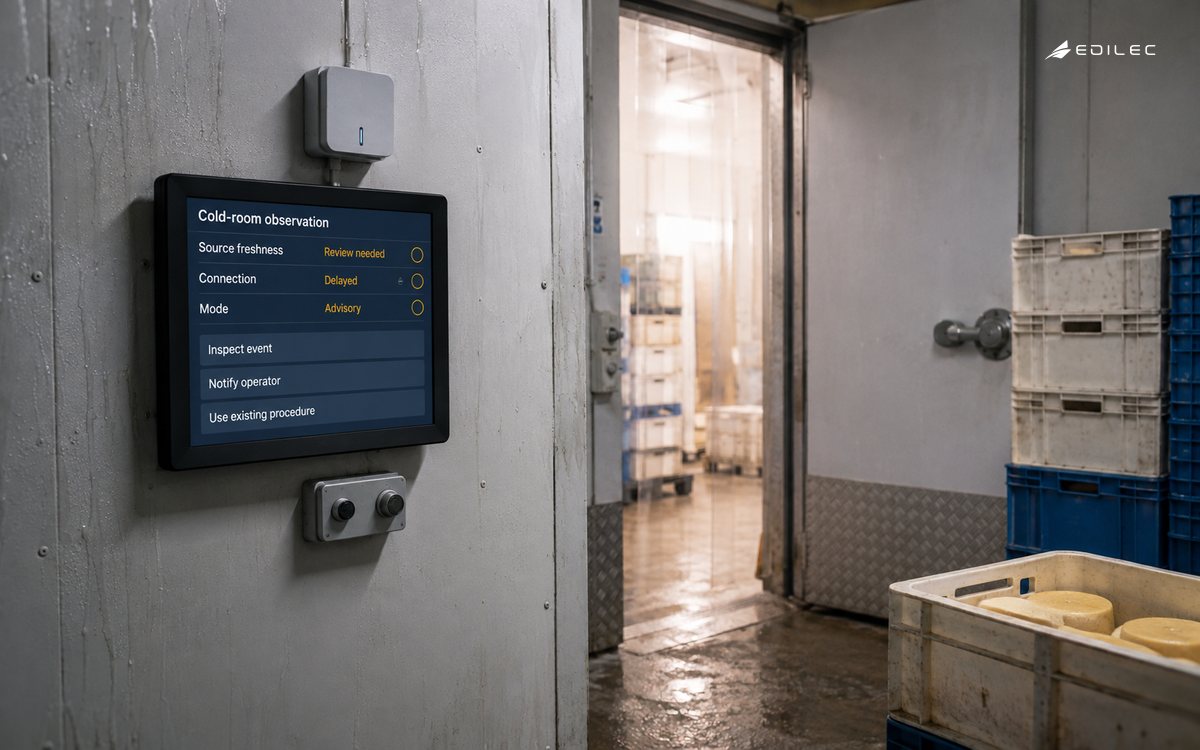
Field tests cover battery loss, gateway outage, clock drift, sensor replacement and interrupted update. A local display preserves immediate operator awareness when cloud service is unavailable. Maintenance work orders reconcile with alert closure. The rollout blocks when unknown devices exceed threshold or support cannot diagnose remotely. Cost includes calibration, installation and replacement, not just cloud ingestion. At retirement, certificates are revoked, retained data follows policy and devices enter approved disposal.
Key takeaways
- Treat enterprise IoT as a physical and digital operating lifecycle.
- Preserve operational safety and local authority across IT, OT and cloud boundaries.
- Maintain a testable device baseline with unique identity, secure update and state awareness.
- Govern event meaning, timing, quality and reconciliation across enterprise systems.
- Pilot installation, faults, recovery, support and economics in representative settings.
- Retain enterprise access to fleet authority, evidence, source and exit capability.
Additional enterprise IoT FAQ
Platform or custom build? Use managed capabilities where they meet identity, protocol, region, scale, evidence and exit requirements. Build only differentiating or unmet controls, and account for lifecycle ownership.
How long should devices be supported? Set a period from expected asset life, customer obligations, vulnerability response and component availability. Communicate end of support early and provide a migration or safe retirement path.
Can telemetry drive automated action? Yes when data quality, authorization, limits, safe state and independent protection match the consequence. Begin advisory and expand authority from observed evidence.
Conclusion
Enterprise IoT succeeds when physical operations and software governance share one lifecycle contract. Define authority, tailor the fleet baseline, preserve event meaning, prove resilience and support in the field, then expand through controlled waves. Select a company that leaves the enterprise able to understand, secure, operate and eventually retire every connected asset.