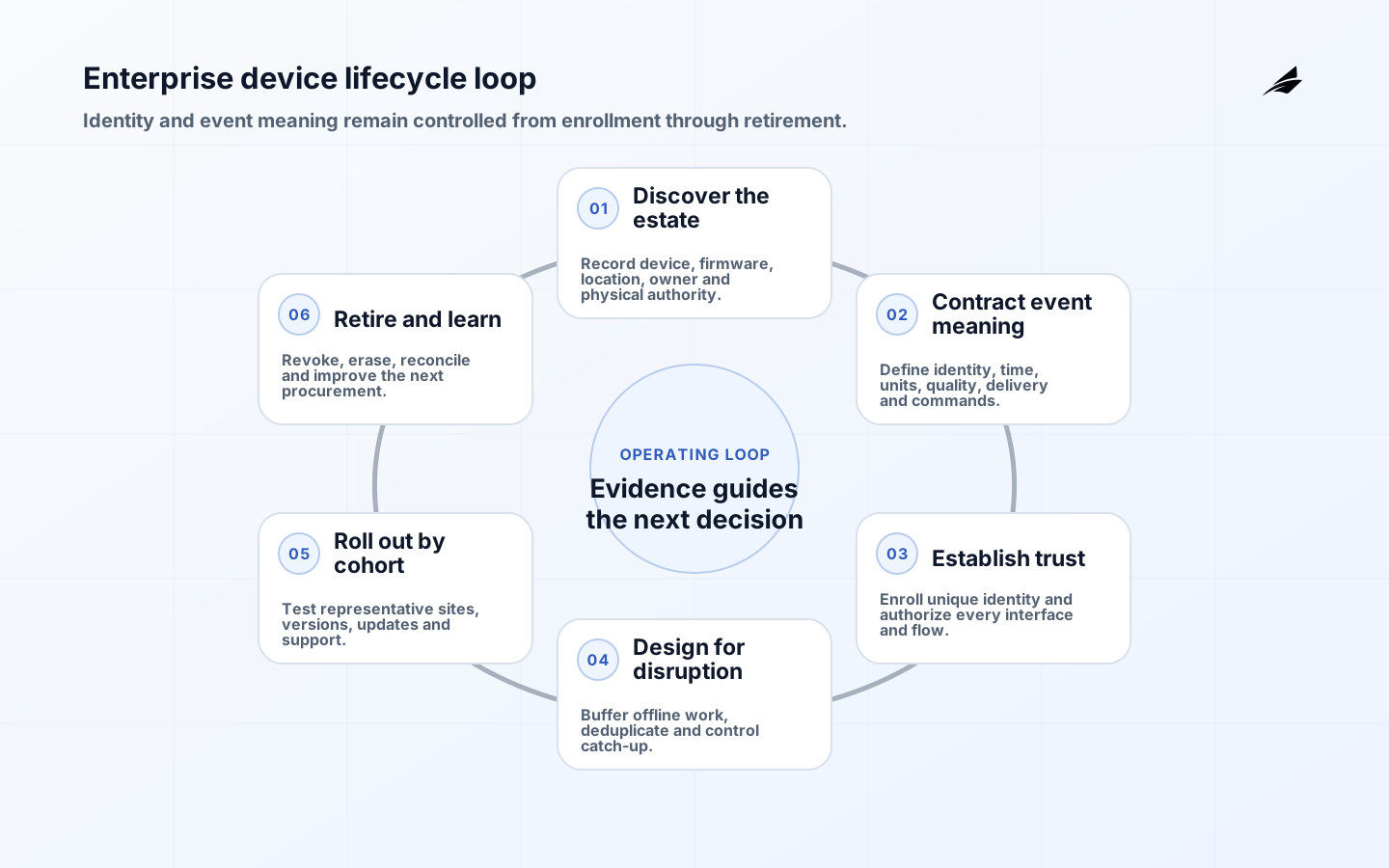
Enterprise device integration services connect physical equipment to business systems without losing the identity, timing, units, authority and operational context that make device data trustworthy. This implementation checklist is for teams integrating sensors, gateways, industrial controllers, scanners, cameras or other connected products across sites. It treats integration as a lifecycle service rather than a one-time protocol adapter. A production design must survive intermittent links, old firmware, duplicate events, certificate expiry, site maintenance and eventual device retirement.
Use Edilec's enterprise device integration delivery plan to frame commercial scope and the device integration FAQ to compare approaches. The cognitive infrastructure checklist is relevant when device events feed analytical or AI decisions.
1. Discover the estate and bound authority
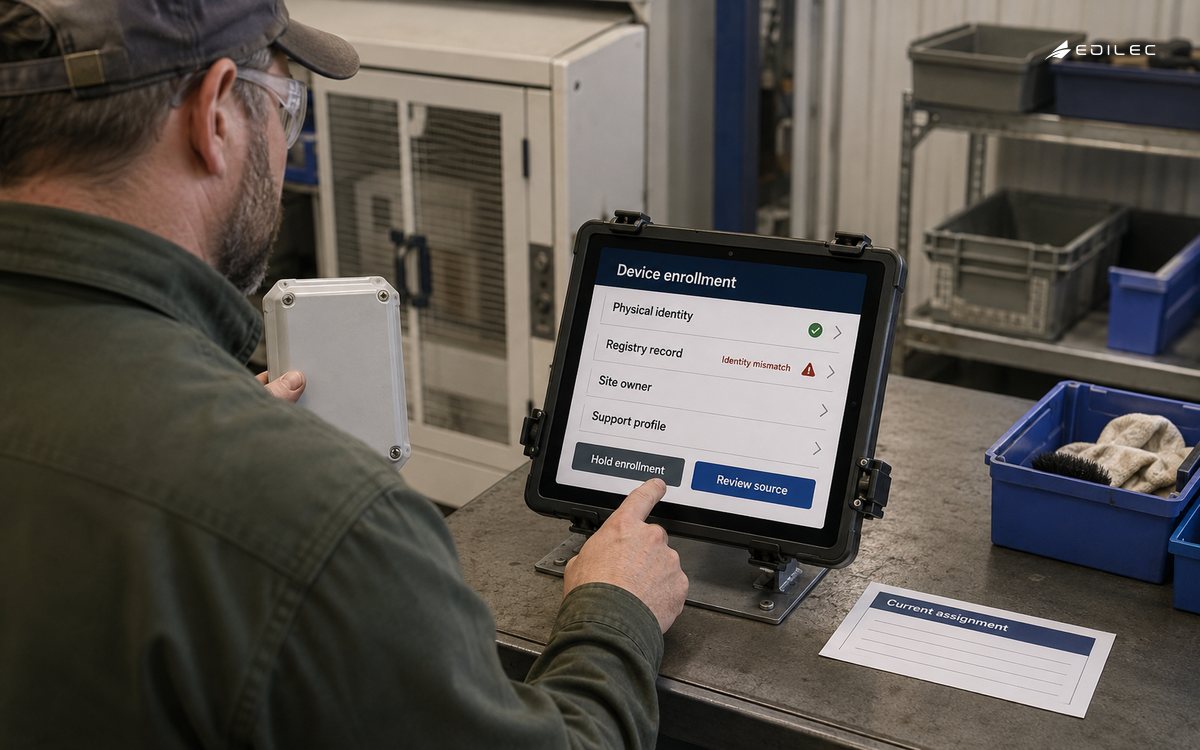
Inventory device type, manufacturer, model, hardware revision, firmware, serial or cryptographic identity, owner, location, network path, protocol, support status and physical process. Observe representative sites rather than relying on a purchasing list. Record what each device may sense, store, transmit or actuate and the harm from incorrect behavior. The NISTIR 8259 series separates device cybersecurity capabilities from the non-technical support customers need across a product lifecycle; assess both.
Define the system of record for device identity and current assignment. Asset labels, cloud registry entries and application records commonly drift. Establish how a newly found device is quarantined, verified and enrolled. Document local safety and production constraints before remote commands are designed. A central service should never assume it may restart, unlock or reconfigure equipment merely because an API permits the call.
| Contract area | Required definition | Failure to test |
|---|---|---|
| Identity | Stable device and current owner or site | Events attach to the wrong asset |
| Time | Event time, receipt time, clock quality and zone | Sequence and duration become misleading |
| Value | Type, unit, range, precision and quality | Plausible but incorrect analytics |
| Delivery | Ordering, duplication, retention and retry | Double actions or missing history |
| Command | Authorization, expiry, acknowledgement and result | Unsafe or unreconciled physical action |
2. Define protocol and event contracts
Choose protocols from device capability, network conditions and business semantics. The MQTT 5.0 standard defines publish-subscribe behavior, quality-of-service levels, sessions and reason codes; those mechanisms do not decide business deduplication or event truth for you. For industrial interoperability, OPC UA provides information models and services. Keep protocol transport separate from the canonical enterprise event so a device-family replacement does not force every consumer to change.
Version schemas and include device identity, event identity, observed time, ingestion time, value, unit, quality, sequence and source version. State compatibility rules and malformed-message handling. Decide whether late events revise prior aggregates and how corrections are communicated. Commands need a separate contract with initiator, target, purpose, parameters, expiry, idempotency key, acceptance and final outcome. Treat a transport acknowledgement as receipt, not proof that a physical action completed.
3. Establish device identity and trust boundaries
Give each device or gateway a unique identity and a controlled enrollment path. Avoid shared factory credentials. Protect private keys in suitable hardware where risk warrants it, issue bounded certificates and automate renewal before expiry. Use TLS 1.3 or an appropriate secure protocol profile for transport protection, while recognizing that encryption does not validate sensor truth. Define certificate authorities, revocation, time dependencies and recovery when a device loses trust.
Segment device, management and enterprise traffic by required flow. The NIST zero trust architecture emphasizes decisions based on identities and resources rather than network location alone. Authorize each interface and command, constrain egress and keep administrative paths separate. For OPC UA, the security model covers application and user authentication, integrity, confidentiality and audit concepts; deploy supported profiles and maintain certificate trust lists.
4. Build edge resilience and data quality
Place translation, buffering or local decisions at the edge only when latency, bandwidth, availability or protocol isolation requires them. Define offline duration, storage limits, backpressure and eviction policy. Preserve original event identity through retries so downstream processing can deduplicate. Monitor clock drift and gateway health. When connectivity returns, control catch-up rates so a backlog does not overwhelm brokers or consumers. The degraded mode should be visible to operators and safe for the physical process.
Validate values against type, unit, range, rate of change and device state, but retain the raw observation needed for investigation. Mark questionable data rather than silently coercing it. Reconcile device counts, gateway counts, broker messages and accepted enterprise events. If analytics drive maintenance or inventory, sample predictions against physical reality. Data-quality rules should distinguish a failing sensor from a real extreme condition; both can produce unusual readings but require different action.
5. Pilot a complete vertical slice
Select representative device models, firmware versions, networks, sites and operating shifts. Integrate enrollment, telemetry, commands if needed, monitoring, support and retirement rather than proving only connectivity. Test duplicate, missing, late and out-of-order events; offline buffering; invalid units; expired credentials; certificate rotation; gateway loss; malformed payloads; broker throttling; rollback; and unauthorized commands. Include site operators in acceptance because technically correct behavior may still disrupt maintenance or safety practice.
Release by site or cohort with entry, health, pause and rollback criteria. Keep a compatibility matrix for device, firmware, gateway, protocol and cloud-service versions. Firmware updates should be signed, staged, observable and recoverable, with power-loss behavior tested. Do not expand while enrollment remains manual and ambiguous or support depends on the original integration team. A pilot is complete when permanent operators can diagnose and recover it.
| Operating signal | What it reveals | Response |
|---|---|---|
| Known fleet coverage | Inventory completeness | Discover or quarantine unknown devices |
| Credential expiry horizon | Renewal risk | Rotate before devices become unreachable |
| Event acceptance rate | Contract and quality health | Inspect by model, firmware and site |
| Duplicate and late rate | Network and retry behavior | Tune buffering without hiding loss |
| Command reconciliation | Physical action confidence | Investigate accepted but incomplete work |
| Update success by cohort | Fleet change safety | Pause rollout and preserve recovery |
6. Operate, update and retire the fleet
Assign owners for registry accuracy, credential lifecycle, schema compatibility, gateway operation, firmware, vulnerability response, data quality and site support. Maintain runbooks for replacement, lost connectivity, compromised identity, failed update and cloud outage. Record vendor support periods and plan replacement before security updates end. Monitor per-site and per-model behavior because global averages hide concentrated failures. Exercise a platform outage and prove that local behavior fails safely.
Retirement must revoke identity, remove network authority, stop billing, export required records, erase sensitive data where appropriate and update physical and digital inventories. Confirm that reused equipment cannot reconnect under a previous owner. Archive schema and firmware context for retained historical events. Feed incident, support, update and data-quality evidence into procurement: integration improves when the next device contract requires lifecycle capabilities the current fleet lacked.
Carry integration requirements into procurement
A technically successful integration can still fail commercially when the next hardware revision changes identifiers, payloads or remote-management behavior. Put protocol profiles, schema compatibility, credential provisioning, update method, vulnerability notification, support period, replacement behavior and data export into procurement requirements. Require notice before firmware or cloud API changes and access to a representative pre-release environment where feasible. Define who diagnoses a defect that crosses hardware, site network, gateway and platform boundaries; otherwise each supplier can claim the fault belongs elsewhere.
Maintain an approved-device profile rather than a simple product name. Include hardware revision, firmware range, enabled interfaces, certificate policy, gateway version, tested configuration and known limitations. Revalidate when any element changes. For third-party devices that cannot meet the target controls, document network isolation, reduced authority, monitoring and retirement date. Exceptions should not quietly become the enterprise baseline because one site had an urgent installation.
Capacity planning should model event bursts and recovery, not only average telemetry. A site reconnecting after several hours can produce concentrated messages, writes and downstream calculations. Test broker quotas, partitioning, consumer lag, database behavior and rate-controlled catch-up with representative payloads. Include command traffic and certificate operations in the model. Monitor cost per active device, accepted event and supported site, because a fleet can remain technically healthy while diagnostics, storage or connectivity become economically unsustainable.
Finally, define a service acceptance pack per site: installed identities, approved network flows, firmware and configuration, event reconciliation, support ownership, recovery result and open limitations. Store it with the live inventory and update it after replacement or major change. This gives security, operations and auditors a current description of the deployed capability rather than a design diagram that ceased to be accurate after the pilot.
Key takeaways
- Inventory device capability, support and physical authority before choosing middleware.
- Separate transport protocols from versioned enterprise event and command contracts.
- Authenticate each device, authorize each interface and plan certificate lifecycle from enrollment to revocation.
- Design explicitly for offline operation, duplicates, late data and controlled catch-up.
- Scale only after permanent teams can update, diagnose, recover and retire representative devices.
Frequently asked questions
Should every device connect directly to cloud services? No; gateways can isolate legacy protocols, buffer offline work and reduce credential exposure. Does MQTT quality of service eliminate duplicates? No; application-level idempotency is still needed. Is OPC UA only for factories? It is strongest in industrial interoperability but can support other structured device domains. How long should a device pilot run? Long enough to cover representative shifts, connectivity and maintenance conditions, with explicit evidence goals. Who owns firmware risk? Manufacturer, integrator and customer duties should be contractually divided, while the service owner remains accountable for operational impact.
Conclusion
Enterprise device integration services succeed when a physical asset remains identifiable, understandable, controllable and supportable through change. Establish the fleet facts, contract event meaning, create a device trust lifecycle, rehearse degraded behavior and roll out in observable cohorts. That discipline turns a successful connection demo into an enterprise capability that can be operated for the lifetime of the equipment.