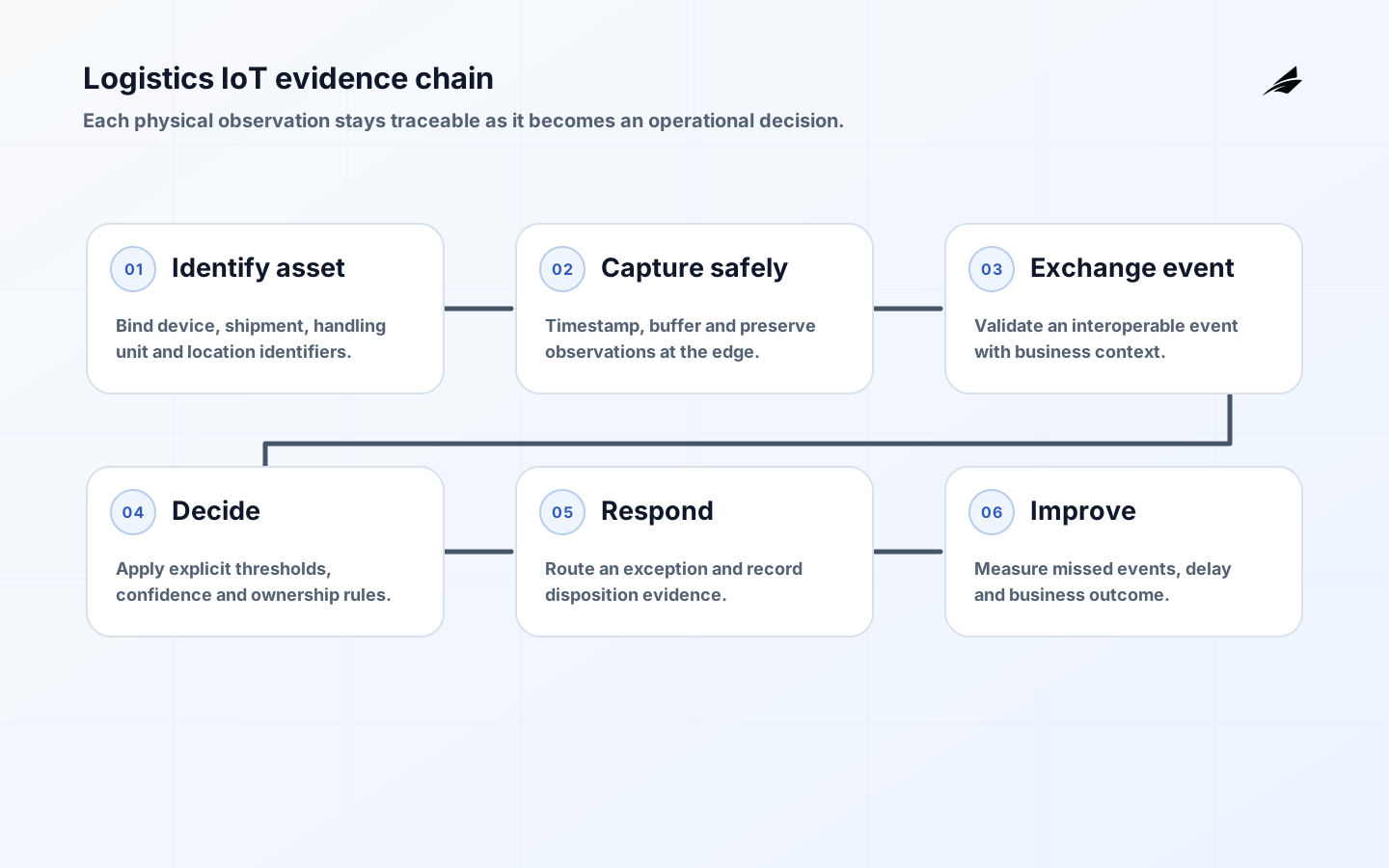
IoT software development for logistics is not primarily a dashboard project. It is the design of a trustworthy event chain from a physical asset to an operational decision. A shipment, pallet, trailer or return moves through locations controlled by different people and systems. Sensors may lose power, gateways may lose connectivity, scans may arrive late and partners may describe the same event differently. The software must preserve what happened, when it happened, where it happened and which identifier was observed without turning uncertain data into false certainty.
A useful engagement starts with one costly decision such as locating delayed cold-chain freight, proving a custody handoff or reducing trailer dwell. It then defines the minimum devices, events, integrations and response workflow needed to improve that decision. GS1 EPCIS is especially relevant because it provides a standard way to exchange visibility events across organizations. MQTT can provide efficient device messaging, but neither standard replaces product rules, security, data-quality controls or operational ownership. This FAQ explains the architecture and acceptance evidence a buyer should expect.
What should a logistics IoT project deliver first?
Choose a bounded lane, facility or asset class and write the intervention before selecting hardware. For a refrigerated shipment, the intervention might be: alert the named controller when a confirmed temperature excursion exceeds the product-specific threshold for a defined duration, show the evidence, and record the disposition. For yard operations, it might be: identify trailers whose dwell exceeds the service target and route a verified task to the responsible team. These statements expose required identifiers, timing, confidence, ownership and system interfaces.
Do not make universal real-time visibility the first milestone. It hides differences between a device observation, a business event and a derived prediction. Define the business clock: a two-minute delay may matter for a cross-dock exception but not for a weekly utilization report. Establish the authoritative source for shipment, asset, route, customer and location master data. The IoT platform should enrich those records with observations; it should not quietly create a second, conflicting logistics master.
| Layer | Design question | Acceptance evidence |
|---|---|---|
| Physical asset | What is identified and how is the device attached? | Installation record and sampled identifier match |
| Edge | What survives loss of network or power? | Store-and-forward and restart test |
| Messaging | How are duplicates, order and expiry handled? | Replay test with delayed and repeated messages |
| Event model | How does an observation become a business event? | Versioned schema and example EPCIS events |
| Workflow | Who receives and closes an exception? | Timed exercise with named owner |
| Analytics | Which decision improves? | Baseline and post-pilot outcome measure |
How should tracking events and identifiers be modeled?
Use stable identifiers for the object, device, business location and transaction context. Preserve source timestamps separately from ingestion and processing timestamps. Record measurement units, sensor precision, calibration state and uncertainty where they affect interpretation. A location should distinguish a GPS estimate, a gateway sighting, a facility scan and a planned stop. These are not interchangeable. Keep the raw observation immutable, then create versioned transformations that derive alerts, milestones or predictions. Investigators must be able to trace a decision back to its source evidence.
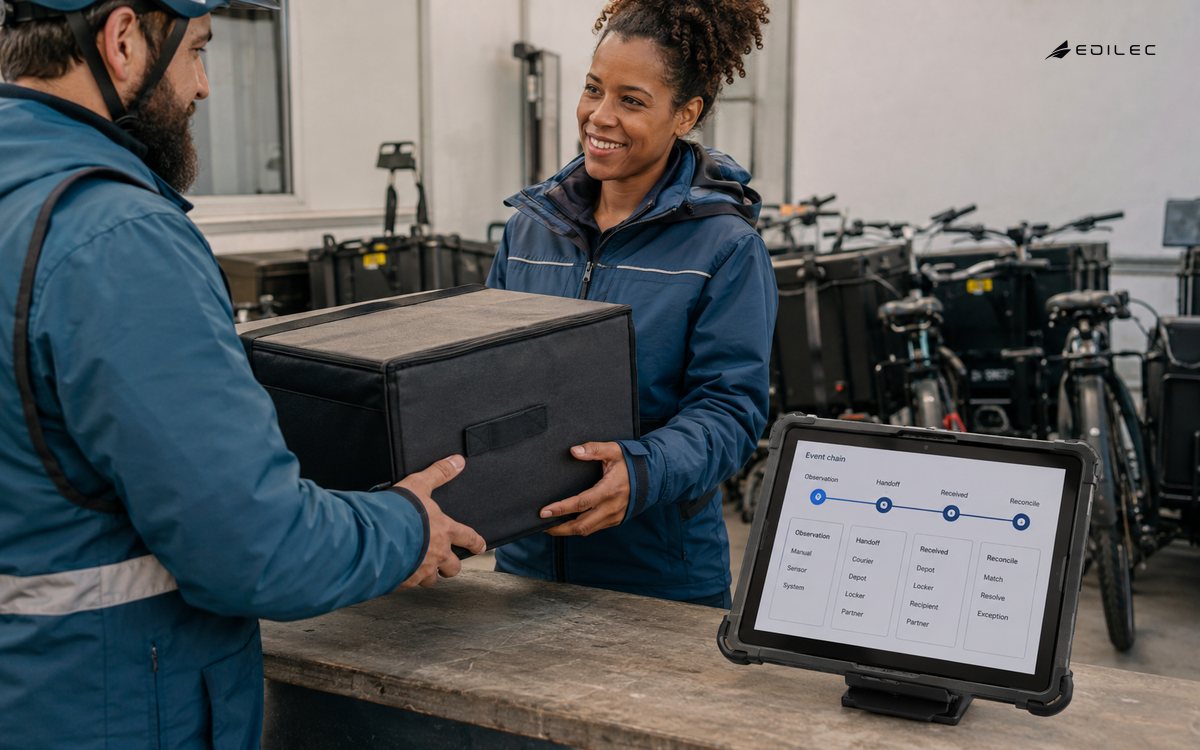
GS1 EPCIS frames visibility around what, when, where, why and how. Its event types and Core Business Vocabulary can reduce bespoke partner mappings, while JSON/JSON-LD and REST interfaces support modern integrations. Adoption still requires a profile: which identifiers are mandatory, which business steps are allowed, how corrections work and which extensions partners may send. Validate inbound events against that profile, quarantine malformed records and publish clear rejection reasons. A schema that accepts everything merely moves ambiguity downstream.
When are MQTT, cellular and edge processing appropriate?
Select connectivity from route coverage, message size, power budget, roaming, cost and recovery behavior. Cellular may fit mobile high-value assets; facility Wi-Fi may fit controlled sites; low-power wide-area networks may suit sparse telemetry; scanners may upload in batches. Design for intermittent service even when coverage maps look strong. The edge component needs a durable queue, monotonic sequence or unique event identifier, bounded retention and a policy for expired data. Operators need to know whether a blank period means normal silence, device failure or network loss.
MQTT 5 provides publish/subscribe messaging, quality-of-service choices, session expiry, message expiry and reason codes. At-least-once delivery can create duplicates, while exactly-once protocol delivery does not guarantee exactly-once business action across every downstream service. Make consumers idempotent and define deduplication keys. Use retained messages and persistent sessions deliberately; stale device state can be dangerous when presented as current. Test broker failover, reconnect storms, throttling, oversized payloads and clock drift before a fleet-scale rollout.
What security controls belong in the device lifecycle?
Treat each device identity separately from the asset it observes. Provision unique credentials, protect private keys, authenticate both ends, authorize narrow topics or APIs and rotate credentials without visiting every site. Inventory device model, hardware revision, firmware, owner, location, support period and current security state. NISTIR 8259A identifies baseline capabilities including device identification, configuration, data protection, logical access control, software update, cybersecurity state awareness and device security. Procurement should translate those capabilities into evidence and support obligations.
Signed updates, rollback protection and staged deployment are essential for long-lived field equipment. Define what happens when a supplier stops supporting a component. Separate operational commands from telemetry and require stronger authorization for immobilization, lock control or configuration changes. Monitor unusual message rates, impossible movement and repeated authentication failure without assuming every anomaly is malicious. Preserve forensic records while limiting collection of driver or customer data to a defined purpose and retention period.
How should the platform integrate with TMS, WMS and partner systems?
Integrate through explicit contracts rather than database coupling. The transportation management system may own planned loads and routes; the warehouse system may own picks and scans; the IoT service may own observations and device health; an exception service may own investigations. Publish events with stable correlation identifiers and make write-back rules narrow. If the IoT platform changes a shipment status, document who authorizes that transition and how conflicting updates are reconciled.
Partner boundaries need conformance tests, rate limits and replay procedures. Keep a sample corpus of valid, late, corrected, duplicated and malformed events. Version schemas compatibly and announce deprecation dates. Do not expose an unrestricted device broker to every partner. Use an API or exchange layer that validates tenancy and purpose. Reconciliation reports should compare expected assets, observed assets and unresolved gaps by facility or partner so missing data becomes owned work rather than a hidden dashboard defect.
| Metric | What it reveals | Misleading interpretation to avoid |
|---|---|---|
| Observation completeness | Expected assets or milestones with usable evidence | Raw message volume |
| Event latency | Source-to-decision delay by percentile | Average latency alone |
| Device availability | Healthy reporting time by device class | Broker uptime |
| Exception precision | Alerts that warranted action | Number of alerts closed |
| Resolution time | Time from confirmed exception to disposition | Time to first notification |
| Business outcome | Dwell, loss, spoilage or search-time change | Pilot activity count |
How should a pilot become a production rollout?
A pilot should test the hardest representative conditions, not only a clean demonstration route. Include poor coverage, partner handoffs, power interruption, damaged equipment, time-zone changes, duplicate scans and an operational escalation outside office hours. Establish baseline measures before installation. Run a shadow period in which the new workflow makes recommendations but established controls remain authoritative. Compare false positives, missed events and operator effort, then decide whether to expand, redesign or stop.
Scale by cohorts with an installation standard, device acceptance checklist, support model, spare inventory and rollback plan. Track firmware and schema versions as rollout dimensions. Capacity testing must include reconnect bursts and partner batch uploads, not just steady traffic. Before each cohort, confirm alert ownership, training and field replacement logistics. A technically successful deployment can still fail when nobody owns a dead battery, a disputed geofence or a device attached to the wrong trailer.
Key takeaways
- Begin with an operational decision and measurable baseline, not a device catalogue.
- Preserve raw observations and make every business interpretation traceable.
- Design for offline operation, duplicates, late data and device lifecycle from the start.
- Use standard visibility models where they reduce partner ambiguity, then define a strict implementation profile.
- Accept the rollout with field exercises and business outcomes, not message throughput alone.
Frequently asked questions
Does every logistics asset need a sensor?
No. Instrument where a decision or risk justifies the device, connectivity and support cost. Facility scans, carrier events and sampled sensing may provide enough evidence for lower-value flows. Model expected coverage so users know which assets are directly observed.
Can GPS alone provide chain-of-custody proof?
Usually not. GPS estimates location but does not by itself prove who controlled an asset or whether a handoff was accepted. Combine location evidence with authenticated scans, business transactions and named responsibility.
What should be owned after the developer leaves?
The buyer should retain source code or contractual access, infrastructure definitions, schemas, device inventory, keys and certificate procedures, runbooks, monitoring, test fixtures, supplier terms and exportable event history.
Before approving expansion, compare the installed fleet with the authoritative asset register and sample physical labels against digital identity. This final reconciliation catches installation and ownership errors that message-level tests cannot see.
Conclusion
The right logistics IoT partner makes physical uncertainty visible and manageable. Its design connects identifiers, resilient edge behavior, interoperable events, secure device operations and a real response workflow. Evaluate the solution by replaying failure and handoff scenarios, tracing an alert to evidence and proving that the receiving team can operate the system. That is a stronger test than a polished map and the foundation for supply-chain visibility that remains useful after the pilot.