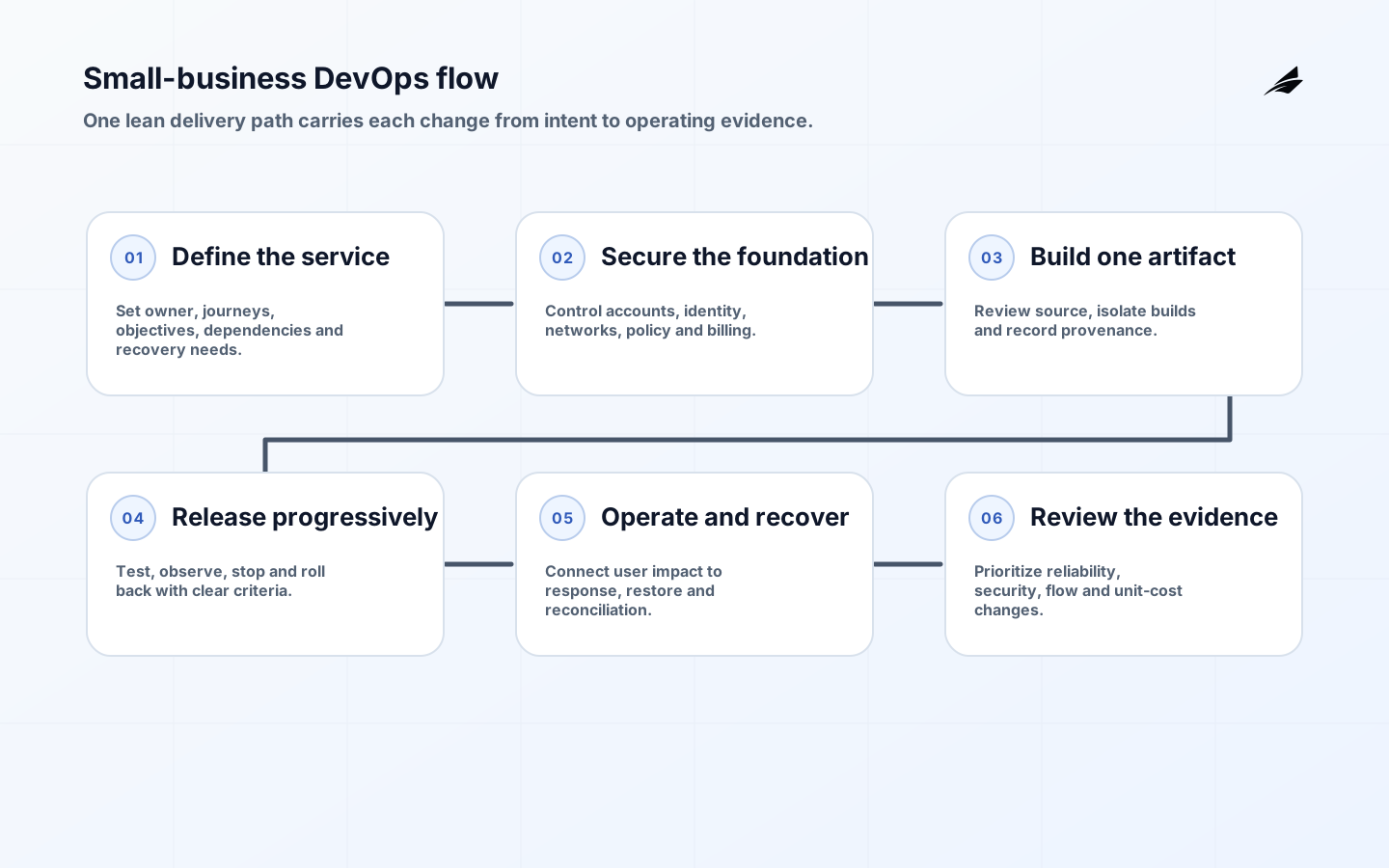
Cloud DevOps services for small business should create a reliable path from a reviewed change to a recoverable production service without requiring a large platform department. This checklist is for an owner, technical lead or delivery partner preparing a real implementation. It prioritizes a thin, complete operating model: clear service ownership, controlled accounts, repeatable infrastructure, protected software delivery, useful telemetry, tested rollback and a support route. The goal is not maximum tooling. It is a delivery system the available team can understand and sustain.
Begin with Edilec's small-business cloud DevOps delivery plan to set scope and budget, and use the small-business DevOps FAQ for provider questions. The broader cloud DevOps implementation checklist helps when the platform grows beyond the lean baseline described here.
1. Define the service and the release promise
Name the application, users, critical journeys, business owner and technical owner. Record operating hours, sensitive data, dependencies, expected demand and tolerated interruption. Choose two or three service indicators such as successful checkouts, p95 API latency or background-job age. The Google SRE guidance recommends objectives based on behavior users care about. Targets should guide release and investment decisions; an arbitrary 99.99% promise can consume scarce capacity without improving the customer experience.
| Checkpoint | Minimum evidence | Owner |
|---|---|---|
| Service boundary | Journey and dependency map | Business owner |
| Release behavior | Pipeline stages, approvers and rollback trigger | Technical lead |
| Security | Data class, access model and open risks | Security owner |
| Operations | Dashboard, alerts, rota and escalation | Service owner |
| Recovery | Restore targets and recent exercise | Continuity owner |
2. Establish a controlled cloud foundation
Keep organization or tenant ownership, billing, domains and root identities under company control even when a provider operates them. Separate production from development using accounts, subscriptions or projects. Require named users, federated sign-in and least privilege. CISA's small-business MFA guidance recommends MFA broadly and phishing-resistant methods where possible. Protect emergency access separately and test it. Define approved regions, networks, encryption, logging, tags and backup defaults before teams provision workloads.

Express repeatable resources as reviewed infrastructure code. Pin tool and module versions, store state in protected remote storage and prevent credentials from entering plans or logs. Require owner, service, environment and cost-center metadata. Start with managed services where they remove undifferentiated maintenance, but record data portability, version limits and recovery behavior. Small teams benefit from fewer components only when each one has a clear owner and exit path.
3. Build one trusted delivery path
Put application, infrastructure and pipeline configuration under version control with protected branches and peer review. Build once, then promote the same immutable artifact through environments. Isolate runners, use short-lived workload identity and restrict production deployment to the pipeline. The SLSA levels specification provides a staged way to reason about build provenance and tamper resistance. A small business may begin modestly, but it should know who produced an artifact, from which source and with which dependencies.
Make checks proportional and fast: formatting, unit tests, dependency and secret scanning, infrastructure policy, an integration test and a deployment smoke test. The NIST Secure Software Development Framework groups work around preparing the organization, protecting software, producing well-secured releases and responding to vulnerabilities. Record accepted exceptions with an owner and expiry. A permanently ignored red check is worse than a smaller gate the team actually maintains.
4. Release progressively and make rollback real
Use a staging environment that exercises production-like identity, data contracts and dependencies without copying unnecessary personal data. Deploy with a health check and observation window. For higher-impact changes, expose a small cohort or instance first. Define rollback conditions before release and distinguish code rollback from data rollback. Database changes should preserve compatibility across the rollout or use a tested forward-fix path. Keep feature flags owned and time-bound so they do not become hidden permanent branches.
Run a failed-release exercise. Confirm the operator can identify the deployed version, stop exposure, restore a known artifact and validate business behavior. Capture how long detection, decision and recovery take. A pipeline's success message is not acceptance; verify a user journey from outside the service and confirm telemetry receives the deployment marker. Require an approval only where a human decision adds risk context, not as a ritual click on every routine change.
5. Instrument supportable operations
Collect signals that connect customer impact to likely cause. The OpenTelemetry overview distinguishes traces, metrics and logs; use each deliberately. A practical baseline includes request success, latency, saturation, queue age, dependency errors, deployment events and security-relevant changes. Redact secrets and personal data at collection. Keep dashboards compact and alerts actionable: each alert needs urgency, owner, notification path and linked response.
Define who responds during and outside business hours, including provider escalation. A small team may use a paid support service rather than a full internal rota, but user impact still needs an accountable incident lead. Prepare runbooks for failed deployment, expired certificate, database saturation, credential compromise and backup restoration. Review incidents without blame, then fund a few high-value actions. An oversized action list that never closes does not improve reliability.
| Signal | Healthy interpretation | Action trigger |
|---|---|---|
| Release frequency | Changes arrive in manageable batches | Pressure causes bypassed checks |
| Change failure rate | Most releases meet the observation window | Repeated rollback from the same cause |
| Time to restore | Authority and runbooks support recovery | Waiting dominates technical repair |
| Objective attainment | Critical journeys meet agreed targets | Error budget is consumed too quickly |
| Cloud unit cost | Spend tracks customers or transactions | Cost rises without a demand driver |
| Unowned alerts | Every page reaches a responder | Alerts wait or bounce between suppliers |
6. Test recovery, handover and cost control
Set recovery time and recovery point targets from business impact. Back up application data, configuration, identity dependencies and infrastructure state as needed, then restore them into an isolated environment. Test application correctness and reconcile records after restoration. Document supplier contacts, renewal dates, architecture, access procedures, dashboards and known limitations. Have someone other than the builder execute a routine release and a recovery step; the resulting questions reveal missing handover detail.
Create budgets and anomaly alerts, but connect cost to service demand. Track cost per customer, order or workload where feasible. Review idle environments, oversized capacity, data retention and network transfer. Do not buy long commitments before demand and architecture are stable. Monthly operating reviews should examine reliability, security, delivery flow, cost and unresolved risk together, then select a small number of owned improvements.
What to require from a DevOps provider
- A responsibility matrix for accounts, pipelines, security, incidents, recovery and cost.
- Customer ownership of strategic identities, repositories, cloud accounts and billing.
- Version-controlled infrastructure and delivery configuration with reviewable change history.
- Service indicators, support hours, escalation and evidence from recent recovery tests.
- Transferable runbooks, dashboards, inventories and a priced transition or exit process.
Use explicit acceptance and handover evidence
Convert the checklist into an acceptance register with requirement, implementation, test result, owner, limitation and review date. Sample evidence rather than accepting screenshots in bulk. Confirm the company can access repositories, cloud consoles, billing, domains, secrets recovery, dashboards and support records without a departing provider employee. Review open vulnerabilities, policy exceptions, failed backups and deferred upgrades. Each accepted limitation should state business impact, compensating control and expiry. This record gives a small team one place to understand what production approval actually covered.
Plan the first month after launch as part of delivery. Limit unrelated changes, watch the defined service indicators, reconcile cloud spend and hold short reviews with users and responders. Check whether alerts lead to useful action, releases remain routine and support documentation answers real questions. Close urgent gaps before expanding scope. At the end of the observation period, decide whether to accept steady-state operation, extend a bounded remediation window or roll back the service change. This prevents a nominal handover from transferring unresolved project work into an invisible support queue.
Review supplier dependence at the same gate. List managed services, marketplace products, hosted source systems and external monitoring or identity providers. Record account owner, renewal, export path, outage behavior and replacement difficulty. Verify that provider staff use customer-approved access and that access can be revoked without disabling the service. A lean delivery model can rely heavily on suppliers, but the business still needs enough information and authority to respond when one changes price, terms, availability or support.

Key takeaways
- A small-business DevOps platform should be thin enough to maintain and complete enough to recover.
- One protected build-and-promotion path is more valuable than several inconsistent pipelines.
- Release checks, telemetry and rollback must be exercised against real user journeys.
- Provider support does not remove the business's responsibility for risk, ownership or evidence.
- Review reliability, security, delivery and unit cost as one operating system.
Frequently asked questions
Does a small business need Kubernetes? Usually not by default; choose it only when workload and operating evidence justify the added platform. Can a provider own the cloud account? The business should retain strategic control and grant scoped provider access. How much automation is enough? Automate frequent, risky and repeatable steps first, while preserving understandable recovery. Is production access ever acceptable? Yes, when time-bound, least-privileged, approved where required and fully logged. How often should recovery be tested? After material changes and on a risk-based schedule, with at least one representative end-to-end exercise.
Conclusion
Implement cloud DevOps services for small business by making the production promise explicit and building one dependable path around it. Secure the account foundation, protect source and artifacts, release progressively, observe customer behavior and rehearse recovery. Once that baseline works under ordinary change and controlled failure, expand automation only where operating evidence shows a real constraint.