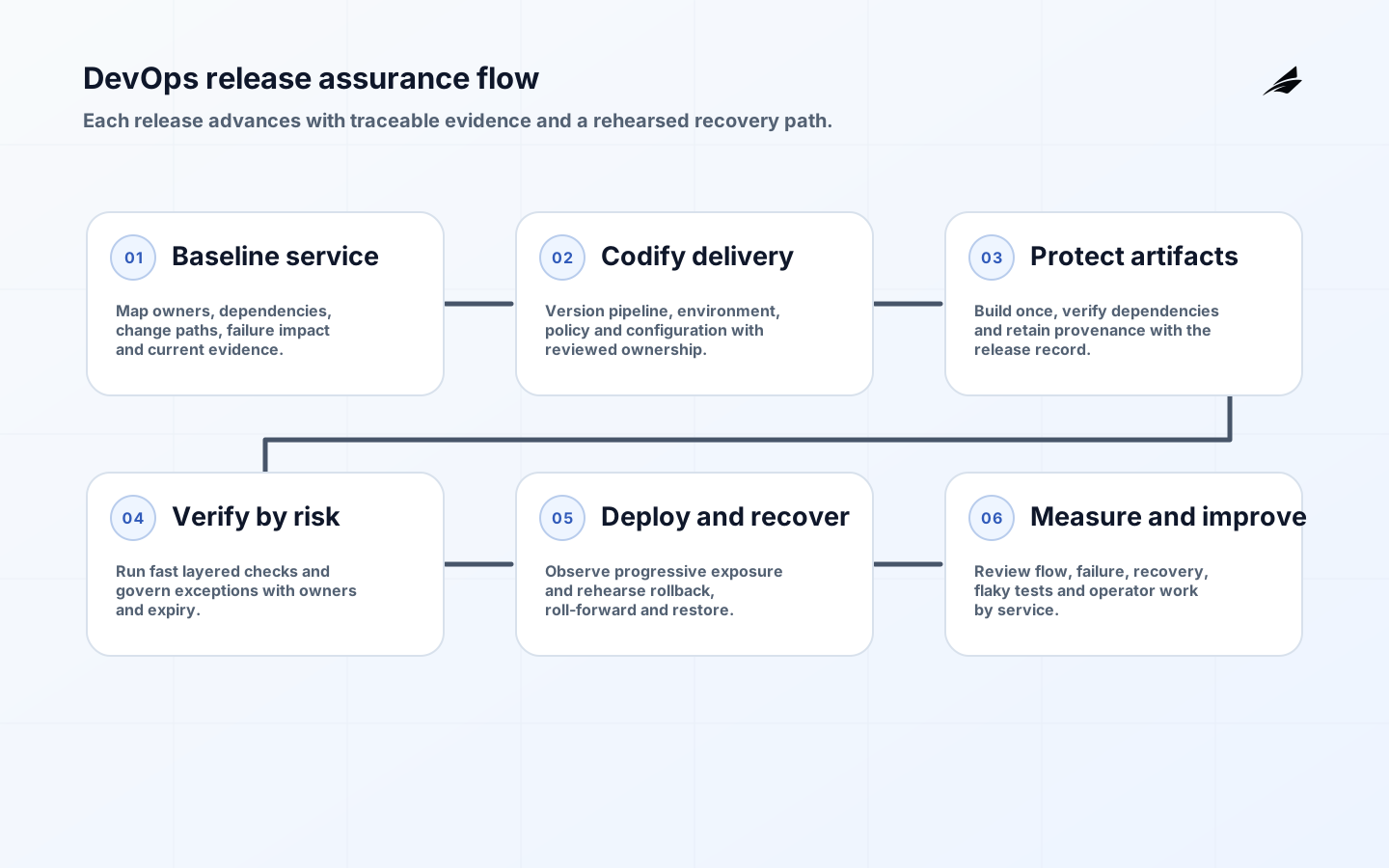
A DevOps automation services implementation checklist should produce more than a working pipeline. It should show that every release has a known source, repeatable build, proportionate verification, controlled promotion, observable outcome and tested recovery path. The search intent behind this guide is practical: buyers and delivery leaders need acceptance criteria they can use before signing off an automation engagement.
This checklist works alongside Edilec's DevOps automation services FAQ, cloud DevOps implementation checklist and cloud DevOps services FAQ. Apply it per service and risk tier; a low-impact internal tool and a revenue-critical platform should not inherit identical gates.
Key takeaways
- Start with the service, current release path and failure consequences before selecting tools.
- Keep source, configuration, infrastructure definitions, policy and pipeline logic under reviewable version control.
- Build one immutable artifact, verify it, promote it and preserve provenance instead of rebuilding per environment.
- Automate recovery evidence as deliberately as deployment; an untested rollback button is not a control.
- Measure flow and reliability together so speed does not conceal rework, failed changes or fragile tests.
1. Baseline the release system and ownership
Map the path from an approved change to a production outcome. Record repositories, build workers, artifact stores, environment boundaries, secrets, approvals, database changes, external dependencies, manual handoffs and people with emergency access. Capture elapsed time and active work separately. The map often reveals that the longest delays are queues, unclear ownership or environment drift rather than compilation.

Define a service owner, platform owner, security approver and incident decision maker. For each control, name who maintains it and what evidence demonstrates that it ran. The DORA continuous delivery guidance treats automation as one capability within a broader system of testing, version control, architecture and team practice. That is the right implementation frame: tooling cannot compensate for ambiguous release authority or an application that cannot be deployed independently.
| Baseline question | Evidence to collect | Acceptance condition |
|---|---|---|
| What enters production? | Repository, branch policy and artifact identity | Every deployed version resolves to reviewed source and a retained build |
| Who can promote it? | Role matrix, approval policy and emergency path | Least privilege is enforced and exceptional access is logged |
| How is failure detected? | Service objectives, smoke tests and telemetry | A release outcome is visible within an agreed detection window |
| How is service restored? | Rollback, roll-forward and data recovery runbook | Recovery is rehearsed against a representative failure |
2. Design the target path before configuring tools
Write the target workflow as states and contracts: change accepted, build created, checks passed, artifact signed, environment prepared, release authorized, deployment observed and outcome recorded. Specify inputs, outputs, timeout behavior and retry rules at each boundary. A pipeline that retries a non-idempotent database step can amplify damage; a pipeline that silently skips a scanner can create false confidence.
Favor small, composable stages with explicit failure behavior. The DORA deployment automation guidance recommends versioning deployment scripts and configuration, using CI-created packages and simplifying manual steps. Treat pipeline code as production code: peer review it, test reusable modules, pin dependencies, protect runners and separate build identity from deployment identity.
3. Secure the build and preserve provenance
Create artifacts in isolated workers from declared dependencies. Do not place long-lived production credentials in build jobs. Use short-lived workload identity where the platform supports it, restrict egress where practical and prevent unreviewed forks from reaching protected secrets. Generate a dependency inventory or software bill of materials when it supports vulnerability response and customer obligations. Retain the commit, builder, dependency lock, test result, policy result and artifact digest as one release record.
Use the NIST Secure Software Development Framework to check that automation covers organizational preparation, software protection, production of well-secured software and vulnerability response. Scanner presence is not enough. Define what severity blocks a release, who may accept a time-bound exception, how compensating controls are recorded and when the exception expires.
| Control area | Automated gate | Human decision that remains |
|---|---|---|
| Source | Protected branch, review and secret detection | Whether the change is appropriate for the service |
| Build | Dependency integrity, unit tests and artifact digest | Risk acceptance for unresolved findings |
| Environment | Policy checks, drift detection and configuration validation | Approval for material topology or data changes |
| Release | Smoke test, health threshold and progressive exposure | Continue, pause or reverse under ambiguous impact |
| Operations | Alert routing and release annotation | Incident severity and business communication |
4. Build a fast, risk-based test portfolio
Put deterministic, inexpensive checks early: formatting, static analysis, unit tests, policy validation and configuration tests. Follow with contract and integration tests, then a narrow set of end-to-end journeys and nonfunctional checks. The DORA test automation guidance emphasizes fast feedback throughout delivery rather than a separate testing phase. Track test duration, failure cause and flake rate; a suite that engineers habitually rerun or ignore is not protecting releases.
Use production-like interfaces and representative data shapes without copying sensitive production data casually. Test schema evolution, backward compatibility, queue redelivery, duplicate events, dependency timeouts and partial failure. Add security verification appropriate to the threat model. Keep exploratory testing for new behavior and uncertain risks rather than attempting to automate every observation.
5. Automate deployment, verification and recovery
Promote the same artifact through environments. Separate deployment from feature exposure where feature flags are suitable, and use canary, rolling or blue-green strategies according to statefulness and blast radius. Define health signals before rollout: request success, latency, saturation, queue lag, business transaction completion and dependency errors. A green orchestrator status is not sufficient evidence that users received a healthy service.
Choose rollback or roll-forward based on data compatibility. Reversing application binaries cannot undo a destructive migration, so use expand-and-contract changes, backups and reconciliation where state is involved. Rehearse a failed release, loss of the artifact store, expired credential and unavailable dependency. Record recovery time and the operator decisions that automation cannot safely make.
6. Instrument the path and hand it over
Instrument the delivery system and the deployed service. OpenTelemetry defines traces, metrics and logs as complementary signals; correlate them with artifact and deployment identifiers so an operator can connect a regression to a release. Monitor runner capacity, queue time, stage duration, cache behavior, policy failures, deployment frequency, change failure and restore time.
Handover should include architecture, repository ownership, credential rotation, runner maintenance, dependency update policy, exception register, alert routing, cost envelope and support escalation. Pair the receiving team through normal releases and at least one recovery exercise. Remove implementation-team access that is no longer needed and schedule an early operational review.
Acceptance scorecard
| Outcome | Leading evidence | Operational measure |
|---|---|---|
| Repeatability | Environment and pipeline definitions are versioned | Manual release steps and drift incidents |
| Security | Protected identities, retained provenance and governed exceptions | Escaped critical findings and exception age |
| Flow | Fast deterministic checks and clear ownership | Lead time, queue time and deployment frequency |
| Reliability | Progressive verification and rehearsed recovery | Change failure rate and restoration time |
| Maintainability | Named owners, runbooks and tested upgrades | Pipeline failures caused by platform debt |
Migrating an existing release path
Do not replace a fragile release system in one jump. Select one representative service, capture the current artifact and deployment evidence, then run the new path in parallel through nonproduction. Compare configuration, package contents, database behavior and post-deploy signals. Preserve the known recovery procedure until the automated replacement has passed failure exercises. Migrate shared pipeline modules only after their interface and ownership are stable.
Sequence services by learning value and consequence. A low-risk but realistic service can validate runners, identity, artifacts and telemetry; a critical service can follow once common controls are proven. Freeze new bespoke pipeline variants during migration and publish a retirement date for legacy paths. Track exceptions explicitly so temporary compatibility does not become permanent platform debt.
For each migrated service, reconcile deployed versions, revoke obsolete credentials, archive evidence required for audit and remove unused runners or scripts. Review whether lead time, failure rate and operator work actually improved. If automation shifted effort into brittle test maintenance or platform support, adjust the design before expanding.
Maintain a control catalog that maps each pipeline check to the risk it addresses, the services that inherit it and the person who can change it. Review bypasses and stage failures monthly. This keeps a shared platform from accumulating ceremonial gates that delay delivery without detecting meaningful defects.
When a control changes, test both its intended block and its failure behavior. Confirm that a scanner outage, policy-service timeout or artifact-store error cannot be interpreted as a pass. Record availability objectives for the delivery platform itself because a reliable application team still depends on runners, repositories and identity services.
Frequently asked questions
What should a team automate first?
Automate the repeated path that creates the most risk or delay, usually build reproducibility, unit checks, artifact retention and deployment to a nonproduction environment. Preserve a working manual recovery path while the automated control earns trust. Avoid starting with a broad tool migration when service ownership and release criteria are still unsettled.
Should production deployment always require manual approval?
Not necessarily. Approval depth should follow consequence, confidence and regulatory needs. Low-risk changes with strong automated evidence may flow automatically, while high-impact data, identity or infrastructure changes may need separation of duties. Manual approval adds value only when the approver has useful evidence and authority to stop the release.
How should DevOps automation services be measured?
Use a balanced set: lead time, deployment frequency, change failure, restoration time, escaped defects, pipeline availability, flaky-test rate and operator effort. Compare trends by service and change type. A single organization-wide target can encourage gaming and obscure materially different risk profiles.
Conclusion
A strong DevOps automation services implementation checklist links every automated step to an owner, risk and observable acceptance condition. Build once, preserve provenance, test in layers, promote deliberately, watch real outcomes and rehearse recovery. When those controls are documented and operable by the receiving team, automation becomes a durable delivery capability rather than a collection of scripts.