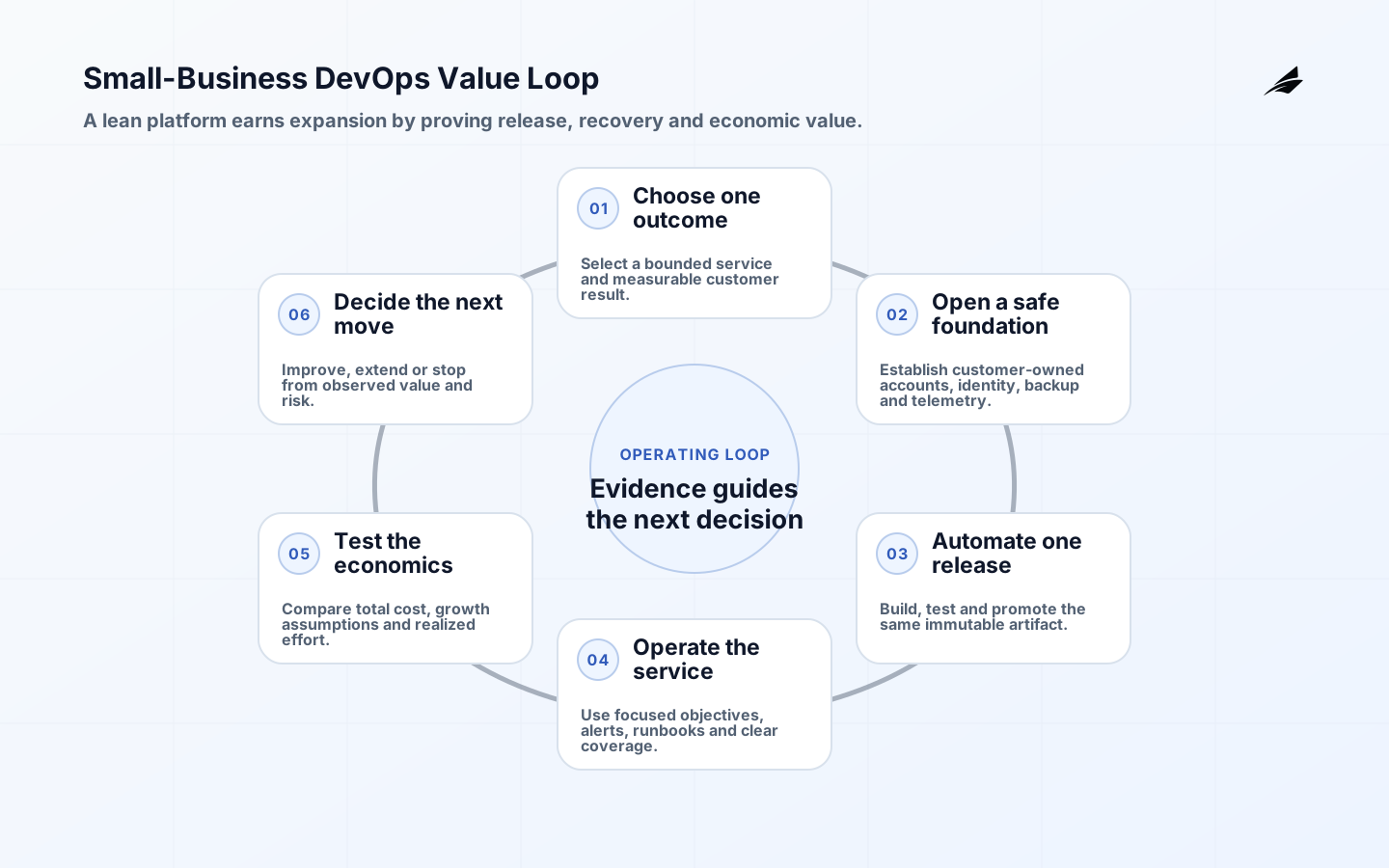
Cloud DevOps services for small business should reduce release risk and operating effort without creating a platform that needs a larger team to understand it. The right scope is usually a narrow, repeatable path from reviewed code to observable production, supported by clear recovery and cost controls. Sophisticated orchestration is valuable only when the workload and team can justify its continuing burden.
Use this delivery plan with the small-business implementation checklist, small-business DevOps FAQ, enterprise cloud DevOps guide and SaaS cloud DevOps plan. The goal is an operating capability, not a tool inventory.
Scope services around business outcomes
Start with three questions: which customer journey depends on the platform, how often must it change, and what failure can the business tolerate? Convert answers into measurable outcomes such as a same-day low-risk release, restoration within two hours, or traceable monthly cloud spend. Inventory applications, repositories, domains, data stores, suppliers and manual deployment steps. Identify the one service that offers the best learning with bounded consequence.
A useful initial scope normally covers account and identity setup, infrastructure as code, one build and deployment path, secret handling, backups, baseline security checks, service-level monitoring, cost allocation and operator runbooks. Migration of every application, a full data-platform redesign and around-the-clock managed response are separate workstreams. Make exclusions visible so an attractive fixed price does not hide unresolved responsibilities.
| Scope level | Includes | Best fit |
|---|---|---|
| Foundation | Accounts, identity, network, logging, backup baseline | Business with inconsistent cloud setup |
| Delivery path | Build, test, artifact, staged deployment and rollback | Team releasing manually |
| Operational readiness | SLIs, alerts, runbooks, restore test and incident roles | Customer-facing workload |
| Managed operations | Monitoring response, patching, change and reporting | Team needing defined ongoing coverage |
Choose the minimum viable platform
Prefer managed services where they remove undifferentiated maintenance, but inspect their exit path, limits and cost behavior. A small web product may need managed runtime, database, object storage, identity and a hosted pipeline. It may not need a multi-cluster container platform. Standardize one supported runtime pattern first; every additional database engine, deployment mechanism and observability stack increases the number of failure combinations the team must own.
The Google Cloud resource-management guidance recommends rightsizing from actual demand, using autoscaling where appropriate and reviewing utilization and cost regularly. Apply those principles provider-neutrally. Establish quotas and budget alerts before load arrives, but do not make automatic shutdown the default for production services where interruption could cost more than temporary overspend.
Build a release path with evidence
Create one pipeline that checks formatting and tests, scans dependencies and configuration, builds an immutable artifact, records provenance, deploys to a representative environment, runs smoke tests and promotes with an explicit decision. Protect the default branch and production environment. Give the pipeline a narrowly scoped workload identity; avoid long-lived cloud keys in repository settings. Preserve the relationship among commit, review, artifact, deployment and operator.
The DORA continuous-delivery capability describes low-risk release on demand and links it to technical practices including version control, deployment automation, continuous integration and test automation. For a small team, progress is visible when releases become smaller, recovery becomes routine and a normal business-hours deployment no longer depends on one person's memory.
Design operations for a small team
Define a few service-level indicators from the user perspective. The Google SRE SLO chapter explains why a handful of representative indicators is more useful than every available metric. For an online booking service, measure successful bookings, latency and payment callback completion. Add infrastructure signals to diagnose those outcomes, then alert only when human action is urgent and documented.
Write runbooks for the failures the team is likely to face: deployment regression, expired certificate, database saturation, third-party outage, lost credential and restore request. Each runbook should include verification, containment, communication, recovery and escalation. Contracted managed operations must state coverage hours, response targets, excluded components and the boundary between investigation and corrective change.
Estimate total cost, not just provider spend
Build a twelve-month model with implementation labor, subscriptions, cloud consumption, support plans, security services, data transfer, backup storage, test environments, observability retention and managed response. Show a base case, expected growth and a credible stress case. State pricing assumptions and currencies. The FinOps Framework treats cloud value as a collaborative practice; assign cost decisions jointly to engineering, finance and the business owner.
| Cost driver | Planning unit | Control |
|---|---|---|
| Compute | Requests, runtime hours or capacity | Rightsize and autoscale from observed demand |
| Data | Stored, queried and transferred volume | Retention, lifecycle and query guardrails |
| Tooling | Users, hosts or ingest volume | Consolidate and cap high-cardinality telemetry |
| Operations | Coverage hours and incident volume | Automate repeatable work and clarify support |
| Change | Releases and failed-change effort | Smaller batches, tests and rollback |
A sample retail firm might budget for one production service and one low-cost test environment, daily backups, thirty days of searchable logs and business-hours response. Its stress case doubles traffic and triples log ingestion during a campaign. That model exposes whether telemetry, data transfer or database I/O grows faster than revenue and gives the owner a decision before the invoice arrives.
Control delivery and supplier risk
Keep repositories, cloud accounts, domains, encryption keys and billing relationships under the customer's organizational control. Grant the service provider time-bound access and log privileged action. Require documentation, export formats, subcontractor disclosure, incident notification, deletion and transition support in the contract. Verify that the team can revoke supplier access without interrupting the application.
Use the NIST Cybersecurity Framework 2.0 functions to check that the project includes governance, identification, protection, detection, response and recovery. The framework is risk-based, so tailor depth to the workload. At minimum, maintain an asset inventory, access control, protected backups, meaningful logging, an incident contact path and a tested recovery procedure.
Deliver in four controlled increments
Weeks one and two cover discovery, ownership, current-state measurement and target architecture. The next increment creates accounts, identity, infrastructure code and telemetry. The third builds the pipeline, migrates one low-risk service and rehearses rollback. The final increment load-tests critical paths, restores data, closes high-risk findings, trains operators and records an agreed backlog. Calendar length changes with complexity; exit evidence should not.

Use acceptance gates after each increment. A design gate confirms trade-offs and cost assumptions; a foundation gate confirms access, logging and recoverability; a release gate links code to running artifact; an operations gate proves alerts, response and handover. Hold back a portion of acceptance until the customer team performs a release and restore themselves.
Worked example: a small retailer's first delivery path
A retailer with six engineers runs an online catalog and order API from manually configured virtual machines. Releases occur monthly at night because rollback depends on snapshots and one senior developer. The initial engagement selects the catalog, which is customer-facing but can tolerate a short degraded mode. The target is a reviewed, repeatable weekday release with p95 response and successful product-view indicators, plus a thirty-minute rollback decision.
The minimum platform uses managed application runtime, managed database, object storage, infrastructure code and a hosted pipeline. The pipeline builds one immutable image, runs unit and contract tests, scans dependencies, deploys to a test environment and promotes the same digest to a small production cohort. A feature flag separates deployment from catalog exposure. Operational work covers certificate and database alerts, daily backup verification, a quarterly restore exercise and business-hours incident response with a documented escalation supplier.
The cost model includes runtime, database I/O, image and backup storage, log ingestion, support, pipeline minutes and eight engineering days for implementation and training. A stress scenario models campaign traffic and log volume. After two release cycles, queue time falls, rollback is demonstrated and the team schedules non-production capacity overnight. The order API moves next only after the catalog owner performs the release and recovery steps without the consultant's credentials.
Evidence to request from the service provider
- Current-state inventory and a target design with explicit exclusions and customer responsibilities.
- Customer-owned account, repository, domain, billing and key arrangements with access revocation tested.
- Infrastructure code and pipeline definitions reviewed by the customer's engineers.
- Artifact-to-deployment trace showing review, tests, digest, target and outcome.
- Twelve-month base, growth and stress cost cases with stated pricing assumptions.
- Service indicators, alert routes, coverage hours and supplier escalation boundaries.
- Recorded rollback, restore and manual-fallback exercises with measured timings.
- A dated backlog for deferred risks, platform improvements and legacy retirement.
Key takeaways
- Start with one important service and one repeatable path to production.
- Select managed components that reduce the team's continuing operating load.
- Model labor, tooling, data, support and growth alongside cloud consumption.
- Keep customer accounts, code, keys and billing under customer control.
- Accept the work through observed releases, restores and operator-led handover.
Frequently asked questions
How much do small-business cloud DevOps services cost?
Cost depends on workload count, migration difficulty, compliance needs, availability targets and coverage hours. Ask for a transparent implementation estimate plus a twelve-month operating model with assumptions. Compare offers on delivered evidence and continuing ownership, not the count of tools configured.
Should a small business use fully managed DevOps?
Managed support can fill coverage and specialist gaps, but the business still needs a service owner who controls priorities and risk. Retain access to accounts, repositories, telemetry and runbooks, and test transition procedures before dependency becomes difficult to unwind.
Does a small business need Kubernetes?
Not by default. It is appropriate when workload portability, scheduling, ecosystem requirements or organizational scale outweigh cluster and platform overhead. Managed application runtimes or simpler container services are often easier to operate for a small, uniform portfolio.
Conclusion
A lean cloud DevOps engagement gives a small business faster, safer change and a service it can understand. Scope one useful platform pattern, attach evidence to every release, plan total cost and leave ownership with the operating team. Scale the platform only when real demand proves the need.