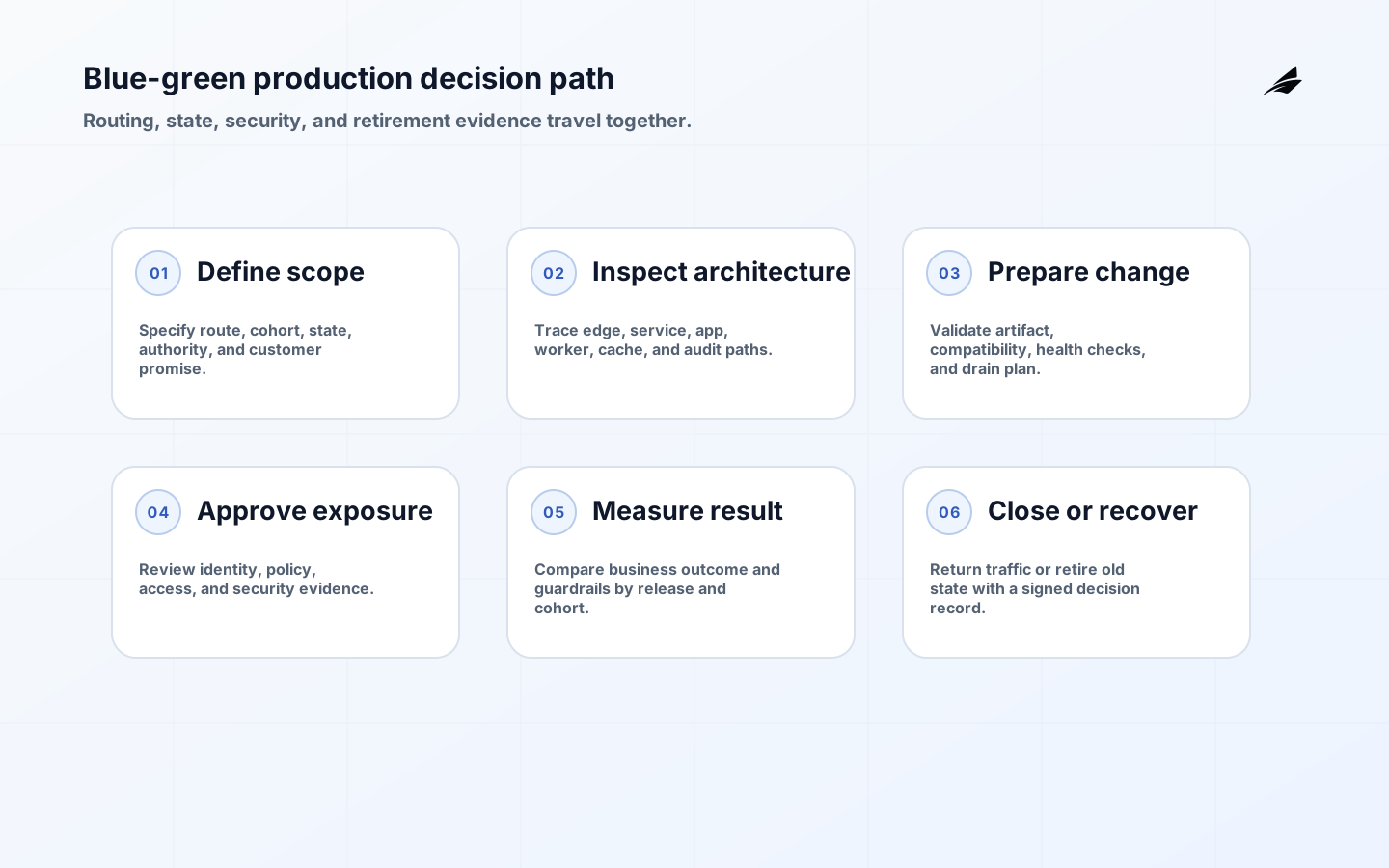
A blue-green deployment gives a team two production-capable environments and a controlled way to send traffic from one to the other. The pattern can reduce code deployment risk, but it does not magically make data or external effects reversible. Google Cloud Deploy’s blue-green documentation describes the deployment and promotion lifecycle; AWS’s deployment-options overview usefully frames the pattern as one choice among deployment strategies. The operational question is whether the inactive environment is truly ready to receive real customer behavior.
Define the blue-green deployment Boundary
The first production artifact is a traffic-switch checklist that names the blue and green revisions, data compatibility rules, health checks, DNS or load-balancer control, and rollback authority. For blue-green deployment, the important risk is switching traffic to a healthy-looking environment whose data, caches, callbacks, or dependencies are not compatible with the live service.
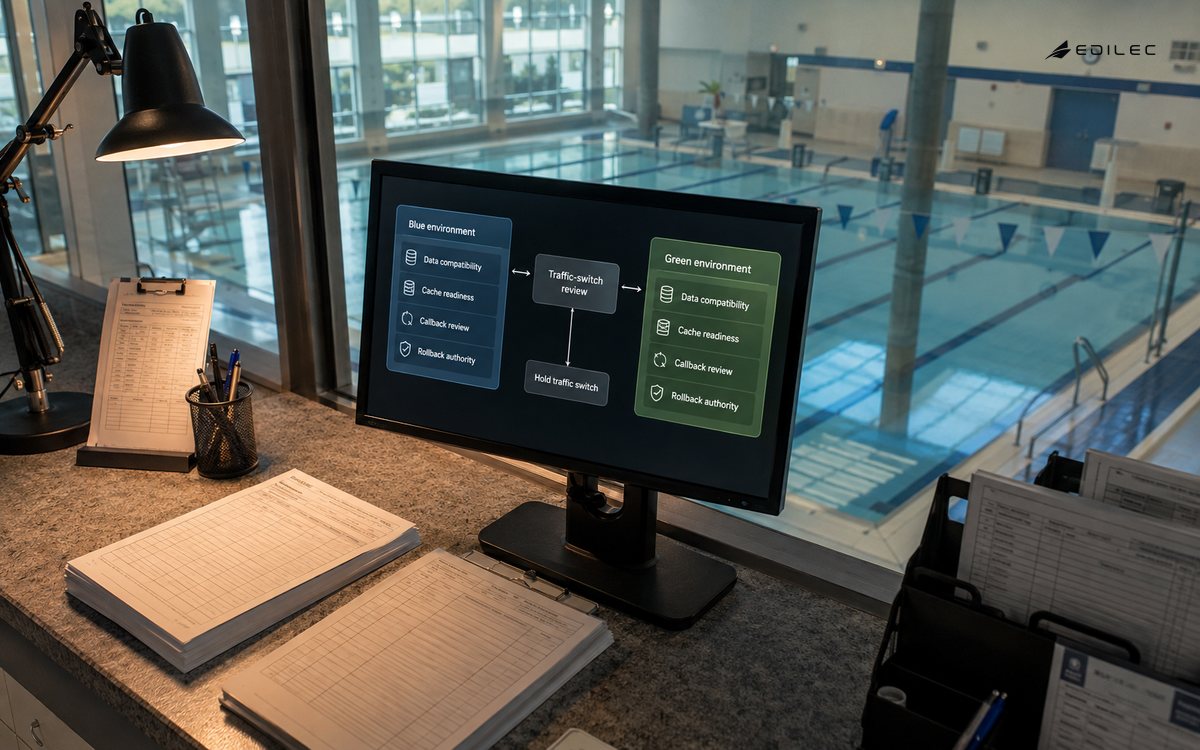
Name the two environments by role, not by color alone: current serving revision and candidate revision. Both need the same infrastructure policy, secrets access, observability, dependency reachability, and capacity assumptions. The candidate can be technically healthy yet unprepared for real queues, partner callbacks, or cached sessions. Capture the precise switch mechanism and its propagation delay, because a DNS change, load balancer action, and service-mesh route have different rollback characteristics.
| Decision element | Question to settle | Evidence to retain |
|---|---|---|
| Outcome | What user or operator result should blue-green deployment improve or protect? | A baseline, target, and named service owner. |
| Scope | Which services, environments, and actors are included? | A current inventory and explicit exclusions. |
| Guardrail | What harm must stop the work? | Thresholds, alert query, and stop authority. |
| Recovery | How is normal behavior restored? | A tested runbook and decision record. |
Build a blue-green deployment Architecture That Can Be Explained
Compatibility is the center of the design. The candidate must read data written by the current version, and the current version must survive any data writes made during a short reversion window. Use additive schema changes, versioned events, and dual-read or dual-write techniques only when the team can observe and retire them. Session, cache, and background-work ownership also need a choice: isolate, drain, or deliberately share. A blue-green diagram without those contracts merely hides the hard part behind two colors.
For blue-green deployment, keep the architecture legible to the person on call. Show the entry point, authoritative records, identities, policy or control points, telemetry, and the path to a safe state Azure canary and blue-green releases is a useful reference for the underlying mechanisms.
Separate Exposure Readiness from Return Readiness
Deploy and validate green before it receives customer traffic. Run smoke tests using production-like identities, verify dependencies and configuration, and warm only the caches that can be safely warmed. Then switch a bounded entry point or region first when possible. Promotion requires an explicit gate based on user-facing transactions, not only infrastructure health. Azure’s release guidance is helpful for comparing the trade-off with progressive exposure.
For blue-green deployment, make the release record specific enough for another operator to continue the work: baseline, exact configuration or revision, expected effect, affected cohort, observation window, guardrail queries, and recovery action. Use the delivery guide to compare this decision with the surrounding release process.
| Stage | Minimum output | Decision gate |
|---|---|---|
| Discover | Current boundary, baseline, owner, and known constraints. | The problem can be measured without guessing. |
| Design | Controls, evidence path, and recovery action. | The main consequence has a practical safeguard. |
| Pilot | A limited change with explicit stop conditions. | Observed behavior supports a wider use. |
| Operate | Runbook, alert owner, and review cadence. | Normal turnover will not erase knowledge. |
| Improve | A recorded lesson and next hypothesis. | Evidence, rather than urgency, selects the next change. |
Make Promotion Evidence Legible
Use traffic-switch duration, successful-transaction rate before and after cutover, restoration time, and the number of environment-drift findings. Compare a direct customer outcome with a guardrail; inspect each revision, region, workload, cohort, and service route separately before treating the aggregate as safe. AWS deployment options overview provides authoritative context, but the threshold must reflect the consequence and operating capacity of this service.
Keep the prior serving environment available for the agreed stabilization period, with its version and operational state recorded. Alerts must identify which environment served the failed request; otherwise the team loses the main diagnostic advantage of the pattern. After a successful cutover, avoid immediately redeploying the old environment. Preserve it long enough to restore traffic, then retire or repurpose it through controlled infrastructure changes so hidden drift does not accumulate.
Test Shared State Before Calling It Reversible
The expensive failure mode is duplicated capacity with no reliable switchback. It often comes from skipping readiness checks, allowing environment-specific configuration, or making destructive data changes during the same release. Another is assuming that a traffic switch reverses asynchronous work already emitted. Define compensating actions for jobs and messages before release. The pattern earns its cost when it offers a quick, understood recovery path for a specific service boundary, not when it is applied by default everywhere.
A sound blue-green deployment review separates evidence from explanation. Use observability and incident context to improve the investigation path rather than adding vague monitoring Close the review with one owned correction, a due date, and an explicit decision about whether the operating boundary can widen
Leave a Record Another Responder Can Reconstruct
Capacity and state determine whether the inactive environment is a real recovery option. A candidate that has never handled production-sized connection pools, background throughput, or cache churn can fail immediately after cutover. Test those assumptions deliberately and record what is shared between environments. The switch decision should include operational readiness, not just application version readiness.
For blue-green deployment, rehearse the traffic change under an ordinary maintenance window and include cache, session, and background-worker observations. A practiced switch is more valuable than a theoretical second environment.
Record which checks must pass before promotion and which failures trigger a traffic return. That clarity prevents a cutover from becoming a judgment call made with incomplete context.
Ask a Different Question About Rollback
A candidate can be ready to receive traffic and still be unsafe to return from. Review those decisions separately. Release readiness asks whether the new revision satisfies compatibility, health, security, and business acceptance checks. Rollback readiness asks whether the previous revision can still serve the state that the candidate may have created, whether queued work can be drained or deduplicated, and whether the routing authority can act within the customer-impact window. This distinction keeps a green deployment check from being mistaken for a complete recovery plan.
For a checkout service, write the decision record around the actual irreversible edges: payment authorization, order creation, inventory reservation, fulfilment notification, and customer email. Test a cutover after authorization but before order confirmation, then test the return path with the same correlation identifier. AWS’s ECS blue/green guidance distinguishes canary, linear, and all-at-once traffic shifts; whichever exposure pattern is chosen, retain the cohort and stabilization evidence with the release record. The right question is not “did the route change?” but “can the team explain every side effect that crossed it?”
| Decision | Evidence to approve | Owner when it fails |
|---|---|---|
| Promote | Candidate health, compatibility, access, and user outcome checks. | Release owner pauses exposure and records the gap. |
| Hold | Observed guardrail breach or incomplete evidence. | Operations owner keeps the current route stable. |
| Return | Known traffic action, state behavior, and verification query. | Incident lead coordinates routing and customer-impact review. |
| Retire | Delayed work settled and recovery evidence retained. | Service owner signs the end of the rollback window. |
Key Takeaways
- Blue-green deployment should begin with a defined user outcome and a named operating boundary.
- Treat ownership, evidence, and recovery as implementation requirements, not documentation afterthoughts
Kubernetes Service documentation explains the stable service endpoint boundary; use it to verify which route can receive traffic during a switch.
Frequently Asked Questions
When is blue-green deployment ready for production? A production decision matrix is ready for bounded exposure once scope, owner, evidence, control, and return action have each been exercised. What should a small team do first for blue-green deployment? Start with one customer journey, capture a baseline, and change one reversible route; broad programmes create evidence gaps. How often should it be reviewed? Review after any material change or incident, using a cadence proportionate to the consequence. What if the data is incomplete? Expose uncertainty, narrow the action, and improve the measurement before choosing an irreversible step. This related operations guide can help establish the surrounding reliability practice.
Conclusion
The durable version of blue-green deployment is an operating promise: what the team is improving or protecting, who can decide, which evidence matters, and how harm is contained.
A useful management checkpoint is to ask an independent responder to reconstruct the change from the record alone. They should find the active and candidate revisions, routing scope, state-compatibility decision, security approval, measured outcome, and recovery trigger. If any answer depends on a private chat or one engineer's memory, the control is not ready for scale. Vendor mechanics may differ, but. Google Cloud Deploy, Azure Front Door, AWS deployment options, and Kubernetes Services should all leave the same decision evidence behind.
A production decision matrix is useful only when another responder can reconstruct the exposure from the record. Retain the active and candidate revisions, state-compatibility judgment, security approval, cohort evidence, and return trigger; then revisit the matrix whenever a shared dependency or customer consequence changes.
A useful operating decision for What Changes. When Blue-green Deployment Moves into Production begins with a specific boundary. For blue-green deployment, that means separating the design choice from the controls that make it safe to operate. Each answer leads to a different next action.