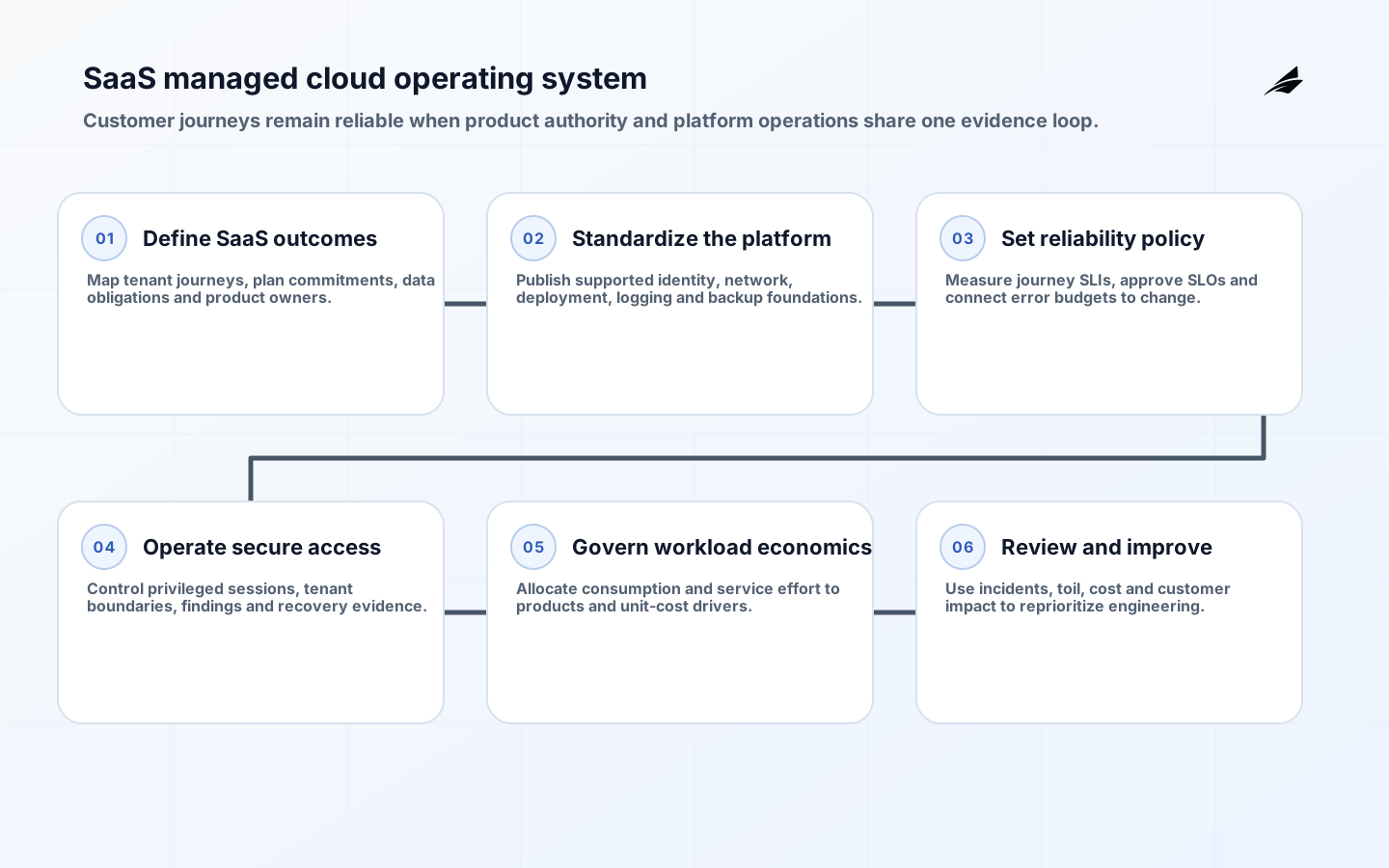
Managed cloud services for SaaS companies combine platform engineering, production operations, security response, reliability work and cloud financial management around a live software product. The service is not simply an administrator watching infrastructure. It must preserve tenant isolation, subscription flows, release safety, data recovery and customer-facing service objectives while the product continues to change. That makes the operating boundary more important than the tool list: a SaaS company must know which decisions stay with its product team, which platform duties are delegated, and how both parties respond when a customer journey degrades.
The commercial question is therefore not whether an external team can manage Kubernetes, databases or alerts. It is whether the arrangement reduces operational risk without separating product knowledge from production authority. NIST's cloud reference architecture distinguishes consumer and provider responsibilities, while Google SRE guidance starts reliability design with behavior users care about. A sound plan applies both ideas: define the service in customer terms, then assign every platform control, workload action and escalation to a named owner. The companion implementation checklist can be used after this scope is agreed.
Define the managed service around SaaS outcomes
Begin with customer journeys and business obligations rather than resources. Login, checkout, data import, scheduled processing, billing, notification and administrative access may each have different availability, latency, consistency and recovery needs. Record the tenants and regions affected when a dependency fails, the support promises attached to paid plans, and the operational events that can create financial or regulatory exposure. This prevents a nominally healthy cluster from hiding a broken product path. Service scope should also state exclusions: product-roadmap decisions, application feature ownership and customer policy normally remain with the SaaS company even when platform work is delegated.
| Area | SaaS company remains accountable for | Managed service may operate | Required evidence |
|---|---|---|---|
| Product behavior | Acceptance rules, tenant impact and release priority | Deployment workflow and runtime controls | Journey SLO and release record |
| Data | Purpose, classification, residency and deletion policy | Encryption, backup, restore and database operations | Restore test and access history |
| Security | Risk acceptance and customer obligations | Patching, posture monitoring and incident triage | Finding owner and response timeline |
| Reliability | User promise and error-budget policy | Monitoring, on-call and recovery execution | SLI, incident log and post-incident action |
| Cost | Unit economics and commercial trade-offs | Allocation, anomaly response and optimization work | Cost per tenant or workload driver |
Build a platform baseline before transferring operations
A managed service cannot standardize an estate it has not classified. Inventory accounts, subscriptions, clusters, networks, data stores, secrets, deployment paths, third-party services, observability systems and manual interventions. For each workload, capture owner, environment, data sensitivity, deployment frequency, recovery objective and known single points of failure. Then establish a supported baseline for identity federation, privileged access, network segmentation, encryption, key ownership, image provenance, logging, backup and infrastructure as code. Exceptions should carry a reason, compensating control, owner and expiry date; otherwise inherited irregularities become permanent operating risk.
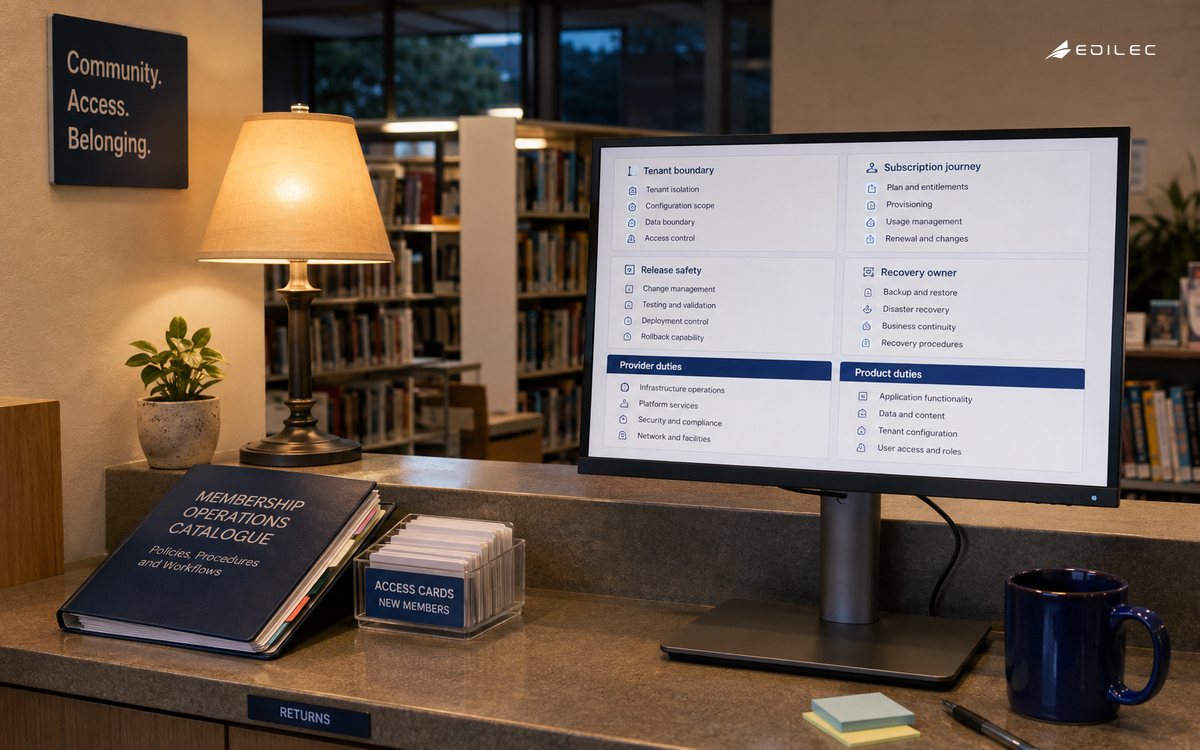
The baseline should be usable by delivery teams, not only auditors. Provide approved modules and paved deployment paths with documentation, test environments and observable failure behavior. Platform changes need versioning and a migration policy because a shared module can affect many tenants at once. The CISA cloud security reference architecture emphasizes shared services and posture management; for SaaS, that translates into reusable controls plus continuous evidence. A baseline is successful when a product team can launch a bounded workload without inventing identity, network, logging and recovery practices again.
Connect service objectives to on-call decisions
Service level indicators should measure customer-visible behavior: successful authenticated requests, completed purchases, fresh scheduled reports or durable writes. Resource utilization is diagnostic context, not the promise itself. Set an objective with a measurement window, data source and exclusions, then decide how error-budget consumption changes release behavior. A breach may pause risky platform changes, trigger capacity work or require a product simplification. Alerting should be actionable and tied to user impact or imminent exhaustion. Every page must have an owner, diagnostic starting point, escalation path and safe mitigation.
Incident response requires more than a shared chat channel. Define who can declare an incident, assume command, change production, communicate with customers and involve a cloud provider. Keep a working timeline of observations, decisions and mitigations. Practice dependency failure, credential compromise, bad deployment, regional impairment and data-recovery scenarios. The managed team needs enough application context to mitigate safely, while product engineers need access to operational evidence. The SaaS managed-cloud FAQ addresses common questions about this shared model.
Preserve tenant security and data obligations
SaaS operations amplify small access mistakes because shared systems serve many customers. Administrative paths should use federated identities, short-lived privileges, strong authentication and attributable sessions. Separate human support access from workload identities, and constrain automation by environment and action. Logs must reveal who changed policy, accessed sensitive records or invoked recovery. Data controls should cover region, encryption, key custody, backup location, retention, deletion and legal hold. A provider's platform certification does not prove that the SaaS configuration, application authorization or support workflow is correct.
| Risk | Early signal | Control | Acceptance test |
|---|---|---|---|
| Cross-tenant exposure | Unexpected tenant identifiers in logs or exports | Immutable tenant context and authorization tests | Attempt cross-tenant API, job and support access |
| Silent backup failure | Backup age or restore duration drifts | Protected schedules and restore rehearsal | Restore representative data to an isolated environment |
| Alert overload | Pages rise while user impact stays flat | SLO-based alerting and ownership review | Sample alerts for actionability and correct routing |
| Provider dependency | Quota, API or region errors recur | Fallback, escalation and dependency SLOs | Run a provider impairment exercise |
| Privilege drift | Standing roles and unused credentials grow | Time-bound access and periodic recertification | Trace an emergency session end to end |
Model cost as workload economics, not a discount hunt
Managed-cloud cost has three layers: provider consumption, service labor and change investment. Provider spend includes compute, storage, database, observability, data transfer and support. Labor includes on-call, routine operations, incident work and reporting. Change investment covers migration, automation, reliability improvements and technical-debt removal. Compare these with avoided downtime, faster releases and reduced specialist hiring, but do not claim savings before a baseline exists. Allocate spend to products, environments and major tenants where practical, and track unit measures such as cost per active tenant, transaction or processed record.
Commercial terms should discourage hidden queues. Clarify included hours, response versus resolution, project work, after-hours changes, third-party escalation and consumption overruns. A low fixed fee can produce a narrow service that forwards alerts without improving the system. A better arrangement funds toil reduction and reviews value jointly. FinOps practices encourage collaboration among engineering, finance and business owners; the managed provider can supply evidence and options, but the SaaS company decides which reliability, growth and margin trade-offs fit the product.
Deliver the transition in controlled stages
Start with discovery and shadow operations. Reconcile inventory, access and monitoring while the current team retains command. Next, stabilize the baseline and close unsafe gaps before transferring routine queues. Pilot one representative service, including a deployment, incident, restore and provider escalation. Transfer responsibility only when runbooks, dashboards, access, communication and acceptance evidence are complete. Expand by workload cohort, not by an arbitrary calendar date. Keep a rollback path for the operating model itself: if the managed team cannot act safely, authority must return without losing records or credentials.
- Estate and ownership inventory reconciled
- Customer journeys and service objectives approved
- Privileged access tested and attributable
- Monitoring routes to staffed, actionable queues
- Backup and restore evidence accepted
- Incident roles and customer communication rehearsed
- Cost allocation and service reporting agreed
- Exit access, records and knowledge-transfer obligations documented
Before closing transition, run a joint service review using one month of representative demand rather than a staged demonstration. Inspect unresolved alerts, manual changes, access exceptions, recovery evidence, cloud anomalies and customer-impacting events. Confirm that each item has one owner and that product engineers can challenge managed-service decisions with the underlying records. This review tests whether the operating model produces shared understanding under ordinary pressure, which is more valuable than a handover document that looked complete on signing day.
Key takeaways
- Manage customer-facing SaaS outcomes, not only cloud resources.
- Keep product authority with the SaaS company and make delegated platform duties explicit.
- Use service objectives, error budgets and rehearsed incident roles to govern reliability.
- Treat tenant access, backup recovery and data residency as application-and-platform controls.
- Measure consumption, service labor and unit economics together.
- Transfer operations by evidence-backed workload cohorts with a practical exit path.
Frequently asked questions
What should be managed first? Begin with identity, production access, observability, backup recovery and the deployment path for one customer-critical service. These controls expose ownership gaps quickly and create evidence before broader transfer.
Does a managed service replace an internal platform team? Not necessarily. It may operate shared foundations and queues while internal engineers own product architecture and platform direction. The boundary should match product complexity, staffing and risk rather than a generic outsourcing model.
How long does transition take? Duration depends on estate consistency, documentation, access readiness and recovery evidence. A smaller but irregular estate can take longer than a larger standardized one. Use acceptance gates instead of promising a date before discovery.
Conclusion
Managed cloud services for SaaS companies work when they join product context with disciplined platform operations. Define customer outcomes, establish a secure baseline, assign decision rights, rehearse recovery and measure both reliability and unit economics. Then transition authority in stages that preserve evidence and reversibility. Teams comparing a broader engineering engagement can also review the cloud and DevOps services plan for SaaS companies. The result should be a service that makes production easier to understand and improve, not a new layer between engineers and their customers.