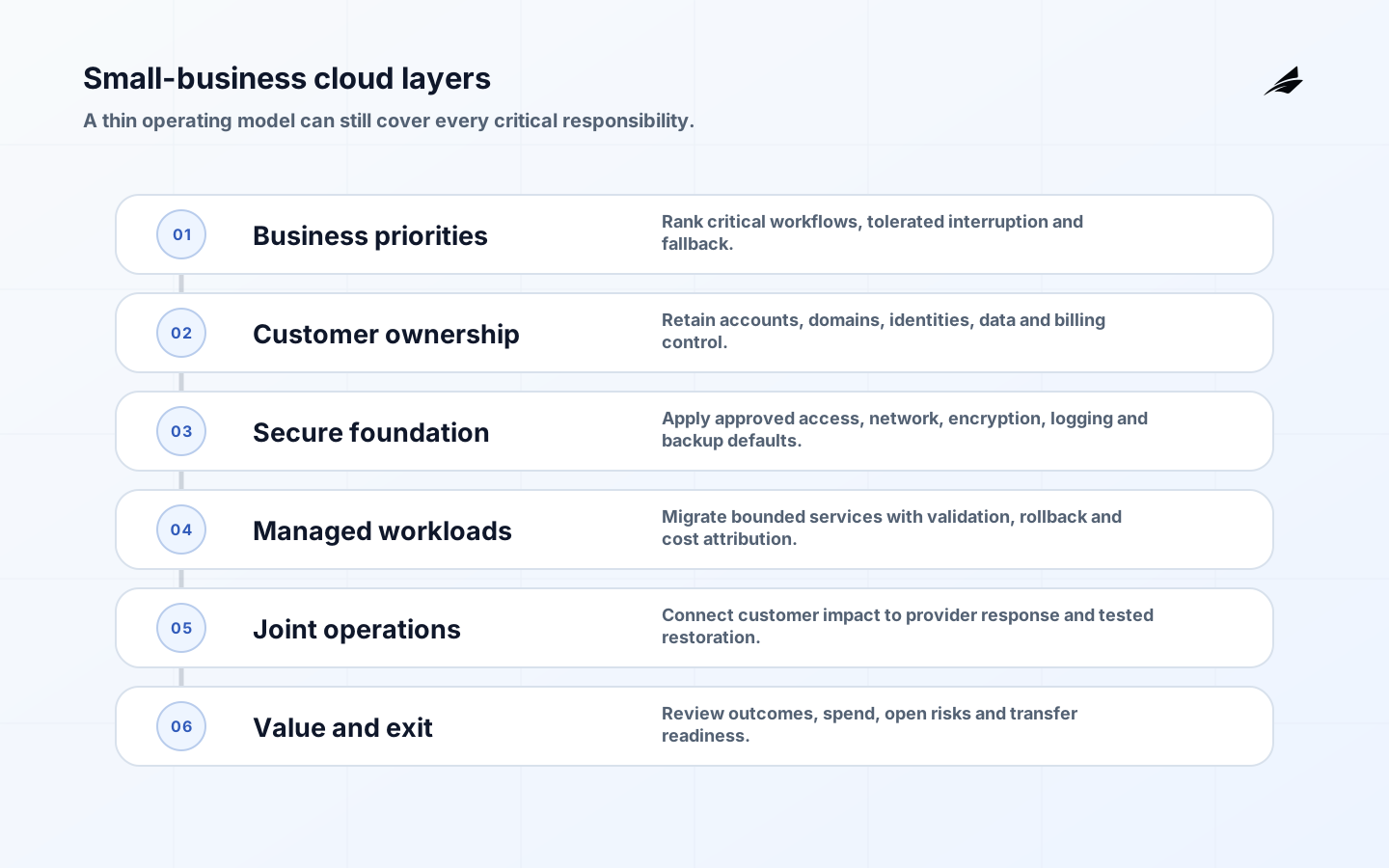
Managed cloud services for small business should reduce operational fragility without hiding decisions the business still owns. A provider can monitor resources, patch systems and respond to incidents, but the customer must define critical workflows, data sensitivity, acceptable downtime, spending authority and who can approve consequential change. This implementation checklist helps a small team establish those duties, migrate a bounded workload and verify that support works before dependence grows.
First compare service scope, risk and cost in the small-business managed cloud delivery plan. The managed cloud FAQ answers purchasing questions, while the broader managed cloud implementation checklist suits organizations with a larger platform team.
1. Rank business services and failure consequences
List the workflows that generate revenue, serve customers, pay staff, fulfill orders or meet legal duties. For each, record the applications, identities, data, integrations and manual fallback. Classify the impact of an hour, a day and several days of disruption. This prevents a loud but low-value server from receiving more attention than an invisible identity, DNS or payment dependency that can stop the whole business.
The NIST small-business quick-start guidance adapts Cybersecurity Framework 2.0 for organizations with modest resources. Use its Govern, Identify, Protect, Detect, Respond and Recover outcomes to identify essential gaps, not to create an oversized program. Give each selected outcome one accountable owner, a practical implementation and a way to verify it.
| Business question | Decision to record | Minimum evidence | Owner |
|---|---|---|---|
| What cannot stop? | Critical workflow and tolerated interruption | Impact and fallback record | Business owner |
| What data matters? | Classification, location, retention and recovery | Data inventory and restore need | Data owner |
| Who may change systems? | Roles, approvals and emergency access | Identity and access record | Service owner |
| Who responds? | Support hours, severity and escalation | Contact path and exercise | Provider and customer |
| What may it cost? | Budget, alert and purchase authority | Attributed forecast | Finance owner |
2. Define the managed service boundary
Write the provider scope by activity: provisioning, patching, backup, monitoring, alert triage, incident command, application support, security review, cost reporting and supplier coordination. State support hours and response targets by impact. Name exclusions such as employee devices, SaaS administration or application code. For every excluded critical activity, assign a customer owner or another supplier.
NIST's cloud definition distinguishes infrastructure, platform and software service models. The distinction matters because management responsibility moves upward as the provider manages more of the stack, but business responsibility remains. Ask for one responsibility matrix spanning cloud vendor, managed provider, software vendor and customer. Require a single route for incidents even when several suppliers must collaborate.
3. Establish identity, accounts and protection
Use the business's own cloud accounts and domain where feasible, not an opaque provider tenancy that cannot be transferred. Federate named workforce identities, require strong authentication, separate administrator roles and protect emergency access. Remove shared daily admin accounts. Record domain registration, DNS, certificate, billing and break-glass ownership because losing any of them can block recovery.
Create repeatable defaults for approved regions, network exposure, encryption, keys, secrets, logging, ownership tags and backups. Start with a small service catalog rather than allowing every cloud product. The AWS Well-Architected Framework offers useful questions across operations, security, reliability, performance, cost and sustainability. Apply equivalent provider guidance to the actual workload and keep a short, owned improvement list.
4. Migrate one representative workload
Choose an important but recoverable service that exercises identity, network, data, deployment, monitoring and support. Inventory versions, licenses, scheduled jobs, interfaces, data volume and peak demand. Define cutover, validation, rollback and communication. Rehearse data transfer and measure the time. Keep the old path available until business owners confirm completeness and the new environment has survived a normal operating cycle.
Microsoft's current Cloud Adoption Framework strategy starts with motivations, mission, measurable objectives, team readiness and strategic considerations. For a small business, the practical version can fit on a page: reason for change, service owner, workload sequence, decision constraints, expected benefit and stop conditions. Review it before each migration so promotional cloud features do not displace the business objective.
| Acceptance test | Method | Pass condition | Evidence retained |
|---|---|---|---|
| Access revocation | Remove an administrator during a session | Access ends and event is visible | Identity and audit events |
| Deployment recovery | Introduce a failed release in test | Known version restored within target | Pipeline and service timeline |
| Data restoration | Restore representative data separately | Usable, complete and within objectives | Restore and reconciliation report |
| Support routing | Raise a realistic priority incident | Correct people engage within target | Ticket and communication record |
| Cost attribution | Trace the migrated service bill | Material spend has owner and purpose | Tagged report and forecast |
5. Operate from customer impact
Monitor whether customers and staff can complete critical journeys, then connect failures to application and infrastructure signals. Every alert should identify impact, owner and action. Agree how the provider communicates incidents, who can authorize containment, when customers are informed and how post-incident actions are tracked. Review repeated low-grade failures before they become accepted manual work.
Backups deserve a separate operating review. Check coverage against the data inventory, investigate failed jobs and perform scheduled restores. Store recovery instructions and critical contacts somewhere reachable during identity or cloud outage. Test the manual fallback for a key workflow. If the fallback depends on an export, confirm that the export is current, protected and understandable to the people expected to use it.
6. Control cost and preserve exit options
Require budgets and anomaly alerts from the first workload. Assign every resource to a customer, environment and service, and investigate unallocated spend. The FinOps Framework treats cloud value as collaboration among engineering, finance and business teams. A small company can implement this with a monthly review of forecast, largest changes, idle commitments, support cost and one unit such as cost per order or active account.
Keep infrastructure definitions, source, images, configuration, account ownership, documentation and backups transferable. Record how to export data, replace proprietary services and end subcontractor access. The contract should cover assistance, formats, timing, deletion evidence and outstanding incidents at termination. Test one export and one credential transfer while the relationship is healthy; an untested exit clause is only a promise.
Example: moving an order application
A wholesaler moves its order application and database. The owner defines weekday availability, a four-hour recovery target and a maximum hour of data loss. The provider builds separate production access, encrypted backups, journey checks and cost tags. The team migrates a copy, validates order totals and integrations, rehearses rollback, then cuts over after a final incremental sync. Acceptance includes a failed deployment, administrator revocation, isolated database restore, support call and attributed first-month forecast.
The first 90 days of managed cloud operation
In the first month, verify inventories, contacts, access and monitoring. Remove former staff and unused provider accounts, test billing access, confirm domain and certificate ownership, and raise sample incidents at each severity. Review every alert for a named action. Establish a shared change calendar and require important decisions to be recorded somewhere the customer can retain after the engagement.
In the second month, focus on resilience and cost. Restore representative application data, time the exercise and reconcile it with source totals. Review backup exclusions, retention and credentials. Attribute the full bill, including support and shared services, and set a forecast. Investigate unexpected egress, idle environments and commitments before buying discounts. Savings that remove recovery headroom or useful monitoring are not genuine optimization.
In the third month, run an end-to-end service incident and review the relationship. The provider diagnoses while the business owner makes priority and communication decisions. Capture handoff delays, unclear authority and missing evidence. Compare service outcomes, support load, security corrections and spending with the pre-migration baseline. Agree the next workload only when the first one is stable enough that expansion will not hide unresolved operating debt.
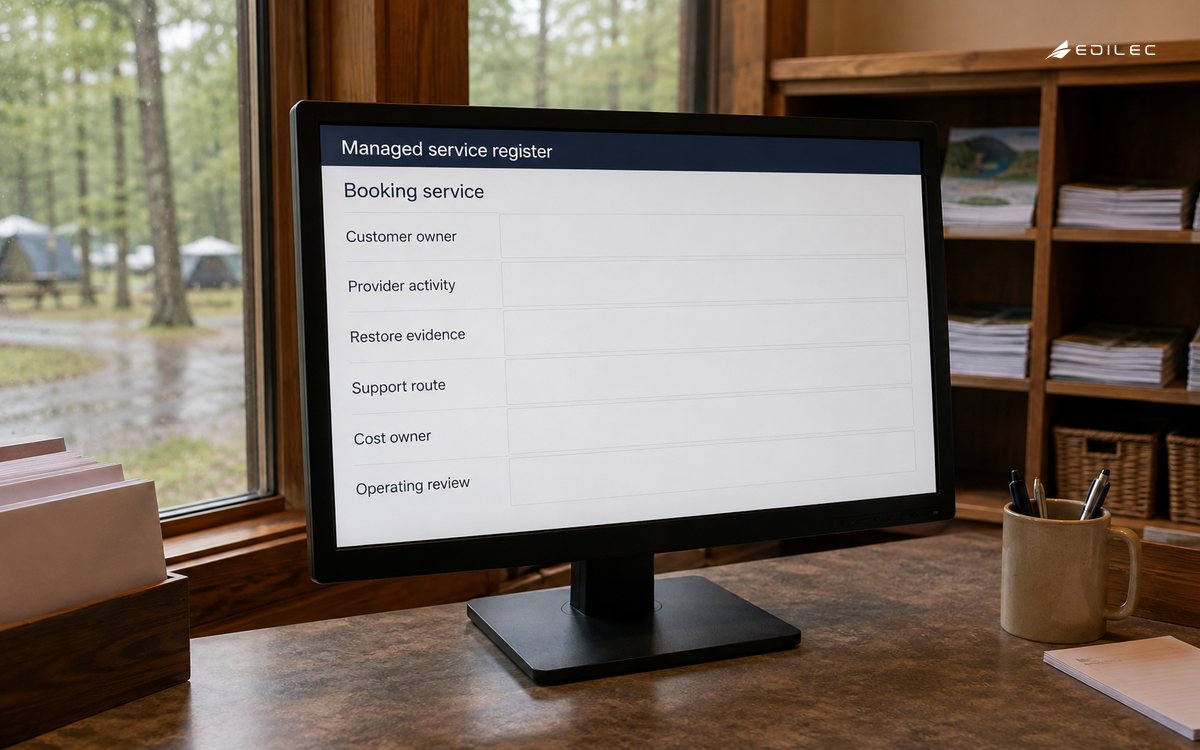
Keep a short customer-owned service register throughout the first 90 days. For each workload it should name the business owner, technical owner, provider contact, data class, recovery objectives, support hours, monthly cost, latest restore and open risks. Review the register with provider reports rather than accepting a separate opaque inventory. This small record gives leadership a durable view of responsibility and makes later supplier change or emergency escalation much less dependent on personal memory.
At day 90, decide explicitly whether to expand, stabilize or change provider scope. Base the decision on restored service evidence, unresolved access, incident response, cost variance and the customer's remaining workload. Record conditions for the next review. Automatic renewal without this evidence can turn a deliberately bounded pilot into a dependency whose risks and commercial terms were never accepted at production scale.
Key takeaways
- Prioritize business workflows and their failure consequences before cloud products.
- Define provider and customer activities, exclusions and escalation in observable terms.
- Retain customer control of accounts, identities, domains, data and billing.
- Migrate one representative workload with tested validation and rollback.
- Prove access revocation, deployment recovery, restoration and support routing.
- Review cost and exit readiness throughout the relationship.
Managed cloud services for small business FAQ
Does a small business need multiple cloud providers? Usually not initially; reduce concentration with backups, exports and tested recovery before adding another operating stack. Should the provider own the cloud account? Customer ownership usually improves visibility and transferability, with delegated provider roles. What should be managed first? Identity, backup, monitoring, patching and incident routing for one critical service. How long should migration take? Duration depends on dependencies and data, so plan accepted workload slices instead of one portfolio date. How is provider value measured? Use service reliability, recovery evidence, security correction, change outcomes, support quality and cost visibility.
Conclusion: keep the managed service understandable
A small business gains from managed cloud when scarce attention moves from repetitive maintenance to useful work without surrendering control of critical decisions. Keep the model thin, explicit and tested: one service boundary, one accountable path through failure, customer-owned assets and regular evidence that the provider relationship remains reliable and affordable.