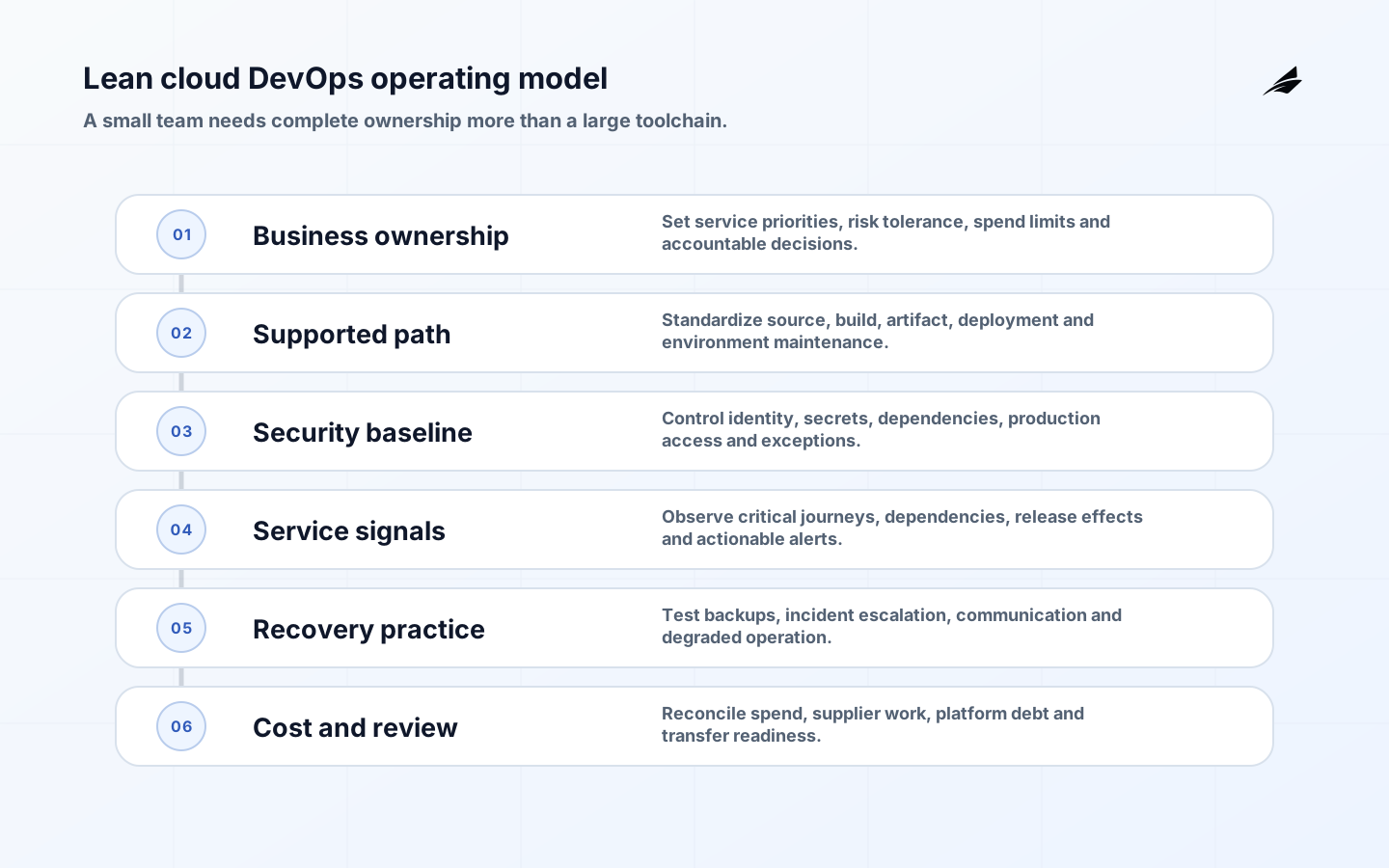
Cloud DevOps services for small business should reduce operational concentration without importing enterprise ceremony. The practical goal is a service that a small team can deploy, observe, secure, recover and pay for predictably. This FAQ answers evaluation questions from founders, technology leads and operations managers who need a proportionate operating model, not a shopping list of tools.
For adjacent planning detail, see Edilec's small-business cloud DevOps delivery plan, implementation checklist and general cloud DevOps services guide. The right scope depends on downtime consequences, data sensitivity, release volume and how much internal ownership the business can sustain.
Key takeaways
- Buy an operating outcome with explicit responsibilities, not indefinite access to engineering hours.
- Standardize one supported delivery path before adding multiple platforms, clusters or observability products.
- Keep production ownership inside the business even when a provider performs daily operations.
- Make backup restoration, incident escalation and privileged access part of acceptance.
- Track service reliability and unit economics together; low infrastructure spend can still hide high support effort.
What should the service include?
A useful baseline includes account and identity structure, infrastructure definitions, a repeatable build and deployment path, environment configuration, secrets management, telemetry, backup and restore, vulnerability handling, incident response, cost allocation and documentation. It should also define routine maintenance: dependency updates, certificate renewal, runner upgrades, access reviews and capacity checks.
The provider should begin with the application and business service, not assume containers or Kubernetes. A managed platform, serverless runtime or conventional virtual machine may be the better fit when usage is modest and operational capacity is scarce. Architecture is successful when the team can explain failure modes, deploy without heroics and exit the provider relationship with usable assets and records.
| Service level | Suitable situation | Minimum evidence |
|---|---|---|
| Foundation | One or two low-complexity applications | Account controls, repeatable deploy, backups, basic telemetry and runbook |
| Managed delivery | Frequent releases or several environments | Pipeline ownership, test gates, release records and support rota |
| Managed reliability | Revenue or operational dependency | Service objectives, alert response, recovery exercises and incident reviews |
| Regulated or high impact | Sensitive data or material customer obligations | Mapped controls, separation of duties, audit records and governed exceptions |
How much internal team is still needed?
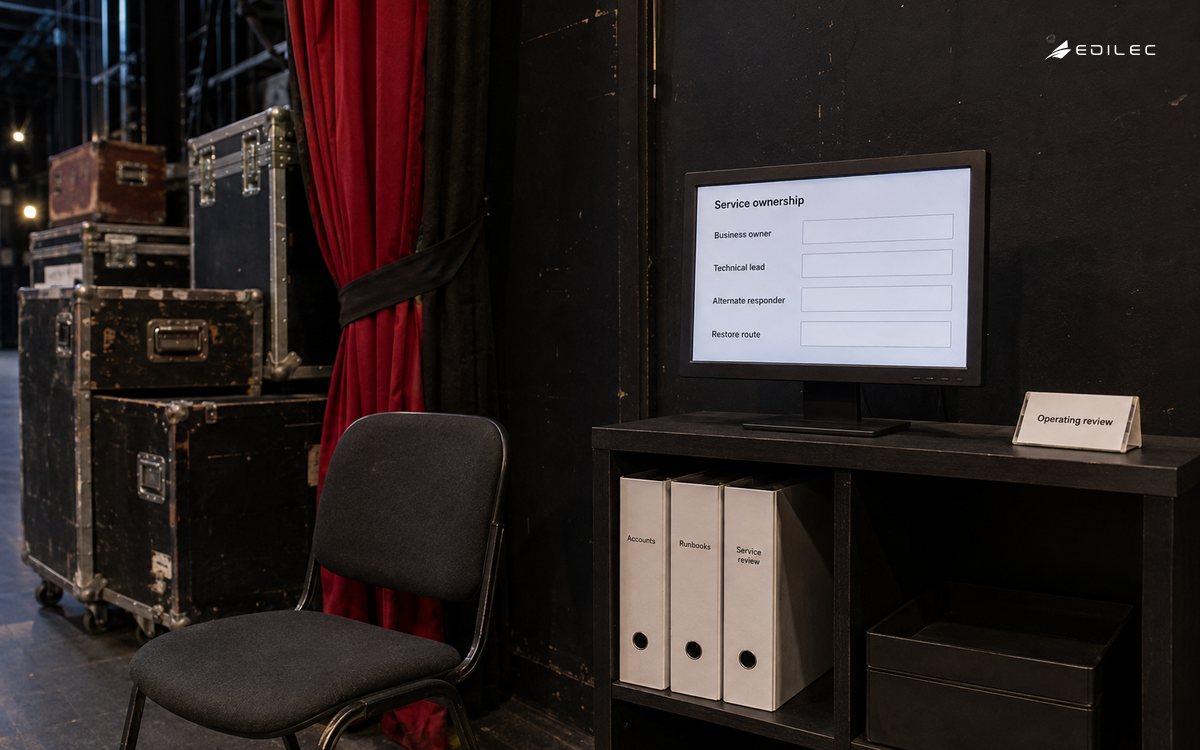
Name an accountable service owner and a technical decision maker even if both roles sit with one person. The business must approve priorities, acceptable downtime, data use, spending limits and residual risk. The provider can operate controls, but it cannot decide how much customer harm is acceptable or whether a risky feature should ship.
Use a responsibility matrix for incidents, security findings, cloud invoices, releases, vendor cases and data restoration. Include nights and holidays. A vague promise of monitoring is incomplete unless someone is expected to interpret alerts and has authority to act. Require named alternates so the arrangement does not create a new single-person dependency.
How much automation is enough?
Automate repeatable, consequential work first: building from versioned source, running fast tests, creating immutable artifacts, provisioning consistent environments, promoting releases, collecting telemetry and executing backups. The DORA deployment automation guidance supports incremental simplification and versioned deployment configuration. A five-person team benefits from this discipline precisely because it has little capacity for avoidable rework.
Do not automate unclear decisions. Keep an explicit human checkpoint for exceptional data migrations, destructive operations and high-impact changes until the evidence supports a safer automated policy. The DORA continuous delivery guidance also makes clear that delivery performance depends on testing, architecture and team capabilities, not only pipeline automation.
What security baseline is proportionate?
Start with phishing-resistant multifactor authentication where available, individual identities, least privilege, separate production access, encrypted transport, managed secrets, protected repositories, dependency review, centralized logs, tested backups and a vulnerability response process. Remove public administration endpoints where practical and inventory data stores and third-party flows.
Use the NIST Secure Software Development Framework as a vocabulary for supplier and engineering practices. Ask how code and artifacts are protected, how third-party components are verified, what checks block a release and how vulnerabilities are triaged. The provider should document exceptions and expiry rather than claiming that a tool makes the application secure.
| Risk question | Provider evidence | Business decision |
|---|---|---|
| Who can reach production? | Role assignments, access logs and emergency procedure | Who approves privileged access |
| Can data be restored? | Restore record with elapsed time and reconciliation | Required recovery point and recovery time |
| How are releases traced? | Commit, checks, artifact digest and deployment record | Which changes require approval |
| What happens after a finding? | Triage policy, owner, deadline and exception register | Tolerance for deferred remediation |
| Can the service be transferred? | Repositories, infrastructure code, credentials and runbooks | Exit trigger and transition budget |
What observability and incident coverage are necessary?
Monitor the customer journeys that matter, plus latency, errors, saturation, queues, jobs and dependencies. OpenTelemetry describes traces, metrics and logs as distinct signals; small teams do not need maximal telemetry, but they do need enough context to answer what failed, who was affected and which release changed behavior. Define retention and control sensitive fields in logs.
Set alert thresholds around actionable conditions and test routing. Document severity, acknowledgment target, escalation and communication ownership. Run a tabletop incident and a restore before launch, then review actual incidents without blame. The result should be changes to code, automation, alerts or documentation, not merely a chronology.
How should cost and contract terms work?
Separate one-time foundation work, recurring platform cost, recurring support and variable incident or change work. State service hours, included environments, response targets, cloud account ownership, software licenses, data egress, after-hours rates and exit assistance. The customer should own or have administrative control of cloud accounts and source repositories wherever feasible.
Use provider billing controls to allocate and forecast spend. The AWS Billing and Cost Management guide is one example of native tooling for tags, cost categories, budgets, forecasts and exports. Regardless of cloud, review spend by service and environment, not only by vendor invoice total. Include support labor when comparing architectures.
What should buyers ask providers?
- Show a representative release record from approved change through production verification.
- Demonstrate a restore and explain which failures cannot be rolled back automatically.
- Identify every production identity, how it is reviewed and how emergency access expires.
- Explain what is standardized, what remains customer-specific and who maintains each component.
- Provide sample incident, maintenance, security exception and monthly service reports.
- Describe account, repository, domain, certificate and documentation transfer at exit.
What should the first 90 days establish?
The first month should establish ownership, service inventory, access control, account structure and a current-state release and recovery map. Fix exposed credentials and missing backups immediately, but avoid broad architecture change before dependencies are understood. Select one supported delivery path and document the risks that remain manual.
The next phase should make builds repeatable, deploy a retained artifact through a controlled pipeline and instrument the critical customer journey. Run a backup restore and incident tabletop. Review alerts with the people who receive them, then remove noise and add missing business context. Publish a short service report covering reliability, security work, spend and unresolved risk.
By the end of the period, the business should be able to approve a release, trace what reached production, contact the right responder, restore essential data and explain recurring cloud cost. The provider should have handed over repositories, runbooks and routine maintenance. Remaining work should be prioritized by consequence, not by a generic maturity ladder.
Avoid creating an outsourced black box. Schedule a monthly operating review in which the provider explains incidents, repeated manual work, security exceptions, capacity, spend and upcoming maintenance. The customer should see raw account and repository evidence where appropriate, not only a traffic-light report. Track actions to completion with named owners.
Plan provider exit at entry. Keep cloud accounts, repositories, domains and core identities under business control; require current infrastructure definitions and credential procedures. Test transition by asking an internal engineer or alternate supplier to perform a routine release from the documentation. Price data export, knowledge transfer and access removal in the contract.
Service objectives should reflect user impact and sustainable support. Define availability and latency around critical journeys, then agree an error budget or escalation threshold. Small teams should resist dozens of objectives that nobody reviews. A few well-owned signals paired with restore evidence provide better control than broad dashboards with no response.
Keep a decision log for architecture and service exceptions. Record the constraint, alternatives, owner, expiry and evidence that would trigger review. This prevents a temporary low-cost workaround from becoming an unexplained dependency as the company grows, and it gives a future provider or employee the context needed to change it safely.
Frequently asked questions
Does a small business need Kubernetes?
Usually not by default. It is justified when workload, deployment or portability needs outweigh the operational cost. A managed application platform or serverless service often removes control-plane and upgrade work. Decide from constraints and team skill, then document an exit path; do not choose an orchestrator because it appears in a provider template.
Is 24/7 support always necessary?
Match support coverage to impact and operating hours. A public revenue service may need round-the-clock detection and escalation, while an internal weekday system may not. Even without 24/7 response, backups, security alerts and provider outages still need clear ownership and a next-business-day procedure.
How long until the service is successful?
Success is not a calendar milestone. Define evidence: repeatable release, restored backup, tested escalation, known service objectives, allocated spend and completed handover. A narrow service can establish this baseline in a short engagement; a legacy application with manual state changes will require staged remediation.
Conclusion
Cloud DevOps services for small business work best when scope is narrow, ownership is explicit and controls are demonstrated. Standardize the supported path, preserve business authority, automate repeated risk, observe user outcomes and test recovery. That creates a platform the company can grow without becoming dependent on undocumented provider knowledge.