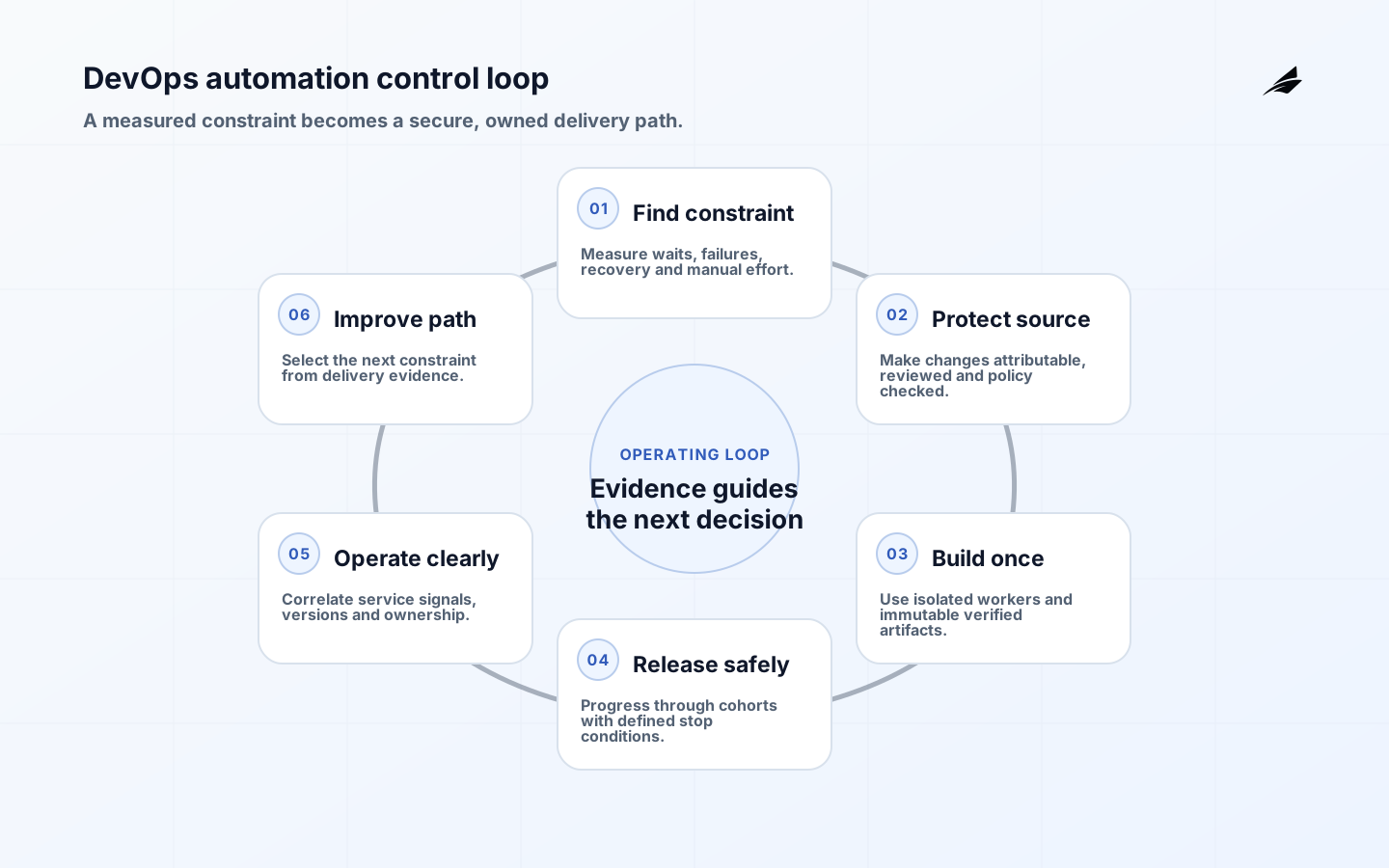
A DevOps automation services FAQ should help a buyer decide which delivery problems deserve automation, what an engagement must produce and how the resulting system will be operated. The service is not simply pipeline installation. It connects version control, builds, tests, infrastructure, policy, release, observability and recovery so a change can move from an accountable author to users with repeatable evidence.
Engineering leaders comparing providers, scope, risk, and cost can use this guide to define a practical work package without committing to one cloud or toolchain. Readers preparing a work package can also use the DevOps automation scope guide and the companion implementation checklist.
What do DevOps automation services include?
A credible service begins by mapping the current path from requested change to production operation. It identifies queues, manual handoffs, repeated defects, access boundaries, environment differences and recovery gaps. The provider then designs a controlled path that may include repository policy, reusable pipeline components, automated testing, artifact management, infrastructure as code, secrets integration, progressive delivery, telemetry and operational runbooks.
Automation should remove avoidable variation while keeping consequential decisions visible. A low-risk, well-tested change may be promoted automatically when policy passes. A database migration, privilege expansion or customer-data change may need explicit approval backed by generated evidence. NIST's Secure Software Development Framework is useful because it groups secure development work into preparing the organization, protecting software, producing well-secured software and responding to vulnerabilities rather than prescribing a single product.
| Service area | Typical deliverable | Acceptance evidence |
|---|---|---|
| Source and planning | Protected branches, review rules and traceable work items | Unauthorized merge is blocked; approved change links to an owner |
| Build and dependencies | Isolated build, declared inputs and immutable artifact | Rebuild or provenance check identifies exact source and tools |
| Infrastructure | Versioned modules, policy checks and environment promotion | Representative environment can be recreated without hidden steps |
| Release | Progressive exposure, health thresholds and recovery action | Failed canary stops automatically and produces a usable record |
| Operations | Service telemetry, alerts, runbooks and ownership | On-call staff can diagnose a release and execute the response |
| Improvement | Delivery baseline, review cadence and prioritized backlog | Measures lead to an owned constraint-removal decision |
When is outside automation help worthwhile?
External help is most useful when several teams share a delivery constraint, the current toolchain has grown through exceptions, or the organization lacks focused capacity to redesign it. Common signals include releases that require many specialists, environments that cannot be reproduced, credentials embedded in jobs, artifacts rebuilt for each stage, long waits for approvals, fragile rollback and incident responders unable to connect a failure to the responsible change.
Do not automate a workflow merely because it exists. First remove approvals that no longer manage material risk, clarify ownership and simplify the path. Automating an ambiguous process makes mistakes faster and harder to question. A provider should be able to describe which decisions will disappear, which become policy, which remain human and how an exception expires. The broader cloud DevOps implementation checklist helps assess the surrounding platform responsibilities.
How should an engagement be scoped?
Choose one representative service and one meaningful change path. Include source, build, test, infrastructure, release, observation and recovery in the first slice. State environments, repositories, clouds, regulatory obligations, support hours and retained client responsibilities. Name exclusions such as application refactoring, test creation, cloud landing-zone remediation or round-the-clock operations; otherwise the buyer and provider may price different projects under the same label.
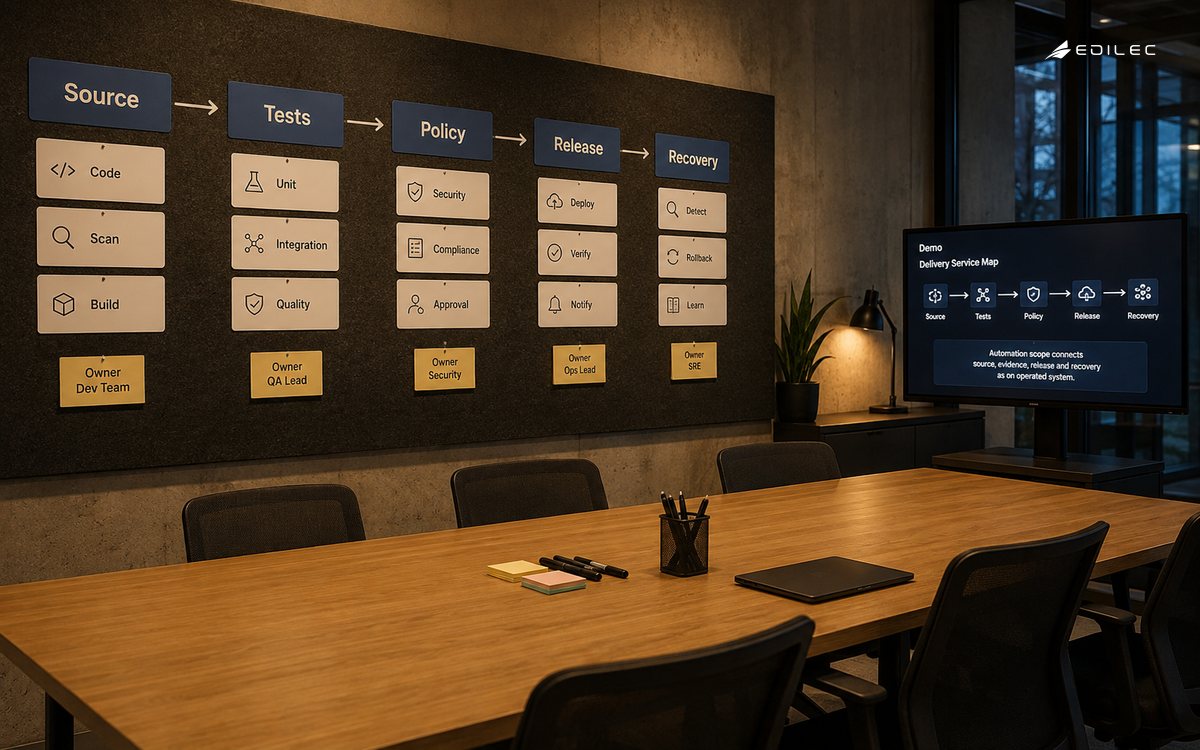
Define acceptance as demonstrated operation. The client's engineers should change code and infrastructure, produce one identified artifact, promote it through controls, release to a limited cohort, see the version in telemetry, respond to an injected failure and recover. Documentation, dashboards and pipeline files are inputs to acceptance, not substitutes for it. Include knowledge transfer and access removal so the permanent team owns the capability when the engagement ends.
Which security controls belong in the automated path?
Treat the delivery system as production infrastructure. Separate human and workload identities, grant narrow permissions, isolate untrusted builds, protect pipeline definitions, keep secrets outside source, verify dependencies and prevent artifacts from being overwritten. NIST SP 800-204D describes software supply-chain controls across CI/CD stages. The SLSA specification provides a vocabulary for build provenance and increasing assurance against tampering.
A scan is not a complete gate. Define severity, exploitability, affected environment, owner, remediation period and exception authority. Preserve the source revision, test results, dependency inventory, artifact digest, policy result, approver and target. Restrict who can change both a control and the code it evaluates. Test denial messages: developers need enough context to fix a problem without being encouraged to bypass an opaque platform.
| Risk | Design response | Evidence to retain | Operational measure |
|---|---|---|---|
| Compromised source | Protected review and attributable change | Commit, reviewer and policy result | Unauthorized-change attempts |
| Untrusted dependency | Pinned inputs, inventory and vulnerability process | Resolved version and assessment | Critical exposure age |
| Build tampering | Isolated worker and signed provenance | Builder identity, inputs and digest | Unverified artifact attempts |
| Secret disclosure | Brokered short-lived credentials | Issuance and use event without secret value | Standing credential count |
| Unsafe release | Progressive exposure and stop conditions | Cohort, health result and decision | Change fail rate |
| Control bypass | Owned, expiring exception workflow | Reason, scope, approver and expiry | Open overdue exceptions |
How are DevOps automation services priced?
Cost is driven less by pipeline count than by heterogeneity and assurance. Important variables include the number of application patterns, clouds and accounts; legacy build constraints; test quality; regulatory evidence; network and identity dependencies; migration overlap; availability expectations; and the amount of application change required. A fixed-price discovery can establish the baseline and target slice. Implementation is safer when priced by accepted increments with assumptions and change rules made explicit.
Ask for total operating cost, not only professional fees. Include licenses, runners, artifact storage, telemetry, egress, retained environments, support, training and internal engineering time. Reusable components lower marginal cost only when teams can understand, update and exit them. A proposal should identify what becomes client-owned, what remains a managed dependency, how versions are supported and how the organization can export artifacts, evidence and configuration.
How should results be measured?
Baseline a service before changing it. DORA's current software delivery performance guidance uses deployment frequency, change lead time, failed-deployment recovery time, change fail rate and deployment rework rate. Review them together and over time; comparing unrelated applications or turning one measure into an individual target invites distortion. Add the customer and risk outcomes that motivated the work, such as checkout availability, vulnerability remediation time or hours spent on release coordination.
Instrument the path so measures are reproducible. OpenTelemetry signals distinguish traces, metrics and logs; correlate them with service, environment and release while protecting sensitive values. A monthly average can hide a dangerous tail, so examine distribution and failed journeys. The improvement review should select one constraint, assign an owner and verify whether the next change moved both throughput and stability.
How should a provider be evaluated?
Ask candidates to explain a recent system in terms of decisions and evidence, not logos. They should describe how they found the constraint, separated platform from application responsibilities, protected the build, handled exceptions, proved recovery and transferred ownership. Review sample runbooks, architecture decisions and acceptance tests with sensitive details removed. Confirm who will actually perform the work and whether specialist availability matches the proposal.
Contract for working capability and transparent dependencies. Require repository access, versioned configuration, documentation, license inventory, administrative handover, incident contacts and deletion of provider access. Set measurable milestones around one end-to-end path before portfolio rollout. Avoid promises to transform every team at once; platform adoption grows when the approved path is easier than bespoke delivery and teams can influence it through a clear product backlog.
Separate delivery warranty from ongoing managed operation. Define which defects the provider corrects after acceptance, response targets, evidence needed to classify a failure and the date normal support begins. Keep a small set of acceptance scenarios executable during that period. This avoids arguments about whether a pipeline outage, application defect or cloud-platform change belongs to the project and gives the client a concrete route from implementation into steady service.
Key takeaways
- Buy an owned delivery capability, not disconnected pipeline tooling.
- Scope the first increment around one complete and representative service path.
- Automate repeatable evidence while preserving explicit authority for consequential change.
- Protect source, builds, identities, artifacts and pipeline definitions as production assets.
- Measure service outcomes, delivery throughput, instability, security and operating effort together.
- Accept the work only after the permanent team can release, diagnose and recover it.
DevOps automation services FAQ
Does DevOps automation eliminate operations roles? No. It removes repetitive execution and gives operators more consistent evidence. People still define policy, investigate novel failures, manage risk, improve the platform and coordinate business response.
Should every test block deployment? No. Place fast, deterministic checks at early gates and schedule deeper checks where their feedback remains useful. A blocking rule needs a clear risk rationale, reliable result, owner and exception path.
Can a company modernize CI/CD without moving cloud providers? Yes. Source protection, reproducible builds, immutable artifacts, policy, progressive release and telemetry can improve on cloud, on-premises or hybrid infrastructure. Provider migration is a separate decision.
How long should the first increment take? Duration depends on identity, network, application and assurance constraints. Plan around a demonstrable vertical slice and explicit dependencies instead of assuming one universal calendar estimate.
Conclusion: automate a delivery system people can trust
DevOps automation services create value when a team can move a small change through a secure, observable and recoverable path with less waiting and clearer evidence. Start with the service outcome, simplify the workflow, automate its stable decisions and prove the result under failure. The lasting deliverable is a client-owned operating system for software change, together with the measures and authority to keep improving it.