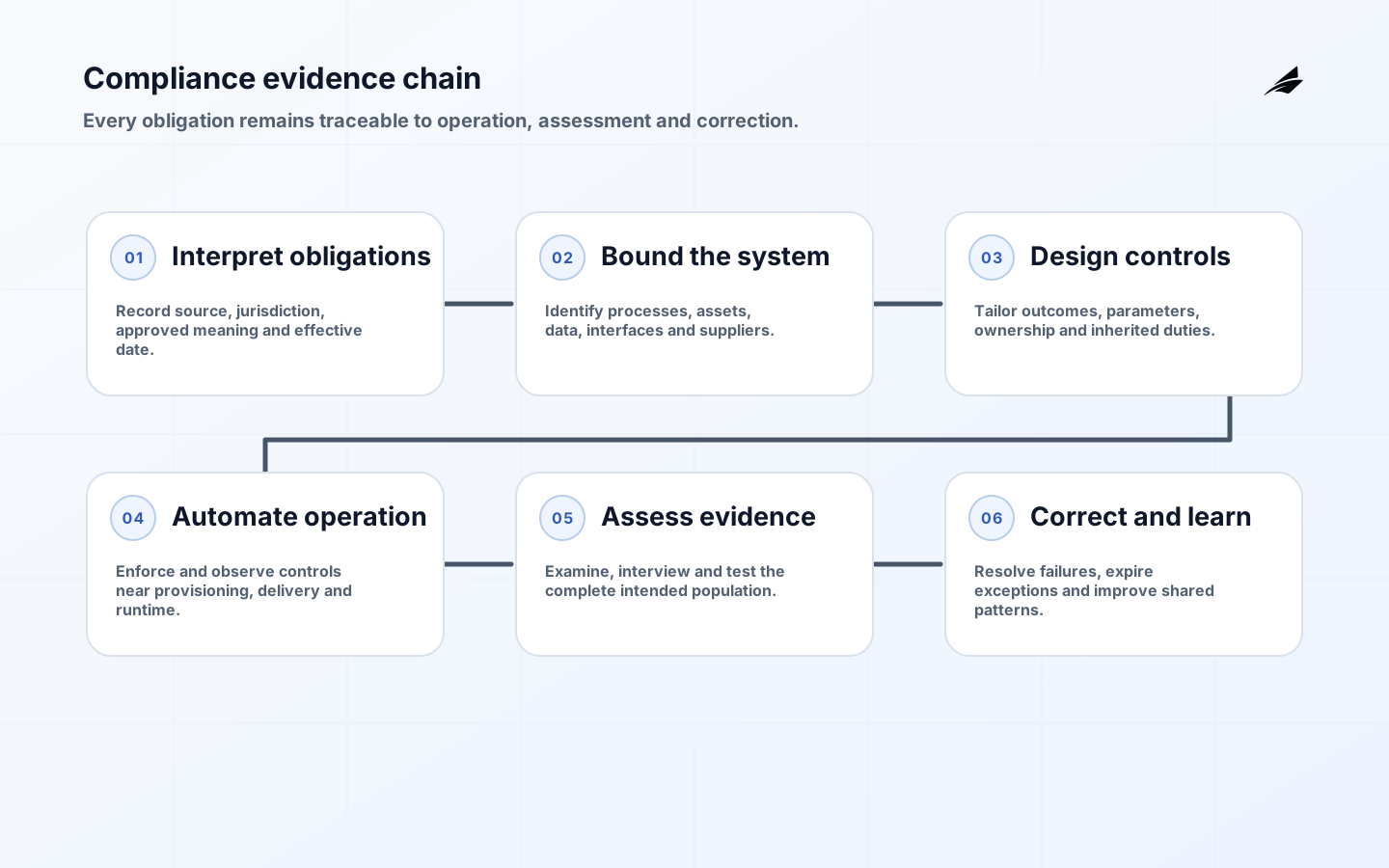
Compliance infrastructure services turn legal, regulatory, contractual and internal requirements into technical controls that can be operated and evidenced. They do not make an organization compliant by installing a scanner. A defensible capability connects each obligation to a scoped system, control objective, implementation, owner, assessment method, evidence record and correction path. This compliance infrastructure services implementation checklist follows that chain from interpretation through continuous review.
The companion compliance infrastructure FAQ helps frame provider questions. Use the infrastructure and cloud checklist for the wider platform foundation and the cognitive infrastructure checklist when automation and operations are being redesigned together.
1. Establish scope and authoritative obligations
Create a system boundary before mapping controls. Record business processes, environments, data classes, regions, users, interfaces, suppliers and supporting services. Identify who owns the regulated activity and who may interpret each requirement. The control team should not decide unsettled legal meaning. It should document the approved interpretation, assumptions and jurisdiction, then make the resulting technical outcome testable.
Use the NIST Cybersecurity Framework 2.0 as an outcome-oriented organizing layer where it fits. Its Govern function explicitly addresses strategy, roles, policy, oversight and supply-chain risk, while the other functions cover identification, protection, detection, response and recovery. CSF outcomes are not a certification checklist. Build a current profile, target profile and prioritized gap record that reflect the organization's actual risk.
| Scope record | Minimum content | Owner | Review trigger |
|---|---|---|---|
| Obligation register | Source, clause, interpretation, jurisdiction and effective date | Legal or compliance owner | Law, contract or policy change |
| System boundary | Processes, components, data, interfaces and suppliers | Service owner | Architecture or supplier change |
| Control profile | Selected outcome, rationale, implementation and inheritance | Risk and control owners | Risk or design change |
| Evidence plan | Method, source, frequency, retention and reviewer | Assurance owner | Control or tooling change |
| Exception | Gap, risk, compensating control, approval and expiry | Risk acceptor | Expiry or material incident |
2. Design controls and assign implementation ownership
Translate each obligation into an outcome, not a copied paragraph. For privileged access, the outcome may require approved, time-bounded access by a traceable identity with monitored emergency use. Then state the implementation across identity provider, cloud roles, ticketing, logs and review. Separate common controls supplied by the platform from workload controls and customer duties. Inherited does not mean invisible: retain the provider evidence and validate that the workload uses the shared control correctly.

The NIST SP 800-53 control catalog is flexible and designed for tailoring to mission, business, legal and risk needs. Use control identifiers to improve traceability, but preserve the organization's specific parameter values and implementation statements. A reference to access control without role scope, review frequency, account lifecycle and emergency behavior cannot guide engineering or assessment.
3. Implement preventive and detective controls
Put high-confidence, repeatable requirements near the change. Infrastructure modules can enforce encryption, logging, network boundaries, approved regions, backup policy and ownership metadata. Pipeline checks can reject exposed secrets, unreviewed changes or disallowed dependencies. Runtime checks can detect configuration drift and unapproved access. Begin uncertain rules in observation mode, inspect false positives and then choose whether to warn, require approval or block.
Treat the delivery system as controlled infrastructure. NIST's Secure Software Development Framework groups practices around preparing the organization, protecting software, producing well-secured software and responding to vulnerabilities. Protect repositories, build identities, runners, artifacts, signing keys and deployment credentials. Keep one traceable artifact through promotion so evidence refers to what actually reached production.
4. Build evidence that proves operation
For each control, define evidence before implementation: what assertion is tested, which authoritative system produces the record, which population is covered, how often it is collected, how long it is retained and who reviews exceptions. Prefer structured records with stable identifiers, timestamps, resource scope, code or policy version and result. Screenshots can explain context but are weak primary evidence because they are hard to reproduce and may omit the tested population.
NIST's OSCAL project provides XML, JSON and YAML models for catalogs, profiles, system security plans and assessments. OSCAL can reduce translation and enable exchange, but a machine-readable claim still needs a trustworthy source and assessment. Link evidence to immutable object storage or an evidence service, control access to sensitive findings and log evidence export. Avoid collecting secrets or full personal records when metadata proves the control.
| Control objective | Preventive implementation | Detective evidence | Failure response |
|---|---|---|---|
| Approved privileged access | Federated role with approval and expiry | Role assignment and sign-in events | Revoke, investigate and review path |
| Protected data storage | Encryption and key policy in templates | Resource inventory and key state | Quarantine or remediate resource |
| Known infrastructure change | Reviewed code and protected deployment | Commit, build, artifact and change event | Revert and investigate bypass |
| Recoverable service | Versioned backup and retention policy | Backup status plus restore result | Repair coverage and run restore |
| Vulnerability handling | Dependency and image policy | Finding, risk decision and remediation age | Patch, mitigate or approve expiry |
5. Assess effectiveness and control exceptions
Assess design, implementation and operation separately. A well-written control may be absent; a configured control may cover only half the estate; a complete deployment may not be reviewed when it fails. NIST SP 800-53A structures assessment around examine, interview and test methods. Select a method and depth proportionate to risk, define the population and sampling rationale, and preserve the result as well as supporting evidence.
An exception is a controlled risk decision, not a label that clears a dashboard. Record the affected resources and requirement, why remediation is not immediate, exposure, compensating controls, accountable approver, due date and expiry. Route expired or materially changed exceptions for escalation. If the same exception recurs, investigate whether the standard, platform pattern, capacity or ownership model is wrong.
6. Operate, recover and improve the control system
Integrate control failures with service operations. Alerts need severity, affected scope, owner, required action and a route to legal, privacy or security specialists when interpretation is needed. Exercise unauthorized access, logging failure, evidence-pipeline outage, expired certificate, failed restore and supplier notification. Confirm that investigators can preserve evidence without altering it and that service recovery does not recreate the original noncompliant state.
Review coverage, exception age, evidence freshness, control-test failures, remediation time and repeat findings. Do not optimize for a green percentage by excluding difficult assets. Reconcile the declared inventory with cloud, identity, endpoint, repository and supplier records. After incidents and audit findings, correct the control or its assumptions and rerun the relevant assessment across the complete affected population.
Example: evidence-ready privileged access
A regulated service requires production administrators to use approved, time-limited access. The platform integrates workforce identity, requires strong authentication, maps an approved ticket to a temporary role and records role issue, use and expiry. A daily job reconciles active privileged assignments with approvals and opens an incident for unexplained access. A quarterly reviewer tests a sample from request through session evidence and separately searches for direct assignments. Emergency access is isolated, monitored and reviewed after every use.
Roll out compliance infrastructure in controlled slices
Choose one service with a clear boundary and several representative control types: identity, configuration, logging, backup and vulnerability handling. Build the trace from obligation to assessment for that service before creating an enterprise control library. This reveals whether owners, identifiers, evidence sources and exception routes work together. It also gives auditors and engineers a concrete implementation to challenge before broad standardization.
Promote proven controls into shared modules with versioning and change notes. Test a module update against nonproduction workloads, identify affected systems and preserve prior evidence semantics. A control change can improve security while breaking evidence continuity, so map old and new versions. Provide workload teams with understandable denial messages and a supported exception route; unexplained blocking encourages shadow deployment paths.
Before adding another framework mapping, test whether a reviewer can select a requirement, identify the complete asset population, inspect current implementation, reproduce the assessment and follow an exception to closure. If any step depends on a private spreadsheet or one person's memory, fix the operating model first. Mapping more requirements onto weak evidence multiplies ambiguity rather than assurance.
Define completion for the pilot as more than a passing automated scan. The service owner should be able to explain the selected obligations and inherited duties; an engineer should reproduce each control deployment; an assessor should independently test operation; and an incident responder should locate relevant evidence under pressure. Record collection and review cost as well as coverage. Controls whose evidence is disproportionately expensive may need a better shared implementation or a more direct assessment source.
Key takeaways
- Start from an approved obligation and a real system boundary.
- Translate requirements into tailored outcomes, implementations and owners.
- Automate close to provisioning, delivery and runtime where the rule is reliable.
- Design structured evidence and assessment methods before collecting artifacts.
- Give every exception scope, approval, compensating control and expiry.
- Measure control operation and correction, not the volume of collected evidence.
Compliance infrastructure FAQ
Can compliance be fully automated? Collection and repeatable tests can be automated, but scoping, legal interpretation, risk acceptance and many effectiveness judgments require accountable people. Does a cloud provider certification cover our workload? It may support inherited controls, but the customer must validate configuration, use and retained responsibilities. How often should controls be tested? Use risk, change frequency and control behavior; test high-impact continuous controls continuously and supplement them with periodic human assessment. Should all violations block deployment? No. Block high-confidence, high-consequence conditions; observe and tune ambiguous rules before enforcement.
Conclusion: connect requirements to correction
Compliance infrastructure services are credible when an obligation can be followed through scope, control, implementation, evidence, assessment and remediation. Build that trace for a representative service, test both the control and its evidence path, then expand from verified patterns rather than from a growing pile of audit artifacts.