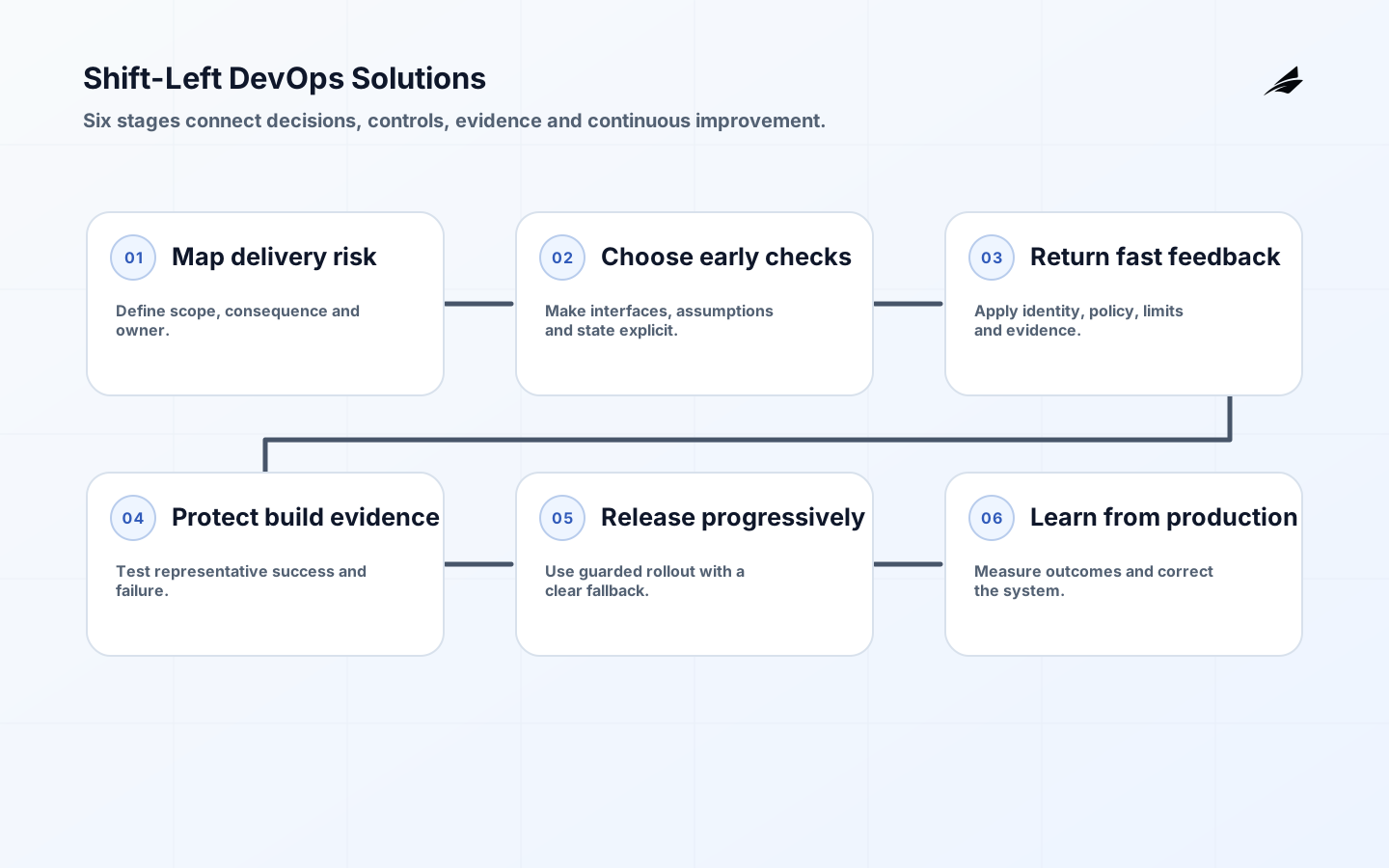
Shift-left DevOps solutions move useful feedback closer to design and code, where a team can fix a defect with less coordination and risk. The goal is not to run every possible scanner on every commit. It is to place the cheapest reliable control at the earliest point where it can make a sound decision, while retaining integration, deployment and production checks for risks that only exist later.
Pair this FAQ with the shift-left delivery plan, shift-left implementation checklist, cloud DevOps checklist and cloud DevOps FAQ. Start with recurring failure modes and developer workflow, then design feedback, ownership and exceptions around them.
What shift-left should and should not mean
The NIST Secure Software Development Framework groups practices around preparing the organization, protecting software, producing well-secured software and responding to vulnerabilities. It supports integrating security into the development lifecycle, but it does not imply that late-stage validation or operational monitoring disappears. Architecture, component, code, integration, deployment and runtime risks each need evidence at the appropriate layer.
A useful shift-left program reduces time from defect introduction to actionable feedback. It should also improve secure defaults, reusable pipelines and engineering knowledge. A program has failed if developers receive thousands of unprioritized findings, copy suppressions between repositories or wait for a central team to interpret routine results. Early feedback must be specific, reproducible, owned and connected to a remediation path.
Select checks from actual risk and change context
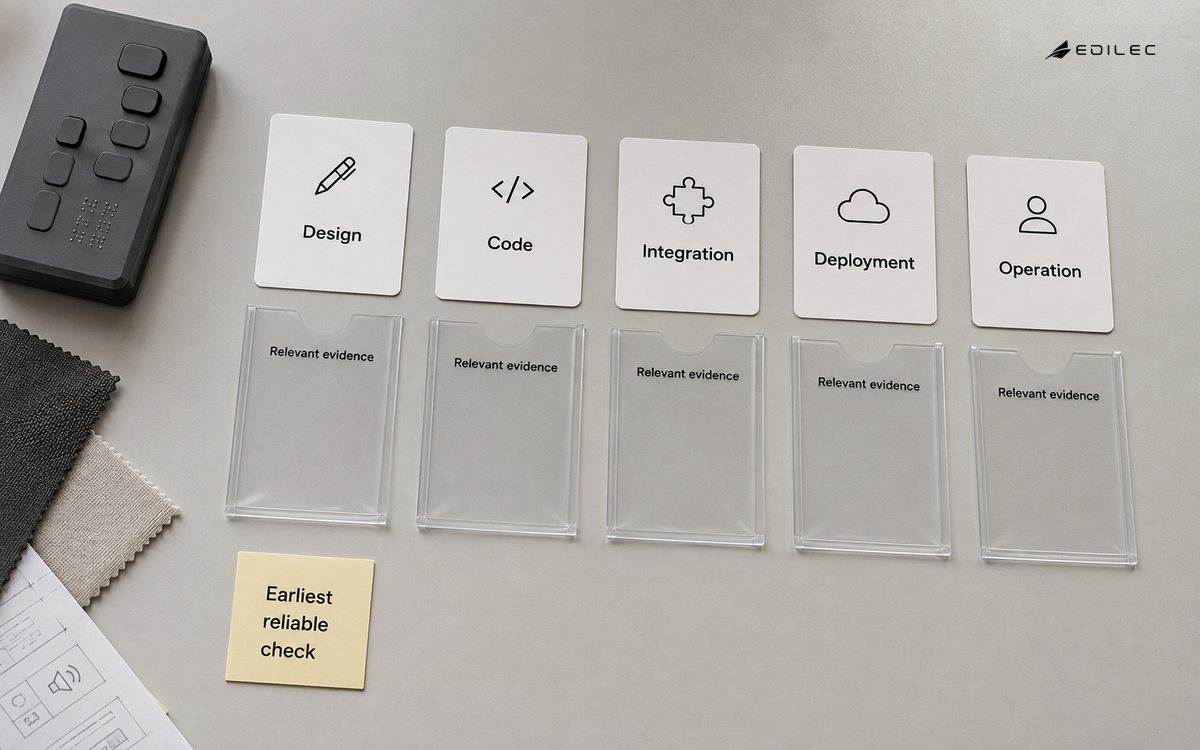
Map threats and historical incidents to controls: architecture review for trust boundaries, secret detection before commit, dependency policy at resolution, static analysis on changed code, unit security tests, infrastructure policy before deployment and dynamic tests against a running system. OWASP ASVS 5.0 can help teams define verifiable application security requirements rather than relying on generic scanner severity.
Use differentiated pipelines. A documentation change should not trigger an expensive full-system test, while an authentication-library change deserves focused security and compatibility evidence. Define required checks by component criticality, data, exposure and change type. Preserve a human escalation path for ambiguous findings and record why an exception is safe, who accepted it and when it expires.
| Risk | Earliest reliable control | Later evidence still required |
|---|---|---|
| Exposed secret | Pre-commit and repository scanning | Credential revocation test and monitoring |
| Broken authorization | Unit and service-level policy tests | End-to-end role tests and audit review |
| Vulnerable dependency | Resolution-time policy and inventory | Runtime reachability and remediation tracking |
| Deployment regression | Configuration validation and rehearsal | Progressive rollout health and recovery |
Build fast, deterministic developer feedback
Keep commit checks short enough to sustain frequent use. Run formatting, compile, targeted unit tests, secret detection and high-confidence policy checks first; parallelize heavier analysis after the initial signal. Cache dependencies safely and make local commands match CI. Fail with the exact file, rule, evidence, remediation and owner. A red gate without diagnosis simply transfers queue time from security to development.
Separate tool health from code health. A scanner outage must not look like a clean result, and a flaky test must not train teams to rerun until green. Pin tool and rule versions, record inputs and retain logs. Use a controlled bypass for urgent recovery, with named authority and retrospective review. The pipeline itself is production software and needs code review, tests, access control and recovery.
Protect source, builds and release provenance
The current SLSA 1.2 specification defines tracks and levels for increasing software supply-chain guarantees, including provenance. Use its concepts to assess source and build trust boundaries, then choose a target based on risk. Generate attestations from the build system rather than asking developers to compose evidence manually. Verify provenance before promotion and bind artifacts to immutable digests.
Control who can modify workflows, runners, dependencies and release policy. Use isolated, ephemeral build environments where practical; protect signing keys; review third-party actions; and retain a software bill of materials with artifact metadata. Provenance does not prove that code is safe, but it helps a verifier understand where an artifact came from and whether the expected build process produced it.
Keep safe deployment and runtime verification
Some failures appear only with realistic data, scale, topology or user behavior. The joint CISA safe software deployment guidance emphasizes well-defined phases, testing and measurement. Use progressive exposure, health criteria, rollback or roll-forward plans and independent observation. Treat configuration and data migrations as first-class release changes.
Test the failure path before launch: unavailable dependency, incompatible schema, exhausted quota, partial region failure and rollback after a write. Production controls should verify the same critical assumptions expressed earlier, such as required headers, authorization outcomes and artifact identity. Feed escaped defects and incident lessons back into design rules and tests so shift-left stays connected to reality.
| Signal | Useful definition | Bad interpretation |
|---|---|---|
| Feedback latency | Commit to actionable result for a named control | Total pipeline time without diagnosis |
| Flake rate | Non-product failures divided by executions | Reruns hidden as successful tests |
| Control coverage | In-scope components producing valid evidence | Repositories with a config file |
| Escaped defect | Qualifying issue first detected after target stage | Every production incident blamed on shift-left |
Clarify platform, product and security responsibilities
A platform team can provide paved paths, runners, policy libraries and evidence storage, but product teams own the behavior they ship. Security should define risk requirements, support threat modeling and tune high-impact rules with engineers. Service owners accept time-bounded exceptions. Tool administrators maintain availability, versions and credentials. Put these responsibilities in a service catalog and support model.
Central standards need an adoption path for legacy repositories. Inventory languages, build systems, criticality and current controls. Offer a supported baseline with migration help, then measure coverage and exceptions. Avoid mandating a single tool when equivalent evidence is available through another approved path. The control objective matters; uniform evidence and ownership are usually more valuable than identical implementation.
Measure feedback quality and delivery outcomes
Current DORA delivery metrics distinguish throughput and instability using change lead time, deployment frequency, failed deployment recovery time, change fail rate and deployment rework rate. Use them with security measures such as time to actionable finding, recurrence by defect class, escaped severity and control coverage. Do not reward teams for raw findings or test counts.
Track false-positive and flaky-test rates because noisy controls consume trust. Segment lead time by queue and check to find bottlenecks. Review whether exemptions expire and whether recurring issues are removed through framework fixes or secure components. The strongest outcome is not more pipeline activity; it is fewer consequential defects, shorter learning cycles and stable delivery.
Example: move API authorization feedback earlier
A SaaS team repeatedly finds tenant-isolation defects during staging. Convert the authorization model into test fixtures representing tenant, role, ownership and resource state. Run service-level policy tests on each relevant change, then retain browser tests for critical journeys and production audit checks. Make failures show the denied or allowed action, subject, resource and governing policy.
- Define authorization invariants before choosing a scanner.
- Generate fixtures from approved role and tenant models.
- Run changed-service tests in parallel with ordinary unit tests.
- Block only on deterministic violations with a named owner.
- Use a dated exception for emergency recovery, never a silent skip.
- Add each escaped defect as a focused regression at the cheapest reliable layer.
Measure the time from commit to authorization result, false positives, escaped isolation defects and deployment lead time. The program succeeds when engineers diagnose issues before integration while end-to-end and runtime evidence remain healthy. If the new suite becomes slow or brittle, improve fixture design and test boundaries rather than weakening the security requirement.
Operate the capability as a managed system
Adoption also needs a control lifecycle. For every required check, record the threat or quality objective, owner, tool or method, repositories in scope, trigger, expected evidence, failure behavior and review date. Sample passing results as well as failures; a policy can look healthy while no longer examining the intended files. Review language and framework upgrades before old rules become misleading. Give teams a documented route to propose an equivalent control and require proof that it detects the target condition. Quarterly, compare escaped defects and developer feedback with the control catalog, remove redundant gates, tune noisy rules and invest in reusable components that eliminate recurring classes of error.
Key takeaways
- Move each check to the earliest stage where it can make a reliable decision.
- Keep feedback fast, specific and reproducible; treat tool failure separately from product failure.
- Protect build workflows and verify artifact provenance as well as source code.
- Retain progressive deployment, runtime verification and incident learning.
- Balance delivery metrics with control coverage, noise, escaped risk and recurrence.
Frequently asked questions
Does shift-left eliminate penetration testing?
No. Early design and automated checks reduce preventable defects, while expert testing can examine emergent behavior, chained weaknesses and realistic abuse. Scope penetration testing from threat and change context, and turn repeatable findings into earlier controls so expert time focuses on problems automation cannot decide well.
Should every security finding block a pull request?
No. Block deterministic violations with material risk and clear remediation. Route uncertain or lower-priority findings into owned workflows with deadlines. A universal blocking policy creates bypass pressure and delays unrelated changes. Calibrate severity using exploitability, exposure, data and compensating controls.
Can legacy systems adopt shift-left incrementally?
Yes. Inventory critical paths and recurring failures, establish a baseline build and start with a small set of high-confidence checks. Add component inventory, secrets, focused tests and deployment safeguards in stages. Track evidence coverage and exceptions while avoiding a disruptive tool migration with no risk benefit.
Conclusion
Shift-left DevOps solutions are an engineering feedback design, not a scanner bundle. Choose controls from real failure modes, make developer feedback trustworthy, secure the pipeline and preserve deployment and runtime evidence. When escaped defects improve the next design rule or test, the lifecycle becomes a learning system instead of a sequence of gates.