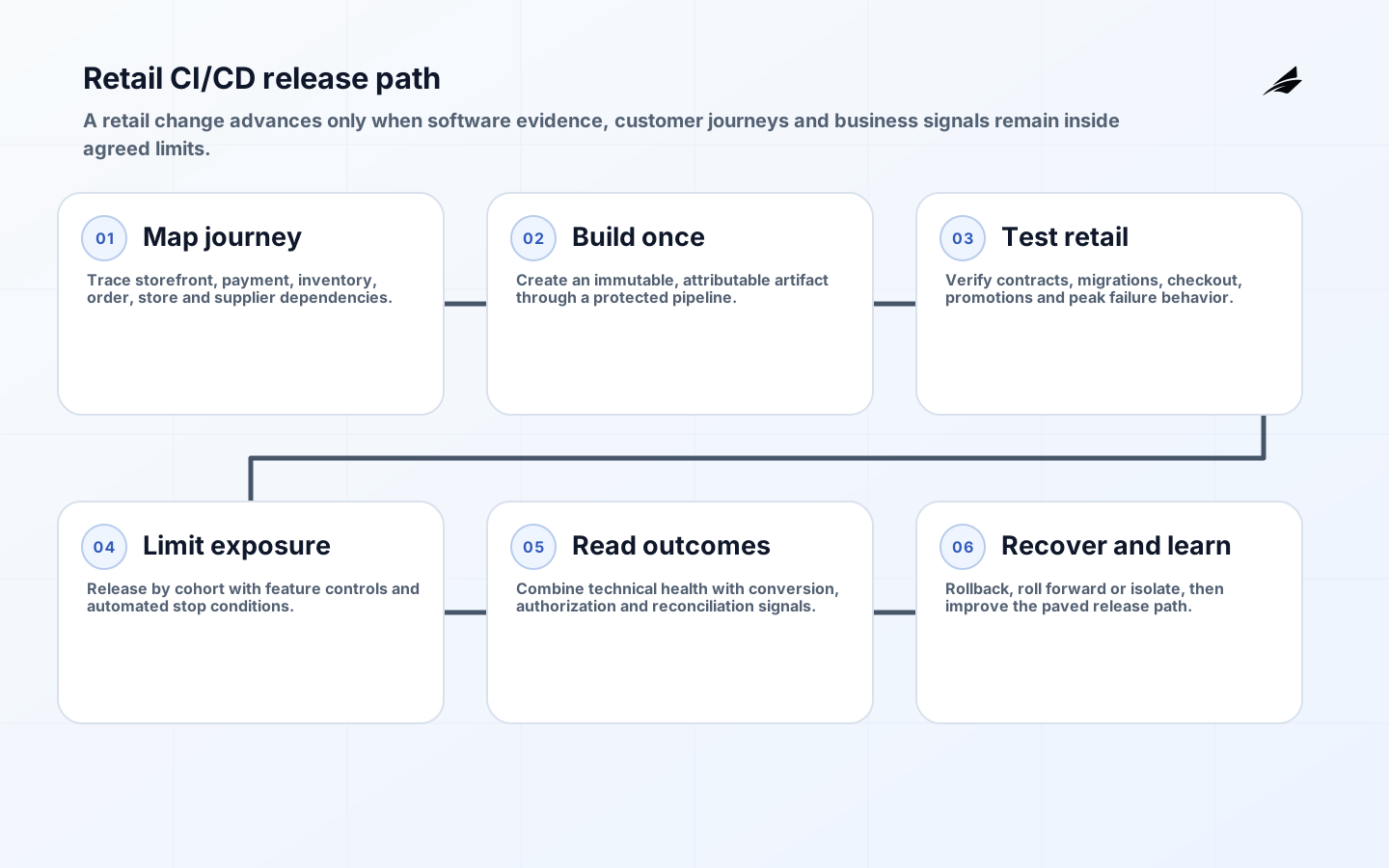
CI/CD modernization for retail is not simply a migration from one build server to another. Retail releases cross ecommerce storefronts, payment integrations, promotion engines, inventory services, order management, warehouse systems, mobile apps and store technology. A pipeline can be technically successful while a price rule is stale, a point-of-sale client is incompatible or an order event is silently dropped. Modernization therefore has to reduce both software delivery risk and commercial disruption. The implementation checklist below treats the pipeline as an operating control: every change is traceable, tested against meaningful retail journeys, released progressively and recoverable before customers or store teams carry the cost.
DORA defines continuous delivery as the ability to release changes safely and sustainably on demand. NIST's Secure Software Development Framework adds the practices needed to protect the development environment, produce well-secured software and respond to vulnerabilities. Retail teams should combine those perspectives. Speed without provenance exposes payment and customer systems; control without automation creates release queues that encourage larger, riskier batches. The target is a repeatable path in which a small change can move from commit to verified production with evidence, bounded exposure and a tested recovery route.
1. Map the retail release boundary before changing tools
Start with business journeys, not repositories. Trace browse-to-buy, click-and-collect, refund, promotion redemption, stock reservation and store checkout through every participating service. For each step record the owning team, deployment mechanism, data contract, external provider, peak period and failure consequence. Include systems that are released on different clocks: a web application may deploy hourly, a mobile app may wait for store review, and store software may be updated in controlled waves. The map should also identify payment-card data flows so that pipeline changes do not accidentally expand the cardholder-data environment or weaken required controls.
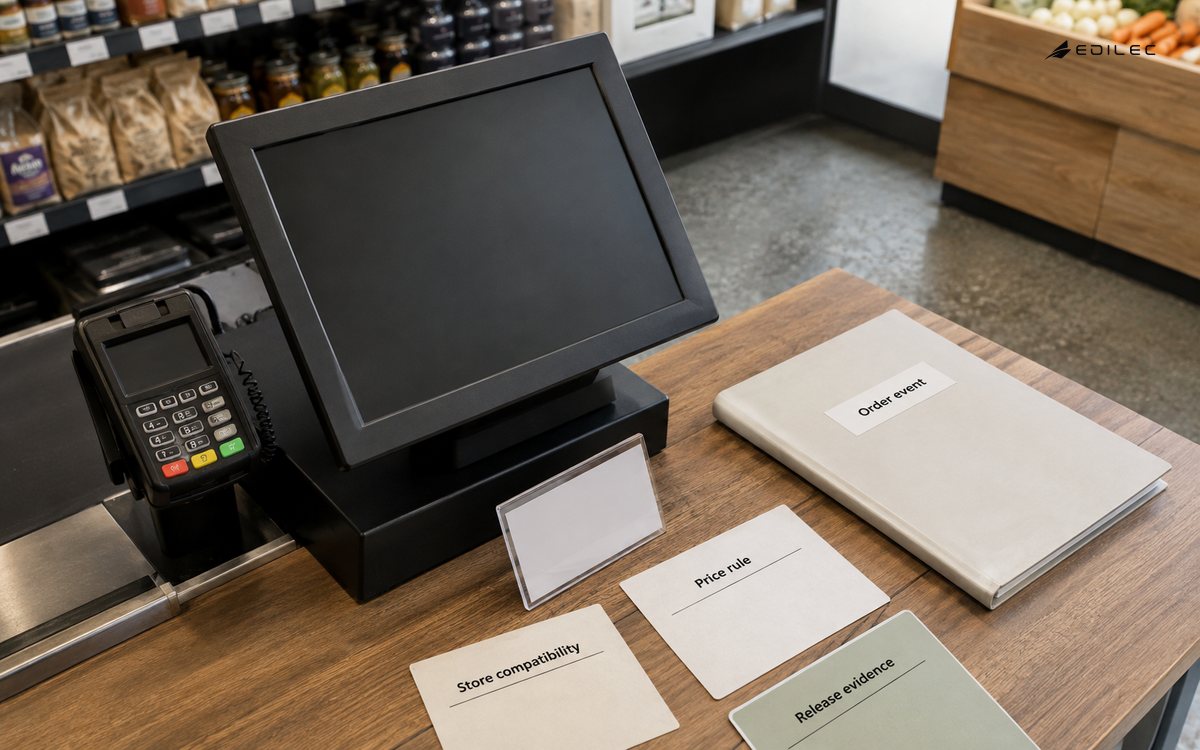
Use the map to define modernization slices. A good first slice is one customer journey and its supporting services, not every repository in the company. Record the current lead time, manual handoffs, test duration, change failure pattern and recovery steps. Mark hidden dependencies such as shared database schemas, promotion calendars, certificates, feature flags and third-party rate limits. This baseline prevents a common failure: producing a faster build while approvals, test data and environment preparation remain manual. Link the resulting delivery map to the retail CI/CD scope guide so technical work stays attached to a business release boundary.
| Retail dependency | Pipeline evidence | Release safeguard |
|---|---|---|
| Storefront and APIs | Versioned artifact, contract tests and synthetic checkout | Canary by region or traffic cohort |
| Payments | Approved dependency inventory and payment-flow tests | No sensitive test data; immediate rollback |
| Inventory and orders | Schema compatibility and event replay result | Dual-read or backward-compatible change |
| Store and mobile clients | Supported-version matrix and upgrade telemetry | Wave deployment with minimum client version |
| Promotions | Rule fixtures using upcoming campaign scenarios | Feature flag and business-owner sign-off |
2. Build a secure, reproducible pipeline foundation
Protect the pipeline as a production system. Use individual identities, phishing-resistant multifactor authentication where available, least-privilege service roles and short-lived credentials. Separate build, deployment and production administration. Pin or verify third-party actions and build dependencies; keep pipeline definitions in version control; and generate artifacts once, then promote the same immutable artifact between environments. A release should carry its source revision, dependency manifest, test results, approvals and deployment record. Rebuilding separately for production breaks provenance and can introduce a package that was never tested.
Harden runners and artifact stores, restrict outbound network paths, scan secrets before commit and preserve tamper-evident logs. Sign release artifacts when the platform supports it and verify signatures before deployment. Define an emergency-change path that remains attributable and reviewed rather than bypassing the pipeline. NIST SSDF is useful here because it separates preparing the organization, protecting software, producing well-secured releases and responding to vulnerabilities. Turn those practices into pipeline controls with named owners and evidence instead of treating security as a final scanner.
3. Design tests around retail failure modes
Create a test portfolio with fast commit checks, service-level tests, contract tests, security checks and a smaller set of end-to-end retail journeys. Unit coverage alone will not reveal an incompatible tax response, delayed stock event or promotion applied twice. Contract tests should protect interfaces between teams and suppliers. Database changes need expand-and-contract patterns, versioned scripts and rollback or roll-forward plans. Test data must be synthetic or properly controlled; production customer or payment data should not be copied casually into lower environments.
Make peak behavior explicit. Rehearse campaign traffic, flash-sale contention, retry storms, queue backlogs and partial third-party failure. Test graceful degradation: if recommendations fail, can customers still buy; if a loyalty provider slows down, can checkout continue under an agreed policy? Include operational checks after deployment, not only pre-release tests. Synthetic purchases, order reconciliation, inventory lag and payment authorization rates provide evidence that the whole journey works. A green container-health check is not proof that retail is operating correctly.
4. Release progressively and keep exposure bounded
Use feature flags to separate deployment from customer release, but govern flags as production configuration. Every flag needs an owner, intended lifetime, default state and removal date. Progress through internal users, a low-risk tenant or store cohort, a small traffic percentage and then wider availability. Select cohorts that can reveal relevant behavior without concentrating risk on one customer group. Define automated stop conditions using technical and business signals, such as error rate, checkout conversion, authorization failure, order reconciliation and support contacts.
Rollback is not always the correct recovery method. Application code can often roll back, but a destructive schema or emitted event cannot be recalled. For each component choose rollback, roll-forward, traffic isolation or feature disablement. Rehearse the procedure and time it. Protect high-risk retail periods with change rules based on consequence rather than a blanket freeze: permit tested low-risk fixes, require stronger review for payment or order changes, and preserve an emergency route. The purpose is to control exposure while retaining the ability to repair a defect quickly.
| Gate | Required proof | Stop condition |
|---|---|---|
| Commit | Fast tests, secret scan and reviewed change | Unresolved critical check |
| Candidate | Immutable artifact, dependency record and security results | Unknown or unapproved component |
| Pre-production | Journey, contract, migration and recovery tests | Incompatible client or failed restore |
| Canary | Technical and retail metrics within agreed range | Material error, conversion or reconciliation regression |
| Scale-out | Stable cohort and support readiness | Unexplained anomaly or exhausted capacity |
5. Measure outcomes and govern exceptions
Measure delivery with DORA's current five metrics: change lead time, deployment frequency, failed deployment recovery time, change fail rate and deployment rework rate. Segment them by service and release class; a company-wide average can hide a fragile checkout system behind frequent low-risk content deployments. Pair delivery measures with retail outcomes and reliability objectives. Track checkout success, inventory accuracy, order-event delay and customer-impact minutes. Metrics should drive investigation and improvement, not team ranking. Targets that reward deployment counts can encourage meaningless releases or conceal unplanned rework.
Create a lightweight exception process. A failed control should either stop the release or produce a time-bound, approved exception with compensating measures. Record who accepted the risk, affected components and expiry. Review repeated exceptions as system problems: an unreliable test, unclear ownership or architecture that resists safe change. PCI DSS v4.0.1 remains relevant where payment account data is stored, processed or transmitted, but scope and validation depend on the actual environment. Engage qualified compliance and security owners rather than claiming that a pipeline tool makes a retail platform compliant.
6. Deliver the modernization in controlled stages
- Baseline one retail journey, its dependencies, controls and delivery metrics.
- Standardize source, artifact and environment conventions for the first service group.
- Automate fast tests, security checks and immutable artifact promotion.
- Add contract, migration, recovery and retail-journey verification.
- Introduce canaries, feature flags and automated business-aware stop conditions.
- Expand service by service while retiring duplicate jobs and recording exceptions.
- Rehearse peak-period deployment and recovery before the next major campaign.
Keep the platform paved but not rigid. Provide reusable pipeline components, policy defaults, observability and documentation so teams do not solve identity, artifact promotion and rollout repeatedly. Allow a documented extension point for genuine differences such as mobile signing or store-device waves. Assign a product owner to the delivery platform and collect developer feedback. Modernization succeeds when the safe path is the easiest path and teams can understand why each gate exists.
Key takeaways
- Modernize around retail journeys and failure consequences, not tool replacement alone.
- Promote one immutable, attributable artifact through controlled environments.
- Test contracts, data changes, peak behavior and business outcomes as well as code.
- Use progressive delivery with explicit stop conditions and rehearsed recovery.
- Combine delivery metrics with retail reliability and customer-impact measures.
Frequently asked questions
Should retailers freeze all changes during peak season?
Not automatically. A risk-based policy is stronger than a blanket freeze because urgent reliability and security fixes may still be necessary. Classify changes, reduce batch size, strengthen review and canary coverage, and require a tested recovery route for high-consequence services.
How long should the first modernization slice take?
Choose a slice small enough to produce a working production path in weeks, not a platform program that waits months for value. The slice is complete only when deployment, observation and recovery work end to end; a new build job alone is not an operational result.
Does CI/CD modernization reduce PCI DSS scope?
It may improve control evidence and reduce unnecessary access, but scope follows payment account data flows and connected systems. Architecture, segmentation and responsibilities determine the result. Validate the actual environment with the organization's PCI stakeholders or qualified assessor.
Conclusion
Retail CI/CD modernization is complete when a team can release a small change during normal operations, prove what was built, observe customer and store outcomes, stop exposure quickly and recover without improvisation. Begin with one journey, make its handoffs visible and use the evidence to improve the paved path. That creates a delivery capability that can support frequent change without treating every promotion, payment update or peak period as a special project.