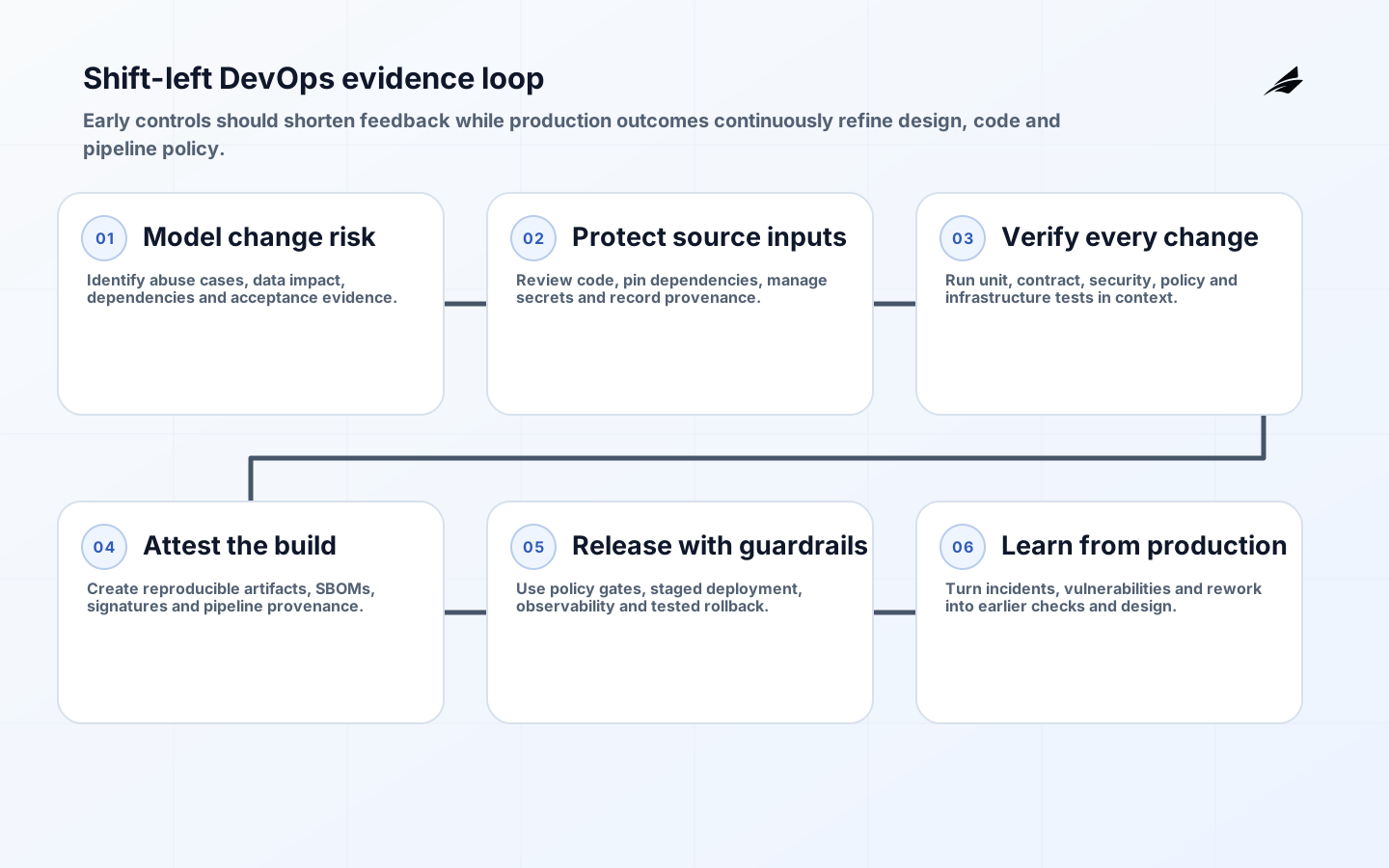
Shift-left DevOps solutions should move useful decisions closer to the person making a change, not move every production control into a developer laptop. Fast feedback is valuable when it is specific, reproducible and tied to an acceptance rule. A noisy scanner that reports thousands of unowned findings earlier has merely advanced the queue. This implementation checklist builds a risk-based path from design and source control through CI/CD, artifact provenance, deployment policy and production feedback, while retaining independent approvals where consequence or regulation requires them.
Begin after the target outcomes and tool boundaries in the shift-left DevOps delivery plan are agreed. Use the shift-left DevOps FAQ for questions about ownership and tool selection. The work below is complete only when a developer can understand why a change is blocked, security can trace the released artifact to reviewed inputs, and operations can return real failure evidence to the earliest control capable of preventing recurrence.
Start with change risk, not a scanner catalog
Create lightweight change classes based on exposed data, privilege, internet reachability, business criticality, dependency change, infrastructure impact and reversibility. For each class, define required reviewers, tests, evidence and rollout controls. A copy change and an authorization rewrite should not wait for identical gates. The NIST Secure Software Development Framework provides outcome-oriented practices that can be integrated into an existing lifecycle; use those outcomes to expose missing responsibilities rather than treating the publication as a tool shopping list.
During refinement or design, record security requirements, misuse cases, trust boundaries, sensitive flows and failure invariants beside the work item. Assign each requirement a verification method before coding begins. The OWASP Application Security Verification Standard can supply testable application objectives, but the team still has to select a level and controls appropriate to the product. Architecture review should focus on irreversible choices and novel trust boundaries, leaving well-understood patterns to automated policy and peer review.
| Change signal | Earliest useful control | Required proof | Escalate when |
|---|---|---|---|
| Authorization or tenant boundary | Design threat model and contract tests | Denied cross-boundary scenarios and reviewer decision | New trust relationship or material data exposure |
| Third-party dependency | Pull-request dependency policy | Version, provenance, license and vulnerability status | Unmaintained package or unacceptable transitive risk |
| Infrastructure privilege | IaC plan and policy test | Least-privilege diff and environment simulation | Wildcard access or external exposure |
| Schema or data migration | Compatibility and recovery test | Forward, backward and reconciliation results | Destructive change without validated restore |
| User-facing behavior | Unit, integration and abuse-case tests | Acceptance result for affected journey | Safety or legal outcome cannot be automated |
Make the repository a controlled source of truth
Protect the path into the main branch with federated identities, strong authentication, reviewed ownership rules and branch protections. Require peer review for production code, pipeline definitions, infrastructure, policy and deployment manifests. Prevent an author from silently changing the workflow that evaluates the same pull request. Secrets belong in managed secret stores and short-lived workload identities, never in source history or developer-specific pipeline variables. Keep emergency changes possible, but make the exception attributable, time-bound and subject to prompt retrospective review.
Pin dependencies and actions to immutable versions where the ecosystem permits, and automate update proposals so pinning does not become abandonment. Maintain an inventory of direct and transitive components, their origin and the products that consume them. Review new packages for maintenance, licensing, namespace risk and install-time behavior before popularity becomes a proxy for trust. CISA's Secure by Design guidance places responsibility on software producers; repository policy should therefore protect secure defaults and product behavior, not shift the burden to individual users.
Build a pipeline that explains its verdict
Order checks to return cheap, high-confidence feedback first: formatting and unit tests, then component and contract tests, static analysis, dependency evaluation, infrastructure policy, image analysis and environment tests. Run affected tests quickly on pull requests and broader suites on protected branches or scheduled builds. Every failure should identify the violated rule, relevant file, owner and safe remediation. Suppressions need a reason, approver and expiry date; an ignored baseline with no retirement path turns a shift-left program into permanent risk acceptance.

Keep test data representative without leaking production records. Include malicious inputs, authorization failures, boundary values, duplicate events, retries and dependency outages. Flaky tests should enter an owned repair queue and lose blocking authority if the team cannot trust them, because repeated false failures train people to bypass real controls. Track whether tests detect the defect class they claim to cover. The goal is a dependable change signal, not a large test count.
Create verifiable artifacts, not anonymous build output
Use isolated, ephemeral build workers with narrowly scoped identities. Fetch inputs from approved registries, record the source revision and build definition, and prevent a release artifact from being rebuilt differently on a workstation. Generate a software bill of materials in a machine-readable format, sign or attest the artifact and store evidence with immutable release metadata. NIST's DevSecOps pipeline supply-chain guidance describes controls around repositories, builds, packages, attestations and deployment; map each stage to an owner and a verification event.
Adopt provenance in increments based on threat and platform capability. The SLSA specification defines tracks and attestations for improving supply-chain assurance. Start by making provenance available and verifiable, then harden the builder and source controls. Consumers must actually verify the attestation before deployment; producing a signed document that no gate checks is record keeping, not protection. Define how keys, identities and trust roots are rotated, revoked and recovered.
Apply the same discipline to infrastructure and policy
Infrastructure code can expose data or disable controls without changing an application binary. Require plans that show resource replacement, network reachability, identity grants, encryption, logging and cost impact. Evaluate policy against the rendered configuration, not only the source template, because defaults and module composition can alter the result. Test modules with representative accounts and regions, version their interfaces and provide migration notes. Production drift should create a reconciled change or an investigated exception rather than an automatic overwrite whose impact is unknown.
Policy as code needs product management of its own. Each rule should name its risk, scope, owner, severity, test cases and exception route. Roll out new rules in observation mode to estimate impact, then fix common causes before blocking. Distribute approved modules and examples so the easiest delivery path already includes identity, telemetry, backup and network controls. Teams bypass controls less often when the paved path solves their deployment problem rather than merely rejecting it.
Preserve release authority with progressive controls
Assemble release evidence from the exact commit and artifact: approved review, passed tests, unresolved exceptions, SBOM, provenance, deployment plan, migration status and rollback or forward-repair procedure. Determine release authority from change risk and environment. Low-risk changes may proceed automatically after policy passes; high-impact changes may require a service owner, security owner or change window. Keep approval decisions structured and attributable instead of relying on a chat reaction that cannot be audited.
Deploy to limited exposure through a canary, ring, tenant cohort or shadow path. Observe customer journeys, error rates, security signals and business invariants before widening. Stop conditions must be machine-readable where possible and paired with a person who can pause rollout. Verify rollback before it is needed, including compatibility with database and event changes. If reversal is unsafe, prepare a tested forward repair and reconciliation process.
| Gate | Pass evidence | Do not release when |
|---|---|---|
| Source review | Required owners approved the final revision | Approval predates a material code or workflow change |
| Artifact integrity | Digest, signature and provenance verify | Artifact origin or build identity is unknown |
| Security posture | Risk-specific checks pass or exceptions remain valid | Critical finding lacks accountable acceptance |
| Deployment safety | Cohort, validation, stop trigger and recovery are ready | Migration cannot be reconciled or repaired |
| Operational readiness | Dashboards, alerts, runbook and responder are active | Team cannot observe the affected user outcome |
Shift production learning back to the left
Production remains the source of truth about real workloads, dependencies and attacker behavior. Join incidents, vulnerabilities, rollback events, support cases and manual interventions to the change and artifact that introduced them. Ask which earlier signal could have changed the decision: a requirement, design pattern, test fixture, dependency rule, policy check or safer deployment default. Add that control only when it would be specific enough to act on; vague lessons create more pipeline noise.
Monitor the controls themselves. Track bypass rate, exception age, false positives, time to remediation, escaped defect classes, provenance verification and the share of releases using progressive delivery. Review differences among teams without turning the measures into individual performance targets. A mature shift-left system reduces surprise and rework while preserving delivery flow. It does not maximize blocked builds.
Treat developer experience as a security dependency
Pilot with a product team that has representative architecture and an engaged owner. Pair platform and security engineers with developers to remove duplicate tools, tune rules and document the path from local check to production evidence. Supply commands or test harnesses that reproduce CI outcomes. Budget time to remediate inherited findings before activating broad gates; otherwise teams begin the program already failing and learn that exceptions are normal.
Scale by reusable capability and defect pattern rather than by forcing every repository onto one date. Publish service objectives for pipeline availability and feedback time, support multiple languages deliberately, and retire superseded scanners or scripts. Funding must cover rule maintenance, build infrastructure, vulnerability response and developer support after rollout. Shift-left solutions are operational products, not a one-time configuration project.
Key takeaways
- Match early controls to change risk and an explicit verification method.
- Protect source, pipeline definitions and dependencies as production inputs.
- Make every blocking result reproducible, owned and time-bounded.
- Generate provenance and verify it before an artifact can deploy.
- Use progressive release controls for risks that cannot be settled before production.
- Turn observed failures into precise earlier checks while pruning noise.
Frequently asked questions
Which shift-left tool should be installed first?
Start with the defect or decision that currently creates the most consequential rework, then choose the smallest control that supplies actionable feedback. For many teams this is dependency policy, secret detection, contract testing or infrastructure review rather than a broad scanner suite.
Does automation eliminate security review?
No. Automation handles repeatable evidence and known rules. Security specialists should concentrate on novel trust boundaries, ambiguous risk, threat modeling, control design and high-consequence exceptions, with their decisions captured so future cases can move earlier.
What if security checks make the pipeline too slow?
Separate fast pull-request checks from deeper protected-branch or scheduled analysis, execute only affected tests where confidence remains sound, cache immutable inputs and remove duplicate tools. Never hide queued scan time; measure when the developer receives a usable result.
Conclusion
Effective shift-left DevOps solutions shorten the distance between a risky decision and trustworthy evidence. They secure the repository and build path, explain policy outcomes, preserve artifact identity and release with bounded exposure. Controls stay proportional because the team starts from change consequence instead of applying the same gate to every commit.
The feedback loop closes in production. Incidents and escaped vulnerabilities should improve requirements, tests, modules and pipeline rules, while stale checks and habitual exceptions are removed. That continuing maintenance is what turns early feedback into a dependable delivery system rather than another layer of unattended tooling.