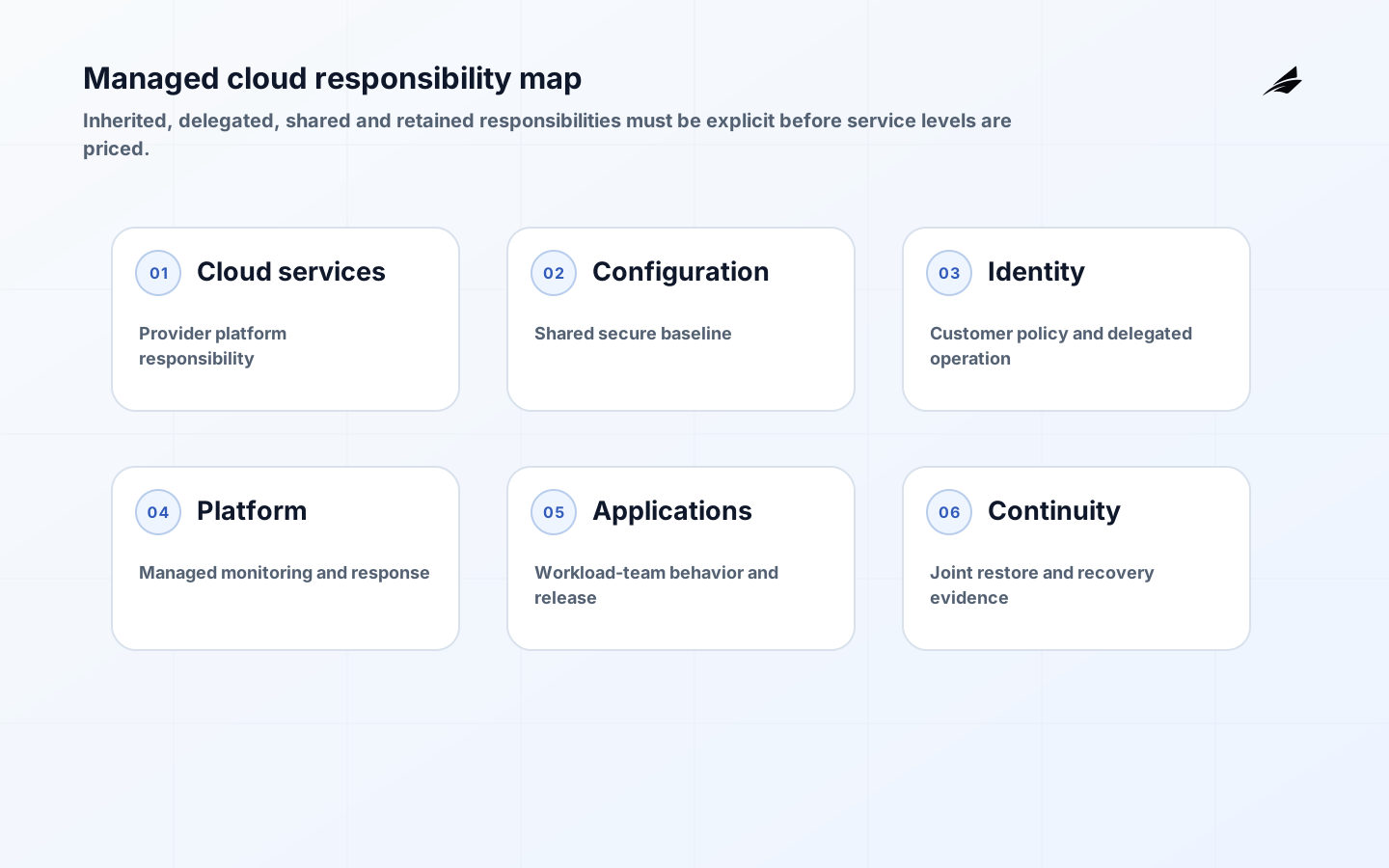
Managed cloud services transfer agreed operational work to a specialist, but they do not transfer business accountability. The useful buying question is not whether a provider can monitor a cloud account. It is which workloads, hours, decisions and outcomes the provider will own; which remain with platform and product teams; and how both sides will prove that the service is secure, reliable and cost-aware. This guide is for leaders comparing an operating partner with an internal cloud team, or replacing an arrangement that has become ticket-driven and opaque.
What buyers need to decide
Searchers usually need a decision framework: what a managed service includes, what drives cost, how an SLA should work, and how to transition without losing knowledge or control. A credible answer begins with business services and user impact, then works down to accounts, subscriptions, clusters, databases and alerts. It also separates cloud-provider obligations from the customer's obligations and the managed service provider's delegated tasks. AWS's shared-responsibility guidance makes the key point: responsibility changes with the service selected. A contract that says only 'manage AWS' or 'manage Azure' is therefore incomplete.
Define the managed boundary before asking for a price
Start with an inventory of production and non-production workloads, owners, criticality, data classification, regions, dependencies and current support hours. For every workload, mark whether the provider will observe, advise, approve or execute. Monitoring without authority to remediate creates long queues; authority without guardrails creates change risk. The statement of work should name supported cloud organizations and accounts, operating systems, container platforms, databases, network components, security services, CI/CD tooling and third-party dependencies. It should also list exclusions such as application defects, data-quality incidents, end-user support or legacy hardware.

| Service tower | Typical managed work | Boundary to write down | Evidence of performance |
|---|---|---|---|
| Platform operations | Provisioning, configuration, patch coordination, capacity and lifecycle tasks | Resource types, environments, maintenance windows and approval rights | Configuration compliance, patch age and successful change rate |
| Reliability | Monitoring, alert triage, incident command, backup and recovery exercises | Coverage hours, severity model, escalation path, RTO and RPO ownership | SLO attainment, actionable alert rate and tested recovery results |
| Security operations | Identity reviews, vulnerability triage, posture findings and log escalation | Control owner, remediation authority and evidence retention | Finding age, privileged-access reviews and incident exercise actions |
| FinOps | Allocation, budgets, anomaly handling, usage optimization and forecasts | Who may resize, stop or commit resources and who accepts performance risk | Allocated spend coverage, forecast variance and unit-cost trend |
| Service management | Requests, changes, problems, reporting and continual improvement | Ticket classes, approval flow, reporting cadence and backlog ownership | Lead time, recurrence rate and completed improvement actions |
Use service levels that reflect user experience
Google's SRE guidance distinguishes an SLI, the measured behavior; an SLO, the target for that behavior; and an SLA, an agreement with consequences. Apply that distinction in procurement. A provider can promise to acknowledge a priority-one ticket in fifteen minutes, but acknowledgement is not availability. Define a small set of workload indicators such as successful transaction rate, latency, data freshness or backup restorability. Then specify how the data is collected, the measurement window, exclusions, reporting source and response when the objective is at risk. Commercial service credits can sit behind these targets, but operational decisions should not wait for a monthly credit calculation.
Build a cost model that exposes demand
Managed-service cost is not the cloud bill. Model at least four layers: provider fees, cloud consumption, licenses and tools, and retained internal effort. Provider fees may be fixed, per-resource, consumption-linked, ticket-based or a hybrid. Each creates behavior: per-resource pricing can discourage accurate onboarding, a percentage of cloud spend can conflict with optimization, and unlimited fixed fees usually contain fair-use assumptions. Ask bidders to price the same baseline inventory and three demand scenarios. Require separate rates for onboarding, projects, after-hours work and out-of-scope engineering so comparison remains meaningful.
| Cost driver | Question for the proposal | Control after launch |
|---|---|---|
| Estate size and change rate | Which accounts, resources or workloads count, and when is inventory measured? | Reconcile the billing inventory to the cloud inventory each month |
| Coverage and skill mix | Is support business-hours, on-call or staffed continuously, and which specialist roles are included? | Review rota coverage, escalations and specialist lead time |
| Tooling | Are observability, security, ITSM and automation licenses included or passed through? | Track license utilization, telemetry volume and retention |
| Demand variability | How are incident surges, migrations and seasonal capacity handled? | Use forecast ranges and pre-agreed surge rates |
| Cloud consumption | Who owns tagging, anomaly response, rightsizing and commitment decisions? | Review allocation, forecast variance, anomalies and unit cost |
The FinOps Foundation treats allocation, forecasting, anomaly management and unit economics as connected capabilities. Put that into the service: require owner and product metadata, an unallocated-spend queue, named anomaly recipients and a cadence for optimization decisions. A unit metric such as cost per active tenant or cost per completed transaction is more useful than celebrating a lower bill that may simply reflect lower demand. Keep commitment purchases and architecture tradeoffs under customer approval because they change financial and technical risk.
Example: a SaaS company moving from informal on-call
Consider a SaaS company with production Kubernetes, managed databases and object storage across two regions. Engineers currently rotate on-call, but alerts are noisy and recovery knowledge sits with two people. The company scopes the provider to platform monitoring, first response, approved low-risk remediation, database maintenance coordination and monthly cost review. Product-code defects remain with engineering. The provider receives time-limited privileged access, operates from customer-owned observability and ticketing systems, and must escalate before any destructive action. Acceptance requires a shadow on-call period, successful restore exercise, complete service map, tested priority-one communications and measured alert reduction. This is a managed capability, not simply outsourced paging.
Risks that deserve contract and architecture controls
- Knowledge concentration: require customer-owned runbooks, architecture decisions, post-incident records and recurring knowledge-transfer sessions.
- Excess privilege: use federated identity, just-in-time elevation, named accounts, session logging and periodic access reviews; avoid shared administrator credentials.
- Tool and provider lock-in: retain logs, infrastructure code, configuration data and ticket history in exportable, customer-controlled systems where practical.
- Split accountability: maintain a workload-level RACI that covers cloud provider, managed provider, platform team, product owner, security and business continuity roles.
- Alert theatre: measure actionable alerts, repeated causes and user-impact detection instead of raw alert volume.
- Untested recovery: make restore and failover exercises scheduled deliverables with recorded results, owners and corrective actions.
- Exit friction: define data return, credential revocation, documentation handover, transition assistance and deletion confirmation before service commencement.
Govern the service through two connected forums. A weekly operational review should cover user-impact events, risky changes, SLO consumption, unresolved escalations, cost anomalies and work due in the next period. A monthly service review should examine recurring causes, capacity, security and compliance exceptions, recovery evidence, financial variance and the improvement backlog. Require each metric to have a definition, owner and source so reports cannot be rebuilt selectively. Minutes should record decisions, accepted risks and due dates. This cadence gives product owners a route to challenge priorities and prevents the relationship from collapsing into a supplier presenting ticket totals to procurement.
A controlled transition and rollout plan
- Weeks 1-2, discover: reconcile the asset inventory, business services, dependencies, incidents, changes, costs, compliance obligations and existing runbooks.
- Weeks 3-4, design: approve the responsibility matrix, severity model, SLOs, access pattern, tool integrations, maintenance calendar and reporting definitions.
- Weeks 5-6, prepare: connect telemetry and ITSM, create least-privilege roles, normalize alerts, draft runbooks and establish a baseline for reliability and cost.
- Weeks 7-8, shadow: the provider observes and recommends while internal owners execute; compare triage quality, escalation timing and documentation completeness.
- Weeks 9-10, reverse shadow: the provider executes approved procedures while internal engineers supervise and can take control.
- Weeks 11-12, accept: run an incident simulation and restore test, close critical documentation gaps, sign acceptance criteria and start the improvement backlog.
Key takeaways
- Buy defined operational outcomes and decision rights, not a broad promise to manage the cloud.
- Map responsibility at workload and control level because it changes by cloud service and architecture.
- Price the provider, consumption, tools and retained team together across realistic demand scenarios.
- Keep identity, telemetry, documentation, infrastructure code and exit evidence under customer control.
- Use shadowing, simulations and recovery tests as acceptance gates before handing over production authority.
FAQ: Does a managed cloud provider replace the internal cloud team?
Usually not. The customer still needs owners for architecture, risk acceptance, product priorities, data, budget and provider governance. A managed provider can supply repeatable operations and specialist coverage, while the retained team sets standards, approves material changes and connects technical decisions to business impact.
FAQ: What should a managed cloud SLA contain?
Include service hours, severity definitions, acknowledgement and action targets, escalation, measurement source, exclusions, reporting and consequences. Link it to workload SLOs, recovery objectives and decision authority. A fast ticket response alone does not demonstrate restoration or good user experience.
FAQ: Is one provider better for a multi-cloud estate?
One provider can simplify coordination, but only if it has credible depth on each platform and a consistent operating layer. Test named specialists, escalation routes and runbooks for each cloud. Do not accept a generic tool dashboard as evidence of equal competence across different identity, network and managed-service models.
Conclusion
A managed cloud service succeeds when ownership becomes clearer, operations become more repeatable and evidence improves. Define the boundary from business service to resource, connect SLOs to user impact, expose every cost layer and rehearse the handover. The resulting contract is only one part of the system; the responsibility map, access design, runbooks, telemetry, governance cadence and exit plan are what keep the customer in control.