Managed IT infrastructure services transfer defined operating work to a provider while the customer retains accountability for business outcomes, information risk and supplier governance. The arrangement can cover cloud, networks, servers, identity, endpoints, databases, backup and service operations. Success depends less on the service label than on a precise boundary, measurable service promises, controlled transition and practical exit path. This guide turns those decisions into a delivery plan.
For execution details, pair this scope guide with the managed infrastructure implementation checklist and managed infrastructure FAQ. The broader infrastructure services delivery plan helps compare managed and internally operated models, while the infrastructure implementation checklist supports acceptance.
Start with service outcomes and retained accountability
Define the business services the infrastructure supports, their users, critical periods, data classes and tolerable interruption. Then map infrastructure components and suppliers to those services. An inventory of devices and subscriptions is necessary but insufficient: it should show dependency, owner, support tier, lifecycle state, recovery requirement and cost center. This baseline prevents a provider from meeting device-level targets while a customer journey remains unavailable.
Use the six functions in the NIST Cybersecurity Framework 2.0 to test governance coverage: Govern, Identify, Protect, Detect, Respond and Recover. The framework describes outcomes rather than prescribing one toolset, which makes it useful for a customer-provider responsibility map. Assign an accountable customer owner for risk, architecture, data, finance and each critical business service even when operational tasks move outside.
| Scope field | Minimum definition | Acceptance evidence |
|---|---|---|
| Service boundary | Included locations, platforms, assets, environments and exclusions | Reconciled inventory linked to business services |
| Operating duty | Provision, change, monitor, patch, backup, respond and retire responsibilities | Signed responsibility matrix and tested workflows |
| Service promise | Hours, severity, response, restore, recovery point and maintenance rules | Measured baseline and reporting calculation |
| Control boundary | Identity, logging, vulnerability, encryption and supplier obligations | Control evidence mapped to owner |
| Exit boundary | Data, tooling, licenses, documentation and access transfer | Executable exit plan with cost and timescale |
Build a service catalog with explicit boundaries
Describe each service as a consumable offer: eligible users, request route, standard configuration, target fulfilment time, support hours, dependencies, price driver and exception process. Separate routine operations from projects. A server patch, emergency firewall change, cloud landing-zone redesign and application migration require different skills and acceptance. Define whether the provider only executes approved instructions or can make bounded operational decisions without prior approval.
Cloud responsibility deserves special attention. The CISA cloud security architecture covers shared services, migration and security posture management. In a commercial agreement, document who configures tenant controls, reviews provider changes, monitors posture, protects administrative access and coordinates incidents with the cloud vendor. A managed-service contract does not replace the underlying cloud shared-responsibility model.
Design identity, security and change controls
Provider staff should use named, strongly authenticated identities issued through an approved federation or dedicated customer directory. Grant time-bound privileged roles through a controlled workflow, record sessions where justified and prohibit shared administrator accounts. Separate service automation identities from human access. Review privileges after staffing changes and at a defined cadence. Emergency access needs independent credentials, alerts, post-use review and a tested revocation path.
The NIST Zero Trust Architecture rejects implicit trust based only on network location. Apply that principle pragmatically: authenticate the subject and device, evaluate requested resource and context, enforce least privilege, and log the policy decision. Do not market a product purchase as zero trust. The useful outcome is narrower, continuously evaluated access across customer, provider and supplier boundaries.
Create standard, normal and emergency change paths. Every change should identify affected services, implementation evidence, validation, rollback and communication. Pre-authorize repeatable low-risk changes only after successful history and automation controls are demonstrated. High-risk changes need independent review and business timing. Measure failed change, unauthorized change and avoidable delay; counting change tickets alone says little about service control.
Set service levels around impact and recovery
Define severity from business impact, not from the component name. A single failed host may have no impact in a resilient cluster, while a valid identity configuration change can stop every employee signing in. State response and restoration objectives separately, include the measurement clock and exclusions, and identify who can declare or downgrade severity. Report distributions and breached cases rather than presenting only monthly averages.
Prepare incident response before transition. NIST SP 800-61 Revision 3 integrates incident response throughout cybersecurity risk management and the CSF functions. The contract should identify detection sources, evidence retention, notification thresholds, decision authority, legal and regulatory contacts, communications, recovery validation and post-incident improvement. Run a joint exercise using a realistic dependency and after-hours escalation.
| Commercial model | Best fit | Risk to manage |
|---|---|---|
| Per asset or user | Stable, countable estate with standard service | Provider incentive to increase units or dispute inventory |
| Capacity band | Variable demand within forecast ranges | Threshold surprises and paid unused headroom |
| Fixed managed scope | Mature catalog and predictable workload | Change requests for poorly defined exclusions |
| Time and materials | Discovery, remediation and uncertain projects | Weak prioritization and open-ended effort |
| Blended base plus projects | Steady operations with controlled modernization | Ambiguous boundary between included improvement and project work |
Model full cost and pricing mechanics
Build a baseline from internal labor, supplier contracts, licenses, hardware, facilities, cloud use, support tooling, project effort, risk exposure and stranded commitments. Add transition, dual-running, remediation, taxes and exit costs. Compare like-for-like scope and service. A lower unit price may exclude backup testing, after-hours changes, security response or lifecycle projects that the customer still must fund.
For cloud spend, the FinOps Framework organizes practice around understanding usage and cost, quantifying business value, optimizing use and managing the practice. Require allocation metadata, shared-cost rules, forecast ownership and optimization decisions. Savings commitments should state baseline and service constraints; deleting resilience or deferring required work is not genuine optimization. Give product owners visibility into the cost they can influence.
Transition in evidence-based waves
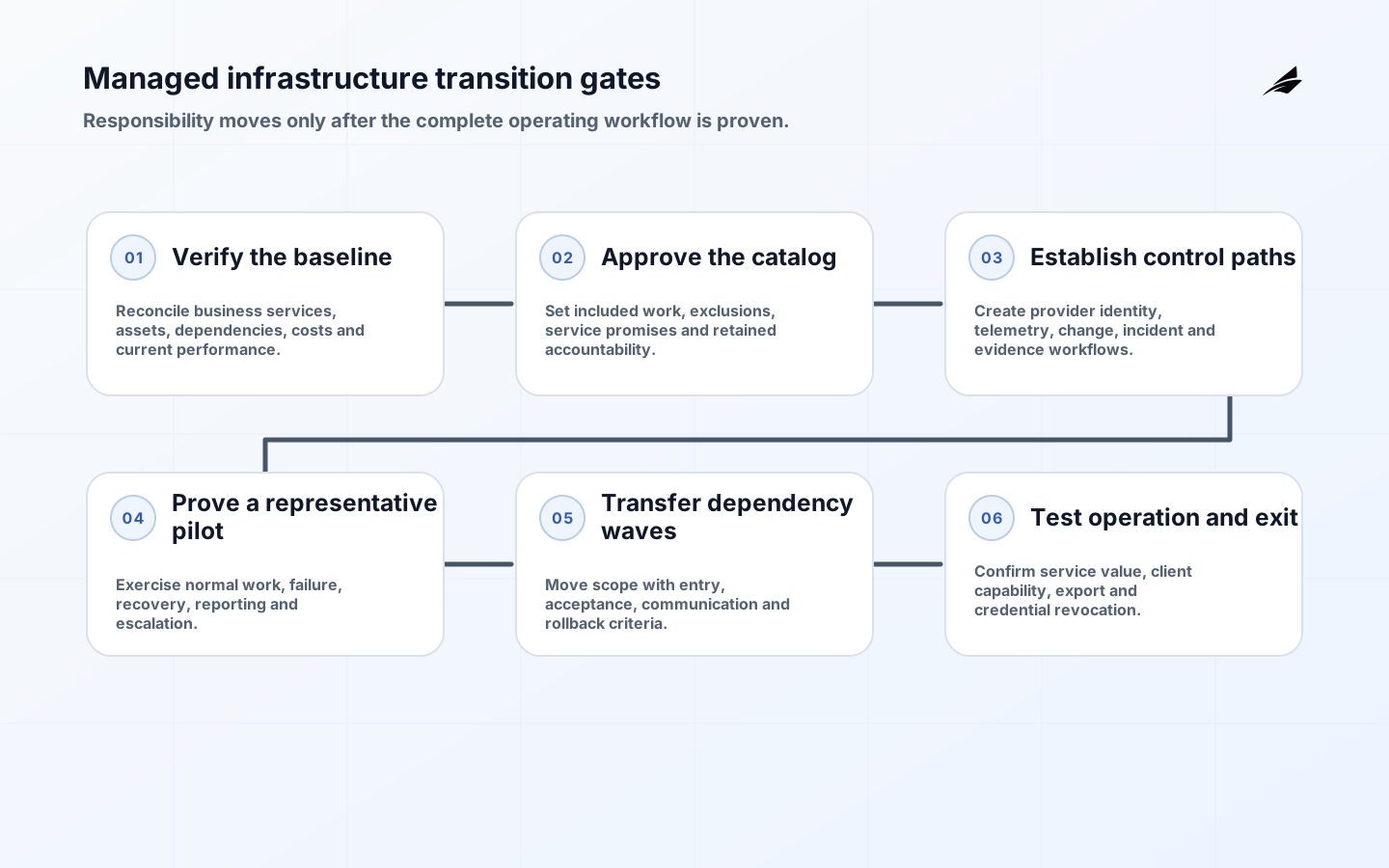
Begin with discovery and reconciliation. Compare inventories, monitoring, contracts, access, backups, architecture records and interviews. Record unknown ownership and unsupported assets as risks, not assumptions. Select a representative pilot that has meaningful dependencies but a tolerable failure consequence. The provider should demonstrate request handling, patching, monitoring, change, backup restoration, escalation and reporting before wider transfer.
Move subsequent waves by dependency and operational readiness, not arbitrary asset counts. For each wave, require accepted inventory, access, telemetry, runbooks, support contacts, baseline measures and rollback. Run a period of shadow support followed by reverse shadowing, where the provider acts and the incumbent observes. Keep a daily decision log during cutover. Do not close transition while critical unknowns remain hidden in a general backlog.
- Baseline business services, assets, dependencies, costs and current performance.
- Approve the service catalog, responsibility matrix and retained organization.
- Establish provider identity, telemetry, evidence and secure administration paths.
- Pilot complete operating workflows and recovery with a representative service.
- Transfer dependency-based waves with explicit entry, rollback and acceptance criteria.
- Review service, risk, cost, improvement and exit readiness after stabilization.
Control concentration, knowledge and exit risks
Common risks include provider concentration, undocumented legacy dependencies, privileged access, subcontractor opacity, tool lock-in, slow security remediation, weak cloud cost incentives and loss of internal knowledge. Put each in a risk register with an owner, treatment, evidence and review date. Contract rights matter, but technical measures such as client-owned repositories, exportable telemetry, open formats and independent credentials make those rights usable.
Maintain a minimum retained capability able to govern architecture, service, security, finance and suppliers. Test exit annually for critical services: export inventory and tickets, restore from customer-accessible backups, transfer one automation workflow, rotate provider credentials and estimate migration duration. Define assistance, data return, deletion evidence, license transfer and continuing support. An exit plan that has never been exercised is only a contractual hypothesis.
Implementation example: a regional services group
A regional services company manages 18 offices, two small data centers and workloads in one public cloud. Discovery finds four identity domains, inconsistent endpoint inventory and backups that have not been restored recently. Rather than transfer everything, the company first establishes one asset record linked to payroll, scheduling and customer service. Customer identity and risk owners remain accountable; the provider receives time-bound administrative roles and works in the customer's service platform.
The pilot covers two offices and a noncritical cloud application. Acceptance requires successful endpoint provisioning, a normal network change, a simulated lost administrator credential, restoration of an application dataset and an after-hours incident exercise. The first report shows service impact and breached cases, not just ticket totals. Later waves follow identity and network dependencies. Unsupported servers enter a funded remediation stream instead of being silently accepted. Quarterly reviews join service, security, cloud cost and exit evidence, giving leadership one view of whether the arrangement is reducing risk and effort.
Key takeaways
- Define managed infrastructure through business services, responsibilities and evidence.
- Retain accountable client owners for risk, architecture, data, cost and service outcomes.
- Treat provider identity and cloud responsibility as first-class control boundaries.
- Price transition, dual running, improvement and exit alongside steady-state operations.
- Transfer in dependency-based waves after complete workflows and recovery are proven.
- Keep knowledge and operational evidence accessible enough to change or leave the provider.
Managed infrastructure planning FAQ
How long should transition take? It depends on estate quality and service complexity. Use entry and acceptance evidence rather than a universal duration. A focused pilot may take several weeks; a diverse enterprise estate can require multiple waves over months.
Should service credits drive selection? Credits can acknowledge failure but rarely compensate for business impact. Prioritize measurable objectives, recovery capability, transparent evidence and improvement obligations. Credits should reinforce, not replace, operational governance.
Can the provider use its own tools? Yes when access, integration, retention, export, security and exit are acceptable. Keep authoritative configuration, code and essential records in systems the customer can access independently.
Conclusion
Managed IT infrastructure services create value when responsibility becomes clearer and operations become more measurable, resilient and economical. Establish the baseline, define the catalog and control boundary, prove the operating model in a representative pilot, then transfer in accountable waves. Design exit at the same time as entry so the organization remains in control of its services and choices.