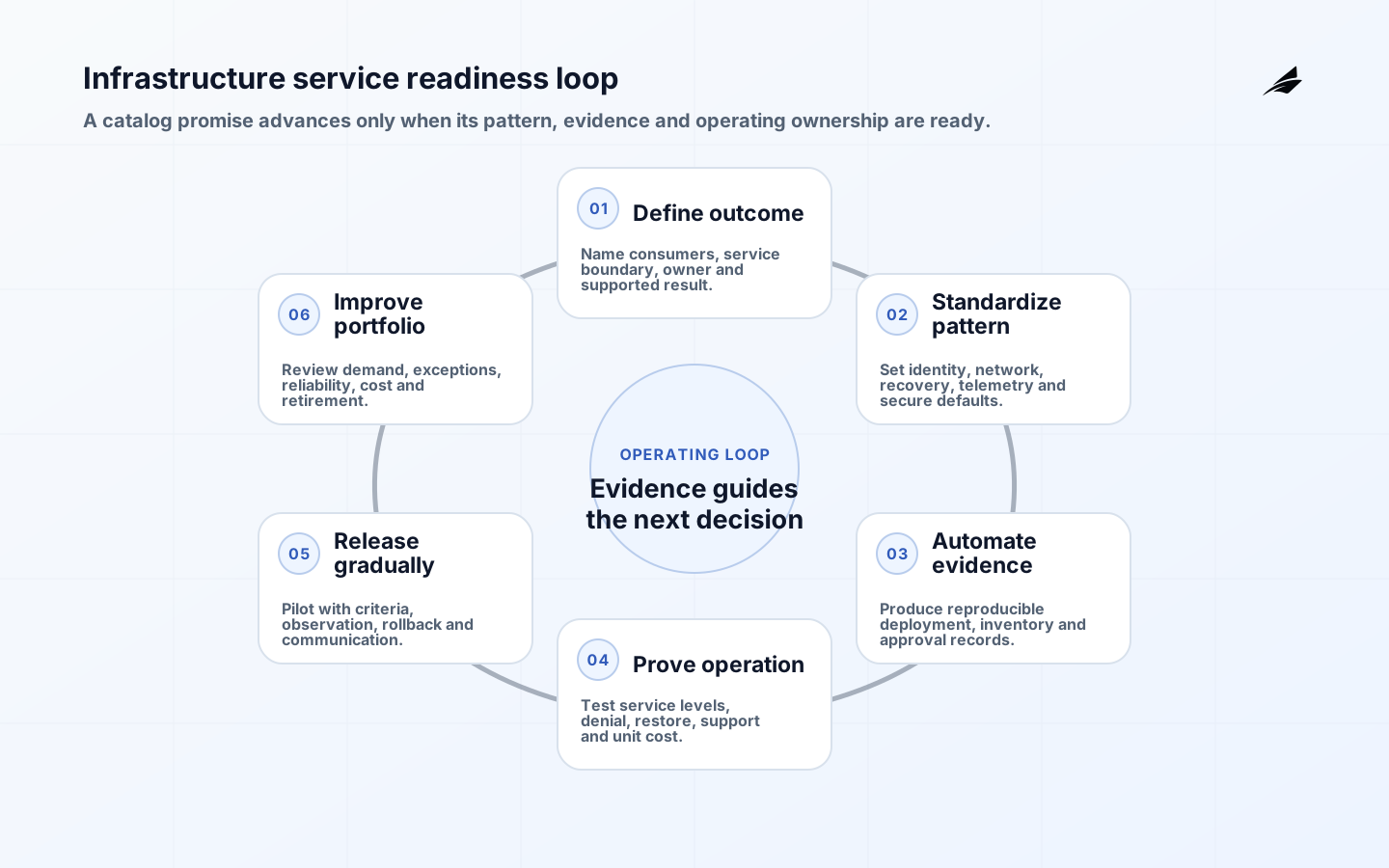
Infrastructure services offerings turn compute, storage, networking, identity, observability, backup and operational support into dependable products for internal teams or customers. The difficult part is not publishing a list of technologies. It is giving each service a clear outcome, supported configurations, measurable reliability, security boundaries, cost model and route for change. This infrastructure services offerings implementation checklist helps platform leaders move from loosely owned components to services that people can request, operate and improve without relying on undocumented knowledge.
Use this guide alongside the infrastructure services scope and cost plan, the infrastructure services FAQ and the cognitive infrastructure delivery plan. The catalog should remain smaller than the underlying technology estate: an offering is a supported promise to consumers, while a component is merely something the provider operates.
1. Define the consumer outcome and service boundary
Begin with the job the consumer needs to complete. A managed application runtime may promise a deployable environment with identity, logs, backup and support; a raw virtual machine does not. State who can consume the service, the regions and data classes it supports, dependencies it includes, and responsibilities retained by the application team. NIST distinguishes infrastructure, platform and software service models, but a useful catalog goes further by making the operational handoff explicit. Avoid overlapping entries such as hosting, cloud hosting and managed cloud unless each has a genuinely different contract.
Write one service brief before designing automation. It should name an accountable service owner, technical owner, support group, consumer personas, lifecycle state, request channel, standard lead time, availability target, maintenance approach, recovery objective, charging method and exit process. Record exclusions in plain language. If a consumer needs an unsupported database version, unusually sensitive data or a custom network route, they should know whether that creates a separate engineering engagement, a time-bounded exception or a rejection.
| Catalog field | Decision to make | Evidence before launch |
|---|---|---|
| Outcome | What usable capability the consumer receives | Consumer scenario completed end to end |
| Boundary | Included components and shared responsibilities | Reviewed responsibility matrix |
| Service level | Availability, latency, support and recovery targets | Measured indicators and escalation test |
| Commercial model | Allocation, quota or unit price | Sample bill or showback report |
| Lifecycle | Request, change, deprecation and exit rules | Published workflow with named owners |
2. Design a secure standard pattern
Translate the service brief into a reference pattern. Define account or subscription structure, network boundaries, identity roles, encryption, secrets handling, logging, backup, approved images, patching and configuration baselines. NIST SP 800-53 is a catalog to tailor through risk management, not a requirement to apply every control identically. Map relevant controls to the party that implements them and the evidence that proves them. Secure defaults should be present in every standard deployment; optional security add-ons usually become inconsistent controls.
Separate the control plane from consumer workloads and reduce standing administrator access. Use individual identities, short-lived credentials where practical, peer-reviewed configuration changes and break-glass access that is logged and reviewed. Define tenant or project isolation, data residency constraints and permitted connectivity. Threat-model the provisioning path itself because automation with broad privileges can create the same defect everywhere quickly. Test denied paths, expired identities and compromised dependency scenarios, not only the successful deployment.
3. Automate provisioning and configuration evidence
Represent repeatable infrastructure in version-controlled code. A request should become validated parameters, reviewed policy decisions, a reproducible deployment and a durable service record. Pin or constrain module and provider versions, review third-party modules, scan configurations and keep state protected. Promotion between environments should use the same tested definitions with environment-specific values. Manual steps are acceptable when they protect a high-consequence decision, but every manual action needs an owner, expected duration and auditable result.
Build idempotency and recovery into automation. Retrying a timed-out request must not create duplicate networks, orphaned resources or conflicting records. Give each transaction a correlation identifier and retain its plan, approvals, applied version and outcome. Validate partial failure by interrupting dependencies during a test deployment. The team should know whether the workflow resumes, compensates or routes an exception. A green pipeline is insufficient if the resulting service is inaccessible, unmonitored or absent from the asset inventory.
4. Set service levels and observable operating signals
Define service level indicators from consumer experience: successful provisioning, workload reachability, restore success, policy decision latency or supported request completion. Set objectives that reflect business need rather than a convenient platform metric. Google SRE guidance uses SLOs to make reliability measurable and to support decisions about risk. Do not promise an availability percentage without defining the measurement point, window, exclusions and consequence of missing the target. Component uptime may conceal a failed end-to-end service.
Instrument metrics, logs and traces where they answer operational questions. OpenTelemetry describes these as telemetry signals, but collecting all signals at full fidelity is rarely sensible. Start with request success, saturation, error rate, latency, capacity, change events and security decisions. Attach service, environment, owner and deployment version consistently. Alerts need a consumer impact, threshold, runbook and response owner. Review noisy pages and missing telemetry after incidents, because alert volume is not evidence of observability.
| Operating signal | Decision it supports | Unhelpful substitute |
|---|---|---|
| Provisioning success rate | Whether consumers can obtain the service | Pipeline job count |
| Restore exercise result | Whether recoverability is proven | Backup job marked complete |
| SLO burn rate | Whether reliability risk needs action | Raw alert total |
| Unsupported configuration age | Whether exceptions must close | Number of open tickets |
| Unit cost by service | Whether demand and architecture are efficient | Undifferentiated provider invoice |
5. Establish cost, quota and capacity controls
Choose a commercial model consumers can understand. Shared foundations may be centrally funded, allocated by a stable driver or charged through measurable units. Explain which costs are included, how commitments and support are handled, and when rates can change. Require ownership metadata at provisioning and validate it continuously. A tag policy that allows unallocated spend for months does not create accountability. Showback is often a useful first step because teams can correct attribution before chargeback affects budgets.
Capacity management belongs in the offering, especially where quotas, scarce accelerators, licenses or regional limits apply. Forecast from demand signals and service adoption, then define thresholds for reservation or expansion. Make quota increases a controlled workflow with cost and risk context, not an informal support request. Remove idle test environments through explicit expiration rules, but protect stateful and regulated workloads from automatic deletion. Optimization must preserve the service objective; the cheapest configuration that misses recovery or performance requirements is not efficient.
6. Pilot, accept and transition the service
Pilot with consumers whose use cases represent the intended boundary. Include a normal request, a rejected request, a change, a restore, a capacity event and a support escalation. Capture time spent and manual intervention, then remove avoidable friction before broad release. Acceptance requires more than deployment: the service record must exist, telemetry must identify the owner and version, backup must be restorable, privileged access must work as designed, and the support team must diagnose a realistic failure from the available evidence.

- Approve the service brief, supported configurations and responsibility matrix.
- Deploy the reference pattern through the production automation path.
- Run security, reliability, restore and exception scenarios.
- Train support and consumer representatives using real requests.
- Confirm unit cost, ownership metadata, quota and capacity thresholds.
- Publish the offering only after owners sign the acceptance evidence.
Use progressive exposure: internal preview, limited availability and general availability are useful only when each stage has entry and exit criteria. Keep rollback and consumer communication ready. For migrated consumers, compare behavior and cost against the previous service, reconcile data or configuration, and retire the old route after an agreed observation window. Permanent parallel platforms create duplicated controls and uncertain ownership, so exceptions need an expiry and a funded removal plan.
7. Operate the catalog as a product portfolio
ISO/IEC 20000-1 covers planning, design, transition, delivery and continual improvement of services. Apply that lifecycle at a proportionate scale. Review demand, reliability, security findings, support effort, cost, exceptions and consumer feedback on a fixed cadence. Use the evidence to improve the standard pattern, change the objective, narrow support or retire the offering. Publish material changes and deprecation dates early, including migration help and the final removal decision.
Assign a portfolio owner to detect duplication and gaps across offerings. A heavily customized service with low adoption may belong in project engineering rather than the catalog. Conversely, repeated exceptions can reveal a missing standard capability. Measure request lead time, successful self-service, SLO attainment, restore proof, unit cost, exception age and consumer outcomes together. Optimizing one metric in isolation creates predictable harm, such as fast provisioning without governance or low cost without reliability.
Key takeaways
- Describe each offering as a supported consumer outcome with an explicit responsibility boundary.
- Put security, recovery, telemetry and ownership into the standard pattern and provisioning path.
- Measure end-to-end service levels instead of relying on component uptime or ticket volume.
- Prove normal, denied, failed and recovery scenarios before general availability.
- Manage catalog entries through adoption, improvement, deprecation and retirement.
Frequently asked questions
How many offerings should an infrastructure catalog contain?
As few as can cover distinct consumer outcomes without forcing unsafe customization. Create a separate offering when the service boundary, assurance, operating model or commercial unit is materially different. Technology variants can usually remain supported configurations within one offering.
What is the difference between an SLA and an SLO here?
An SLO is an internal reliability target tied to a measured indicator. An SLA is a formal commitment that may specify remedies or commercial consequences. Operate with SLOs even when no contractual SLA exists, and leave engineering margin between internal targets and external promises.
Does self-service eliminate platform support?
No. Self-service standardizes routine requests, while the provider still owns the platform, incident response, lifecycle changes and supported escalation. Good automation reduces avoidable tickets and gives support richer evidence when an exception occurs.
Conclusion
Reliable infrastructure services offerings are explicit promises backed by engineering and operating evidence. Define the outcome, standardize the secure pattern, automate a recoverable request path, measure consumer-facing reliability, make costs visible and prove support before launch. Then use operational signals to improve or retire the service. That discipline turns an infrastructure estate into a portfolio that consumers can trust.