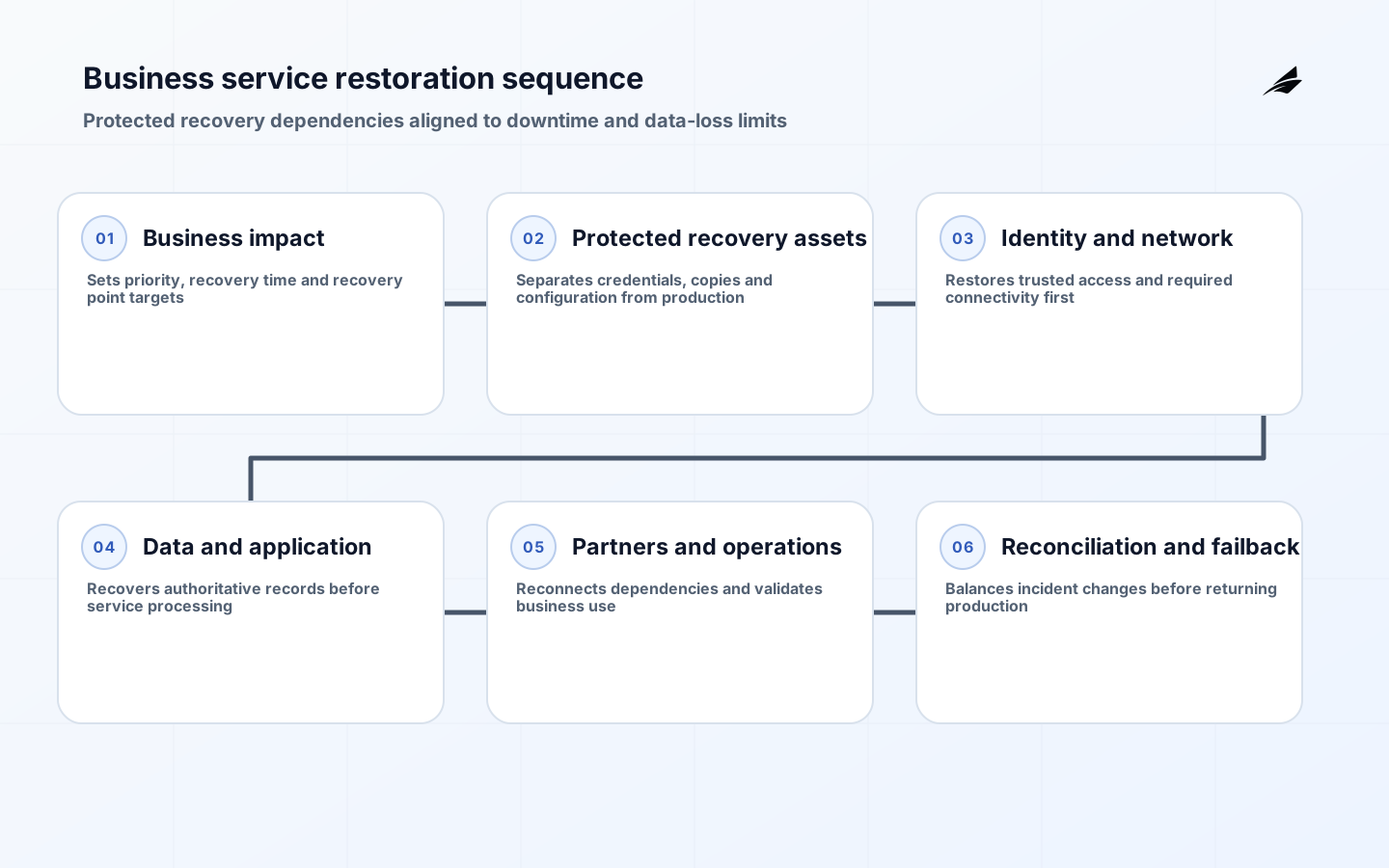
Disaster recovery planning should be planned as an operating capability, not a procurement label. The objective is restoration of priority business services within agreed downtime and data-loss limits. A credible initiative connects business ownership, design, controls, people, transition and measures before broad rollout. It also states what will not change, because a clear boundary protects teams from uncontrolled scope and makes acceptance possible.
Define the service and its boundary
Map the end-to-end scope across business impact, people, applications, data, facilities, suppliers, communications, failover, restoration and failback. Start with priority journeys and name the accountable outcome owner. Describe demand, current failure modes, manual work, dependencies and obligations. Validate the inventory with people who perform and support the work; repositories and contracts rarely capture exceptions or informal handoffs.

For each recoverable service, document upstream and downstream dependencies, authoritative data, restoration order, recovery access and business owner. Relate component objectives to the service RTO and RPO. Exclude lower-priority functions deliberately from the first recovery scope so scarce people and clean capacity are reserved for operations whose interruption becomes unacceptable first.
| Scope area | Decision | Evidence |
|---|---|---|
| Outcome | What result must improve? | Baseline, owner and acceptance measure |
| Workflow | Which normal and exception paths are included? | Journey and exception map |
| Information | Which records are authoritative and sensitive? | Classification, lineage and retention |
| Technology | Which components and providers participate? | Dependency and interface inventory |
| Controls | Which requirements must remain effective? | Control owner, test and evidence |
| Operation | Who supports, recovers and improves it? | Runbook, roles and service objectives |
Turn requirements into an operable design
Start with service flows and failure modes, then choose backup-and-restore, pilot-light, warm-standby, active-active or manual workarounds. Protect recovery credentials and copies from the same event as production. Rebuild configuration and dependencies as well as data, and design failback.
Recovery design must survive the event that disabled production. Separate backup administration, credentials, accounts and locations where risk justifies it; retain protected recovery points; and test clean reconstruction of identity, network, keys, configuration, data and applications. Define communication and manual operation when monitoring or primary collaboration tools are unavailable.
Build a cost model from measurable drivers
A universal price would be misleading. Material cost drivers include RTO, RPO, data change, standby capacity, separation, licenses, automation, exercises, staffing and technical debt. Estimate a range from observed scope and expose assumptions. Discovery should reduce the largest uncertainties before a fixed commitment. Compare options across transition and useful operation, not only the implementation quote.
| Cost group | Include | Control question |
|---|---|---|
| Discovery | Observation, inventory and design | Which unknowns change the approach? |
| Delivery | Build, integration and environments | What is reusable or custom? |
| Assurance | Security, testing and remediation | What evidence is required? |
| Transition | Migration, training and parallel work | How long will coexistence last? |
| Operation | Consumption, licenses, people and suppliers | Who owns demand and unit economics? |
| Exit | Export, replacement and decommission | Can continuity survive departure? |
Separate initial resilience engineering from recurring backup storage, replication, standby capacity, licensing, exercises and plan maintenance. Include business participation, isolated restore environments, data validation, alternate communications and post-exercise remediation. Reforecast after measured restores reveal transfer rates, initialization time, manual bottlenecks and dependencies missing from the architecture inventory.
A bounded example
An order service may accept a four-hour outage but little loss of confirmed orders. The team restores identity, network, database, application and partner connectivity in sequence from protected artifacts, then reconciles orders around the incident. Tabletop, technical and business exercises prove different parts of the plan.
Baseline current restore success, backup age, dependency recovery time, manual backlog and decision latency before changing the plan. In the order-service exercise, measure the actual recoverable point, time to safe reopening and reconciliation exceptions. A server starting within target is insufficient if users cannot authenticate, partners cannot connect or orders remain uncertain.
Manage risks as delivery inputs
| Risk | Early signal | Practical treatment |
|---|---|---|
| Untested backup | Jobs succeed but restores fail | Perform isolated verified restores |
| Shared failure domain | Recovery uses production identity | Separate recovery dependencies |
| False objectives | RTO and RPO are copied | Derive them from business impact |
| Runbook decay | Names and commands are stale | Assign owners and exercise |
| Cyber contamination | Replicas copy corruption | Use protected recovery points |
| Failed failback | Recovered changes are lost | Plan synchronization and reconciliation |
Assign each recovery risk to the service owner, technology owner or incident authority able to act. Use triggers such as missed backups, replication lag, expired emergency access, untested changes or overdue corrective actions. Escalate when measured recovery exceeds tolerance, and record any temporary acceptance with an expiry and compensating procedure.
A staged implementation plan
- Frame: confirm owner, outcome, boundaries, obligations, risk tolerance and funding.
- Discover: observe work; inventory data, systems, providers, controls, demand and failures.
- Design: select architecture, roles, security, recovery, migration and acceptance together.
- Prove: build a representative slice and test the hardest dependency, control and failure.
- Pilot: limit exposure while increasing monitoring, support and feedback.
- Expand: add waves only while quality, risk, operations and cost remain within thresholds.
- Retire: remove obsolete access, jobs, copies, contracts and procedures after verification.
A recovery gate should prove progressively more: tabletop decisions, isolated data restore, dependency reconstruction, technical failover, business operation and controlled failback. Before declaring readiness, verify contacts, access and runbooks from the recovery environment. Retire a former site or process only after retained records, restoration capability and supplier termination are confirmed.
RTO is an acceptable restoration delay and RPO an acceptable data-loss period; set both for service flows, not isolated servers.
A business impact analysis should examine how safety, obligations, customer harm, cash flow and manual backlog change over time, allowing differentiated priorities.
Progress from tabletop decisions to component restores, technical failover and end-to-end business exercises; state clearly what each exercise actually proves.
Define who declares a disaster, approves failover, accepts data loss, communicates externally and authorizes failback, with alternate access and communication.
RTO and RPO should be negotiated with the people accountable for customer, safety, legal and financial consequences. Tighter objectives usually require more automation, replication and standby capacity. Record the cost and residual impact of each option so a target represents a conscious business decision rather than an inherited spreadsheet value.
Cyber recovery differs from ordinary infrastructure failure because replicas, credentials and tools may be untrusted. Define how responders establish a clean point, obtain uncompromised administration, inspect restored systems and prevent reinfection. Coordinate evidence preservation with restoration so urgent service recovery does not destroy information needed for investigation.
Failback needs its own plan and authorization. Decide how changes made in recovery will synchronize, which site becomes authoritative, how traffic returns and how records reconcile afterward. Rehearse rollback from a failed failback. Teams often test entry into recovery while leaving the more complex return path as an assumption.
Manual workarounds have capacity and control limits. Estimate how many transactions staff can process, which approvals remain mandatory, how records are protected and how backlog enters restored systems. A workaround that supports a short outage may become unsafe when disruption lasts longer or key staff are unavailable.
Keep recovery documentation accessible without the primary network or collaboration suite. Store controlled copies of essential contacts, decision checklists, architecture, credentials procedure and vendor routes in an approved alternate location. Verify access during exercises and update the material after personnel, contract and system changes.
Make governance, acceptance and adoption practical
Recovery governance belongs with business continuity, service owners, incident leadership, security, infrastructure, application and supplier management. The forum sets service priorities, approves objectives and resolves shared dependencies. During an event, a smaller command structure must have authority to declare disaster, accept loss, invoke recovery and decide when evidence supports reopening.
Accept a disaster recovery capability only after users complete priority transactions on recovered systems and reconcile them to authoritative records. Test loss of identity, region, administrative access or trusted data rather than a convenient component restart. Capture actual RTO, RPO, manual steps, decision delays and failback results for corrective action.
Prepare business and technical teams for their incident roles. Service owners need impact and reopening decisions; responders need trusted procedures and emergency access; communications teams need approved audiences and channels. Exercises should introduce ambiguity and unavailable personnel so the plan proves resilient judgment, not memorization of an ideal sequence.
Key takeaways
- Anchor disaster recovery planning in an accountable outcome and bounded first service.
- Map authoritative records, decisions, dependencies and failure behavior first.
- Estimate assurance, transition, operation and exit with implementation.
- Use a representative proof and limited pilot to turn assumptions into evidence.
- Scale through explicit gates while retaining ownership of risk, quality and economics.
Frequently asked questions
Where should planning start?
Begin with a business impact analysis for one priority service. Determine when interruption and data loss become unacceptable, identify dependencies and current recovery evidence, then compare strategy cost with consequence. Choose a first exercise that tests the weakest assumption, such as protected data restoration or identity availability, rather than the easiest demonstration.
How should cost be estimated?
Estimate disaster recovery from service-specific RTO and RPO, data volume and change, recovery locations, standby pattern, network capacity, automation, licenses, testing and staffing. Add clean-room needs for cyber recovery and business reconciliation effort. Reforecast using measured restore and startup times instead of nominal transfer rates or product claims.
What should be checked when using a provider?
Check whether recovery providers protect copies from production compromise, support required regions and accounts, expose restore evidence, meet data-retention needs and assist during declared events. Understand dependencies on identity, DNS, keys and provider control planes. Test export and restoration without the provider's ordinary portal or your primary administrator.
How long should implementation take?
Implementation time depends on business-impact decisions, application recoverability, data size, infrastructure automation, supplier lead times and exercise remediation. A backup policy can be written quickly; proving end-to-end recovery usually spans several test cycles. Prioritize critical services and revisit the schedule whenever major architecture or data-flow changes invalidate evidence.
What proves success?
Success is demonstrated recovery, not the existence of plans or backups. Report tested service RTO and RPO, data validation, transaction reconciliation, manual backlog, emergency-access performance, business decision time, failback outcome and closure of exercise actions. State the scenario and limitations so leaders know exactly which disruptions the evidence covers.
Conclusion
A professional plan for disaster recovery planning makes ownership, boundaries, design, controls, economics and transition visible. It replaces broad promises with a representative proof, measurable acceptance and reversible rollout. This exposes uncertainty early enough to make informed decisions while changing direction is still manageable.