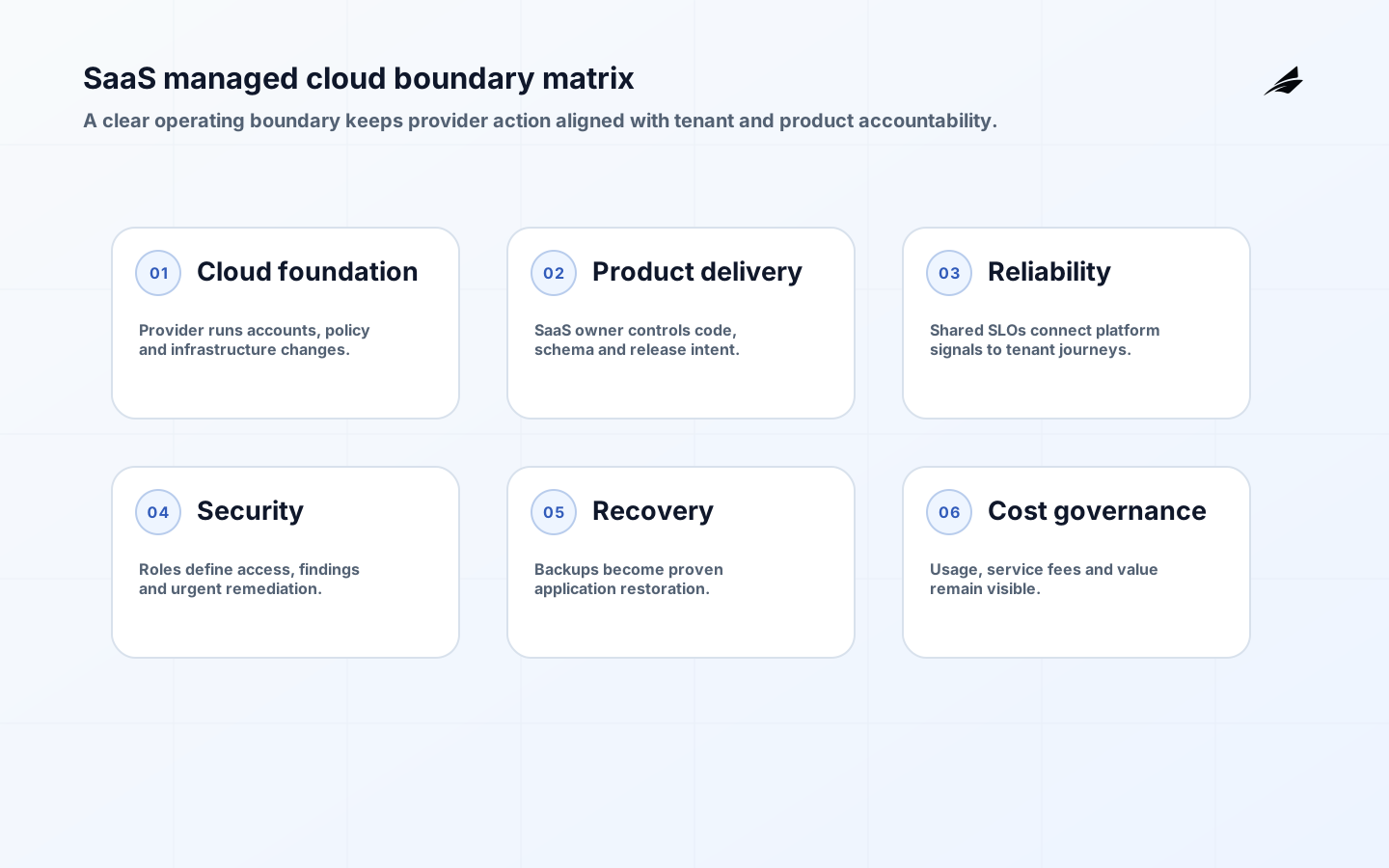
Managed cloud services for SaaS companies combine day-to-day platform operations with the engineering context needed to protect tenant experience. The provider may run cloud foundations, observability, patching, backup, incident response and cost controls, but the SaaS company still owns product behavior, data obligations and customer promises. A useful buying decision therefore starts with service outcomes and an explicit responsibility boundary, not a catalogue of tools. This FAQ explains what to outsource, what to retain, how to compare service levels and how to make the relationship measurable. It complements Edilec's managed cloud scope and cost plan, implementation checklist and SaaS DevOps delivery plan.
Key takeaways
- Define managed cloud coverage by tenant-visible outcomes, environments and decision rights.
- Keep product correctness, data policy and customer communication with the SaaS owner.
- Use SLOs, runbooks and restoration evidence to make operational promises testable.
- Separate recurring service fees, cloud consumption and project work when comparing cost.
- Start with a bounded transition and prove access, alerting, escalation and recovery before expansion.
What do managed cloud services cover for a SaaS company?
Coverage usually includes cloud account or subscription governance, infrastructure as code, operating-system and managed-service configuration, vulnerability and patch routines, monitoring, backup administration, incident coordination and spend reporting. The exact boundary varies by cloud service model. NIST's cloud definition distinguishes infrastructure, platform and software service models; that distinction matters because control of the operating system, runtime and application changes with the model. Build a service catalogue around the actual stack and environments rather than assuming that one generic definition of management applies everywhere.
A provider should also name exclusions. Product releases, database schema decisions, tenant entitlements, application-level authorization and customer support often remain with the SaaS company even when the provider operates the underlying platform. Third-party APIs, identity providers and data processors need named owners on both sides. The responsibility map should cover routine work and pressured situations: who may change production, who declares an incident, who contacts customers, who approves emergency access and who validates restored business transactions. Ambiguity at these handoffs is more dangerous than a modest gap in tooling.
| Area | Provider responsibility | SaaS owner responsibility |
|---|---|---|
| Cloud foundation | Accounts, policy baseline and infrastructure changes | Approved architecture and data classification |
| Application delivery | Operate agreed pipeline and deployment controls | Code, schema, feature and release decision |
| Incident response | Detect, triage and execute platform runbooks | Declare customer impact and validate product recovery |
| Data protection | Run backup and retention mechanisms | Set recovery objectives and test application consistency |
| Cost | Allocate, report and identify anomalies | Prioritize value, commitments and product tradeoffs |
How should reliability and security be specified?
Translate availability language into service-level indicators that reflect user journeys. Google SRE guidance on SLOs recommends starting from behavior users care about, then defining how it is measured. For SaaS, useful indicators may include successful sign-in, API correctness, job completion and data freshness rather than virtual-machine uptime. Specify the measurement source, evaluation window, exclusions, alert thresholds and response when the error budget is consumed. A provider can operate infrastructure well while a broken release still harms customers, so application and platform evidence must be read together.
Security responsibilities require the same precision. CISA's cloud security reference material emphasizes shared services, migration and cloud security posture management. Document identity federation, privileged access, secrets, logging, network policy, encryption configuration, vulnerability handling and evidence retention. Require time-bound emergency access and a review after use. Confirm which findings the provider remediates directly, which require a product change and how a critical issue is escalated when the normal change window is too slow.
What evidence should a buyer request?
Evidence should show that controls work in the buyer's environment. Ask for an asset and account inventory, infrastructure change history, access reviews, patch and vulnerability status, backup job results, sample restore outcomes, incident timelines and unresolved risks. Telemetry should use stable service and environment identity. The OpenTelemetry signals model distinguishes traces, metrics and logs while allowing them to be correlated; a managed service should explain which signals it owns, where they are retained and how the SaaS team can inspect them during an incident.
Do not accept a monthly slide deck as the only operating record. The buyer needs direct or exportable access to material tickets, alerts, changes and cost data, with retention appropriate to investigation and audit needs. Runbooks should state prerequisites, commands or console paths, decision points, validation and rollback. Test one alert from detection to acknowledgement, one privileged action from request to review and one restore from backup selection to application verification. These exercises reveal missing permissions and ownership long before a severe incident does.
| Evidence | Useful question | Acceptance test |
|---|---|---|
| Alert | Does it represent user impact or urgent risk? | Trigger, route and acknowledge a test event |
| Change record | Can a reviewer identify actor, revision and rollback? | Trace one deployment to source and approval |
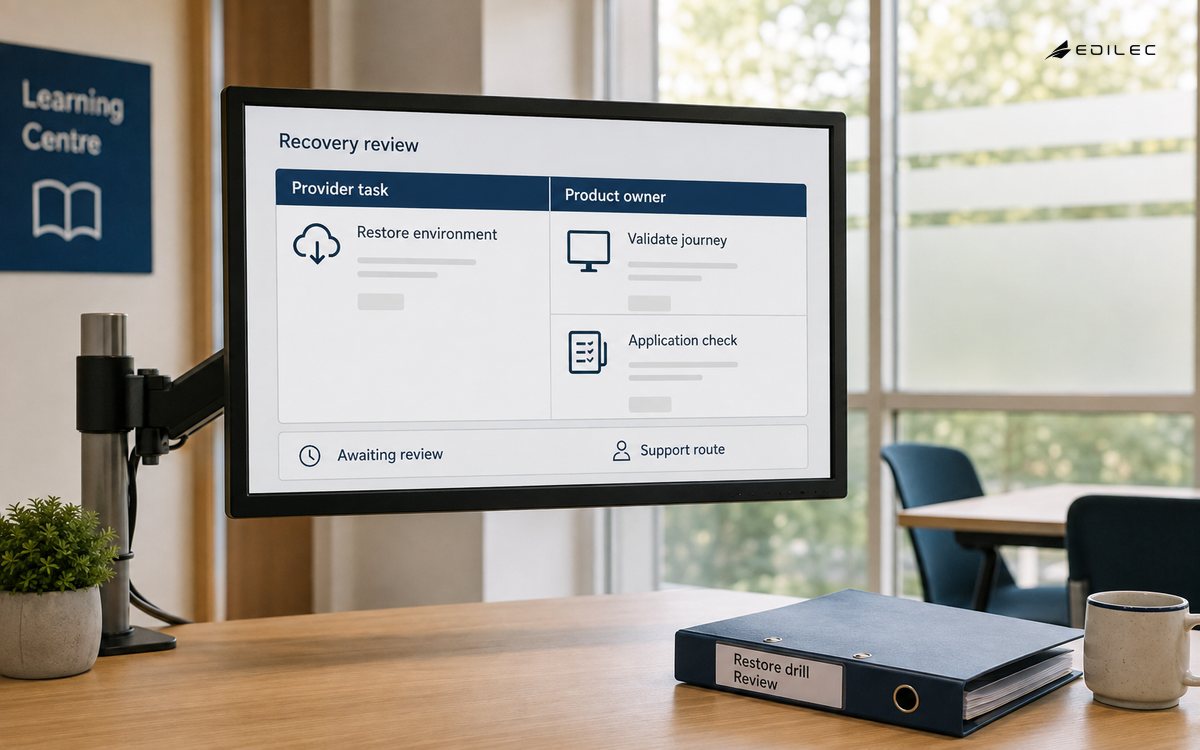
| Restore result | Was application correctness verified? | Restore isolated data and run business checks |
| Access review | Are privileges current and time bounded? | Sample staff, service and emergency accounts |
How do pricing and transition work?
Compare total operating cost in separate layers: provider retainer, cloud consumption, observability and security tooling, on-call or premium response, and project work such as migrations. Clarify whether the retainer scales by account, workload, spend, ticket or service tier. A percentage-of-spend fee can create awkward incentives unless optimization outcomes are independently measured. The FinOps usage optimization capability treats optimization as balancing usage with business value, performance and risk. Savings should never be counted without confirming that service objectives and resilience remain intact.
Transition should be an evidence-producing phase, not an administrative handover. Inventory environments, pipelines, credentials, certificates, domains, dependencies, backups, dashboards, alerts, suppliers and open risks. Establish access through managed identities and remove personal credentials. Shadow routine operations, then reverse-shadow them with the incoming provider acting while the SaaS team observes. Exit readiness belongs in the initial contract: configuration and code repositories, telemetry exports, documentation, credential rotation, knowledge-transfer obligations and a tested method to remove provider access.
How should teams select and govern a provider?
Use scenarios to compare providers. Give candidates a sample degraded-service event, a risky production change, a failed restore and a cost anomaly. Ask who acts, what information they need, what they record and when the SaaS owner becomes involved. Evaluate engineering depth in the actual runtime, databases, orchestration and delivery system, not just cloud certifications. References are most useful when they describe a similar tenancy model, release cadence and regulatory context. Contractual service levels matter, but the quality of diagnosis and collaboration usually determines recovery speed.
After launch, hold an operational review that examines customer-impacting events, error-budget use, change outcomes, security findings, capacity, restore evidence and spend variance. Track actions to closure with owners and dates. Avoid turning the meeting into ticket narration; focus on recurring risk and decisions. The companion tenant-safe SaaS DevOps checklist helps connect provider controls to product delivery. Revisit the boundary whenever architecture, data classification, customer commitments or suppliers materially change.
Contractual acceptance should distinguish transition completion from steady-state quality. Before recurring service begins, confirm that all agreed resources are inventoried, monitoring reaches the correct responders, privileged paths work without shared credentials, backups cover the required data, runbooks match the deployed architecture and the provider can execute a change through the buyer's controls. Record open exceptions with risk owners and dates rather than burying them in transition notes. During service, use a small scorecard that pairs customer-facing reliability with operational evidence: actionable alert rate, change failure and rollback, critical vulnerability age, restore success, incident follow-through and unallocated spend. Credits can address a missed promise, but corrective engineering and a verified prevention action matter more than a small invoice adjustment. Require the provider to disclose material subcontractor or tooling changes that alter data location, access, telemetry retention or response capacity. This keeps commercial governance connected to the technical boundary the buyer actually approved. Review capacity forecasts before seasonal demand or major customer launches, and confirm that rate limits, quotas and supplier support tiers can sustain the planned load. Include one joint game day each review period so documentation, permissions and communication paths are tested as a system.
Frequently asked questions
Does a managed provider replace an internal platform team?
Usually not completely. A provider can supply 24-hour coverage, specialist operations and repeatable controls, while internal engineers retain product architecture, customer context and prioritization. The right blend depends on scale, risk and how much operational knowledge is specific to the product.
Should the provider own the cloud account?
The SaaS company should normally retain organizational ownership, billing visibility and a recoverable administrative path. The provider can receive least-privilege operational roles. This makes supplier changes, investigations and emergency recovery less dependent on one commercial relationship.
What is a sensible first service scope?
Begin with one production service and its non-production path, including monitoring, changes, backup and an incident exercise. A narrow scope exposes boundary problems quickly. Expand after both teams can operate and recover it with the agreed evidence.
How often should restores be tested?
Set frequency from recovery objectives, change rate and data criticality rather than using a universal interval. Test after material architecture or backup changes as well as on a scheduled cadence, and verify application-level consistency rather than only successful file recovery.
Conclusion
Managed cloud services for SaaS companies create value when they make a product easier to operate, explain and recover. Define the boundary at the level of real services and decisions, connect SLOs to tenant experience, retain inspectable evidence and rehearse the difficult handoffs. Price cloud usage and service work transparently, and preserve an exit path from the start. The result is not outsourced accountability; it is a clearer operating partnership in which the provider can act quickly and the SaaS owner can still protect product and customer outcomes.