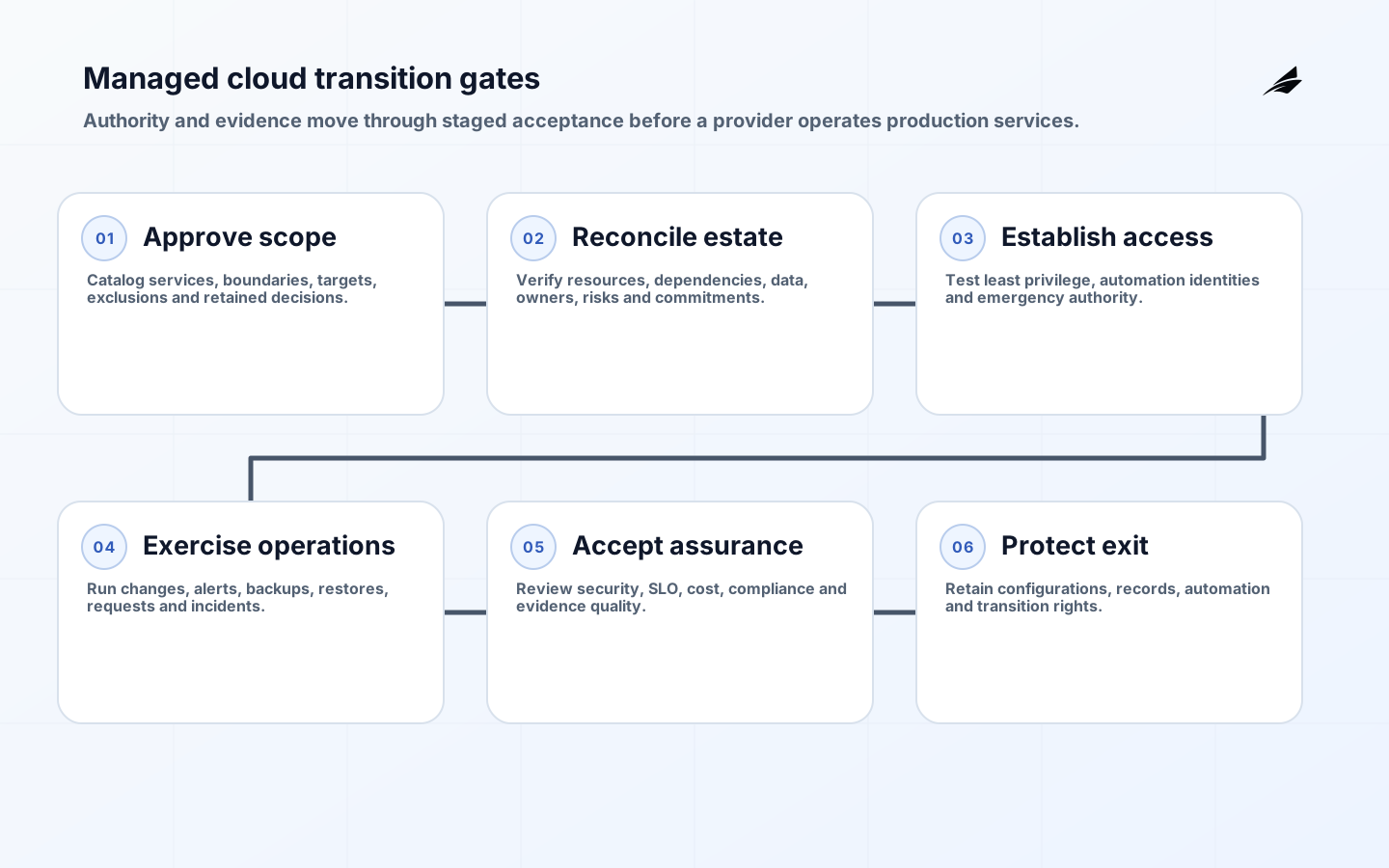
A managed cloud services implementation succeeds when enterprise and provider teams can operate the same production service without ambiguity about authority, evidence or escalation. The contract may describe broad capabilities, but implementation turns them into a service catalog, responsibility model, access design, runbooks, telemetry, objectives, cost controls and acceptance exercises. Moving ticket queues to a provider before those elements exist transfers activity, not accountability. The enterprise remains responsible for business outcomes, risk acceptance, data use and supplier governance.
This checklist covers onboarding and transition for infrastructure, platform and workload operations. It is designed to be adapted by service criticality and cloud service model. Each item should have an owner, due date and evidence link. Acceptance is scenario-based: the parties must demonstrate changes, incident response, access, backup recovery, cost reporting and exit records using real tools. Documents matter, but a runbook that has never been executed with production permissions is still an assumption.
1. Convert the proposal into an operable service catalog
List each managed service with eligible resources, standard requests, operating hours, target, dependencies, customer duties and exclusions. Break labels such as monitoring, backup or security into observable outcomes. Backup management, for example, includes policy, coverage, failed-job response, retention, restore testing and evidence. Separate recurring service, chargeable standard change, project work and unsupported work. Name decisions the provider may make independently and those requiring enterprise approval, including containment, failover, scaling, commitment purchase and emergency change.
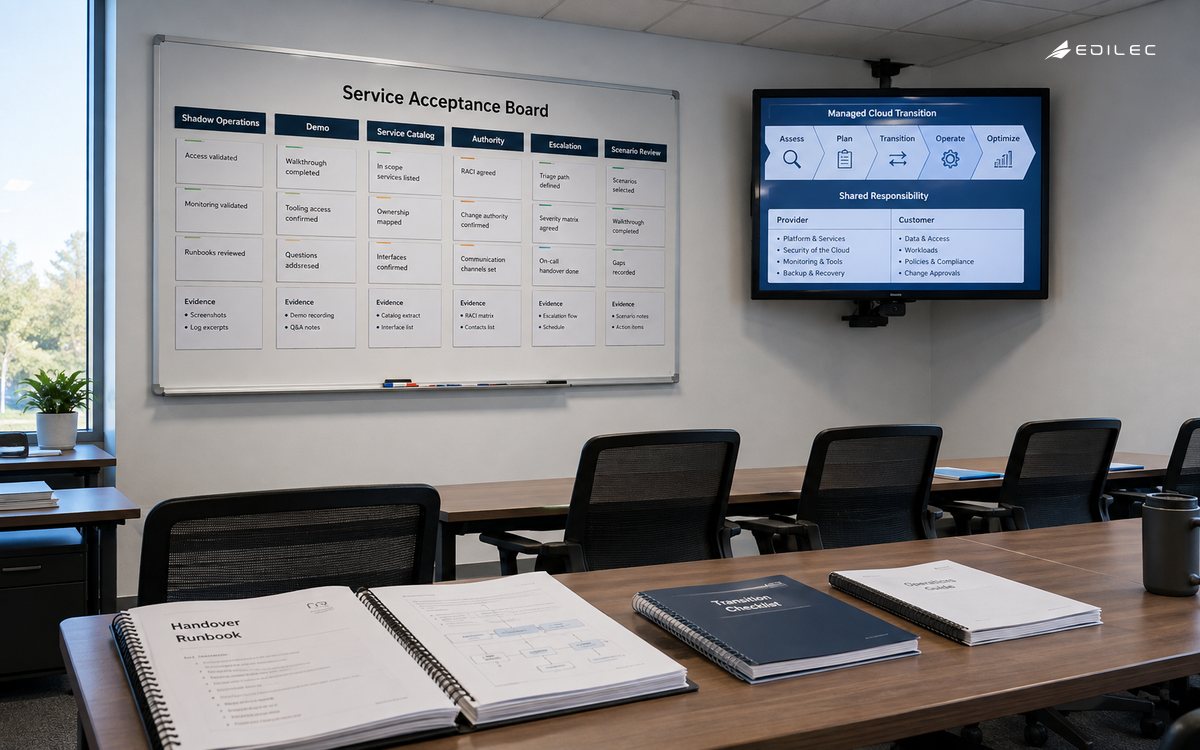
Map catalog entries to business services and technical layers. A provider may operate Kubernetes while a product team owns application correctness and customer communication. Security may set policy while the provider implements controls. Finance may approve commitments while engineering controls consumption. Record these relationships in a responsibility matrix that separates design, implementation, verification, monitoring and response. Define handoff data, system and timing; RACI labels alone do not explain how a vulnerability or failed deployment enters the right work queue.
| Catalog field | Required detail | Acceptance evidence |
|---|---|---|
| Outcome | What reliable service the activity supports | Business-service mapping |
| Boundary | Included resources, environments and exclusions | Reconciled eligibility query |
| Authority | Actions provider may take and approvals required | Runbook and access role |
| Target | Measurement, window, source and consequence | Working report from source data |
2. Reconcile the estate before transfer
Build a shared inventory of accounts, subscriptions, resources, regions, owners, data classifications, dependencies, versions, support dates, commitments and open risks. Compare provider discovery with the enterprise configuration database and billing source. Resolve unknown critical assets before accepting them. Record unsupported or end-of-life components as transition risks with remediation owners. Include external DNS, identity, certificate authorities, SaaS dependencies and network connections because incidents frequently cross the visible cloud account boundary.
Assign stable service and resource identifiers used consistently in monitoring, tickets, costs and reports. Verify tagging or account structures against actual ownership rather than filling fields mechanically. Establish how creation, change and retirement update the inventory. A nightly reconciliation should find unmanaged resources and stale ownership. Preserve the baseline at handover so both parties can distinguish inherited risk from later drift. The provider should not be measured against assets it cannot see, and the enterprise should not accept invisible exclusions.
3. Establish identity, privilege and evidence
Create individual workforce identities with strong authentication and conditional access. Prefer time-bound, approved privileged elevation and automation identities with narrow roles. Avoid shared administrator accounts. Separate provider administration, deployment automation, monitoring and read-only assurance. Test emergency access, including who authorizes it when normal approvers are unavailable and how use is reviewed. Provider actions should be attributable to a person or controlled workload and retained according to incident and assurance needs.
Review permissions against catalog activities, not job titles. Ensure the provider can perform accepted work but cannot approve its own risk exceptions or bypass customer-controlled protections without evidence. Test onboarding, role change, revocation and provider staff departure. Secure support channels against impersonation. Store secrets in managed systems and define rotation ownership. Customer teams need sufficient visibility to audit material actions and take control during exit; operational convenience is not a reason to make the provider the sole owner of authoritative accounts.
| Transition exercise | Expected result | Do not accept when |
|---|---|---|
| Failed backup | Alert, triage, repair and restore evidence produced | Failure remains only on a dashboard |
| Critical vulnerability | Asset, owner, due date, exception and verification linked | Severity is copied without business context |
| Bad deployment | Impact identified, rollback authorized and completed | Provider lacks release or application handoff |
| Cost anomaly | Allocation, cause, forecast and action agreed | Report cannot reconcile to billing data |
| Provider exit | Access returned and records exported in usable formats | Customer depends on provider-owned accounts |
4. Connect monitoring to service objectives
Define service-level indicators for availability, latency, correctness, backup success, restore ability, patch completion, change quality and request fulfillment. State source, exclusions and evaluation window. Cloud-provider availability does not equal business-service availability; combine platform evidence with application and user signals. Route alerts by action and ownership, include recent changes and runbooks, and test every critical route. Provider and internal on-call teams need one incident severity model and a common service map.
Instrument handoffs. Deployment markers, tickets, alerts, configuration and incident timelines should share service and resource identifiers. Review noisy alerts before transition because transferring noise wastes provider capacity and delays important response. Establish telemetry access, retention, privacy and cost. The enterprise should retain or receive essential evidence even if the provider supplies the observability platform. During shadow operations, compare how both teams diagnose the same symptom and close gaps before authority moves.
5. Implement security and compliance operations
Translate enterprise policy into configuration baselines, vulnerability workflows, logging, key management, network controls and privileged-access procedures. Name who approves exceptions, compensating controls and expiry. Certifications and provider reports are inputs; they do not prove that customer resources are configured correctly. Define the assurance package: architecture, control configuration, access reviews, vulnerability status, change records, restore results, incidents and subcontractor dependencies. Sample evidence for accuracy before relying on automated dashboards.
Agree incident notification thresholds, clocks, secure communication, evidence preservation and containment authority. Rehearse an event that crosses provider, cloud platform, application and business ownership. Confirm contacts and deputies outside business hours. Establish data handling for support access, logs and ticket attachments. Review provider tools and agents that enter the environment. A managed service can reduce operational workload, but it introduces supplier access and concentration risk that must be visible in the enterprise risk register.
6. Make cloud cost governable
Provide billing-data access, allocation rules, account and tag policy, budget ownership, anomaly thresholds and forecast cadence. Separate cloud consumption, marketplace software, provider fees, support tiers and transition projects. Define unit economics where meaningful, such as cost per active tenant or transaction, so optimization does not degrade useful growth. Review shared-cost allocation and unallocated spend. The provider should explain recommendations and realized outcomes, not only publish a list of potentially idle resources.
Set bounded optimization authority. Scheduling nonproduction may be preapproved; downsizing production, changing retention or purchasing long commitments should require explicit thresholds and rollback. Track performance and resilience after changes. Align capacity forecasts with launches, renewals and seasonal events. Ensure invoices and reports reconcile to source billing records and contractual rates. Cost governance belongs in regular service review with engineering and finance, not an annual surprise after technical decisions have become expensive to reverse.
7. Use shadow operations and scenario acceptance
Run the service in shadow before final handover. The provider should process representative alerts, requests, changes and reports with current tools and access while the incumbent team observes. Compare decisions, timing and evidence. Transfer authority by service or cohort, not one ceremonial date for the whole estate. Use entry criteria: reconciled inventory, approved access, working telemetry, tested runbooks, trained contacts and accepted inherited risks. Pause a service that cannot meet them without blocking ready areas.
Acceptance exercises should include a failed backup and restore, expired certificate, privileged request, deployment rollback, critical vulnerability, regional incident, quota limit and cost anomaly. Record actual timings and missing dependencies. Close high-consequence gaps before go-live and time-bound the rest. Establish a stabilization period with daily review and clear defect ownership. Knowledge transfer is complete when the receiving team resolves scenarios, not when it has attended presentations.
8. Govern improvement and exit
Use operational, service and executive cadences. Operational reviews cover incidents, changes, vulnerabilities, requests and immediate risks. Service reviews examine objectives, capacity, recurring failure, cost and improvement backlog. Executive reviews address business outcomes, material risk, commercial change and dependency. Use one evidence set so summaries reconcile. Meetings should produce decisions, owners and dates. Reserve capacity for reliability and automation improvements; otherwise ticket demand consumes the work that would reduce future demand.
Design exit before onboarding. Specify export formats and timing for infrastructure definitions, configurations, logs, inventory, tickets, costs, runbooks and decision history. Keep enterprise ownership of key accounts, repositories and domains where feasible. Test access return, data deletion evidence and a partial transition. Record subcontractors and portability limits. A provider relationship is healthier when both parties can change it without losing operational history or control of the production estate.
Key takeaways
- Define managed work as cataloged outcomes with authority and evidence.
- Reconcile inventory, access and inherited risk before transition.
- Connect application objectives, platform telemetry and common incident command.
- Govern security and cost with source evidence and named decisions.
- Prove operations and exit through scenarios, not document delivery.
Frequently asked questions
Does managed cloud transfer accountability?
No. A provider can perform and evidence defined operations. The enterprise retains accountability for business service, data use, risk acceptance, architecture direction and supplier governance.
How long should transition take?
It depends on estate size, documentation, tooling, access and risk. Use service-level gates instead of a universal duration. A small standardized platform may transition quickly; a fragmented regulated estate needs longer discovery and rehearsal.
Are service credits enough for missed targets?
Credits allocate a commercial consequence but do not restore data, deadlines or customer trust. Require corrective action, root-cause evidence and funded reliability improvement for repeated misses.
Conclusion
Managed cloud implementation is complete when both parties can operate, explain and improve the service with tested authority and shared evidence. Turn proposals into a catalog, reconcile the estate, constrain access, connect objectives to response and exercise normal and failed operations. Preserve financial visibility and an exit path from the beginning. This creates a managed service that reduces burden without hiding responsibility or weakening enterprise control.