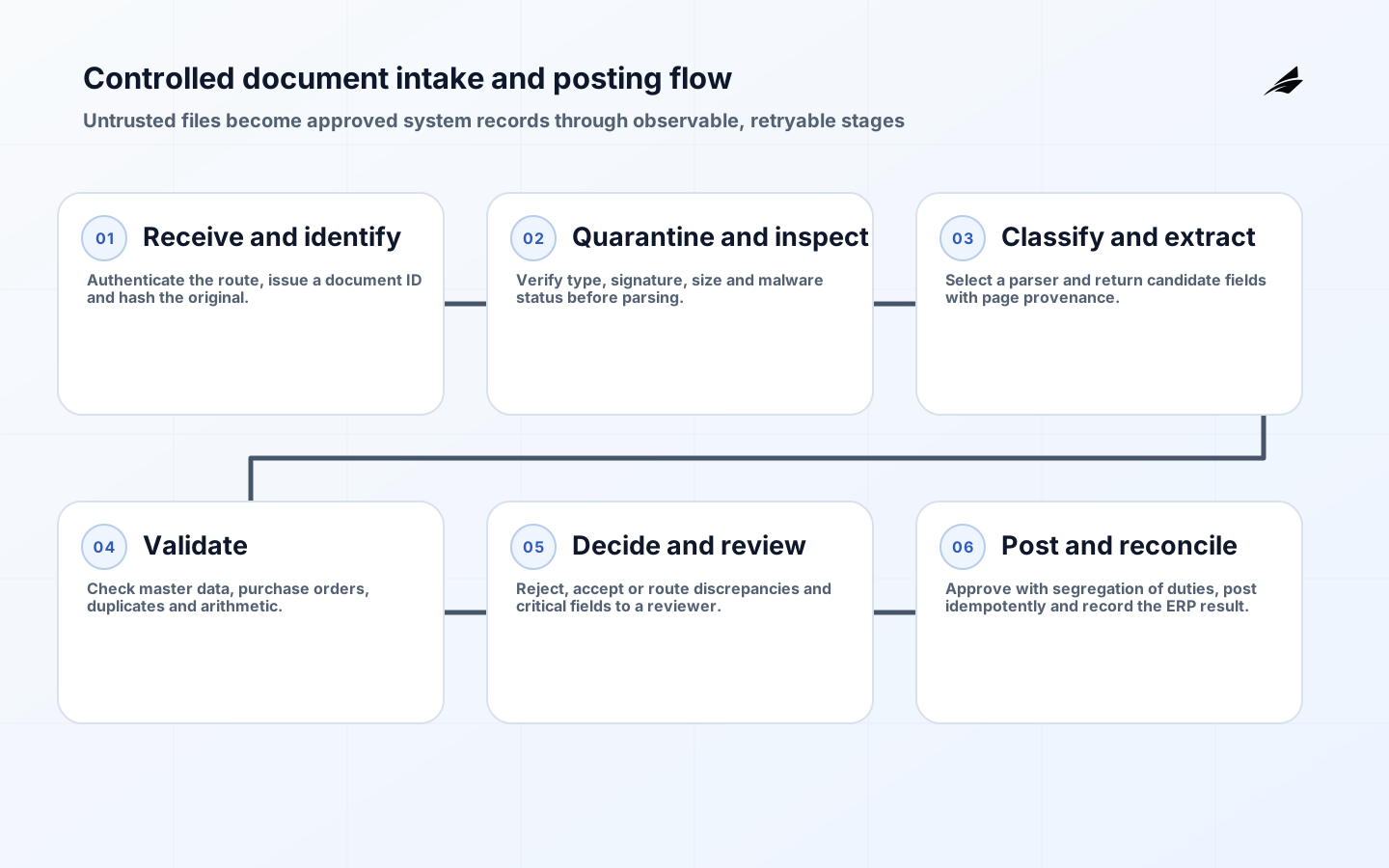
AI document intake is not a button that turns a PDF into an ERP record. It is a controlled pipeline that receives an untrusted document, identifies its type, extracts candidate fields, validates them against business rules and master data, routes uncertainty to a person, and commits only approved data to the system of record. The document remains evidence; the extracted values become proposed data until controls accept them.
Finance and operations teams searching for intelligent document processing usually want fewer manual entries without losing control over invoices, receipts, purchase orders, onboarding forms, claims or service requests. A production design must answer four questions: what documents are eligible, which fields matter, when may the system proceed automatically, and what evidence lets an auditor or operator reconstruct the decision?
Choose one document-to-decision workflow
Begin with a bounded document family and a downstream decision, not a promise to process every PDF. An accounts-payable pilot might cover supplier invoices that can be matched to an existing purchase order, while excluding credit notes, handwritten bills and new-supplier requests. This boundary determines the sample set, fields, validation rules, approvers, exception queues and integration contract.
- Document the accepted channels, formats, languages, page limits and document variants.
- Name the authoritative source for suppliers, purchase orders, tax rules and approval limits.
- Separate extraction fields from derived fields and human decisions.
- Define terminal states: posted, held, rejected, duplicate, needs information or manual processing.
- Record legal, tax, contractual and records-retention requirements with the responsible owner.
Build a staged intake architecture
Keep each stage independently observable and retryable. Intake should issue a document ID and content hash before asynchronous processing. Quarantine isolates the file while validation and malware checks run. Classification selects the parser. Extraction returns values with page geometry and confidence where supported. Validation applies deterministic rules and reference-data checks. Decisioning either accepts, rejects or opens a review task. Posting uses an idempotency key so retries cannot create duplicate records.
| Stage | Output | Control | Failure route |
|---|---|---|---|
| Receive | Immutable document ID, hash, channel and sender context | Authentication, rate and size limits | Reject before storage or quarantine |
| Inspect | Verified type and scan result | Extension, MIME, signature and content checks | Security review |
| Classify and extract | Document type, candidate fields, confidence and geometry | Versioned model and schema | Unrecognized-document queue |
| Validate | Rule results, matches and discrepancy codes | Master data and arithmetic checks | Business exception queue |
| Review and post | Approved values, reviewer evidence and system record ID | Segregation of duties and idempotency | Escalation or rollback |
Treat every uploaded file as untrusted
The upload boundary is part of the security architecture. OWASP recommends defense in depth: allow only required extensions, validate type without trusting the client header, check file signatures, generate storage names, cap sizes, authorize uploaders, store files outside the web root or on a separate host, and scan content where practical. A document should pass these controls before a parser, preview renderer or AI service handles it.
Use encrypted object storage with private access, short-lived retrieval links and tenant-aware authorization. Keep the original file immutable; store normalized text and extraction output as separate versioned artifacts. Define retention for originals, derived data, previews, review evidence and backups. The NIST Privacy Framework is useful here because it treats privacy as enterprise risk management across collection, processing, use, disclosure and disposal.
Design the data contract and provenance
A field should carry more than a value. Store the normalized value, source text, page and bounding region, extractor and schema version, confidence if available, validation results, and final disposition. Provenance lets a reviewer jump from an invoice total to the exact source region. It also prevents corrected values from being mistaken for raw model output in later analysis.
| Invoice field | Extraction result | Deterministic validation | Review trigger |
|---|---|---|---|
| Supplier | Name, address, tax identifier | Match active vendor master and allowed payment account | New, ambiguous or changed supplier |
| Invoice number | Normalized identifier plus source text | Duplicate check by supplier, number, date and amount | Possible duplicate or missing identifier |
| Line items | Description, quantity, unit price, tax and total | Recalculate arithmetic and compare purchase-order lines | Mismatch outside approved tolerance |
| Payment details | Account reference and terms | Compare with approved vendor record; never auto-change master data | Any bank-detail discrepancy |
| Tax | Jurisdiction, rate, category and amount | Apply owned tax rules and reconcile totals | Unsupported or inconsistent treatment |
Calibrate confidence and human review
Provider confidence is evidence about an extraction, not permission to post. Microsoft documents distinct confidence for document type, fields, words and selection marks, and notes that visually similar documents can behave differently to a model. Build thresholds from a representative, labeled sample of your own documents. Evaluate each critical field and document variant; do not copy a threshold from a tutorial or apply one number to the whole record.
Combine confidence with consequence and validation. A low-confidence cost-center description may be reviewable, while a high-confidence bank account that conflicts with the vendor master must be blocked. Route a document when a critical field is missing, a rule fails, a supplier is unknown, totals disagree, the model sees an unfamiliar layout, or random quality sampling selects it. Google Document AI's response schema explicitly accommodates a human-review status, reinforcing review as a workflow state rather than an informal email.
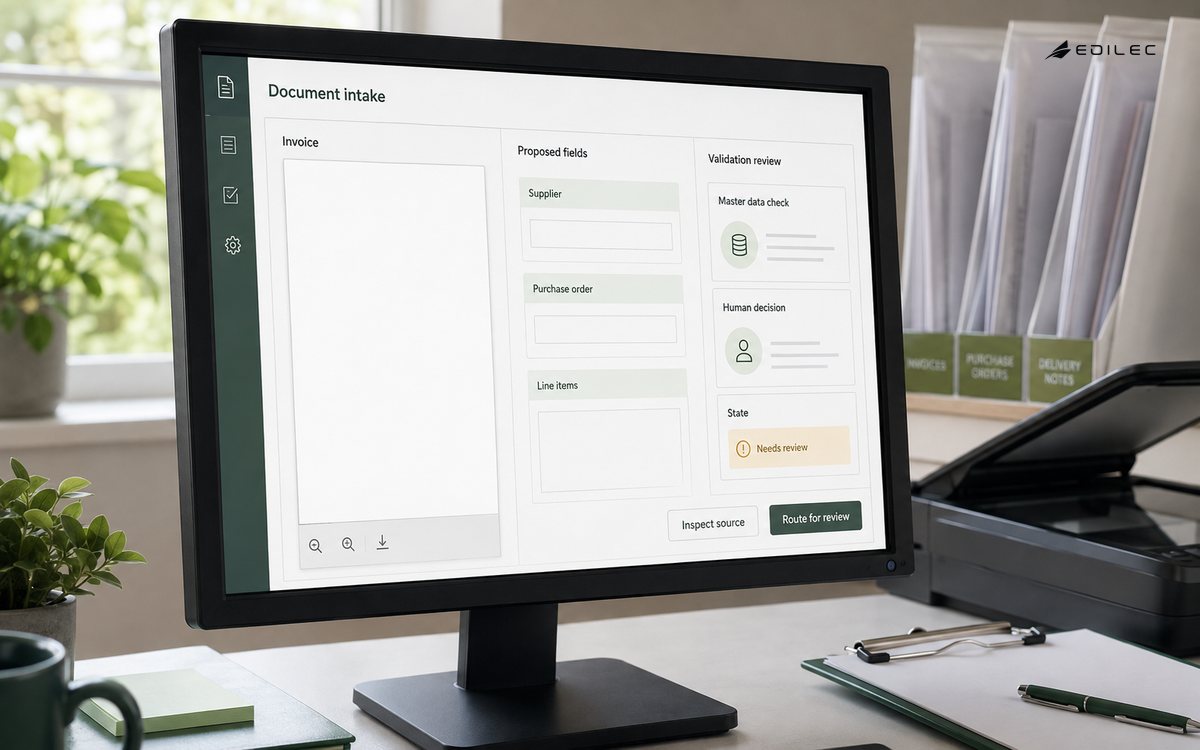
- Show the original page beside extracted fields and highlight source regions.
- Explain why the item was routed: low confidence, failed rule, missing match or random sample.
- Require reason codes for material corrections and preserve before-and-after values.
- Apply role and amount limits; the extractor must not approve its own result.
- Measure reviewer agreement and queue age, not only documents processed.
Integrate without surrendering financial controls
Write to a staging record first. The integration service should validate required fields again, enforce the current approval state and send an idempotency key derived from the controlled document record. Record the ERP response ID and status. Failed posts remain visible and retryable; operators should not re-upload the document. Master-data changes, especially payment details, belong in a separate verified workflow.
Use least-privilege service identities for object storage, extraction and ERP actions. Separate people who configure rules from those who approve high-risk exceptions where policy requires it. Audit document access, corrections, approvals, exports, rule versions and posts. Edilec's ERP, CRM and workflow integration guide covers the broader system-of-record boundary, while the zero-trust guide provides an access-control foundation.
Example: purchase-order invoice routing
A supplier emails a PDF invoice. The gateway authenticates the mailbox route, creates a hash and places the file in quarantine. Security checks pass, classification identifies an invoice, and the extractor proposes supplier, invoice number, purchase-order number, line items and totals with page coordinates. The validator matches the supplier and purchase order, recomputes totals and checks for duplicates.
The amount is correct, but the account printed on the invoice differs from the approved vendor master. Even if extraction confidence is high, policy blocks straight-through posting and opens a supplier-detail exception. A reviewer verifies the invoice and routes the account change through the separate vendor-maintenance control. The invoice is posted only after the discrepancy is resolved, and the audit record links the original document, extracted candidates, rules, reviewers and ERP record.
Measure quality, flow and control effectiveness
| Measure | Calculation | Use |
|---|---|---|
| Field precision and recall | Compare extracted critical fields with reviewed labels | Find omissions and wrong values by field and variant |
| Straight-through rate | Eligible documents posted without manual correction divided by eligible documents | Track automation only within the approved scope |
| Exception rate and age | Exceptions by reason plus elapsed time in queue | Expose rule, model, source and ownership bottlenecks |
| Duplicate-prevention catches | Potential duplicate attempts blocked and reviewed | Validate intake and idempotency controls |
| Cost per accepted document | Processing, review and integration cost divided by accepted records | Compare against the measured baseline, not a generic ROI claim |
Segment every measure by document type, supplier, channel, language, scan quality and model version. A rising straight-through rate is not success if corrections after posting also rise. Keep a random review sample from automatically accepted documents to estimate silent errors. Track upstream behavior too: repeated poor scans may be better solved with supplier guidance or structured e-invoicing than more model tuning.
Plan for the failure modes
- Prompt or content injection inside a document influences a generative extraction step: isolate instructions from document content and validate output against a strict schema.
- A parser or preview service handles a malicious file: quarantine, scan, patch, sandbox and minimize supported formats.
- A new layout silently degrades extraction: monitor by variant and route unfamiliar types for review.
- Duplicate messages or retries create duplicate postings: hash inputs, use idempotency keys and reconcile downstream state.
- Reviewers rubber-stamp suggestions: show evidence, sample accepted work, measure corrections and rotate quality review.
- Sensitive originals and derived text persist indefinitely: implement owned retention, deletion and backup handling.
A practical rollout plan
- Baseline current volume, handling time, error types, exception reasons and correction cost for one document family.
- Collect permission-cleared examples representing every channel, layout, language and difficult case; label critical fields and outcomes.
- Implement secure intake, immutable IDs, artifact storage, schema and deterministic validation before ERP writes.
- Run extraction in shadow mode, compare with human processing and calibrate field- and risk-specific routing rules.
- Launch assisted review with no automatic posting, measure reviewer behavior and harden exception ownership.
- Enable straight-through processing only for proven low-risk cases, retain random review and expand scope one variant at a time.
Key takeaways
- The model proposes data; validation and accountable policy decide what may be posted.
- Secure intake and provenance are foundational, not post-launch hardening.
- Use machine-readable e-invoices directly where available and reserve OCR for unstructured inputs.
- Calibrate review using local evidence, field criticality and rule results rather than a universal confidence threshold.
- Measure accepted outcomes, silent errors, exceptions and full handling cost together.
Frequently asked questions
Is AI document intake the same as OCR? No. OCR transcribes text. A document-intake workflow also classifies documents, extracts structured fields, validates business rules, manages human review, integrates with systems of record and preserves evidence.
Can confidence alone decide automatic posting? No. Confidence must be calibrated on representative data and combined with field criticality, deterministic validation, policy and random quality review. A confident value can still conflict with authoritative master data.
Should corrected documents automatically retrain the model? Not directly. Corrections require quality checks, permission, labeling rules and a controlled evaluation process. Preserve them as candidates for a curated dataset, then test a new model version before release.
What is the safest first use case? Usually a high-volume, bounded document type with stable fields, reliable reference data, reversible downstream actions and an experienced review team. The safest choice depends on consequence, not volume alone.
Conclusion
A dependable document pipeline makes uncertainty explicit. It preserves the source, records how each candidate value was produced, applies owned business controls, and gives reviewers the evidence needed to decide. That is how document AI reduces repetitive work without weakening finance and operational accountability. Teams planning a pilot can connect this architecture to Edilec's AI automation services and related human-in-the-loop workflow guide.