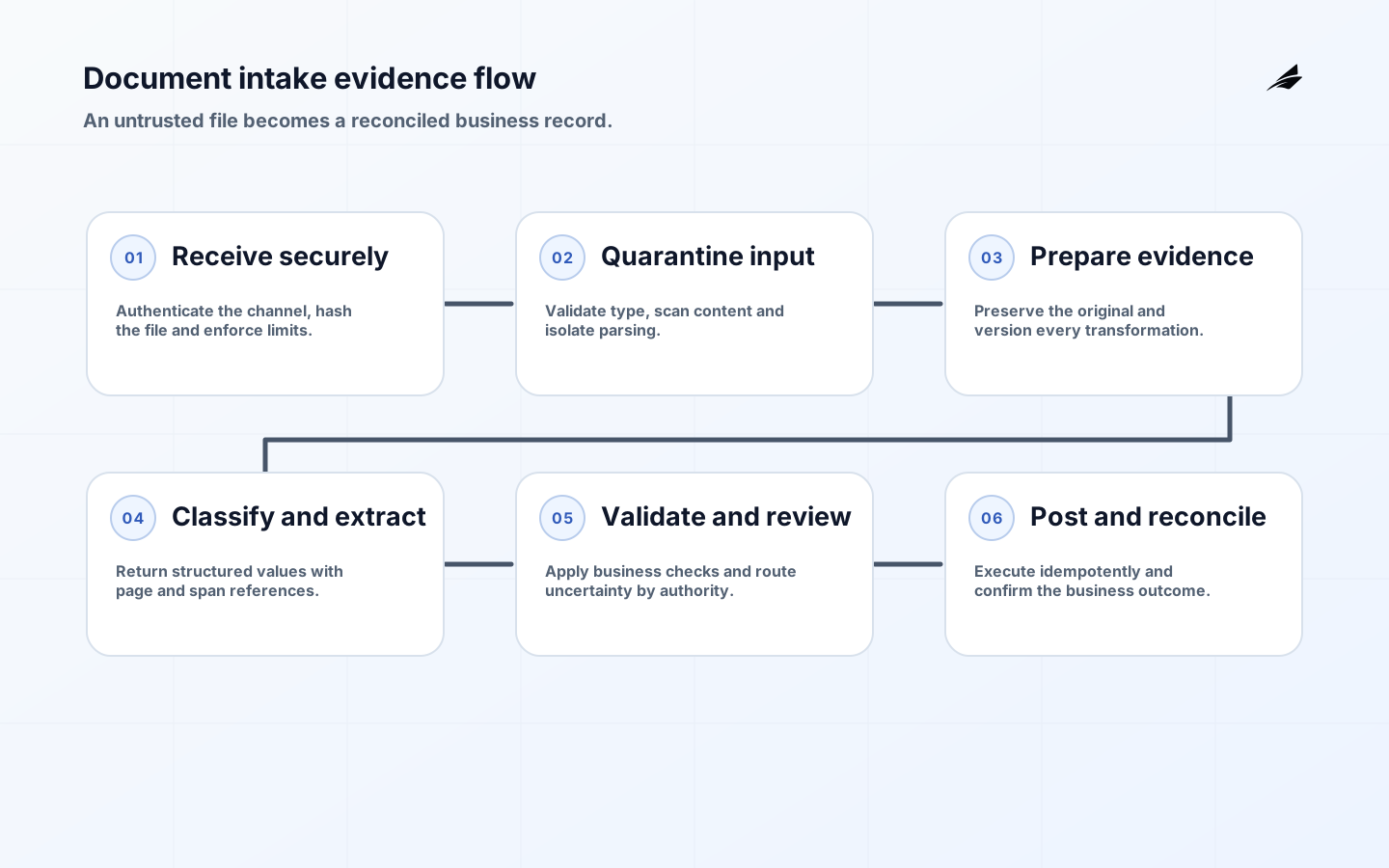
An AI document intake workflow turns files into operational work: receive, secure, identify, extract, validate, review and post. The production challenge is not optical character recognition alone. Documents can be malicious, incomplete, duplicated, rotated, handwritten, mislabeled or inconsistent with master data. Every extracted field needs evidence, and every downstream action needs authority and a recoverable exception path.
Begin with one document class and business outcome, such as supplier invoices entering accounts payable. Define what a complete, correct result means and what happens when the system is unsure. Vendor confidence scores and pretrained processors are useful components, but the organization remains responsible for input security, task-specific evaluation, privacy, human decisions and the final system update.
Use Edilec's finance document intelligence guide, document intake mistakes guide, human review mistakes guide, and document intelligence operations guide for related design detail.
Key takeaways
- Quarantine and validate files before any parser or model handles them.
- Preserve the original, page coordinates and processor version for every value.
- Calibrate acceptance per field and consequence, not with one document score.
- Combine extraction confidence with deterministic and cross-record validation.
- Reconcile the approved payload with the actual downstream business outcome.
Define the document contract
Describe accepted document types, channels, languages, page limits, image quality, required sections, expected fields, authoritative identifiers and completion outcome. Separate a file from a business document: one PDF may contain several invoices, while one claim may arrive across several files. Define split and grouping rules. Preserve sender, receive time and channel as evidence rather than inferring them from content.

For every field, record type, normalization, required status, source span, validation, confidence use, reviewer authority and destination. An invoice total may require exact arithmetic and purchase-order comparison; a memo field may accept free text. Define whether the workflow produces a draft record, a posted transaction or only a review case. This prevents a later integration from granting extraction results more authority than intended.
| Stage | Required control | Evidence | Stop condition |
|---|---|---|---|
| Receive | Authenticated channel and rate limits | Sender, timestamp and file hash | Unauthorized or excessive submission |
| Quarantine | Type, signature, malware and size checks | Scan result and storage reference | Unsupported or suspicious content |
| Prepare | Preserve original and create controlled derivatives | Page map and transformation log | Unreadable or incomplete file |
| Classify | Supported class and versioned model | Class probabilities and page assignment | Unknown or conflicting class |
| Extract | Field schema and source coordinates | Value, confidence and span | Critical value lacks evidence |
| Post | Authorized payload and idempotency | Approval and destination reference | Validation or authority fails |
Secure the upload boundary
Treat every upload as untrusted. Use allowlisted extensions, content signatures, generated storage names, size and page limits, malware scanning and isolated processing. Store files outside a public web root and restrict retrieval. The OWASP File Upload Cheat Sheet provides practical controls, including validation at multiple levels and least-privilege storage.
Run converters and parsers in constrained environments with patched dependencies, timeouts, memory limits and no unnecessary network access. Protect against decompression bombs and parser exploitation. Encrypt sensitive documents, separate tenant storage and apply retention by purpose. Redact secrets and personal data from logs. A model service should receive only the pages and fields required for the approved task under a documented data-handling agreement.
Preserve originals and prepare reproducibly
Keep the original immutable object with a cryptographic hash. Derivatives such as deskewed images, split pages or converted PDFs should reference the original and transformation version. Never improve readability by overwriting source evidence. Detect blank pages, rotation, blur, low resolution, handwriting and truncation before extraction so the workflow can request a better file instead of manufacturing certainty.
Vendor guidance reinforces input quality. Amazon Textract's best practices recommend suitable formats, clear document images and use-case-specific confidence handling. Google lists specialized Document AI processors and cautions that sensitive identity uses need broader controls and human verification. Select processors by validated document class, language and region rather than marketing category.
Extract values with source evidence
Return structured values alongside raw text, page, polygon or span, processor ID, version and confidence. Keep normalization separate: the source may say 01/02/26, while the normalized date depends on locale. Reviewers should see both. Preserve tables as row and column structures with cell evidence; flattened text can shift amounts between line items. Do not silently fill a required field from a prior document unless policy explicitly allows it.
Field-level confidence is more actionable than one document score, but it still requires calibration. Microsoft's confidence guidance notes that outputs can include confidence at different levels and recommends human review for critical workflows. Build thresholds from representative production-like documents and the cost of false acceptance versus review, then monitor by template and field.
Validate against business reality
Use deterministic checks for format, arithmetic, ranges, checksums and required combinations. Cross-check authoritative systems: supplier ID, purchase order, currency, bank details, contract and prior document hash. Validate relationships, not only fields. An invoice subtotal, tax and total may each be plausible but fail arithmetic. A high-confidence supplier name may still map to the wrong legal entity.
Distinguish extraction error from business exception. An unreadable amount should return to document review; an accurately extracted amount above a purchase order should route to an authorized finance exception. This separation creates clearer queues and evaluation labels. Deduplicate by file hash plus business identity, but support legitimate resubmissions and corrected versions. Never discard a document solely because it resembles a prior one.
| Field or rule | Automatic acceptance example | Review trigger | Prohibited shortcut |
|---|---|---|---|
| Supplier | Exact approved identifier and consistent name | Ambiguous match or changed bank data | Fuzzy-match and auto-create supplier |
| Invoice number | Valid format and unique for supplier | Potential duplicate or missing value | Invent number from filename |
| Line amount | High calibrated confidence and arithmetic fit | Low confidence or table misalignment | Trust document total only |
| Tax | Recognized code and recomputed amount | Unknown jurisdiction or mismatch | Copy historical tax without evidence |
| Purchase order | Open PO with matching entity and currency | Closed, absent or over tolerance | Route around purchasing control |
| Payment | Approved draft after all controls | Any identity or authority conflict | Let extraction release funds |
Design efficient, accountable review
Route only the fields and decisions needing judgment. Show the document beside highlighted source spans, normalized value, validation results and relevant master record. Allow correction, reject, request resubmission and escalate. Record reviewer identity, reason and final value. If a correction changes dependent arithmetic or routing, re-run those checks before approval.
Measure whether reviewers catch seeded and audited errors, not only throughput. Protect capacity with document-class queues and service levels. High-risk cases should reach qualified roles; low-quality scans may return to sender instead of consuming specialist time. Use corrections to improve evaluation sets after privacy and quality review, but do not assume every reviewer edit is ground truth.
Post idempotently and reconcile outcomes
Create a versioned approved payload and idempotency key. The downstream system must validate authority and return a durable reference. On timeout, look up the prior outcome before retrying. If posting partly succeeds, preserve per-step state and use an approved compensation or completion path. Do not edit an approved payload in a dead-letter tool and replay it without renewed validation.
Reconcile accepted documents with created records, posted amounts and later reversals. Track documents awaiting review, approved but not posted, posted twice or rejected downstream. Add business controls such as total invoice value by day and supplier. The NIST AI Risk Management Framework supports continuous governance and measurement; document workflow controls should likewise persist after launch.
Example: supplier invoice intake
A supplier emails a three-page invoice. The gateway authenticates the channel, hashes and scans the PDF, then stores the original. Classification identifies an invoice and supporting delivery page. Extraction returns supplier, invoice number, purchase order, line items, tax and total with source coordinates. Arithmetic passes, but the supplier bank account differs from the approved master record.
The workflow does not send the document to a general OCR queue or update the bank account. It creates a vendor-control case with the conflicting evidence and blocks payment. After independent verification updates the supplier record under separate authority, finance reviews a regenerated payment draft. The final ERP reference reconciles to the exact document version and approval.
Production readiness checklist
- Define supported classes, channels, fields, languages and outcomes.
- Threat-model upload, parsing, storage, model and reviewer surfaces.
- Preserve originals, hashes, page maps and transformation versions.
- Evaluate classification, extraction and normalization separately.
- Calibrate critical fields and route business exceptions by authority.
- Test duplicates, corrupted files, partial pages and downstream timeouts.
- Reconcile every approved payload to one business outcome.
- Monitor drift by processor, template, field, language and customer segment.
Maintain a representative evaluation set
Sample real layout, language, scan quality, handwriting, table and template variation under appropriate data controls. Include blank fields, duplicate pages, adversarial files and business exceptions. Keep a held-out release set and report classification, field extraction, false acceptance, review rate and downstream correctness by document subgroup. Re-run it for processor, preprocessing, schema and threshold changes; an unchanged model can still regress when upstream image conversion changes.
AI document intake FAQ
What accuracy is good enough for document automation?
Use field- and task-specific criteria tied to consequence. A mailing address and a payment amount may require different thresholds and validation. Report false acceptance as well as extraction accuracy.
Should an LLM extract every document type?
No. Compare specialized parsers, layout models, deterministic methods and multimodal models on representative data. Use the simplest approach that meets quality, security, latency and cost needs.
Why retain the original after posting?
The original supports audit, dispute resolution, reprocessing and model evaluation subject to retention policy. Keep it immutable and access-controlled; retention should not be indefinite by default.
Conclusion
A production AI document intake workflow preserves evidence while reducing manual transcription. Secure the file boundary, maintain lineage, validate critical values, give reviewers real authority and reconcile the resulting transaction. When uncertainty becomes owned work instead of hidden error, document AI can support dependable operations.