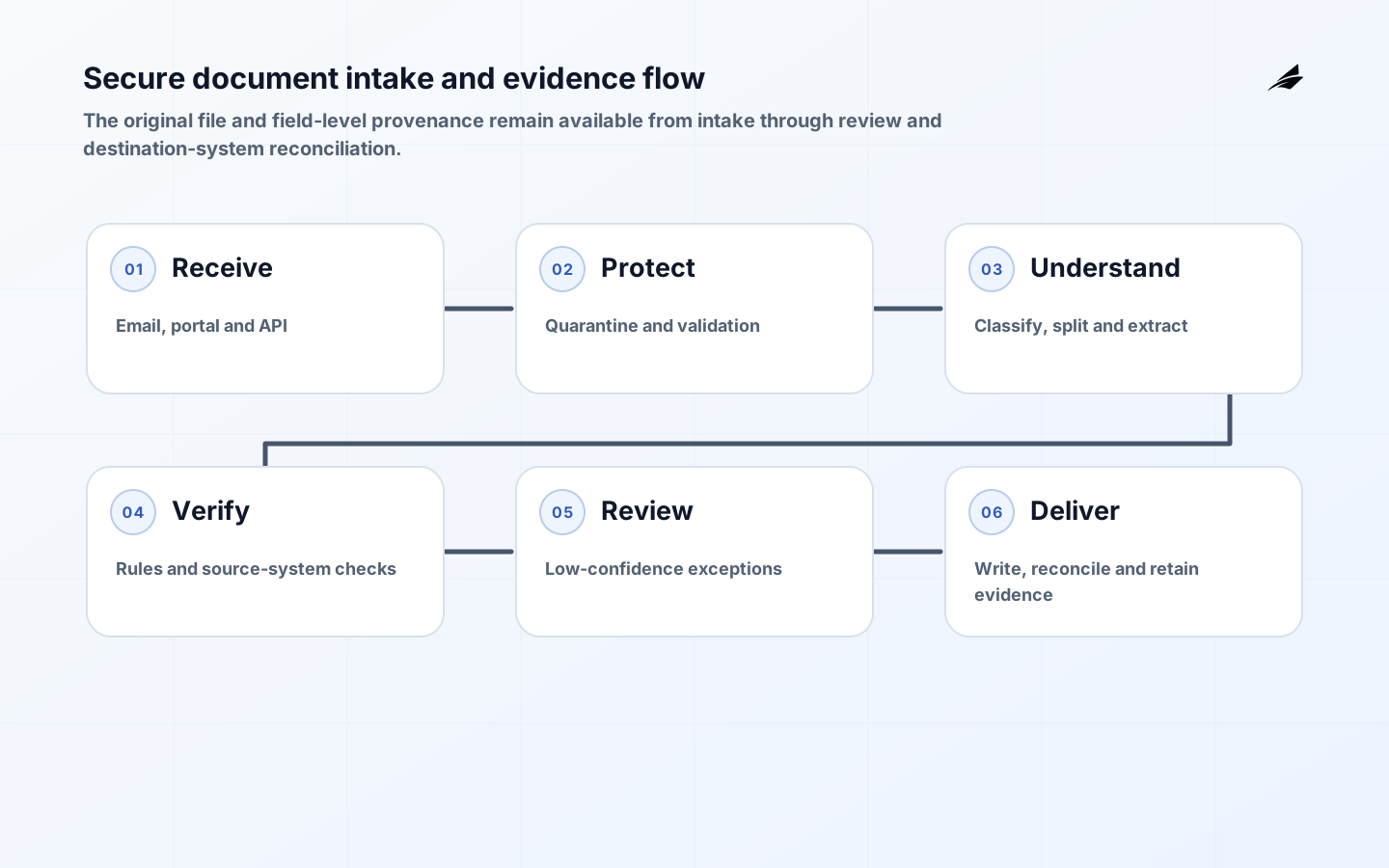
An AI document intake workflow turns incoming PDFs, scans, images and office files into validated records and work queues. The valuable outcome is not OCR text by itself. It is a traceable chain from the original document to classified type, extracted fields, confidence, human corrections and a controlled update in the destination system. A reliable design assumes that files may be malicious, layouts will change, some fields will be absent and model confidence will occasionally be misleading.
Define the operating outcome before choosing a model
Start with a document family and a downstream decision. Invoice intake may need supplier identity, invoice number, dates, currency, totals, tax and line items before matching to purchase orders. An onboarding form may need identity data and consent evidence before a case can progress. The workflow should specify what happens when the document is unreadable, duplicated, incomplete, unsupported or contradictory. Buying a document-AI API before defining these outcomes often produces an impressive demo and an unusable operations queue.
Searchers evaluating document intake usually need to decide three things: which documents are suitable, what accuracy is adequate for each field and where people remain accountable. There is no single safe confidence threshold. AWS advises considering confidence together with use-case sensitivity, Microsoft exposes several confidence levels, and Google recommends evaluating predictions against labeled test documents with precision, recall and F1. Your acceptance policy should therefore be field-specific and consequence-aware.
| Stage | Purpose | Failure path |
|---|---|---|
| Receive | Accept from approved channels and assign a canonical intake ID | Reject unavailable channel or rate-limit abusive source |
| Quarantine and validate | Check authorization, size, type, signature and malicious content | Isolate, record reason and notify an operations queue |
| Normalize | Preserve original while creating supported renditions and page boundaries | Route password-protected, corrupt or unsupported files |
| Classify and split | Identify document type and separate multi-document packets | Human triage for unknown or ambiguous classes |
| Extract | Return fields, tables, geometry, confidence and provenance | Do not coerce uncertain values into the target schema |
| Validate and review | Apply business rules and collect targeted corrections | Return missing evidence or unresolved conflicts |
| Post and reconcile | Write idempotently to the system of record and verify outcome | Retry safely, then move persistent failures to recovery |
Treat every incoming file as untrusted
The upload boundary is a security control, not a convenience endpoint. OWASP recommends allowlisting required extensions, validating type rather than trusting the client-supplied Content-Type header, checking signatures, generating storage names, setting size limits, restricting uploaders, storing files outside the web root and scanning or sandboxing content where available. Apply controls in layers because extension, MIME type or signature checks alone can be bypassed. Parse documents in an isolated environment with limited network and filesystem permissions.
- Preserve the original file and cryptographic hash so later transformations can be traced.
- Separate quarantine storage from approved document storage and the user-facing application.
- Limit accepted formats to those required by the business; handle archives and macro-enabled files as higher-risk cases.
- Do not place confidential document content, access tokens or signed URLs in general application logs.
- Apply retention and deletion rules to originals, renditions, extraction output, reviewer notes and backups, not just the final record.
Build a representative evaluation set
Before integration, assemble documents that reflect production variation: digital and scanned files, low contrast, skew, handwriting where relevant, different suppliers or form revisions, optional fields, multi-page tables, multiple languages and adversarial edge cases. Remove duplicates across training and evaluation sets. Label the fields and page evidence that matter to the process, and define matching rules for dates, currencies, identifiers and line items. A test set dominated by clean examples will overstate operational quality.
Measure by field and document class. Precision answers: when the processor returns a value, how often does it match the annotation? Recall answers: of the expected values, how many did it find? F1 combines both. Google notes that optional labels and repeated values make a generic accuracy measure less informative for extraction. Also evaluate exact business validity: a syntactically plausible supplier ID can still identify the wrong supplier. Keep test data versioned and add corrected production failures after privacy review.
| Field class | Validation and review policy | Example consequence |
|---|---|---|
| Routing metadata | Auto-use only when class confidence and required evidence pass; otherwise triage | Wrong department receives the case |
| Reference identifier | Check format and existence in an authoritative system | Record attaches to the wrong customer or order |
| Monetary amount | Cross-check subtotal, tax, currency and total; review mismatches | Incorrect payment or approval threshold |
| Date | Normalize explicitly and reject ambiguous locale formats | Missed due date or wrong accounting period |
| Consent or signature | Require evidence location and human validation where legally or operationally material | Case proceeds without required authorization |
| Narrative text | Retain source span; summarize only for navigation, not as replacement evidence | Nuance is lost in a downstream decision |
Design human review around uncertainty and consequence
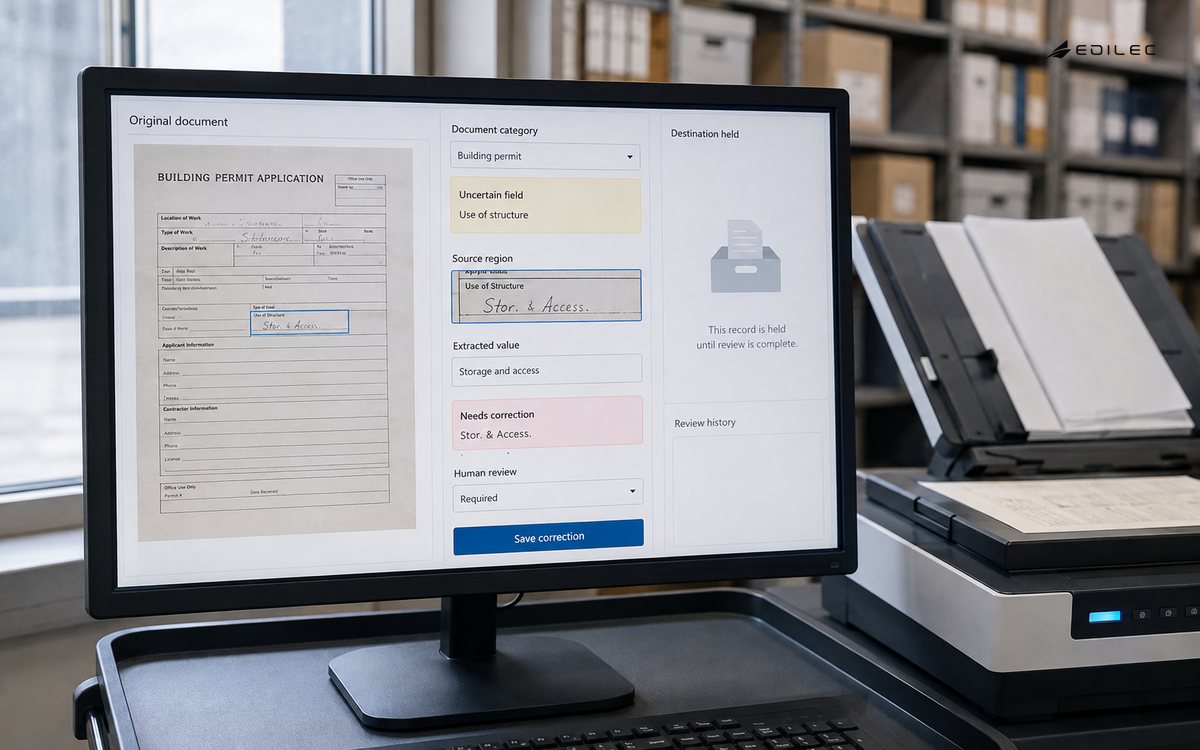
A reviewer should see the original page beside extracted fields, with the source region highlighted and uncertainty visible. Ask people to review only fields that failed a threshold or rule, while allowing them to inspect the full document. Capture the corrected value and a reason such as OCR error, wrong class, layout change, missing source value or business-rule conflict. Do not train automatically on every correction; a reviewer may make a mistake, and production data may not be authorized for training. Curate corrections through a controlled labeling process.
Practical example: invoice intake
A supplier emails an invoice. The gateway checks sender policy, stores the original in quarantine and creates a content hash. Validation rejects encrypted archives and scans the PDF before processing. Classification identifies an invoice and separates an attached delivery note. Extraction returns supplier name, invoice number, order number, dates, totals and line items with page coordinates. The workflow resolves the supplier against master data, checks whether totals reconcile and finds the purchase order. A low-confidence order number and a tax mismatch are shown to an accounts-payable reviewer. After correction, the system posts once using the intake ID as an idempotency key, verifies the resulting record and links it to the retained evidence.
Plan privacy, residency and vendor controls
Inventory personal, financial, contractual and regulated data before selecting a service. Determine legal basis, allowed regions, retention, deletion, support access, subprocessors, encryption, customer-managed keys where required and whether submitted content is used for service improvement. The NIST Privacy Framework can help structure privacy risk management, while each provider's current documentation must be checked against your configuration and contract. For example, Microsoft's Document Intelligence documentation describes regional processing, temporary encrypted storage and a deletion API; those implementation details are not universal promises across vendors or versions.
| Risk | Preventive control | Detection or recovery |
|---|---|---|
| Malicious file | Allowlist, signature checks, limits, scanning and isolated parsing | Quarantine event, parser telemetry and incident path |
| Silent extraction error | Evidence spans, field thresholds and business validation | Sampling, correction rate and downstream reconciliation |
| Layout or population drift | Representative tests and versioned processors | Quality by source, template and score band |
| Duplicate processing | Content hash plus source-specific deduplication rules | Idempotent writes and duplicate review queue |
| Data over-retention | Documented schedule and deletion automation | Retention audit across all storage layers |
| Destination write failure | Transactional outbox or durable queue | Retry, dead-letter recovery and reconciliation report |
Roll out in controlled stages
- Map one document family end to end, including channels, owners, decisions, exception codes, target systems and retention.
- Build the secure intake and canonical data contract before optimizing extraction; retain provenance for every field.
- Label a representative evaluation set and agree per-field acceptance, review and rejection policies with process owners.
- Run historical documents and then shadow live traffic without posting results; investigate failures by source and layout.
- Launch reviewer-assisted processing with fast access to evidence, correction reasons and a manual bypass.
- Enable straight-through posting only for document classes and fields that meet agreed quality and consequence thresholds.
- Monitor drift, queue health, privacy controls, costs and downstream reconciliation; retrain or roll back through versioned releases.
Metrics for a production document workflow
Track intake volume, valid-file rate, duplicate rate, class distribution, processing latency, cost per completed document, straight-through rate, review time and backlog age. For quality, retain precision, recall or exact-match measures by critical field and document class, reviewer correction rate, unsupported-document rate and downstream rework. Monitor confidence calibration by score band instead of reporting average confidence alone. The decisive business metric is not pages processed; it is correct, timely records created with fewer uncontrolled exceptions.
Key takeaways
- Design for a correct downstream record, not an OCR demonstration.
- Quarantine and validate untrusted files before any parser or model receives them.
- Evaluate by document class and critical field using representative labeled data.
- Link every extracted value to source evidence and route uncertainty according to consequence.
- Retain a manual recovery path and reconcile every write to the system of record.
Frequently asked questions
Is document AI the same as OCR?
OCR recognizes text. Document AI may also classify files, detect layout, extract named fields and tables, and return confidence or geometry. A complete intake workflow adds security checks, business validation, human review, posting and reconciliation around those model capabilities.
What accuracy is required before automation?
There is no universal percentage. Set acceptance by field and consequence using a representative test set. A routing label may tolerate review on uncertainty, while a payment amount or identity field needs stronger validation and often independent checks.
Should a generative model extract the fields?
It can be evaluated as one option, especially for variable documents, but outputs still need a schema, source grounding, field-level tests and controls for fabricated or normalized values. Compare it with specialized parsers on the same labeled set and operational constraints.
How should the system improve over time?
Review corrections and failures by reason, curate authorized examples, update labels and validation rules, then evaluate a new version against the fixed benchmark plus recent edge cases. Deploy versions gradually and preserve the ability to roll back.
Conclusion
Document intake becomes dependable when security, extraction quality and operations are designed as one workflow. Preserve the original, make provenance visible, calibrate review to real consequences and treat every destination write as a transaction that must be verified. That architecture can reduce manual handling while keeping people in control of ambiguous and material cases.