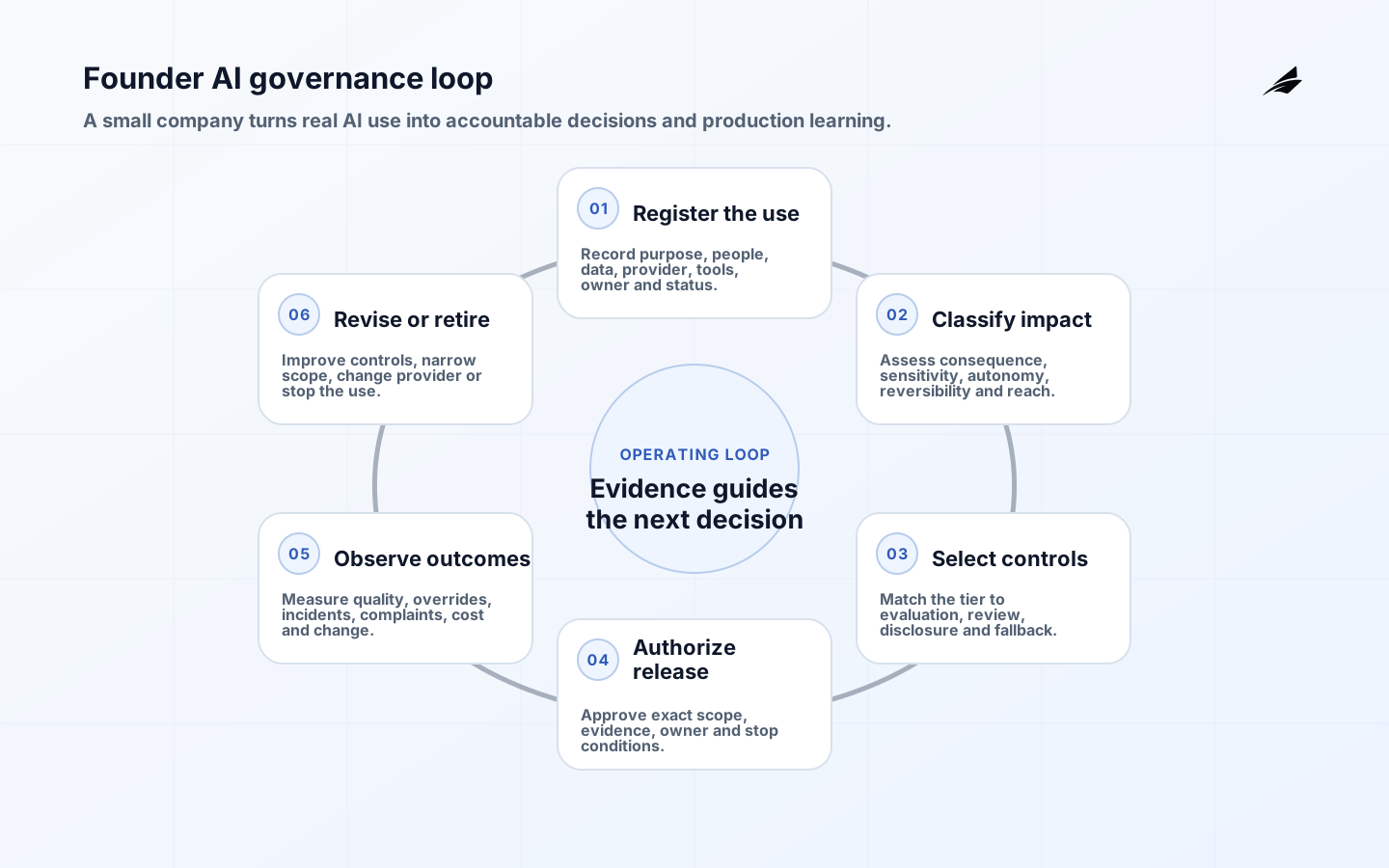
AI governance for founder-led companies should preserve speed while making consequential choices visible. It does not require a large committee or a policy copied from a bank. It requires an inventory of actual uses, an owner for each business outcome, a simple way to classify consequence, and release evidence proportionate to risk. The founder’s role is to set risk appetite and insist that product velocity includes accountability; it is not to approve every prompt. A lightweight operating model lets teams experiment safely, prevents shadow systems from becoming critical infrastructure, and gives customers, employees and investors a credible explanation of how the company chooses, tests, monitors and retires AI.
Key takeaways
- Inventory real AI use cases, including vendor features and employee tools, before drafting broad policy.
- Classify use by consequence, data sensitivity, affected people, reversibility and degree of autonomy.
- Assign one business owner and one technical owner to every material use case.
- Require evidence and approval proportional to the tier, with a fast path for low-consequence experiments.
- Review production outcomes, incidents, complaints, model changes and vendor changes on a regular cadence.
Start with company decisions, not governance theatre
A useful policy answers questions a team faces this week: May support paste customer data into a public assistant? Can a model automatically change a subscription? Who evaluates a résumé-screening feature? What evidence is required before an AI summary appears in a regulated record? Begin with a one-page statement of permitted experimentation, prohibited data and actions, escalation routes, and the requirement to register material use. Link that statement to existing security, privacy, procurement and release processes rather than creating a parallel bureaucracy. The NIST AI RMF is deliberately voluntary and scalable; its Govern, Map, Measure and Manage functions translate well into a small company’s operating rhythm.
Create an AI use-case and dependency inventory
Inventory products sold to customers, internal automations, analytics models, generative assistants, code tools and AI capabilities embedded in SaaS vendors. For each, record purpose, users, affected people, data classes, model or provider, connected tools, output use, owner, deployment status and exit path. Do not equate “we do not train models” with low risk: a hosted model may still receive confidential data or influence a consequential decision. Ask finance and procurement for AI-enabled vendors, engineering for model APIs, and team leads for browser-based tools. A monthly fifteen-minute review of additions and changes is more valuable than an annual spreadsheet exercise.
| Inventory field | Question it answers | Why the founder should care |
|---|---|---|
| Business purpose | Which decision or task becomes better? | Prevents novelty projects without accountable value |
| Affected people | Whose access, money, work or rights may change? | Reveals consequence and complaint paths |
| Data and provider | What leaves the company and under which terms? | Exposes confidentiality and lock-in |
| Authority | Can the system advise, draft or execute? | Determines required controls |
| Owner and exit | Who monitors it and how can it stop? | Avoids abandoned critical dependencies |
Use consequence-based tiers
A three-tier model is often enough. Tier one covers reversible assistance with no sensitive data and human verification, such as rewriting public marketing text. Tier two covers internal or customer-facing recommendations using controlled data, where an error creates meaningful cost or trust damage. Tier three covers decisions or actions affecting employment, credit, health, safety, legal position, security or substantial money, or autonomous access to production tools. Classification should consider the worst credible use, not only the intended prompt. The NIST Generative AI Profile notes that organizations may adapt existing risk tiers and may need additional review, tracking and management oversight for generative systems.

| Tier | Example | Minimum path |
|---|---|---|
| 1 — assisted and reversible | Draft public copy that an employee edits | Approved tool, no restricted data, owner and user guidance |
| 2 — material recommendation | Summarize support history or prioritize a queue | Data review, representative evaluation, monitoring and fallback |
| 3 — consequential or autonomous | Change access, employment or financial state | Executive risk acceptance, independent review, strict authority and incident plan |
| Prohibited | Deceptive impersonation or unapproved sensitive-data use | Block, investigate and remove access |
Connect each tier to a short approval path
For tier one, a team lead can approve a registered tool and standard data rule. Tier two should require business and technical owners to document baseline, evaluation, security and customer communication. Tier three needs an executive risk owner and specialist review appropriate to the domain. Keep the evidence compact: use-case card, data map, evaluation report, threat model, vendor record, user disclosure, runbook and decision. The NIST AI RMF Playbook offers suggested actions, but a founder-led company should select the outcomes relevant to its context rather than claim blanket compliance.
Human review is not automatically protective. A reviewer needs time, evidence, authority to disagree and a supported alternative. Measure override and appeal outcomes; a 99% approval rate may indicate excellent quality or a meaningless checkpoint. For high-consequence actions, bind approval to the exact payload, model and time window, and prevent the model from changing parameters after review. If the team cannot describe the manual fallback, the company is not ready to automate the action.
Treat vendor changes as production changes
Record model version controls, data-use terms, retention, subprocessors, service region, security evidence, availability, pricing and export options. Ask how the provider communicates material model or policy changes and whether the company can pin or evaluate a version before rollout. Avoid promises that exceed contract or architecture. A vendor may label a feature “enterprise” while the implementation still grants broad workspace access. Procurement should trigger the same use-case record and tiering as an internally built model. The OECD AI Principles provide a durable reference for accountability, transparency, robustness and human-centered values across both build and buy decisions.
Monitor outcomes that matter to the business
For every material use, monitor task completion, quality, abstention, overrides, appeals, harmful outcomes, data incidents, cost and latency. Segment by relevant user or case groups where lawful and necessary so aggregate performance does not hide a poor outcome. Preserve provenance sufficient to reconstruct a disputed result. Review model, prompt, retrieval corpus and policy changes through version control and representative regression tests. Set stop conditions before launch. The AI safety review guide provides a useful production gate, while the Edilec AI governance model for growing companies goes deeper on cross-team ownership.
Know when specialist legal review is necessary
Rules depend on jurisdiction, sector, role and use. The European Union’s AI Act text, for example, uses risk-based obligations and distinguishes roles across the AI value chain. Employment, biometric, credit, health, children’s data and regulated professional decisions deserve early specialist review. Governance should record applicable obligations and responsible counsel, not turn engineers into lawyers. The practical founder decision is to detect higher-consequence use early enough that product design, evidence and customer terms can change before launch.
Run governance in the company cadence
Add AI use and risk to routines that already work. Product review checks new or changed use cases. Security review checks data and tool boundaries. Procurement checks providers. Release review checks evaluation and rollback. The monthly leadership review sees only material tier changes, incidents and unresolved exceptions. Quarterly, sample tier-one uses to detect drift and revisit risk appetite. Publish a clear route for employees to ask before using a tool and to report an issue without blame. The objective is fast, visible decisions—not approvals hidden in chat.
Practical review checklist
- Ask every team lead to identify AI features, model APIs and employee tools used in the previous month, then reconcile the answers with procurement, expense and code records. The exercise should discover reality, not punish early disclosure.
- For each tier-two or tier-three use, record the baseline human process and the harm of both wrong action and missed action. This keeps quality thresholds tied to the decision rather than a generic model score.
- Give employees a short approved-tool list, examples of restricted data, and a responsive question channel. A policy that requires legal interpretation for an ordinary prompt will be bypassed even by well-intentioned teams.
- Include AI providers in continuity planning. Preserve exportable prompts, evaluation cases, configuration and business rules, and test whether the workflow can fall back or move providers without losing authoritative records.
- Review public claims about accuracy, safety, automation and human oversight against actual design and evidence. Marketing language should not imply independent judgment, guaranteed correctness or controls that the product does not provide.
Frequently asked questions
Does a startup need an AI ethics committee?
Usually not as a standing first step. It needs accountable owners, a tiering rule and access to domain, security, privacy and legal expertise when consequence demands it. A small review group may help for tier-three cases, but its decision rights and response time must be explicit.
Should the AI policy be public?
Publish what customers and affected people need to understand: material AI uses, relevant limitations, data practices, review or appeal routes and contact. Keep sensitive security detail internal. Make external claims match evidence and contracts. The internal policy can be more operational and include tiers, tools, owners and incident procedures.
Conclusion
Founder-led companies can govern AI without losing momentum. Inventory actual use, classify consequence, connect each tier to concise evidence, monitor production outcomes and keep the founder focused on appetite and accountability. That operating model makes experimentation easier to approve, material risk harder to hide and successful systems easier to scale.