An AI copilot assists a person inside a workflow by finding information, summarizing context, drafting content or recommending a next step. For a service business, the most valuable copilots are rarely general chat windows. They are bounded experiences connected to customer records, approved knowledge and a clear handoff: a support agent reviews a reply, a salesperson verifies an account brief, or an operations coordinator checks an exception summary.
A rollout should improve service without making accountability ambiguous. The employee remains responsible for decisions within their role; policy and authorization remain deterministic; and customers should not receive unsupported commitments because a fluent draft looked plausible. The plan below moves from workflow evidence to controlled scale while keeping data, evaluation, adoption and operations in the same program.
Select one narrow, high-frequency workflow
Choose a task with accessible source material, a stable owner, repeated volume and reviewable output. Avoid beginning with the most sensitive customer decision or a process dominated by exceptions. Document the current steps, systems, wait states, rework and quality checks. The baseline might be handling time, time to first useful action, correction rate, conversion-stage progression or exception age, but it must reflect the selected workflow rather than a broad productivity claim.
| Team | Bounded first use case | Human responsibility | Avoid at first |
|---|---|---|---|
| Support | Summarize case history and draft a source-linked response | Verify facts, tone, entitlement and resolution | Autonomous refunds or contractual commitments |
| Sales | Prepare an account brief from approved CRM and product sources | Confirm relevance and choose outreach | Unreviewed external claims or pricing |
| Operations | Explain an exception and assemble evidence for review | Apply policy and authorize the action | Changing systems of record without approval |
| Professional services | Draft meeting notes and action items from permitted material | Confirm decisions, owners and confidentiality | Final advice in a regulated domain |
- Name the workflow owner, user group, affected customers and systems of record.
- Collect representative examples, including escalations, incomplete records and policy conflicts.
- Define what the copilot may read, generate, recommend and never do.
- State when a person must review, approve, disclose AI use or provide an appeal route.
- Measure the current process before changing it.
- Choose a manual fallback that can absorb pilot and production failures.
Prepare knowledge and access before licenses
A copilot can expose existing access mistakes faster than people discover them manually. Review shared folders, CRM visibility, inactive accounts, broad groups and public links before connecting organizational knowledge. Preserve source permissions during retrieval rather than copying everything into one universally visible index. Classify sensitive material, remove obsolete duplicates, assign content owners and define a refresh or expiry rule for policies, offers and product facts.
Create a source register containing owner, audience, authoritative status, update frequency, retention and escalation contact. Retrieval quality depends on document structure and metadata as well as model capability. Test whether the correct source is found for realistic language, abbreviations and customer terminology. When sources conflict, the system should show the conflict or route it to an owner, not blend both into a confident answer.
Define the copilot boundary and user experience
Separate suggestions from actions. A copilot may draft a case reply, but the service platform should enforce who can send it. It may recommend a discount review, but pricing policy should determine authority. If tools are enabled, place a gateway between the model and business systems. The gateway validates identity, allowed operation, parameters, record state and approval. Use idempotency and reconciliation for writes so a retry cannot create duplicate work.
The interface should show source links, freshness and the status of any proposed action. Make correction easier than starting over and capture a reason when practical. Tell users what the copilot can and cannot do in the moment of use, especially when the interaction or outcome affects a customer. OECD's transparency principle supports clear disclosure of AI interaction, capabilities and limitations, plus information that enables affected people to challenge an outcome.
| Capability level | Example | Required control |
|---|---|---|
| Retrieve | Find the current cancellation policy | Permission-aware sources and citation |
| Summarize | Condense a long case history | Link to records and preserve material exceptions |
| Draft | Prepare a response or account brief | Human review and prohibited-claim checks |
| Recommend | Suggest route, next step or priority | Evidence, uncertainty and policy validation |
| Act | Update a record or trigger a workflow | Least privilege, confirmation, audit and rollback |
Build evaluation from real service work
Create an evaluation set before the pilot so enthusiasm does not redefine quality after the fact. Sample permitted historical work across common intents, long and short records, missing fields, multiple languages where relevant, difficult customers, outdated documents, conflicting sources and malicious instructions embedded in content. Domain reviewers should define a reference answer or rubric and mark errors by consequence.
Evaluate the whole path. For a support copilot, ask whether retrieval found the governing policy, whether the summary preserved earlier promises, whether the draft was factually supported, whether tone was appropriate and whether the proposed action stayed within authority. Track severe failures separately; a high average score can conceal a small number of unacceptable disclosures or commitments. Re-run regression tests whenever models, prompts, sources, connectors or policies change.
- Task quality: supported facts, completeness, instruction following and correct refusal.
- Service quality: accepted output, correction effort, escalation and customer-impacting errors.
- Retrieval: source coverage, permission correctness, freshness and citation support.
- Operations: latency, availability, failed integrations, fallback and queue recovery.
- Adoption: eligible users, repeat use, workflow completion and manual bypass.
- Economics: total cost per resolved or completed task, including review and support.
Run a representative assisted pilot
Select participants across roles, experience levels, locations and realistic work types. A volunteer-only group can overstate adoption and underrepresent training needs. Give the pilot one workflow, a short usage policy, examples of good review, a feedback channel and a named support contact. Keep human approval in place. Review failures quickly enough that users see changes and do not create private workarounds.
Microsoft's deployment documentation uses pilot, deploy and operate phases and recommends beginning with early adopters, gathering feedback, then monitoring usage and sentiment. The transferable lesson is phased adoption, not a particular license. Define pilot exit criteria for quality, permission tests, incidents, workflow value, user understanding, support load and cost. Compare with the baseline and investigate whether apparent time savings shift work to reviewers or downstream teams.
Manage the risks that appear in service workflows
| Risk | Control | Operational signal |
|---|---|---|
| Unsupported customer statement | Grounding, source display, review and claim restrictions | Material correction and complaint rate |
| Sensitive data exposure | Access cleanup, minimization, role tests and output checks | Permission failures and disclosure incidents |
| Prompt injection in a case or document | Treat content as untrusted and constrain tools outside the model | Adversarial-test and blocked-action results |
| Automation bias | Evidence-first interface, sampling and reviewer coaching | Acceptance without source review and correlated errors |
| Knowledge staleness | Owners, expiry, source health and conflict handling | Stale citation and unanswered-query rate |
| Uncontrolled cost | Usage limits, context control, model routing and loop caps | Cost per completed task and outlier sessions |
Use the NIST AI RMF to maintain ownership, context, measurement and treatment rather than treating launch review as a one-time approval. The NIST generative AI profile adds risks specific to generated content and human reliance. The NCSC secure development guidance places security across design, development, deployment and operation. Together, these support an operating rhythm that covers ordinary application security and AI-specific failure modes.
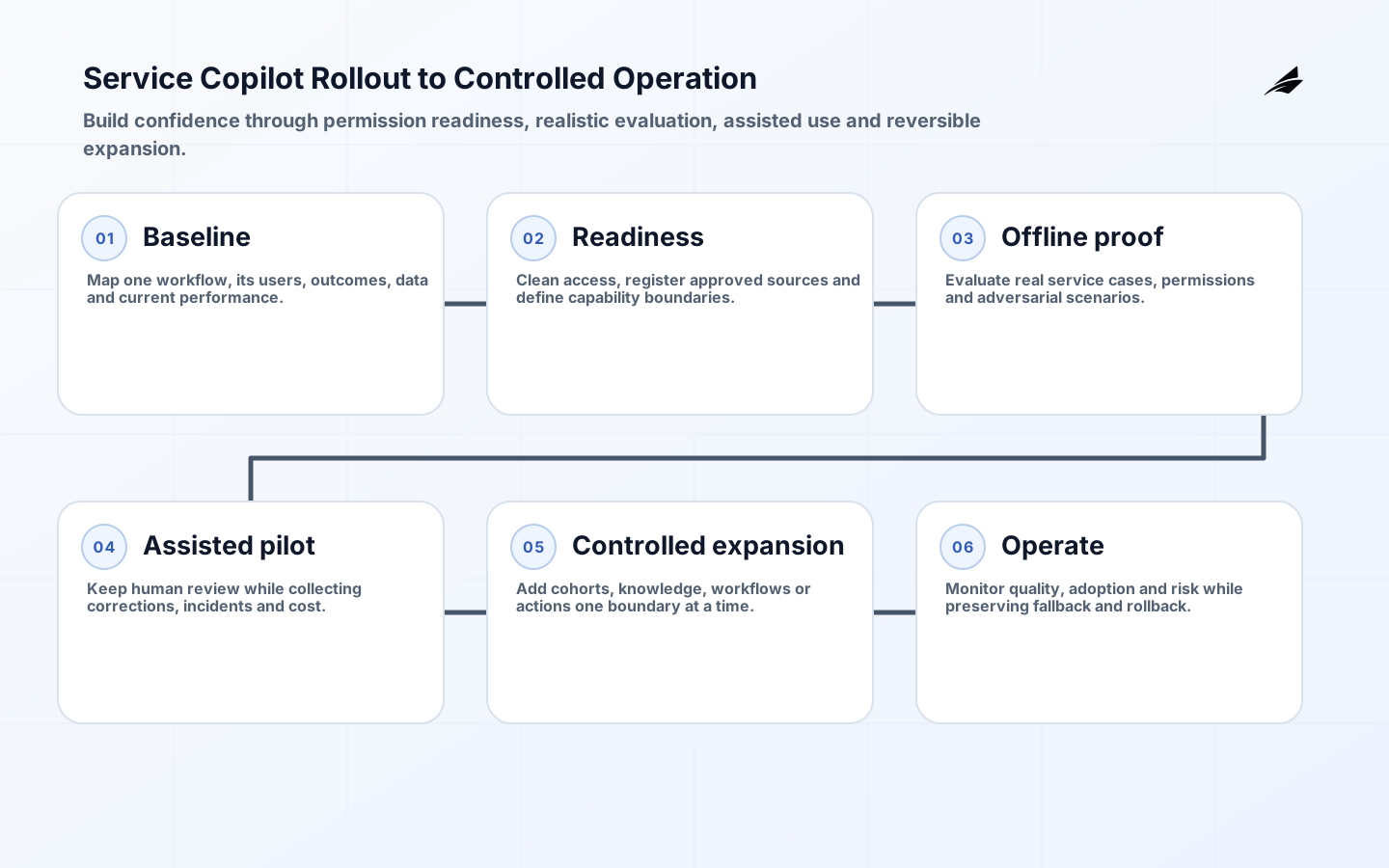
Move through six rollout stages
| Stage | Main work | Exit evidence |
|---|---|---|
| 1. Baseline | Map workflow, outcomes, users, data and risk | Owned use case and measurable current state |
| 2. Readiness | Clean access, register sources and define boundaries | Passed role tests and approved data use |
| 3. Offline proof | Evaluate representative work and threat scenarios | Quality and risk thresholds met |
| 4. Assisted pilot | Limited users, human review, telemetry and support | Demonstrated value with acceptable incidents and cost |
| 5. Controlled expansion | Add cohorts, workflows or actions one boundary at a time | Stable metrics and tested rollback at higher volume |
| 6. Operate | Monitor, evaluate changes, train, review sources and rehearse incidents | Recurring governance and retirement criteria |

Expansion should be reversible. Add one dimension at a time: more users, more knowledge, another workflow or a higher action level. This makes a regression diagnosable. Keep a kill switch and manual queue, document how pending actions are reconciled, and tell users when capability is reduced. Assign owners for product behavior, sources, security, privacy, change approval, training, support and business outcomes.
Treat adoption as workflow change
Training should use the team's records and decisions, not generic prompt tricks. Teach users how to verify sources, recognize uncertainty, protect sensitive information, correct output and escalate a suspected incident. Managers should not interpret low use as resistance until they check access, latency, workflow placement and output quality. High use is also not proof of value if employees spend longer checking the result.
Review metrics on a fixed cadence with business, operations and technical owners. Examine accepted and corrected outputs, severe failures, source gaps, bypasses, support issues, cost and downstream outcomes. Publish release notes and known limitations to users. Retire a workflow when its source is no longer maintained, its value disappears, its risk exceeds tolerance or a simpler deterministic feature replaces it.
Key takeaways
- Start with one frequent workflow whose output remains easy to review.
- Clean permissions and assign owners to approved knowledge before rollout.
- Separate copilot suggestions from policy, approval and system actions.
- Pilot with representative users and evaluate real service cases end to end.
- Expand one boundary at a time while preserving human fallback and rollback.
What is the difference between a copilot and an agent?
A copilot usually assists a person who remains in the interaction and approves the result. An agent may plan and perform multiple steps with greater autonomy. Product labels vary, so govern the actual capabilities: data access, tool use, action authority, supervision, limits and recovery.
Which team should receive a copilot first?
Choose the team with a bounded, frequent workflow, an engaged owner, accessible knowledge, measurable baseline and reviewable output. Do not choose solely by headcount or enthusiasm. The first team should generate reliable learning without exposing the business's highest-consequence process.
How should copilot return be calculated?
Measure the changed business task. Include useful capacity released, quality, customer or pipeline outcome and avoided rework, then subtract licensing or model use, integration, review, training, support and governance costs. Validate that time released is actually usable and that work has not moved downstream.
When can human review be reduced?
Only after representative production evidence shows a well-bounded output remains within agreed quality and risk thresholds, and policy permits automation. Reduce review by risk tier, preserve sampling and monitoring, and retain escalation and rollback. High-impact commitments may require human authority regardless of model performance.
Conclusion
A successful copilot rollout is a service redesign with an AI component. It starts with one measurable workflow, prepares permission-aware knowledge, keeps action authority explicit, evaluates realistic work and expands through evidence. When adoption, risk, cost and quality are reviewed together, the copilot can become a dependable part of service operations instead of another disconnected channel.