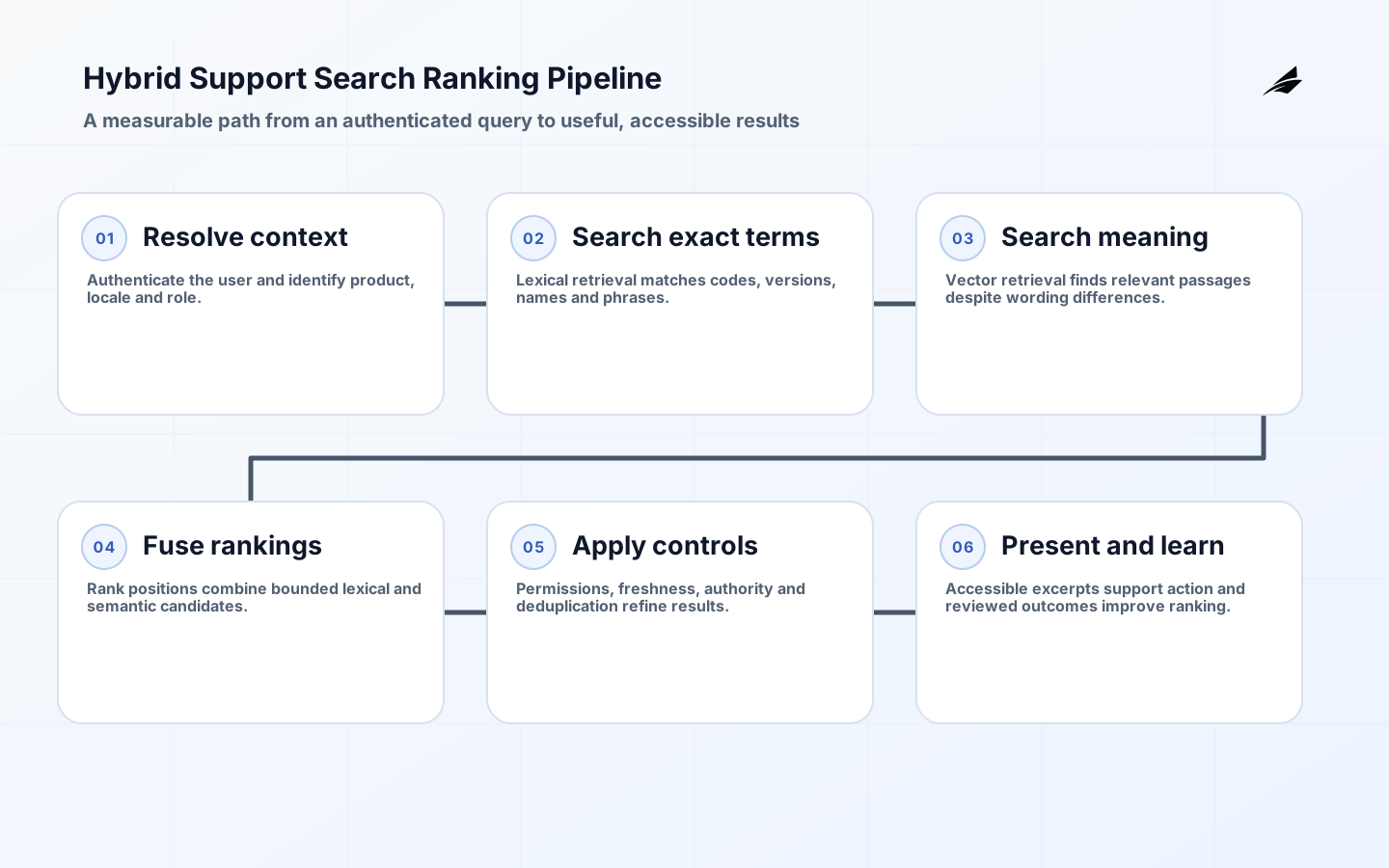
Support search must handle two languages at once: the customer's description of a problem and the organization's terminology for resolving it. A user may report that a device keeps dropping offline while an article describes intermittent network association. Semantic retrieval can bridge that wording gap, but support teams also depend on exact matches for error codes, model numbers, plan names and policy clauses. The strongest architecture combines lexical and vector retrieval, then applies permissions, freshness, source quality and measurable ranking rules before presenting results or passing them to an answer generator.
Define the support outcome before choosing a search engine
Search architecture should start with the work being performed. A customer self-service search needs safe, concise public guidance. An agent console can surface internal diagnostics but must still respect team, geography and account restrictions. An escalation engineer may need case history, logs and known defects. These audiences have different corpora, latency expectations and consequences. Define the successful next action: opening the right article, completing a troubleshooting step, attaching an approved response or routing to the correct queue. Clicks alone are ambiguous because users also click misleading results.
| Search audience | Typical sources | Principal constraint |
|---|---|---|
| Customer self-service | Public help and status content | Safety, clarity and accessibility |
| Frontline agent | Approved articles, scripts and account context | Speed and role-aware access |
| Specialist support | Runbooks, defects and technical case history | Precision and diagnostic depth |
| Operations lead | Aggregated query and outcome data | Privacy and reliable measurement |
| Answer assistant | Retrieved passages through an API | Bounded context and provenance |
Build a search-oriented content model
A search index should not be a shapeless copy of the source repository. Define fields for title, summary, body, headings, product, component, error code, audience, locale, content type, status, effective date, updated date, source authority and access groups. Keep a stable document identifier and source URL. Divide long material at meaningful boundaries while preserving section ancestry. Store passages for retrieval and enough document-level metadata for filtering, display and deduplication. If a source update removes a warning or revokes access, the corresponding index entries and caches must change predictably.
Lexical analysis also deserves design. PostgreSQL's full-text documentation illustrates the core operations: parse documents into tokens, normalize related forms and construct a query representation before ranking. Product names, abbreviations and error codes may need field-specific analyzers or protected tokens. Synonyms should reflect verified support vocabulary, not every loosely related phrase. Treat synonym changes as ranking changes and test them against a labeled query set.
Combine exact and semantic retrieval deliberately
Keyword retrieval commonly ranks documents with a lexical relevance model and remains essential when exact terms carry meaning. Vector retrieval embeds the query and passages into a shared space and finds nearby representations, helping with paraphrases and vague symptom descriptions. Run both against compatible filters, gather a bounded candidate set and combine rankings. Reciprocal rank fusion is one practical method documented by Elastic, Azure and OpenSearch: it uses each result's position rather than assuming lexical and vector scores are directly comparable. Its candidate window affects both relevance and cost, so tune it rather than accepting a default blindly.
| Query | Lexical contribution | Semantic contribution | Useful metadata |
|---|---|---|---|
| E104 after firmware 7.2 | Exact error and version match | Related failure description | Model, firmware, effective date |
| Calls sound metallic | May miss informal wording | Maps symptom to audio distortion | Device, channel, locale |
| Cancel annual plan | Finds plan and action terms | Finds termination wording | Region, customer type, policy status |
| VPN disconnects after sleep | Matches product acronym | Finds resume and network concepts | OS, client version, article status |
| Where is my refund? | Finds refund references | Finds settlement-delay explanation | Payment method, region, audience |
Design the query pipeline as a sequence of decisions
- Authenticate the user and resolve current tenant, role and group context.
- Normalize obvious formatting without changing meaningful identifiers.
- Detect supported filters such as product, locale and time range; ask for clarification when a missing attribute changes the answer.
- Execute lexical and vector retrieval with mandatory authorization filters.
- Fuse and optionally rerank a bounded candidate set using features approved for the audience.
- Deduplicate versions, suppress expired material and diversify results when one source dominates.
- Return titles, excerpts, source type, freshness and accessible status updates; record privacy-minimized diagnostics.
Query rewriting can expand abbreviations, correct spelling or split a complex request, but it can also erase intent. Keep the original query in the trace, constrain rewrites to known vocabularies and evaluate changes by query class. A support search for an exact billing code should not be transformed into a broad concept search. When a conversational system uses previous turns, make the active filters visible so an old product or customer context does not silently contaminate a new question.
Apply permissions inside retrieval
Security trimming must happen before restricted text is returned to the application or model. Index access attributes derived from an authoritative identity or content system, then filter each query using the authenticated user's current context. Microsoft documents a filter-based pattern using user or group identities. Whichever platform is used, decide how nested groups, tenant boundaries, public content, temporary access and revocation propagate. Avoid one giant index with an optional permission clause supplied by the client; mandatory policy should be enforced in a trusted service layer.
| Authorization test | Expected result | Failure exposed |
|---|---|---|
| Public user requests internal runbook title | No result or disclosure | Metadata leakage |
| Agent changes tenant context | Only selected tenant's permitted records | Cross-tenant access |
| User removed from a group | Access disappears within the agreed target | Stale authorization index |
| Restricted passage shares a public document | Restricted passage remains excluded | Document-level permission too coarse |
| Reranker receives candidates | Only already authorized text is sent | Downstream disclosure |
| Cached result after revocation | Cache is invalidated or permission rechecked | Authorization bypass through cache |
Measure ranking quality with support judgments
Create a query set from de-identified search logs, failed searches, case summaries and known critical journeys. Relevance assessors should label results against a written scale: directly resolves, useful background, related but insufficient, or irrelevant. Capture the audience and expected next action. Evaluate recall at a chosen candidate depth, precision near the top, normalized discounted cumulative gain for graded relevance and reciprocal rank for the first useful result. Segment by exact identifier, symptom description, policy question, multilingual query and no-answer case.
Online signals complement offline judgments. Track successful article use, reformulation, rapid return to results, escalation after search and the support outcome when it can be attributed responsibly. Do not optimize solely for click-through: a sensational or vaguely broad title can attract clicks without solving the case. Run controlled experiments with guardrails for critical content, latency and no-result behavior, and retain the ability to restore the previous index, embeddings or ranking configuration.
Make the search experience operationally useful
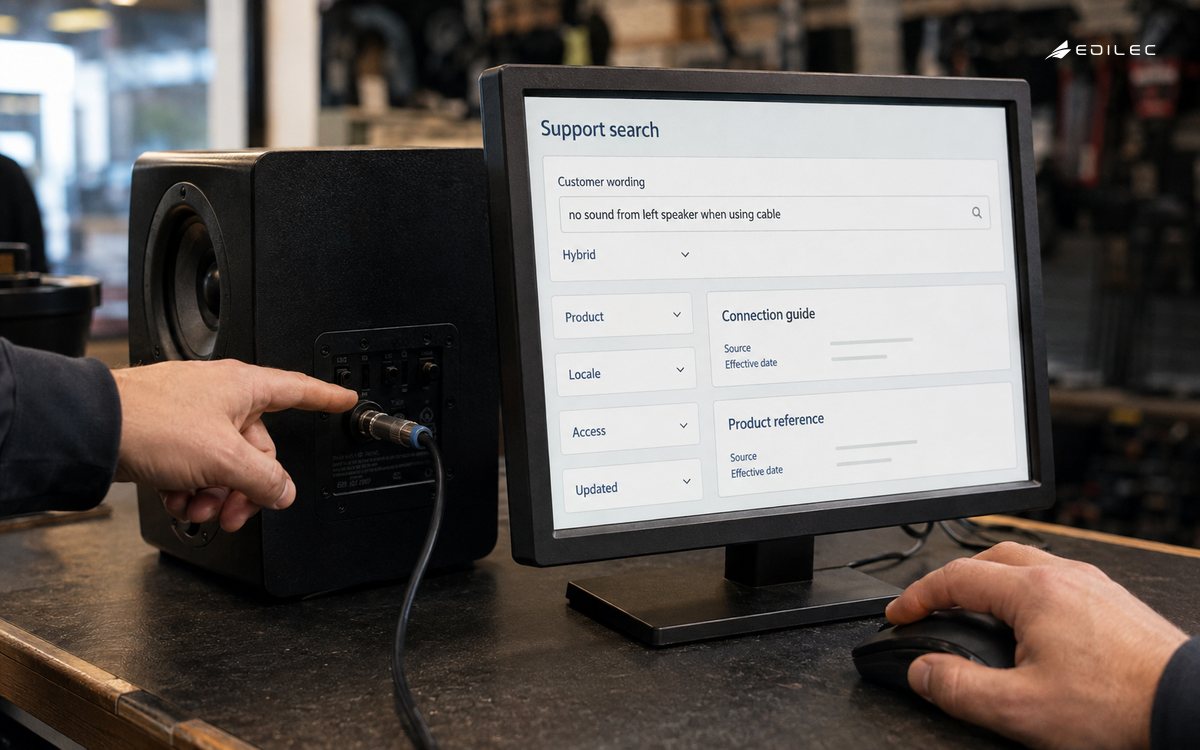
Show why a result is relevant through a concise excerpt, matched identifiers and useful metadata such as product, audience and updated date. Filters should reflect the support workflow, not internal database vocabulary. Preserve keyboard focus, label controls and announce result counts, loading and no-result status without forcing assistive-technology users to move focus; W3C's status-message guidance is directly relevant to dynamic search interfaces. On no results, preserve the query, suggest a small number of valid corrections and provide an escalation path.
Example: routing a difficult connectivity case
An agent searches for 'tablet drops Wi-Fi when the lid opens after update.' Product context identifies the tablet family and current operating-system version. Lexical retrieval finds release notes containing the version, while vector retrieval finds an article titled 'network reassociation failure after wake.' Authorization filters exclude an engineering-only diagnostic. Rank fusion places the current public workaround above an older generic Wi-Fi article; freshness and product fields break the tie. The interface shows the relevant excerpt and date. After the agent records that the workaround resolved the case, the outcome becomes a relevance signal for review, not an automatic training label.
Operate search as a product
| Operational risk | Control | Signal |
|---|---|---|
| Index staleness | Change feed, retries and reconciliation | Freshness lag by source |
| Embedding migration | Versioned fields and shadow index | Quality and latency comparison |
| Ranking regression | Fixed evaluation suite and canary release | Metric change by query class |
| Latency spike | Budgets per stage and bounded candidates | Tail latency and timeout rate |
| Zero-result growth | Vocabulary review and ingestion health | No-result rate by product |
| Sensitive logging | Redaction, minimization and retention policy | Privacy review findings |
| Single-source dominance | Deduplication and diversity policy | Top-result source concentration |
A practical implementation sequence
- Baseline current search using a labeled query set and support outcomes.
- Define the content schema, authority levels, permission model, deletion behavior and freshness targets.
- Launch lexical retrieval with trustworthy filters and diagnostics before adding semantic complexity.
- Create passage embeddings and run vector retrieval in shadow mode; compare candidate recall by query class.
- Introduce fusion and reranking through offline evaluation, then a limited canary with rollback.
- Improve the interface, accessibility and feedback capture alongside ranking.
- Establish owners for content, relevance, identity integration and platform operations; review changes on a regular cadence.
Key takeaways
- Define the support outcome and audience before selecting search technology.
- Preserve exact identifiers while using vector retrieval to bridge differences in wording.
- Apply authorization filters inside retrieval before candidates reach rerankers or applications.
- Tune hybrid ranking with labeled support queries and segmented relevance measures.
- Operate indexes, embeddings and ranking changes as versioned releases with monitoring and rollback.
Frequently asked questions
Are semantic search and vector search the same?
Vector similarity is one technique used to provide semantic matching. A complete semantic search system also includes content structure, metadata, lexical matching, filters, ranking, permissions and user experience. The architecture should be judged by support outcomes, not by whether it contains vectors.
Why not use vector search alone?
Support queries frequently contain exact codes, versions, names and regulated wording. Lexical retrieval handles those signals well, while vectors help with paraphrases. Hybrid retrieval gives each technique a role and can be measured against the same relevance set.
When is reindexing required?
Reindex when source content or access attributes change and when schema, analyzer, chunking or embedding versions require new representations. Use versioned indexes or fields, test the replacement in parallel and plan cutover plus rollback. Deletions and revoked access need explicit verification.
Does semantic support search need an LLM?
No. Embedding models and rerankers can improve retrieval without generating an answer. Starting with well-presented search results is often easier to evaluate. Add generation only when the use case benefits from synthesis and the organization can control citations, unsupported claims and escalation.
Conclusion
Semantic search for support is a relevance and operations discipline. Preserve exact identifiers, use vectors for language variation, combine rankings transparently and enforce permissions before results leave the search tier. A labeled query set, accessible experience and versioned rollout turn search improvements from intuition into an accountable service that helps people reach the right next action.