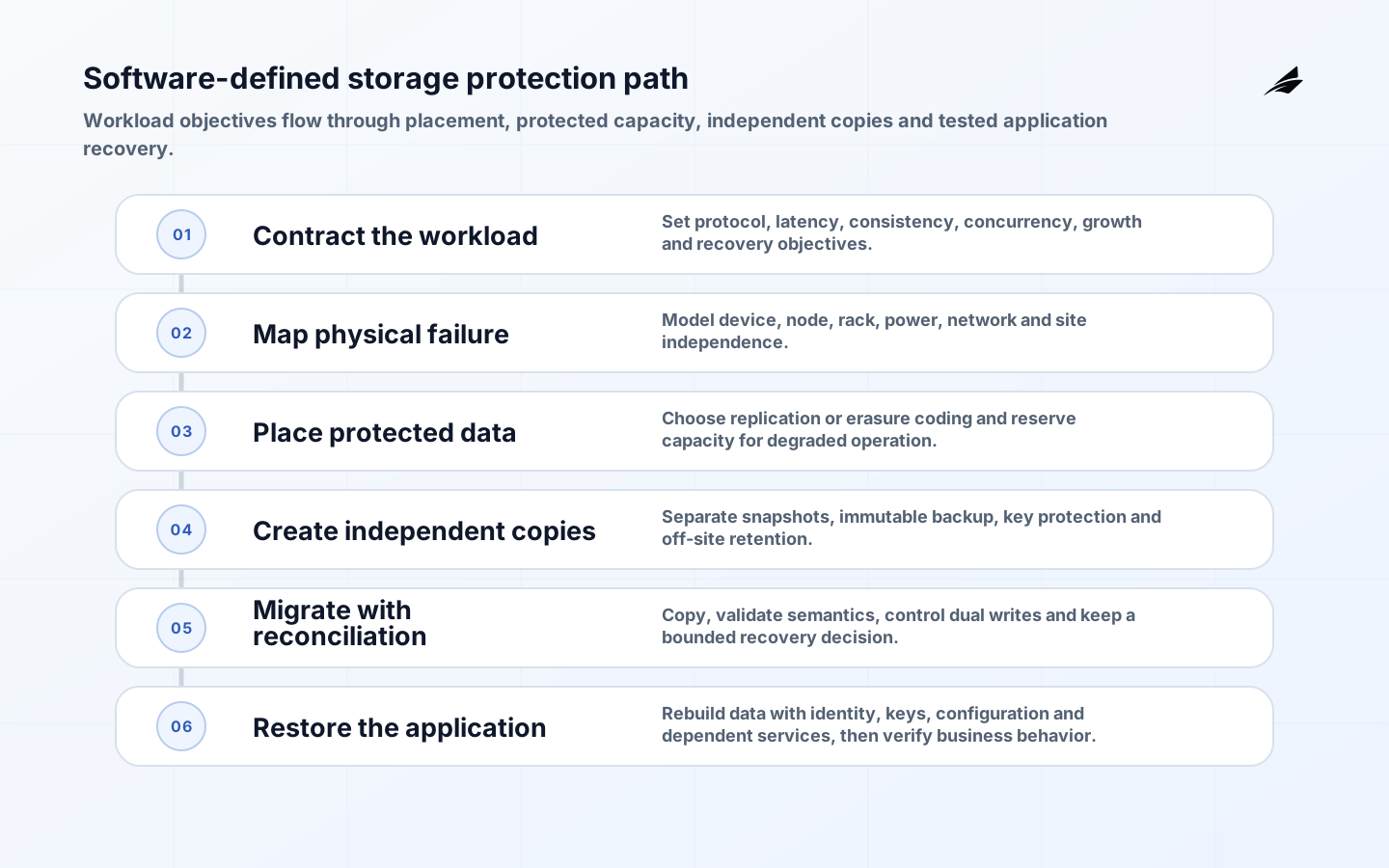
Software-defined storage solutions separate storage services and policy from dependence on one proprietary appliance, but that abstraction does not remove physical constraints. Latency still depends on media, network paths and queueing; durability still depends on independent failure domains; and recovery still consumes bandwidth and operator attention. A credible plan begins with workload behavior and failure objectives, then selects software, hardware and topology that can meet them. Buying commodity servers first and deciding the service later is a common route to expensive rework.
This guide covers block, file and object services delivered through software-defined storage, including clustered systems such as Ceph and container integrations through the Container Storage Interface. It focuses on scope, cost, risk and delivery evidence rather than product rankings. Teams that also need broader operational ownership can connect the plan to a managed cloud services implementation checklist and managed cloud architecture guidance.
Turn workload behavior into a storage service contract
Inventory applications by access protocol, working-set size, read-write ratio, block or object size, concurrency, burst pattern, consistency expectation and data lifecycle. Average throughput is insufficient: a database log, virtual-machine fleet, analytics repository and backup target can report the same daily volume while stressing completely different resources. Capture p95 and p99 latency at meaningful concurrency, not just vendor maximums. State which applications can retry, which require ordered writes and which fail when latency crosses a threshold.
Define availability, durability, recovery point and recovery time separately. Replication may keep a service available after a device failure but does not protect against deletion, corruption, ransomware or a faulty application write. Snapshots can shorten rollback but may share the same administrative and physical fate as primary data. A service contract should identify the failure classes covered, maximum data loss for each class, expected restoration time and the business owner who accepts residual risk.
| Workload question | Design consequence | Evidence before approval |
|---|---|---|
| What is the p99 latency target at peak concurrency? | Media, network, replication and cache design must be tested together. | Replay representative I/O and measure host-observed latency. |
| How much data may be lost after corruption or site failure? | Snapshot, backup, replication and off-site policy must be distinct. | Restore a sampled dataset to an isolated environment. |
| Which protocol and semantics does the application require? | Block, file and object interfaces are not interchangeable. | Application-level consistency and failover tests pass. |
| How quickly will capacity and IOPS grow? | Node, rack, network and rebuild headroom affect expansion. | Forecast includes normal growth and degraded-state reserve. |
| Who may delete, snapshot or restore data? | Administrative roles and approval controls shape the platform. | Least-privilege and emergency-access tests are recorded. |
Design the control, data and failure planes
Separate the control plane that manages topology and policy from the data path that serves reads and writes. Identify metadata services, quorum members, storage daemons, gateways, client drivers and management endpoints. Then draw failure domains: device, node, chassis, rack, power feed, network switch, room and site. Replicas or erasure-coded fragments provide the promised resilience only when placement rules distribute them across truly independent domains. Quorum services also require odd-member placement and reliable latency.

Capacity planning must include usable capacity after replication or erasure coding, reserved free space, metadata, snapshots, rebalance overhead and failure reserve. A cluster near full capacity may become unstable precisely when it must rebuild. Model the largest credible failure and verify that remaining nodes and network links can absorb recovery traffic without violating application objectives. Separate client, replication and management traffic when contention or security requires it, but avoid unnecessary network complexity that operators cannot diagnose.
Design protection beyond platform replication
Create independent protection layers for operational error, software defect, cyberattack and physical loss. Use immutable or isolated backup copies where the threat model requires them, and protect backup credentials from storage administrators. Define snapshot frequency, retention, replication lag and off-site copy behavior by data class. Encryption protects confidentiality but does not prove recoverability. Key loss can be as destructive as data loss, so key backup, rotation and emergency access belong in the recovery design.
Test restores at application level. Recovering blocks is not enough if database logs are inconsistent, object indexes are stale or identity and encryption dependencies are unavailable. Record restore duration, data validation, sequence of dependent services and the point at which users can safely resume work. Run a full-site or administrative-compromise exercise, not only a single-disk drill. Measure recovery while the primary service continues to handle load because real incidents rarely pause demand.
Match hardware and network to the software model
Use hardware qualified for the chosen platform and workload. Consider endurance, write amplification, power-loss protection, controller behavior, firmware compatibility, memory, CPU for checksums or erasure coding and replacement availability. Mixing device classes can be useful when policy places data deliberately, but accidental heterogeneity produces unpredictable tails. Maintain drive and firmware inventories and a staged update process. Commodity components are economical only when operational qualification and spares are funded.
Network design is part of storage design. Calculate east-west traffic for replication, recovery and rebalancing as well as client throughput. Validate maximum transmission unit, bonding, routing, congestion and failure convergence under load. A healthy link-state dashboard may miss packet loss or microbursts that cause severe storage latency. Time synchronization and DNS are also dependencies for authentication, logs and cluster membership. Include out-of-band management and a method to recover nodes when the primary network is impaired.
Protect storage administration and tenant data
Apply separate identities for platform administration, host access, backup and monitoring. Use least-privilege roles, strong authentication and short-lived credentials where supported. Restrict management endpoints to controlled networks and log configuration, policy, snapshot, key and deletion actions. For multi-tenant environments, test data-path isolation and metadata exposure across namespaces or pools. Encryption in transit and at rest should have documented algorithms, key ownership, rotation and revocation behavior.
Treat storage software, firmware, drivers and management consoles as a supply chain. Track versions and advisories, verify packages and test updates against representative clients. Vulnerability remediation must consider data availability: an emergency patch that forces simultaneous restarts can create a larger outage. Establish forensic retention for administrative events and integrate high-impact changes with incident monitoring. NIST SP 800-209 is useful for mapping threats across storage networking, management and data protection.
| Cost component | Often missed in estimates | Planning method |
|---|---|---|
| Usable capacity | Replication, erasure coding, free-space reserve and snapshots. | Price per protected usable terabyte at target performance. |
| Performance headroom | Rebuild and rebalance compete with production I/O. | Benchmark normal and largest-failure states. |
| Network | High-speed switching, optics, redundancy and inter-site transfer. | Model client plus replication and recovery traffic. |
| Operations | On-call, upgrades, firmware qualification, monitoring and spares. | Estimate recurring labor by cluster and site, not only nodes. |
| Protection | Backup media, isolation, retention, restore compute and testing. | Cost each recovery tier against business loss tolerance. |
| Migration | Dual running, data transfer, application testing and rollback. | Fund waves until source retirement is accepted. |
Migrate data in bounded, reversible waves
Group applications by protocol, dependency, criticality and migration mechanism. Start with a representative but recoverable workload to prove performance, observability, backup and support. For each wave, define source consistency, copy method, change capture, freeze window, validation and rollback. File counts and checksums may validate transfer, but application owners must also verify permissions, semantics and business behavior. Maintain a reconciliation report until the source is formally retired.
Avoid a big-bang move driven by hardware lease dates. Some workloads will need refactoring, driver changes or a different service class. Measure production-like I/O before committing them. During coexistence, name the authoritative copy and prevent users from writing to both sides accidentally. Cutover communication should include the recovery decision time: after a certain point, restoring the source may lose accepted writes and forward repair may be safer.
Prepare day-two storage operations
Monitor client latency, queue depth, capacity, placement health, degraded objects, recovery rate, device errors, network loss and quorum state. Alert on service impact and exhaustion forecasts rather than every transient daemon event. Operators need drill-down from an application complaint to host, network, placement group and device evidence. Create runbooks for failed media, full pools, unavailable metadata, split connectivity, slow nodes, accidental deletion and key-service outage.
Define change windows and compatibility matrices for storage software, operating systems, client drivers, orchestration platforms and firmware. Rehearse rolling upgrades and rollback before production. Capacity review should use both growth and failure reserve. Track repair time and recurring device or rack patterns to improve hardware choices. A software-defined platform remains maintainable only when configuration, topology and policies are stored as reviewed, reproducible definitions.
Software-defined storage planning takeaways
- Start with workload latency, consistency and recovery behavior rather than hardware inventory.
- Map replicas, quorum and fragments to independent physical failure domains.
- Fund usable capacity, degraded-state performance, network and operational labor.
- Separate replication from backup and prove application-level recovery.
- Protect management, keys and backup identities as separate security boundaries.
- Migrate in reversible waves and accept each workload before retiring its source.
Frequently asked questions
Is software-defined storage always cheaper than an appliance? No. It can improve hardware choice and automation, but savings depend on usable capacity, network, support, skilled operations, spares and lifecycle management. Compare total protected service cost at the required performance, not raw disk price.
Should every workload use one SDS cluster? Consolidation can improve utilization, but workloads with incompatible latency, failure, security or upgrade requirements may need separate pools or clusters. Isolation should reflect measurable service differences rather than organizational preference.
Does erasure coding replace backup? No. Erasure coding protects against a defined number of component failures. It does not independently protect against authorized deletion, logical corruption, compromised administration or a defect propagated across fragments.
Conclusion
Software-defined storage succeeds when abstraction is paired with engineering discipline. Workload contracts, explicit failure domains, protected usable capacity, independent recovery, secure administration, evidence-based migration and practiced operations turn a cluster into a dependable storage service. The delivery plan should make every promise testable before critical data depends on it.