Software-defined storage solutions separate storage services and policy from dependence on one fixed appliance design. At its core, SDS virtualizes pooled storage and exposes software-controlled management and data services. The value is programmable, policy-driven capacity and protection. The obligation is to engineer the complete system: media, servers, network, software, failure domains, data protection and skilled continuous operation.
SDS is not automatically cheaper, faster or more resilient than an array or managed cloud service. Those outcomes depend on workload shape, scale, replication or erasure coding, hardware lifecycle, network behavior and team capability. This guide scopes an evidence-led program. Use the SDS implementation checklist during delivery and the SDS architecture FAQ when comparing designs.
Scope SDS from workload service levels
Inventory applications and data before selecting products. Capture block, file or object access; protocol and client versions; capacity; object or file size; IOPS; throughput; read-write mix; latency percentiles; concurrency; growth; change rate; snapshots; retention; encryption; locality; consistency; and recovery objectives. Note peak and rebuild behavior. Average utilization is a weak sizing input for transactional workloads and can conceal the network cost of recovery.
Create service classes only where requirements and implementation genuinely differ. A low-latency database volume, research object archive and shared home directory should not inherit one generic gold label. Define measurable targets at the client, including availability, latency or throughput, durability assumptions, restore time and support response. State exclusions and maximum supported scale. Keep application-level backup and database consistency needs visible; a storage snapshot is not automatically a recoverable application backup.
| Workload question | Design consequence | Acceptance evidence |
|---|---|---|
| Block, file or object? | Protocol, client, consistency and feature choice | Supported-client matrix and functional tests |
| Latency or throughput priority? | Media, caching, network and placement design | Client-side percentile tests at expected concurrency |
| Failure tolerance? | Replication, coding and failure-domain layout | Node, disk, rack and network fault exercises |
| Recovery objective? | Snapshot, backup, replication and restore workflow | Timed restore with application reconciliation |
| Growth and churn? | Usable-capacity headroom and expansion method | Forecast plus tested node-add and rebalance behavior |
Design control, data and failure domains together
Distinguish management or control services from the data path and identify quorum dependencies. Ceph, for example, uses monitors to maintain cluster maps and OSDs to store objects, with placement determined algorithmically through CRUSH. Other platforms use different designs, so inspect their authoritative architecture. Determine what happens when control services, metadata, time, name resolution or certificate services fail; healthy disks do not guarantee an available storage service.
Map physical topology into placement policy: device, host, chassis, rack, room or site. Replicas on separate logical nodes can still share a power feed or top-of-rack switch. Decide whether failure domains protect availability, durability or both, and quantify correlated risk. Reserve headroom for rebuild and maintenance. Test a second failure during recovery because repair traffic increases resource pressure and can expose assumptions hidden in steady-state benchmarks.
Engineer network and hardware as storage components
Distributed storage converts local media behavior into network traffic. Model client traffic, replication or coding overhead, recovery, scrub, backup and management flows. Validate oversubscription, packet loss, latency, MTU consistency, routing convergence and switch failure. Separate traffic where the design requires it, but avoid adding networks without operational reason. Instrument interfaces and queues so storage and network teams can diagnose the same event with correlated time.
Build a qualified bill of materials covering CPU, memory, media endurance, controllers, firmware, network adapters, power, cooling and replacement stock. Commodity does not mean arbitrary. Mixed hardware can improve flexibility but expands performance and firmware combinations. Automate firmware and software compatibility checks, burn-in new devices and preserve serial-level inventory. Plan secure media sanitization and disposition using current NIST SP 800-88 Revision 2 and applicable organizational policy.
| Cost element | Often omitted assumption | Planning method |
|---|---|---|
| Usable capacity | Raw terabytes ignore replicas, coding and reserved headroom | Model policy, failure tolerance, growth and rebuild reserve |
| Network | Existing fabric may not absorb recovery traffic | Measure peak plus failure and backup concurrency |
| Operations | Software licensing excludes 24/7 skill and on-call | Estimate staffing, training, support and exercises |
| Data protection | Snapshots are counted as off-cluster backup | Cost independent copies, retention, immutability and restore tests |
| Lifecycle | Initial hardware price ignores refresh and exit | Include spares, power, migration overlap and sanitization |
Protect data, administration and recovery
Define identities and roles for cluster administration, tenant provisioning, client access, backup and break-glass response. Use individual accounts, least privilege and audited changes. Protect management endpoints and automation credentials. Specify encryption in transit and at rest, key ownership, rotation and recovery. Test certificate and key failures. Multi-tenancy needs explicit isolation testing at API, namespace, network, quota and data-remanence boundaries.
NIST’s ransomware backup guidance stresses conducting, maintaining and testing backups. Keep backup credentials and copies resistant to compromise of the primary cluster. Define immutable or offline protections where risk requires them, monitor deletion and retention changes, and rehearse restore without relying on the failed control plane. Replication can reproduce corruption or malicious deletion quickly; it supports availability but does not replace independent recovery.
Pilot and migrate with data-integrity proof
Build a production-like pilot with representative clients, dataset shape and concurrency. Benchmark steady state and degraded states: device loss, node loss, control-service loss, network partition, full or near-full capacity, rolling upgrade and rebuild. Verify alerts and runbooks. A synthetic sequential benchmark alone cannot predict application behavior. Capture tail latency and recovery impact, not only peak throughput.
Choose migration per workload: application copy, host or volume replication, backup and restore, or dual-write only when semantics are controlled. Establish checksums, record counts or application reconciliation, a write-freeze or change-capture method, cutover authority and rollback point. Test the process with realistic volume. After cutover, observe the application through a defined window before deleting the source. Retain chain-of-custody and sanitization evidence where required.
Prepare day-two operation before production
Create dashboards for client service levels, capacity and forecast, device health, placement balance, recovery, scrub, control quorum, network errors, backup and restore outcomes. OpenTelemetry’s signal model can help correlate traces, metrics and logs, but storage-specific telemetry still needs consistent cluster, pool, node, device and client labels. Alerts must identify an action and owner; device noise without service context can overwhelm on-call staff.
Practice expansion, replacement, upgrade, certificate rotation, restore and full-site recovery. Track unsupported versions and firmware. Define safe fullness thresholds and stop conditions, because a distributed system near capacity may need free space to rebalance or recover. Keep vendor or community support paths current. Record architecture decisions and exceptions so future operators understand why placement, protection and network choices exist.
Set procurement and acceptance around service evidence
Request the supported hardware matrix, release and patch policy, upgrade compatibility, telemetry, security advisories, support severity and response, license or subscription metric, capacity limits and data-export method. For open-source designs, identify who integrates, qualifies and supports the exact build. A community project, commercial distribution and managed appliance may share code while offering materially different lifecycle and escalation commitments. Contract for access to diagnostic evidence and assistance during severe recovery.
Write acceptance scenarios before purchase. Include target workloads at expected concurrency, a failed device and node, control quorum loss, network impairment, rebuild under load, near-full capacity, rolling upgrade, backup restore and expansion. Specify measurement points and tolerances. Retain test datasets, scripts, configurations and raw results for future release comparisons. Repeat critical tests after final firmware and topology are installed because laboratory evidence from a smaller or differently wired cluster may not transfer.
Assign operational acceptance to named storage, network, security, application and continuity owners. Require inventory, diagrams, policy code, credentials procedure, dashboards, alerts, runbooks, training and open-risk records. The supplier’s installation completion is not production acceptance. Operations should demonstrate recovery from a realistic failure without relying on an engineer who will leave after the project.
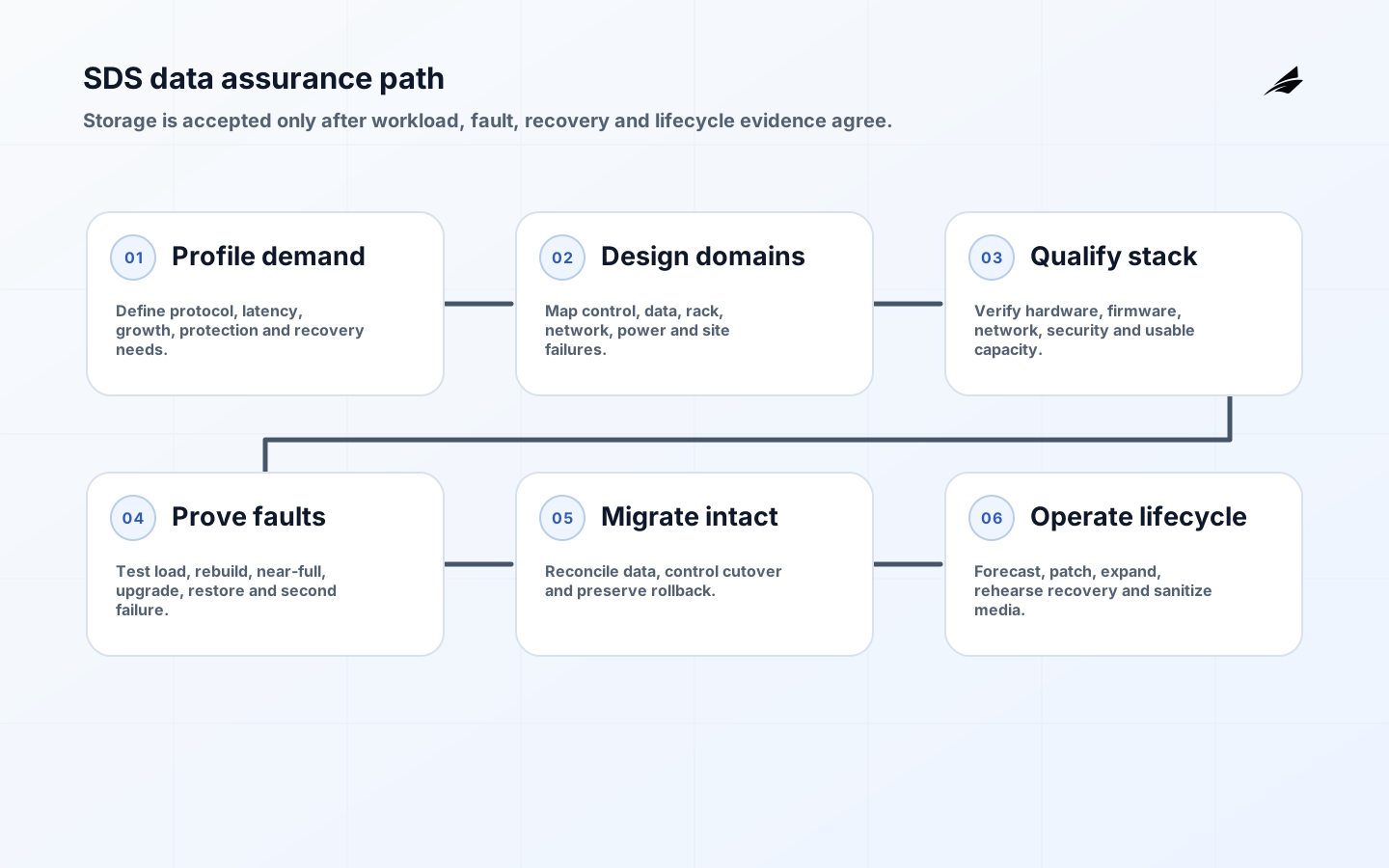
Follow a six-stage SDS delivery plan
- Profile workloads, data classes, service levels, growth, recovery and client constraints.
- Select an architecture and qualified hardware-network design with explicit failure domains and usable-capacity math.
- Build security, backup, observability, automation and operating roles into a production-like pilot.
- Test normal load, degraded modes, upgrade, near-full behavior, restore and a second failure during recovery.
- Migrate in waves with integrity reconciliation, rollback authority, observation windows and source disposition.
- Operate through service-level review, capacity forecasting, recovery exercises, lifecycle updates and funded exit planning.
Key takeaways
- Define storage services from client workloads and recovery needs, not raw capacity.
- Treat network, hardware, control services and physical topology as one failure system.
- Calculate usable capacity under protection, rebuild and maintenance conditions.
- Keep independent, tested recovery even when replication and snapshots are available.
- Accept migration only after application-level integrity and degraded-mode evidence.
Frequently asked questions
Is software-defined storage always cheaper?
No. It can improve hardware choice and incremental scale, but total cost depends on usable capacity, networking, power, support, staffing, spares, backup and lifecycle migration. Compare a service-level-matched total cost over the expected life, not raw cost per terabyte.
Does Kubernetes require software-defined storage?
No. Kubernetes uses storage classes, persistent volumes and CSI drivers to consume many storage types. Choose a driver and backend that satisfy workload and operating requirements. Container orchestration does not remove the need for backup, failure-domain or data-integrity design.
Is replication a backup?
Not by itself. Replication can preserve access after failures, but it may copy deletion, corruption or compromise. Maintain recovery copies with suitable independence, retention and access controls, then prove restoration and application consistency.
Conclusion
Successful software-defined storage solutions turn workload intent into verifiable policy across software and physical infrastructure. The program is complete when data remains usable through faults, upgrades, restoration and lifecycle change, not when the cluster first reports healthy. The related SDS solutions planning guide offers an additional buyer perspective, and the business process plan helps connect storage change to the applications and records it supports.