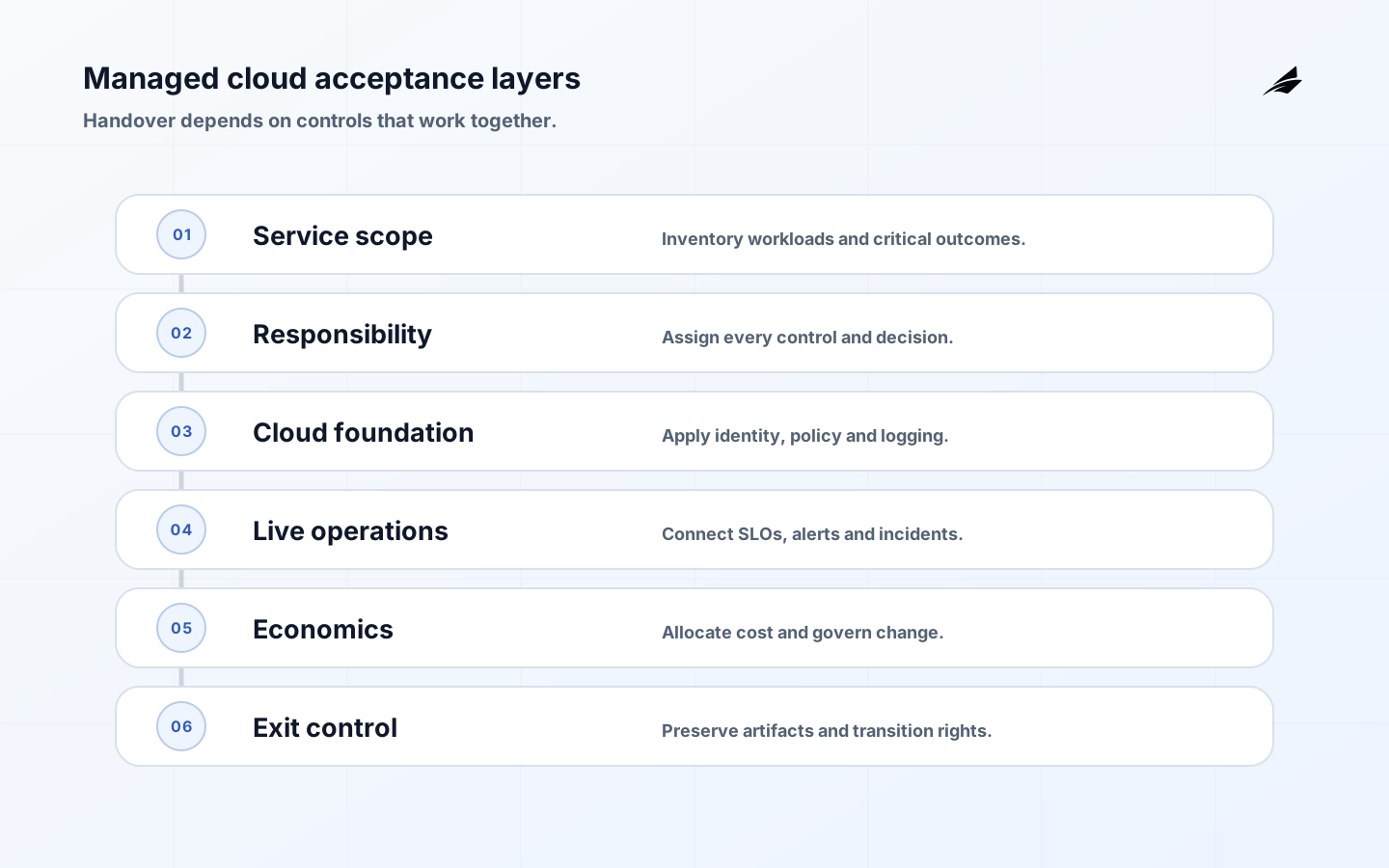
A managed cloud services implementation checklist is an acceptance instrument, not a list of vendor meetings. It should prove that a named team can operate the agreed workloads through normal demand, change, degradation and recovery. The implementation boundary includes the customer, provider and cloud platform because each controls different failure modes. Before onboarding, define the business services in scope, responsibility for every control, evidence required at handover and the conditions that pause migration. 'Fully managed' is not a useful boundary unless the contract and operating model say who detects, decides, changes and communicates.
This checklist complements the managed cloud services buyer FAQ and the deeper enterprise managed cloud scope guide. Use it in discovery, design reviews, migration waves and service acceptance. Mark an item complete only when its evidence is available to the people who will rely on it. A policy document without an implemented control, or a dashboard that no one owns, remains open work.
1. Confirm scope, criticality and decision rights
List accounts, subscriptions or projects; regions; environments; workloads; data classes; network connections; identities; licenses; and third parties. Tie each workload to a business owner, technical owner, support tier, critical period, recovery objective and regulatory or contractual need. NIST SP 800-145 distinguishes service and deployment models; that matters because responsibility changes between infrastructure, platform and software services. Record exclusions such as application code, database administration or end-user support beside the included work.

Build a responsibility matrix for provisioning, policy, identity, secrets, patching, vulnerability response, backups, restore, certificates, capacity, observability, incident command, cost, data requests and offboarding. Name decision authority, not just the team performing a task. Specify emergency access and risk acceptance. The enterprise managed cloud implementation checklist adds portfolio-scale controls, while this checklist emphasizes the evidence needed for an individual service transition.
| Decision area | Evidence before handover | Acceptance test |
|---|---|---|
| Service boundary | Asset and workload register with owners | Sample resource maps to an in-scope service |
| Responsibility | Customer-provider-control matrix | Incident scenario reaches a named decision-maker |
| Criticality | User journey, SLO and recovery requirements | Monitoring represents the real journey |
| Access | Role design, privileged path and review cadence | Unauthorized and expired access fail |
| Change | Repository, pipeline, approval and rollback path | Representative change is released and reversed |
| Exit | Export, credential, data and transition plan | Customer can obtain essential artifacts |
2. Establish the governed cloud foundation
Create an organization hierarchy and account vending path that applies naming, tagging, regions, identity federation, logging, network policy, encryption defaults, budget contacts and guardrails consistently. Separate production from development and security administration from workload operation. Avoid long-lived shared administrator credentials. Workload identities should be scoped to specific actions and resources; emergency privileges should be time-limited, logged and reviewed. Test policy exceptions and their expiry rather than assuming the default prevents every unsafe configuration.
Use the six functions of NIST CSF 2.0, including Govern, to check that technical controls connect to risk ownership, detection, response and recovery. Capture cloud control-plane logs in a protected destination and verify the provider can investigate without granting broad standing access. Document key management, secret rotation, certificate renewal, vulnerability handling and tenant-level dependencies. Security tools are inputs; acceptance depends on an exercised operating process and retrievable evidence.
3. Define reliability, backup and recovery evidence
Write service-level indicators from the customer journey: successful requests, processing freshness, data durability or completion time. The Google SRE SLO guidance separates indicators, objectives and agreements and recommends choosing measures users care about. Define measurement windows, exclusions and consequences. Provider infrastructure uptime is not enough when a failed identity dependency, queue or application deployment prevents the business outcome.
Backups become a control only after restore is tested. Record protected resources, frequency, retention, immutability or separation, encryption, failure alerting and restoration ownership. Exercise loss of a resource, region or credential according to the service threat model. Measure recovery point and recovery time from the drill, reconcile restored data and document the decision to return to normal service. Include SaaS configuration and identity data where the platform backup does not cover them.
4. Connect observability to incident response
Collect service, platform, security and cost telemetry with consistent resource identity and time. OpenTelemetry defines traces, metrics, logs and baggage; use correlation to connect a user symptom to dependencies without indiscriminately copying sensitive payloads. Monitor black-box outcomes as well as resource health. Every page needs an owner and immediate action; lower-urgency signals should create reviewable work rather than continuously interrupting responders.
Agree severity definitions, notification windows, command roles, evidence preservation, customer communications, supplier escalation and post-incident follow-through. Run a tabletop and one technical exercise before handover. Test outside normal hours and with a primary contact unavailable. The provider must be able to state impact and last known reliable state, while the customer retains authority for legal, regulatory and customer decisions. Record actions from reviews to owners and verify completion.
| Operational signal | Owner question | Required response |
|---|---|---|
| User SLO burn | Which journey and cohort are affected? | Limit change and restore service |
| Control-plane anomaly | Was access authorized and attributable? | Contain, preserve evidence and investigate |
| Backup failure | Is a recoverable copy still within objective? | Repair protection and reassess risk |
| Capacity saturation | Will demand breach the service window? | Scale, shed load or communicate degradation |
| Cost variance | Is usage valuable, wasteful or misallocated? | Correct allocation or architecture |
| Certificate or secret age | Will expiry interrupt service or access? | Rotate through the tested path |
5. Prove change, security and vulnerability routines
Store infrastructure definitions and policy in version control where practical. Require peer review, automated checks, protected artifacts, environment-specific authorization and recorded deployment. Test rollback and forward recovery. Patch responsibilities must cover operating systems, managed services, images, agents and application dependencies, with a route for urgent remediation. Scan findings need ownership, risk-based deadlines, exception approval and verification after correction; a large unresolved findings list is not vulnerability management.
Measure delivery at the service level. DORA's current five-metric history groups change lead time, deployment frequency and failed deployment recovery time with change failure and deployment rework. Use these trends to improve the system, not rank individuals or compare unrelated workloads. Pair them with reliability, security and customer outcomes. A faster pipeline that increases emergency work or weakens evidence is not an improvement.
6. Make cost and commercial controls operable
Enable billing exports, budgets and anomaly routes before migration. Require ownership tags or another durable allocation method and define treatment for shared services, commitments, support and data transfer. The FinOps Foundation allocation capability frames allocation as a way to attribute cost and enable accountability. Review unit cost against demand and service outcomes rather than rewarding indiscriminate reductions that transfer risk to reliability or security.
Align the service schedule, responsibility matrix and technical reality. Contract for evidence access, incident cooperation, subcontractor controls, data location and use, vulnerability notification, service credits, transition assistance, deletion and credential removal. Establish governance cadence and escalation, but keep routine decisions close to the operators with evidence. The enterprise managed cloud FAQ helps resolve commercial questions that surface during acceptance.
Before final acceptance, have the incoming operations team lead a complete service day while the outgoing project team observes. The incoming team should approve a routine change, investigate a user-visible symptom, explain current risk and cost, restore a selected object and remove temporary access. Capture gaps as acceptance actions with owners and deadlines. This reverse-shadow exercise tests whether knowledge, permissions and evidence actually transferred. It also reveals hidden dependence on an individual consultant or project chat before that dependence becomes an after-hours incident.
Retain an acceptance pack in a customer-controlled repository. It should include the current inventory, responsibility decisions, architecture, service objectives, alert routes, restore results, open risks, cost baseline and access review. Set review dates because this pack becomes stale as soon as workloads or contacts change. A provider portal can link to evidence, but it should not be the only place the customer can find the service definition during a supplier outage or transition.

Key takeaways
- Define workloads, exclusions, criticality and decision rights before provider onboarding.
- Apply identity, policy, logging, network and cost controls through a repeatable foundation.
- Measure user-facing service objectives and prove restore against the stated recovery need.
- Exercise incidents, emergency access and supplier escalation before handover.
- Make change, vulnerability and cost routines observable and owned.
- Accept the service only when customer and provider can operate it together under failure.
Managed cloud services implementation FAQ
How long should managed cloud onboarding take? Duration follows estate size and uncertainty. Use staged waves: foundation, representative workload, recovery exercise, operating acceptance and expansion. Do not set a portfolio migration date before the first slice tests identity, networking, telemetry and support.
Who owns cloud security in a managed service? Responsibility is shared among cloud provider, managed service provider and customer, and it changes by service model. Document each control and decision. The customer retains accountability for its data, users, risk acceptance and supplier oversight.
What is the minimum handover evidence? An owned inventory, responsibility matrix, access model, architecture and data flows, SLOs, dashboards, alert routes, runbooks, tested restore, change records, risk register, cost allocation and exit plan.
Should the provider have permanent administrator access? Prefer federated, role-scoped and time-limited privileged access with approval and audit. Any standing access needs explicit justification, monitoring and periodic review.
Conclusion
A managed cloud service is ready when ownership and evidence survive a difficult day. Complete the implementation checklist through a representative workload, not a paper review: release a change, deny unauthorized access, follow a trace, respond to an alert, restore data, explain cost and revoke temporary privileges. When those routines work with named customer and provider owners, migration can expand with confidence. Until then, the service is still onboarding, regardless of how many resources have moved.