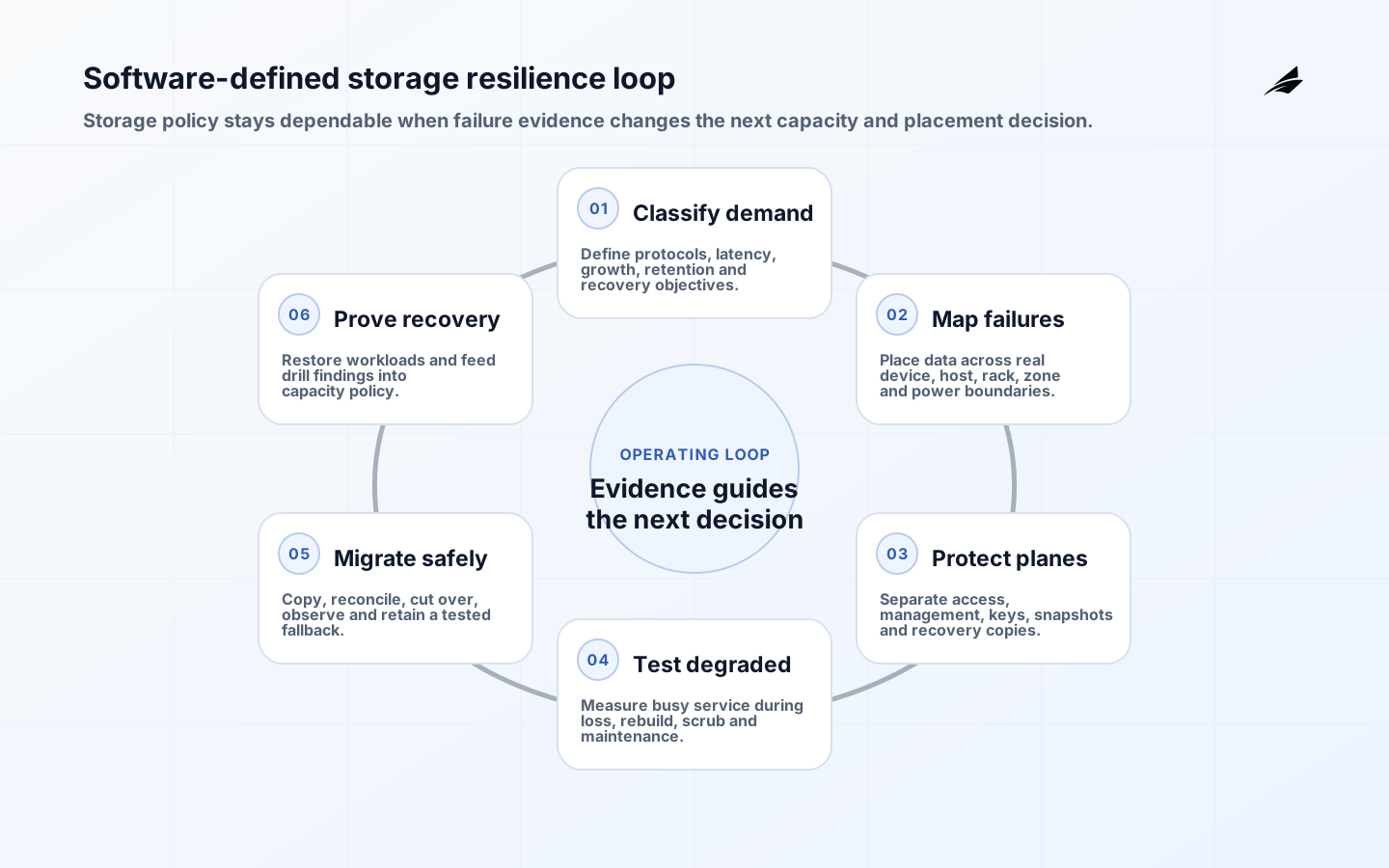
Software-defined storage solutions separate storage service policy and management from a single appliance, but software does not remove the physics of media, networks or failure domains. A successful SDS implementation starts with workload evidence and ends with tested recovery under realistic faults. This checklist complements the SDS scope and cost plan, SDS FAQ and architecture and operations checklist.
NIST SP 800-209 covers software-defined storage and storage-specific protection, isolation and restoration assurance. Kubernetes storage concepts explain claims, classes and CSI-mediated provisioning, while Ceph architecture shows how a distributed implementation maps objects and placement. Ceph's erasure-coding guidance exposes durability, capacity and processing tradeoffs, and NIST SP 800-53 Revision 5 provides a control catalog. Acceptance criteria must still come from the organization's workload, topology, threat and recovery requirements.
Software-defined storage separates storage services and policy from a single proprietary hardware controller, enabling software to pool capacity and expose block, file or object interfaces. The abstraction does not remove physical limits or operational responsibility. This storage SDS solutions implementation checklist connects workload requirements, failure-domain design, security, migration, performance, recovery and lifecycle operations so flexibility does not become an opaque data risk.
Use the software-defined storage scope and cost plan and the storage SDS FAQ with this checklist. The SDS solutions FAQ provides another view for platform teams.
1. Classify workloads and service objectives
Inventory applications, owners, data classes, protocols, capacity, growth, object or file size, read/write pattern, latency, throughput, concurrency, retention, snapshot and recovery needs. Separate usable capacity from raw media. Define availability, recovery time and recovery point objectives with measurement points. A single gold tier usually overpays for ordinary data and still fails to express special workloads.
Map client dependencies and compatibility: operating systems, hypervisors, databases, backup software, Kubernetes CSI drivers, multipathing and network paths. Kubernetes persistent volumes decouple storage provisioning from pods, but application consistency and recovery remain workload concerns. Establish data residency, legal hold, deletion and export requirements before platform selection.
| Workload class | Design question | Acceptance evidence |
|---|---|---|
| Transactional block | Latency under peak and degraded operation | Percentile latency and consistency test |
| Shared file | Namespace, permissions and metadata scale | Concurrent access and authorization test |
| Object/archive | Durability, lifecycle and retrieval time | Integrity, expiration and sample restore |
| Container persistent | CSI behavior, topology and expansion | Provision, reschedule, snapshot and restore |
| Backup target | Isolation and immutability controls | Credential compromise and recovery exercise |
2. Design placement and failure domains
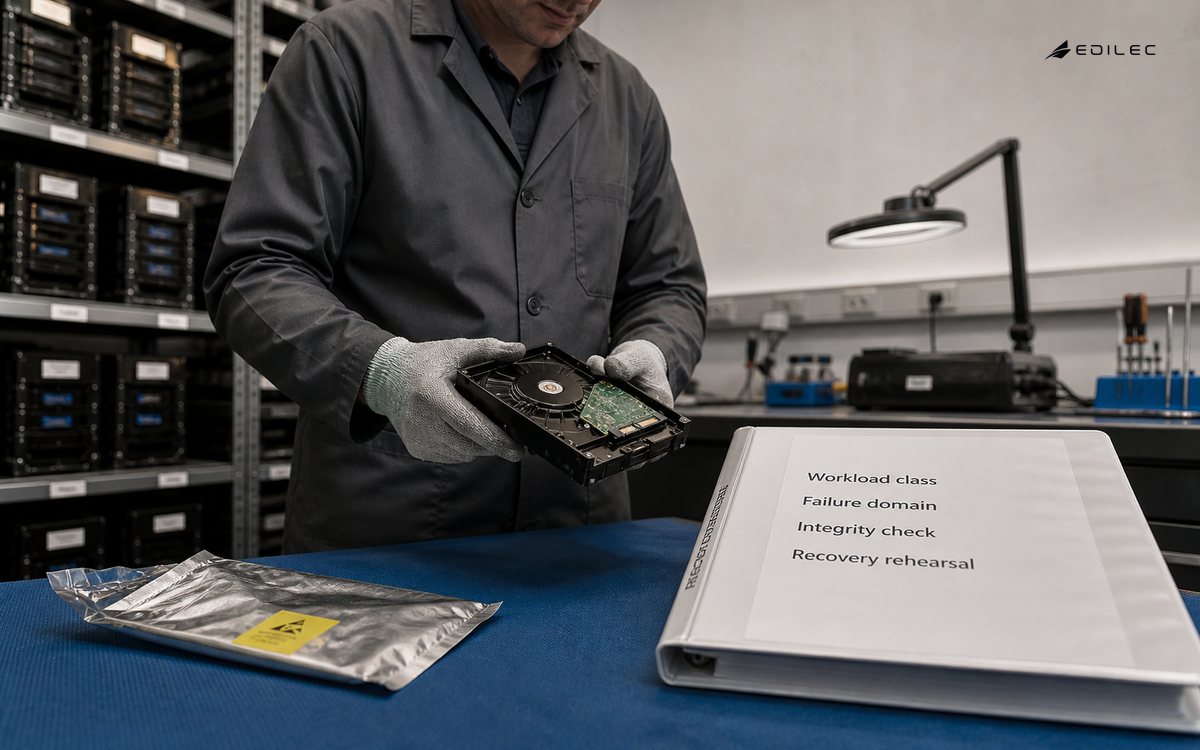
Model device, host, rack, room, zone, network and power failures. Select replication or erasure coding based on durability, usable capacity, write behavior, recovery traffic and fault tolerance. Ceph uses CRUSH maps and rules to place data across failure domains; similar concepts apply across distributed systems. Verify that logical policy matches physical cabling and location metadata.
Calculate behavior during failure and maintenance, not only steady state. Reserve capacity and network bandwidth for rebalance, rebuild and scrubbing. Avoid running near full thresholds where recovery can stall. Quorum and metadata services need independent placement and time synchronization. Document what happens under simultaneous faults and which failures reduce availability versus durability.
3. Secure control, data and management planes
NIST SP 800-209 covers storage-specific concerns including isolation, restoration assurance and encryption alongside common access, configuration and incident controls. Use individual administration, federation and least privilege. Separate management networks, protect APIs and automation credentials, encrypt appropriate data paths and media, manage keys independently and log policy and destructive operations.
Define tenant and pool isolation, secure erase, media handling, vulnerability and patch processes. Protect snapshots and backups from workload credentials and mass deletion. Restrict diagnostic bundles because they can contain names, paths or data. Review supplier components and remote support. Test denied reads, revoked identities, lost keys and compromised administrator scenarios proportionately.
| Risk | Control | Proof |
|---|---|---|
| Silent corruption | Checksums, scrub and media-health response | Injected or detected corruption recovery |
| Node or rack loss | Placement across declared failure domain | Failure drill with data availability |
| Ransomware or deletion | Separated immutable recovery copy | Restore after simulated destructive action |
| Capacity exhaustion | Forecast, quotas and reserve thresholds | Alert and controlled expansion |
| Configuration drift | Versioned policy and reviewed change | Desired-state comparison and rollback |
4. Build a representative pilot
Use production-like hardware, network, encryption, client and workload shape. Benchmark empty and realistically filled clusters, then repeat during node loss, rebuild, scrub, snapshot and backup. Measure tail latency, throughput, CPU, memory, network, queue depth and recovery completion. Vendor headline throughput under ideal sequential I/O does not predict mixed application behavior.
Test upgrades, certificate rotation, key access, capacity addition and replacement of failed media. Validate monitoring and support diagnostics. Confirm that declared replication or erasure policy produces expected usable capacity and fault tolerance. Keep test data and destructive scenarios isolated, with written safety checks before fault injection.
5. Migrate with reconciliation and rollback
Choose application-aware copy or replication methods and define freeze, delta synchronization, cutover, validation, observation and rollback. Sequence by dependency and consequence, beginning with representative low-risk workloads. Preserve source until acceptance but prevent uncontrolled dual writes. Validate counts, checksums or application-level records rather than relying only on copied bytes.
Rehearse the rollback time and client remapping. Communicate performance changes and maintenance behavior to application owners. After acceptance, update backup, inventory, monitoring, capacity and incident records, then securely retire old media and paths. Permanent parallel systems duplicate cost and confuse data authority.
6. Operate capacity, integrity and recovery
Monitor cluster health, quorum, capacity by failure domain, latency percentiles, error rate, rebalance, scrub, media health, replication state and client symptoms. Alert with thresholds, impact and runbooks. Forecast from growth and rebuild reserve, not just current free space. Review noisy health warnings and never normalize a permanently degraded cluster.
Run scheduled restore and fault exercises, including recovery when ordinary administration credentials are unavailable. Patch through tested waves and respect compatibility matrices. Track unit cost per usable protected capacity, energy, support effort and performance. Retire obsolete classes and clients through published migration paths. Automation should make state reproducible while operators retain enough understanding to diagnose distribution and placement failures.
Applied example and assurance notes
Capacity planning should model usable protected capacity after replicas or coding, reserved recovery space, snapshots, metadata and expected growth. Include the time and network needed to rebuild a failed device at busy load. A cluster that can survive a device loss mathematically may still violate latency objectives or reach a full threshold during recovery. Procurement should therefore follow a failure-aware forecast, not raw terabytes divided by current consumption.
An operational drill can remove one node, observe placement and client symptoms, replace capacity, watch rebuild and verify integrity, then restore a sample workload from the independent recovery copy. Operators record alerts, decisions, elapsed time and unexpected bottlenecks. Repeat with a management-plane outage and expired credential. These exercises test different assumptions and reveal whether dashboards describe data safety or merely daemon availability.
For container platforms, document storage-class parameters, topology, reclaim behavior, expansion, snapshots and backup integration. Application owners must know whether a volume is crash-consistent or application-consistent and how a rescheduled workload finds its data. Test node drain, zone loss and restore using the supported CSI path. A successful dynamic provision does not prove that stateful recovery meets the application objective.
- Record the accountable owner and the decision the evidence supports.
- Test a normal journey, a denied path and a realistic failure.
- Keep assumptions, versions and unresolved risks visible.
- Require acceptance evidence before expanding scope or authority.
- Review operating outcomes and close corrective actions.
Before approval, the storage service owner should convene application, platform, network, security, backup and facilities teams for a scenario review. Walk through ordinary use, a denied request, one unavailable dependency, a partial change and recovery. For each step, identify the authoritative record, person with decision rights, expected signal, time limit and safe alternative. Challenge capacity exhaustion, correlated failure, corruption and unrecoverable deletion. Record assumptions that could change after launch and assign each one a trigger for reassessment. The review is successful when participants can explain not only the preferred path but also how they recognize an unsafe state, who can stop progress, and how users continue while the issue is resolved. Preserve the placement map, degraded benchmark and timed restore with the configured release rather than in a detached presentation.
For Software-Defined Storage Implementation Checklist: Architecture, Resilience and Operations, conduct a review thirty days after release or completion. Compare actual demand, quality, exceptions, incidents, cost and user effort with the baseline. Separate design defects from training gaps and changed operating context. Sample complete cases because averages can conceal a rare path carrying most consequence. Confirm that temporary access, duplicate infrastructure, transitional policy and manual workarounds have closed or have an owner and expiry. Reforecast the next period and publish decisions to people who operate or depend on the capability. At each material change, refresh cases, assumptions and risk treatment; assurance is a maintained operating practice, not a certificate inherited from the first release.
Software-Defined Storage Implementation Checklist: Architecture, Resilience and Operations also needs a concise evidence index that a new reviewer can navigate without oral history. Link the current boundary, named owners, architecture or workflow, decisions, tests, exceptions, operating signals and closure records. Mark superseded artifacts instead of silently replacing them, and protect sensitive material by role. During a review, select one claim from the summary and trace it to its source and observed result. If that trace is slow or ambiguous, improve the index before scale. Good evidence reduces repeated discovery, supports accountable challenge and makes future migration or retirement materially easier.
Key takeaways
- Classify workloads before choosing one storage architecture or tier.
- Design placement from real physical failure domains and recovery capacity.
- Protect management, data, keys and recovery copies as distinct control surfaces.
- Benchmark degraded operation and maintenance, not only an empty healthy cluster.
- Migrate with application reconciliation and operate through integrity and restore evidence.
Frequently asked questions
Does SDS make hardware irrelevant?
No. Software abstracts and manages hardware, but device endurance, controllers, network, power and topology determine performance and failure behavior. Use supported configurations and test the actual bill of materials.
Is erasure coding always more efficient?
It can reduce capacity overhead at scale, but adds compute, network and recovery trade-offs and may be unsuitable for some small-write workloads. Select data and coding chunks with failure domains and performance tests.
Does replication replace backup?
No. Replication preserves availability across failures but can replicate deletion, corruption or compromise. Maintain separately controlled recovery copies and test restoration.
Conclusion
Software-defined storage succeeds when abstraction is backed by physical truth and operational evidence. Define service classes, place data across real failure domains, protect every plane, test degraded behavior, reconcile migration and prove recovery repeatedly. That discipline turns pooled capacity into a dependable data service.