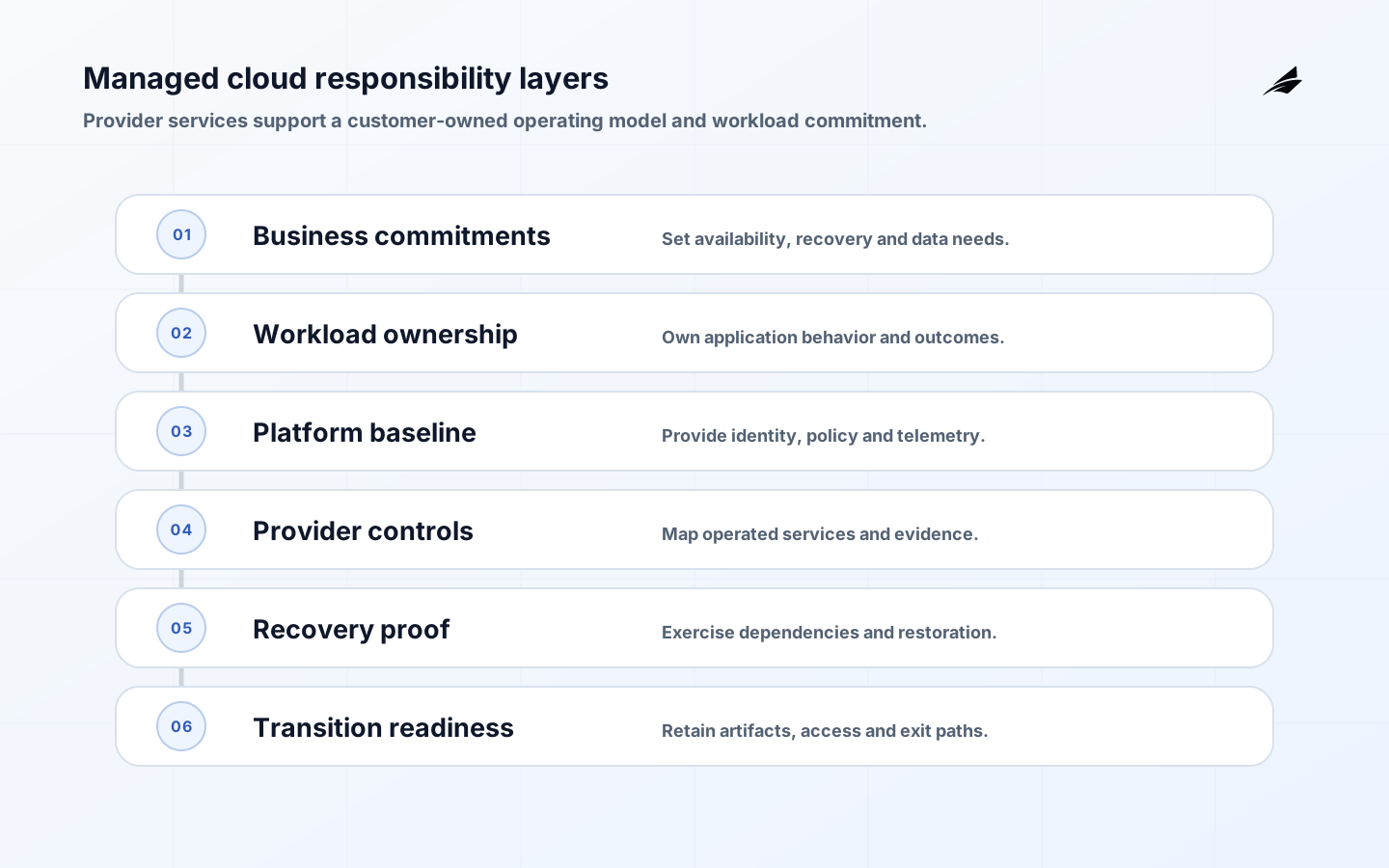
Managed cloud architecture defines how an organization and its providers share responsibility for platforms and workloads. It covers account or subscription structure, identity, network, policy, observability, resilience, cost, change and support. “Managed” does not mean the customer stops owning outcomes. It means routine responsibilities are deliberately assigned, measured and exercised across a service boundary.
Use this guide with Edilec's managed cloud planning guide, cloud migration checklist and minimum viable platform guide. Together they connect architectural decisions to the people who provision, deploy, support and improve workloads.
Key takeaways
- Classify responsibilities by platform and workload layer, with named primary and backup owners.
- Build a small landing-zone baseline that makes compliant workload delivery repeatable.
- Design resilience from business recovery objectives and dependency behavior.
- Keep provider and customer telemetry joined through common service identifiers.
- Test transition and exit so managed service continuity is not dependent on one team or contract.
Define the cloud service outcome and boundary
Start with a workload portfolio and business commitments. Record critical journeys, data classes, regions, recovery objectives, availability needs, change windows, regulatory constraints, demand patterns and expected lifespan. Separate shared platform capabilities from workload-specific engineering. A central team might own identity federation, policy, network and logging; an application team still owns code behavior, data use, dependencies and customer impact.
The NIST Cloud Computing Reference Architecture uses roles such as cloud consumer, provider, broker, auditor and carrier to establish a vendor-neutral vocabulary. Adapt that clarity to your suppliers and internal teams. For every responsibility, name who performs, approves, monitors and supports it. Contract language should match the operating map rather than promising broad “end-to-end management.”
| Layer | Platform responsibility | Workload responsibility | Proof |
|---|---|---|---|
| Identity | Federation and privileged baseline | Application roles and authorization | Access review and denied-action test |
| Network | Shared connectivity and policy | Service exposure and dependency rules | Flow test and inventory |
| Data | Storage guardrails and key services | Classification, retention and recovery | Restore and deletion test |
| Observability | Collection and retention platform | Useful signals and service objectives | Incident trace |
| Change | Landing-zone and policy release | Application and schema release | Versioned approval and rollback |
Build a proportionate landing-zone baseline
A landing zone should provide account structure, identity integration, policy, network patterns, logging, security monitoring, budgets and deployment automation. Keep the first version small enough to operate. Product teams need a documented request path, expected lead time and supported templates. Guardrails should prevent high-consequence mistakes while leaving low-risk choices to workload teams. Every policy needs an owner, rationale, exception route and test.

Microsoft's Cloud Adoption Framework separates strategy, planning, readiness, adoption, governance, security and management. Its cloud operating model guidance distinguishes centralized, shared and decentralized responsibility patterns. Use such models to ask organizational questions, not to copy a provider topology without understanding local skills and risk.
Design workload resilience and recovery evidence
Translate business impact into recovery time and recovery point objectives, then map dependencies and failure domains. Determine whether backups, multi-zone deployment, regional recovery, queueing or graceful degradation are warranted. A provider's service availability does not guarantee your composed application. Identity, DNS, secrets, deployment control, observability and external SaaS dependencies can all block recovery even when compute is healthy.
Document recovery sequence, data consistency decisions, communication and authority. Test restoration into an isolated environment, not just backup creation. Run dependency and credential-loss scenarios. The AWS Well-Architected Framework frames architectural tradeoffs across operational excellence, security, reliability, performance, cost and sustainability. A managed service review should consider those dimensions together rather than using uptime as the only health signal.
| Scenario | Architecture decision | Exercise | Acceptance evidence |
|---|---|---|---|
| Region unavailable | Recover, fail over or wait | Regional recovery rehearsal | Journey restored within objective |
| Identity control unavailable | Emergency access boundary | Break-glass drill | Logged, limited and revoked access |
| Bad deployment | Rollback or forward repair | Production-like release drill | Data and service consistency |
| Provider console unavailable | Infrastructure-as-code path | Rebuild essential resource | Reviewed reproducible state |
| Supplier transition | Export and runbook ownership | Handover exercise | New operator resolves incident |
Integrate security, policy and exceptions
Use federated human identity, workload identity, least privilege and environment separation. Keep privileged access time-bound and independently logged. Apply encryption and key ownership based on threat and regulatory need. Maintain asset and exposure inventories. Policy-as-code can provide rapid feedback, but a denied deployment must explain the rule and remediation. Exception records need scope, approver, compensating control and expiry.
Clarify incident duties before an event. The provider may investigate platform signals while the customer analyzes application behavior and business impact. Agree notification routes, evidence access, retention and escalation. Ensure the managed team can identify the affected service from a customer report. Contractual severity labels should map to operational thresholds and communication expectations, including events outside provider business hours.
Create joined operational evidence
Give every workload and shared service stable identifiers used in inventories, tags, telemetry, cost and support. Collect platform health, application service levels, security signals, changes and customer outcomes. OpenTelemetry can provide portable traces, metrics and logs across providers, but teams must define domain events and ownership. Protect telemetry as production data and test that responders can query it during an outage.
Measure service objective attainment, detection time, recovery time, change failure, unresolved risk exceptions, configuration drift, capacity, backup restore evidence, cost per business unit and support responsiveness. Review recurring manual work as a candidate for platform improvement. Avoid dashboards with no decision owner. Every measure should inform a release, capacity, security, recovery or commercial decision.
Manage cost and commercial change
Allocate provider charges, managed service fees, licenses, support and internal labor to workloads. The FinOps Framework connects allocation, forecasting, unit economics, optimization and governance. Build budgets and anomaly routes that reach workload owners. Review idle and oversized resources, data transfer, storage lifecycle, commitments and non-production schedules without sacrificing recovery or test requirements.
Contract for measurable responsibilities, access to operational evidence, change notification, subcontractor controls, data handling, transition assistance and deletion. Keep infrastructure definitions, runbooks, diagrams, inventories and incident history in customer-accessible systems. Exercise an operator handover and one representative workload export. Exit readiness improves day-to-day resilience even when the supplier relationship remains healthy.
Govern platform and provider change
Managed cloud environments change continuously: providers retire services, update control behavior, add regions, revise quotas and patch managed runtimes. The internal platform also changes policies, modules and network patterns. Maintain a change calendar that distinguishes emergency, routine and potentially breaking work. Subscribe to provider health and retirement notices through owned channels, map each notice to affected services, and test upgrades against representative workloads. A notice sent to an individual account is not a durable control.
Version infrastructure modules and policy bundles. Publish compatibility, migration and deprecation rules, including the date on which an old path stops receiving fixes. Test modules with creation, update, rollback and deletion scenarios; then release to a small set of accounts before broad adoption. Keep drift visible but avoid automatically overwriting every difference: emergency recovery, incident containment or an approved exception may explain a change. The review path should distinguish unauthorized drift from intentional state and bring the latter back under version control.
Require a change record for provider actions that can affect customer workloads, including maintenance scope, expected symptoms, validation and reversal. For customer-requested changes, document the business reason, affected dependencies and observation period. Join platform events with workload telemetry so an incident responder can see whether a shared control changed shortly before failures. Review failed and high-toil changes with both provider and workload owners; the objective is to improve the service boundary, not assign every fault to one side.
Architecture review should recur when consequence changes. New regulated data, a larger customer base, lower recovery tolerance, another operating region or a critical supplier can invalidate an earlier decision. Use the existing responsibility map and recovery evidence as the starting point, update only what changed, and record newly accepted tradeoffs. This keeps governance connected to the living system instead of a design document produced once during migration. Include support and finance in these reviews when operating hours, contract commitments or cost allocation change. Their evidence often reveals dependencies that a technical topology omits, such as manual settlement, customer notification and supplier escalation.
Maintain a small set of architecture decision records for material choices: identity boundary, network exposure, recovery pattern, data residency, logging and supplier portability. Each record should state the context, options, decision, consequences, owner and review trigger. Link it to deployed modules and exercises. This gives future operators a reason for the design and prevents a managed provider from becoming the only institutional memory.
Managed cloud architecture review checklist
- Workload commitments and data boundaries drive the architecture.
- Platform, workload and provider responsibilities have primary and backup owners.
- Landing-zone controls have tests, explanations and expiring exception paths.
- Recovery objectives are backed by dependency-aware exercises.
- Telemetry, inventory, cost and support share stable service identifiers.
- Transition artifacts and deletion are available and periodically rehearsed.
Frequently asked questions
Does a managed cloud provider own security?
The provider owns specified controls; the customer retains accountability for its data, users, workload design and supplier oversight. Map each control instead of relying on a broad shared-responsibility phrase.
Is multicloud required for resilience?
No. Multicloud can reduce one dependency but adds identity, data, skills and operating complexity. Use business recovery objectives and failure scenarios to justify it.
Should every workload pass every framework check?
Use frameworks to expose decisions, then apply rigor proportionate to consequence. Record accepted tradeoffs and revisit them when the workload or threat changes.
Conclusion
Managed cloud architecture succeeds when responsibility is visible and evidence travels with the service. Build a proportionate landing zone, keep workload ownership intact, test recovery and supplier transition, and join reliability, security and cost in one operating review. The provider can perform substantial work, but the organization must remain able to understand and govern the business system it depends on.