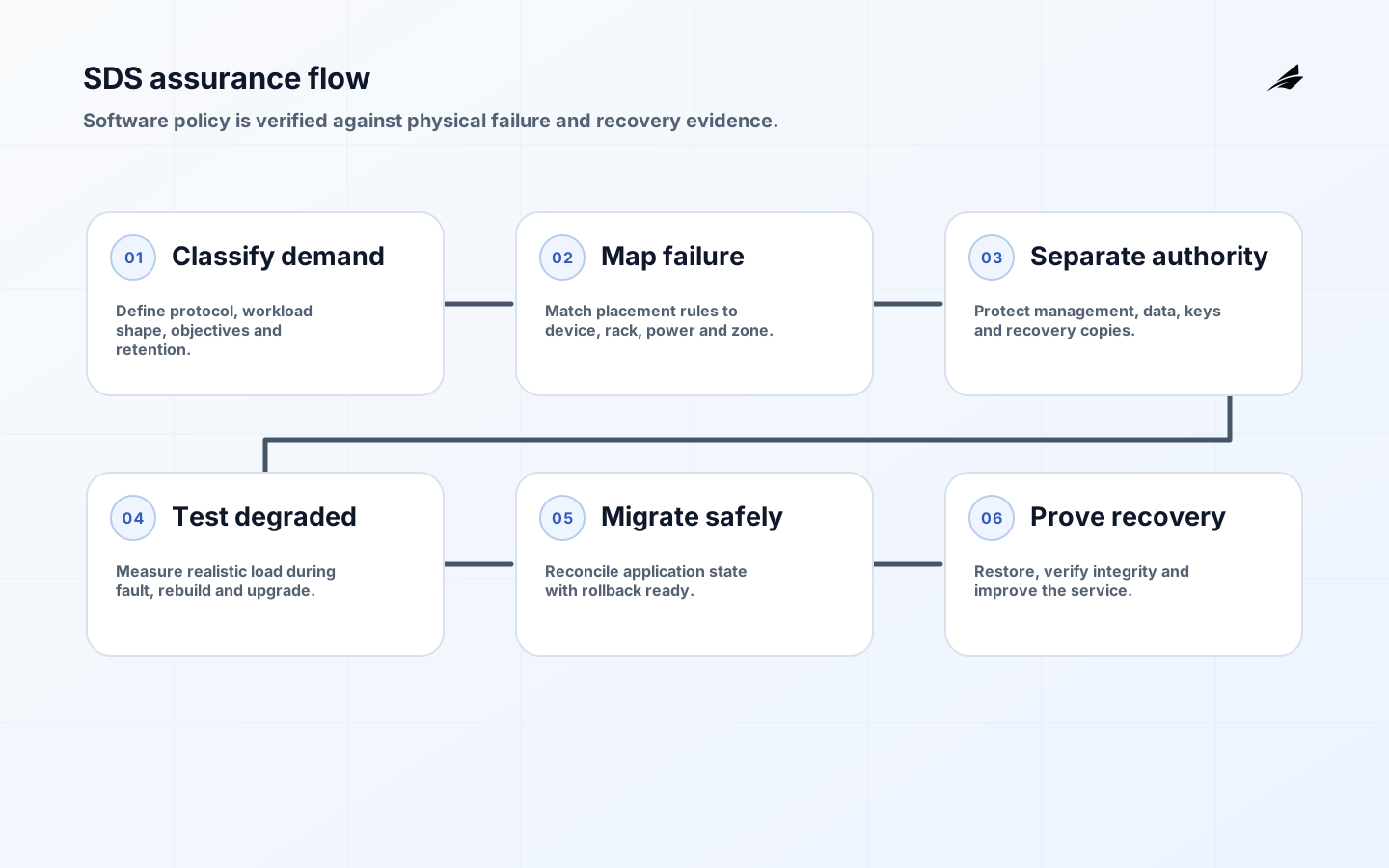
A software-defined storage implementation replaces appliance-centered decisions with software policy for pooling capacity, placing data and exposing block, file or object services. That flexibility is valuable, but it does not make disks, networks, failure domains or recovery time abstract. The platform still has to satisfy application latency, integrity, retention and availability requirements while operators patch nodes, replace media and respond to incidents. This software-defined storage implementation checklist turns those obligations into architecture decisions and acceptance evidence.
Use it alongside Edilec's SDS scope, cost and risk plan, software-defined storage FAQ and alternate SDS implementation checklist. Those guides help separate portfolio and procurement questions from the engineering proof required before data is moved.
1. Define storage service classes from workload evidence
Start with consumers, not products. Inventory each application's protocol, usable capacity, growth, read and write shape, object or file size, concurrency, latency sensitivity, retention, legal hold, encryption and locality. Record recovery point and recovery time objectives with their measurement boundaries. A database may need predictable tail latency and application-consistent snapshots; an archive may prefer lower capacity cost and tolerate slower retrieval. One premium class for every workload hides these differences and usually increases both cost and operational coupling.
For container platforms, define the contract between the application, Kubernetes and the storage driver. The official Kubernetes StorageClass documentation explains that a class supplies a provisioner, parameters and reclaim policy, and that dynamically provisioned volumes default to Delete when no reclaim policy is set. Review topology, expansion, snapshots, access modes, volume binding and reclaim behavior explicitly. A successful PersistentVolumeClaim proves provisioning, not backup consistency, zone recovery or application reconciliation.
| Workload class | Design decision | Test condition | Acceptance evidence |
|---|---|---|---|
| Transactional block | Latency, consistency and multipath behavior | Peak load during node or path loss | Percentile latency and committed-record check |
| Shared file | Namespace, permissions and metadata scale | Concurrent clients and directory churn | Authorization and metadata response results |
| Object or archive | Durability, lifecycle and retrieval tier | Expired, restored and partially unavailable objects | Integrity hashes and timed retrieval |
| Container persistent | CSI topology, reclaim and snapshot semantics | Reschedule, zone loss and restore | Application-consistent recovery record |
| Recovery target | Isolation, immutability and retention | Ordinary credentials compromised | Independent restore with reconciled data |
2. Map logical policy to physical failure domains
Draw the real topology down to device, host, rack, switch, power feed, room and zone. Then state which simultaneous failures the service must tolerate. Labels and placement rules must reflect cabling and location rather than an intended diagram. Metadata, quorum and management components need independent placement too. Include maintenance as a failure condition: a node already offline for upgrade changes what the cluster can survive when another device fails.
Ceph is one useful reference for the general principle. Its architecture documentation describes how clients and OSDs use CRUSH to calculate object placement without a central lookup table, while monitors maintain cluster maps. The lesson is not that every SDS design should use Ceph; it is that placement, control-plane availability and client behavior are coupled. Validate the configured rule against the actual fault boundary and observe client impact while maps change and data rebalances.
Choose replication or erasure coding from workload behavior, capacity overhead, network cost and recovery requirements. Current Ceph erasure-code profile guidance shows how data and coding chunks, along with the CRUSH failure domain, determine overhead and tolerated chunk loss. Profiles can be hard to change after pool creation. Treat coding parameters as durable architecture, benchmark representative small and large writes, and reserve bandwidth and free capacity for rebuilds.
3. Protect management, data and recovery planes
Storage administration can read, copy, retain or destroy large data populations, so use named identities, federation, least privilege and time-bounded elevation. Separate management traffic, client data traffic and replication where risk and scale justify it. Protect APIs and automation credentials, rotate certificates, log destructive actions and keep key-management authority distinct from storage administration. Diagnostic bundles also need handling rules because paths, names and sampled content may be sensitive.
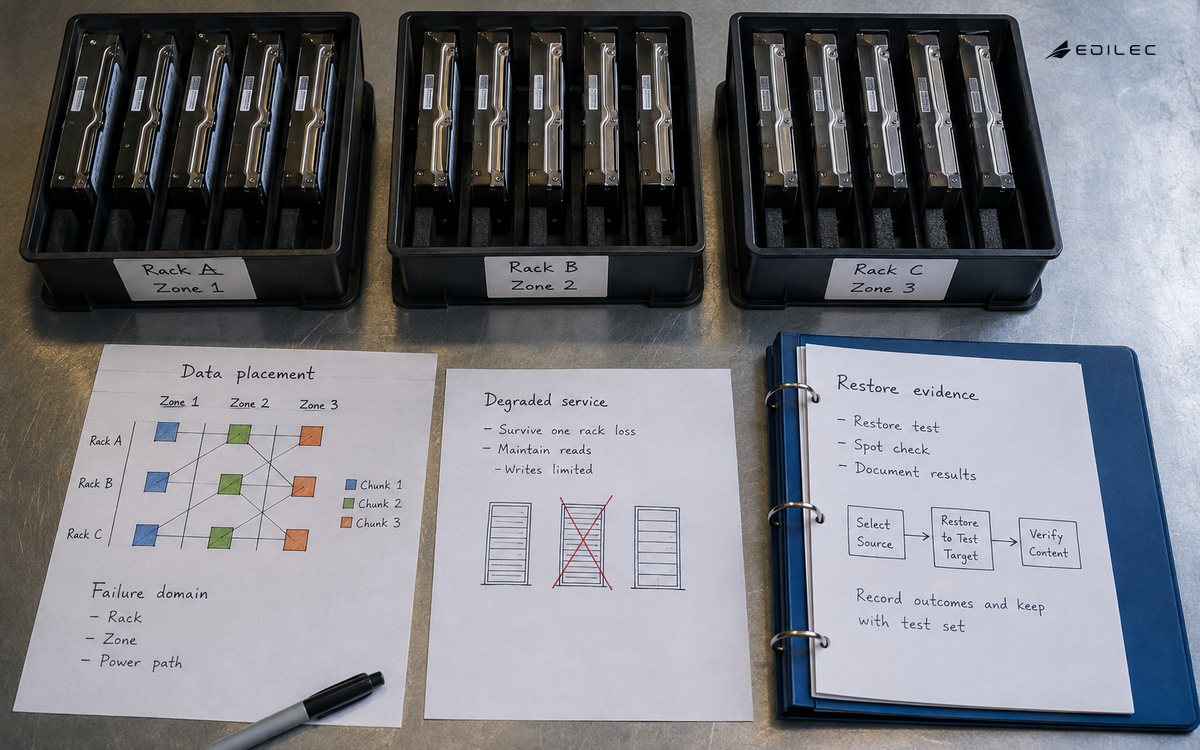
The storage-specific recommendations in NIST SP 800-209 cover isolation, restoration assurance, data protection and encryption alongside configuration, incident and access controls. Apply those concerns to every interface: hypervisor, CSI driver, backup connector, object API, support tunnel and monitoring exporter. Snapshots and replicas improve recovery options but remain vulnerable if the same compromised identity can delete them. Maintain a separately governed recovery copy and test it without ordinary production credentials.
| Risk | Preventive control | Detection | Recovery proof |
|---|---|---|---|
| Silent corruption | End-to-end checksums and supported media | Scrub errors and integrity sampling | Restore a verified object or volume |
| Correlated node loss | Placement across declared domains | Domain-aware health and quorum alerts | Fault exercise under business load |
| Ransomware or mass deletion | Separated immutable copy and narrow authority | Unusual deletion and privilege telemetry | Restore after simulated compromise |
| Capacity exhaustion | Quotas, forecast and rebuild reserve | Domain-level fullness and growth alerts | Controlled expansion before hard threshold |
| Unsafe configuration | Reviewed, versioned policy | Desired-state and runtime comparison | Rollback plus client validation |
4. Pilot normal, degraded and maintenance behavior
Build the pilot from the proposed bill of materials, network, firmware, encryption and client stack. Populate it to a realistic fullness level and replay representative concurrency and I/O distributions. Measure throughput and median latency, but give equal attention to high-percentile latency, queue depth, CPU, memory and network saturation. An empty cluster running sequential I/O is a component demonstration, not evidence for a mixed production estate.
Repeat tests during device loss, host loss, path failure, rebalance, scrub, snapshot and backup. Time how long redundancy remains reduced and how much application headroom is consumed. Exercise an upgrade, certificate rotation, failed-media replacement and capacity addition. Record platform version, policy, data shape, fault injection and expected outcome so the result can be reproduced after a release. Stop a test when defined safety limits are crossed rather than damaging shared pilot data.
Security and resilience acceptance should map to organizational outcomes. The NIST Cybersecurity Framework 2.0 provides a current outcome taxonomy across Govern, Identify, Protect, Detect, Respond and Recover. Use it to check that storage controls have owners, monitoring and response paths instead of treating encryption as the complete security story. The implementation remains accountable to the organization's legal and sector requirements.
5. Migrate with application reconciliation and rollback
Group workloads by dependency and consequence, then choose copy, replication or application-native migration methods. Define the source of truth, initial transfer, delta synchronization, write freeze, cutover, validation window and rollback point. Start with a low-consequence workload that is technically representative, not an easy static share that exercises none of the platform. Preserve the source until acceptance, but prevent indefinite dual writes that make data authority ambiguous.
Validation must reach application meaning. Compare object counts and hashes where they are useful, then reconcile database records, permissions, timestamps, links, search indexes or business totals as appropriate. Rehearse client remapping and rollback within the actual outage allowance. After acceptance, update backup, monitoring, inventory, capacity and incident records; revoke transitional access; and securely retire old media and paths. A migration is incomplete while operators cannot identify the authoritative copy.
6. Operate integrity, capacity and recovery as one service
Monitor customer-visible symptoms alongside cluster internals: request errors, latency by class, quorum, placement health, degraded objects, scrub findings, media errors, rebuild progress, capacity by domain and backup completion. Alerts should carry likely impact, owner and first safe action. Forecast usable protected capacity after coding overhead, snapshots, metadata and rebuild reserve. Raw terabytes divided by current consumption is not a safe expansion plan.
Run restoration and fault exercises on a calendar and after material topology or version changes. Sample different service classes and recover into an isolated location when possible. Reconcile the restored application, record elapsed time and close gaps found in credentials, documentation, network or supplier escalation. Patch in supported waves, watch compatibility across clients and drivers, and retain enough diagnostic skill that automation does not turn distribution failures into an unexplained black box.
Maintain a customer-owned service register that links each storage class to its business owner, technical owner, approved workload types, data classification, objectives, current version, capacity threshold and latest restore. Review it during application onboarding and material changes. This prevents an old class name from implying guarantees that no longer match its topology or operating practice, and it gives incident responders a quick route from a cluster symptom to the applications and decisions affected.
Review value as well as health. Track unit cost per usable protected capacity, energy, support effort, growth forecast, restore success and service-objective attainment. Retire unused classes and unsupported clients through published migration paths. When a workload needs a new tier, require evidence that the benefit exceeds added policy, testing and operational complexity. This keeps a flexible platform from becoming a permanent collection of bespoke exceptions.
Key takeaways
- Define service classes from application behavior and recovery obligations.
- Match placement policy to verified physical failure domains.
- Separate management, data and recovery authority.
- Benchmark realistic fullness, faults and maintenance, not only healthy throughput.
- Reconcile application meaning during migration and restoration.
- Operate integrity, capacity, performance and cost as one accountable service.
Software-defined storage implementation FAQ
Does software-defined storage make hardware interchangeable?
No. Software can standardize policy across supported components, but media endurance, controllers, firmware, CPU, network and topology still determine failure and performance behavior. Qualify the actual configuration and manage its compatibility lifecycle.
Does replication remove the need for backup?
No. Replication can preserve availability through component failure, but it can also copy deletion, corruption or malicious change. Keep recovery copies under separate authority and prove restoration with application-level reconciliation.
How large should an SDS pilot be?
Large enough to exercise the intended fault domains, quorum, client paths and representative data behavior. It need not match final capacity, but a single-node or single-rack demonstration cannot prove a multi-domain resilience claim.
Conclusion
A sound software-defined storage implementation makes policy portable without pretending physics disappeared. Classify demand, verify placement, divide powerful authority, test degraded operation, migrate with reconciliation and restore repeatedly. The result is not merely pooled capacity; it is a data service whose limits and recovery evidence application owners can understand.